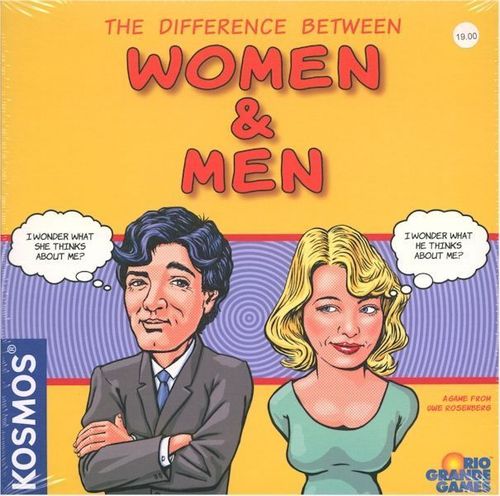
The Difference Between Women & Men
The Difference Between Women & Men Rulebook
Table of Contents
Table of Contents
Contents
1 score pad, 1 sand timer, 8 pencils, 100 double-sided theme cards with 600 themes, 20 picture cards, and 1 rule booklet.
Preparation
Each player takes a sheet from the score pad and a pencil. Shuffle the theme cards and place them as a theme supply. Shuffle the picture cards and place them face down as a separate supply.
Playing the Game
The players discuss amongst themselves how to determine a starting player. Will it be the most manly man? The most womanly woman? The most womanly man? The most manly woman? Whatever is decided, she is the starting player in the first round and chooses a theme. However, the staring player is decided will have little outcome on the game, but the method should get everyone in the modd for a fun and exceiting game. In the following rounds, the task of starting player moves in clockwise order from player to player. Each new starting player is responsible for choosing the theme for the round. A normal game is 8 rounds.
Choosing a Theme
The starting player for the round takes the top-most theme card from the supply. She reads the six themes on both sides of the card to herself, chooses one, and reads it aloud to the other players. If none of the themes on the card appeal to her, she places the card under the theme card supply and takes the top-most picture card. She looks at the scene on the card for inspiration. When inspiration strikes (if someone seems to be taking long, set the sand timer), she announces the theme for the round to the other players. Then, she places the card, face down, under the picture card supply.
Write the Top 5 Lists
All players now note their top 5 responses to the chosen theme in the top-most empty region of the score sheet. A player may not use the same response more than once in her top 5 list. She may, however, leave one or more spaces empty. The first player to complete her top 5 list (even with empty spaces), turns over the sand timer. The other players have until the sand runs through to complete their lists. When the sand runs through, the round is scored.
Players should not focus on speed or the sand timer. The goal of the game is to find good responses. The player who finishes first gains no advantage over those finishing later. Players may choose to play without the sand timer. Responses should be short: a single word or phrase is all that is expected. Save essays for English class!
Determine Victory Points for the Round
- The starting player for the round announces the top-most response on her top 5 list along with the corresponding simple points. For the top-most entry on the list, this is 4 points.
- The other players check their lists for the same or a similar response. The next player announces the corresponding simple points for this entry on her list, if any, adding it to the previous sum for this response. If the player has, for example, the same response in her third entry, she adds 2 simple points. Thus, she would say, "2 points added to 4 equals 6 points for this response."
- In this way, each other player, in clockwise order, announces her simple points for this response in her top 5 list, the previous sum for this response, and the new sum.
- After all other players have checked their lists and made their announcements, all(!) players, who had this (or similar) response, write the final sum for this response in the victory point column next to the entry for this response on their score sheet.
Then, the starting player continues, announcing, one at a time, her remaining responses and their corresponding simple points on her list. As before, the others, in clockwise order, announce their same or similar responses, with their corresponding simple points, and the new sums. As above, when all have made their announcements, they record the victory points, if any, on their score sheets next to their entry for this response.
Then, the other players, following in clockwise order, announce the responses on their lists that have yet to be scored. As before, the players announce the corresponding simple points, their opponents follow with their simple points and the sums, and, after all have had their chance to participate, all who had this response or a similar one, write this sum as victory points next to the response on their lists. Of course, a player may not announce a response that she has already scored!
When all have had the chance to share their responses with the others, the players move on to the next step, which is to calculate their complex points. To do this, they add the points in the victory point column to those from the column between the victory point column and the complex points column. They record each sum in the complex points column on their score sheet. For example, a player has 3 points in the victory point column for her second entry. She adds this to the 5 points from the column to the right of that and writes 8 on that line in the complex points column. Each player then crosses out the entire entry with the highest complex point value in her list. If several tie for highest, the player chooses which to cross out.
Then, each player sums the victory points for her remaining four entries.
Example: Determine Victory Points per Response
The simple points for each response that the player has written on her top 5 list. The sum of all players' simple points, who had the same or a similar response on their lists is written as victory points in the victory points column. If a player has an empty response or a response which no other player had, the player merely writes the simple points for that line in the victory point column.
Example: Determine Complex Points
The player adds the victory points to the value in the column to the right to get the complex points for the response. The player writes the complex points in this column. The player now sums the victory points for the 4 remaining responses. The player crosses out the response with the highest complex points. The victory points for this response are not included in the score for this player for this round!
Game End
After eight rounds, each player sums her victory points for the eight rounds to get her total score for the game. The player with the most victory points is the winner!
Special Cases and Notes
Empty responses only score their simple points, even if several players have empty responses.
Double responses in a player's list - if a player has the same (or similar) response two or more times on her top 5 list, she may score only one of those entries. The player scores one of the entries as normal - with other players if there are like or similar responses from them. The player's duplicate responses score as empty responses.
Super and sub responses may be considered similar responses in some cases. If a player has, for example, wash clothes and another has housework, these can be considered similar. However, if the player with wash clothes also has vacuum floors, then she could not score either with the player who had housework.
"False" responses, those that do not fit the theme, are scored as if they did. Of course, the response is not likely to be similar to any other player's response.
Interpretation of the theme - Many themes can be interpreted in different ways. Such interpretations only add fun to the game. For example, a western hero could be either fictional or real. Of course, players may want to spend some time discussing the theme before they start writing responses - this adds to the value of the game.
"Person x" - When a theme has this form, the starting player chooses one of the players as x for the theme.
This game lives on communication. Thus, players should always strive to talk about the themes and their responses. Many will be amazed at what they learn about each other - and about themselves while playing the game.