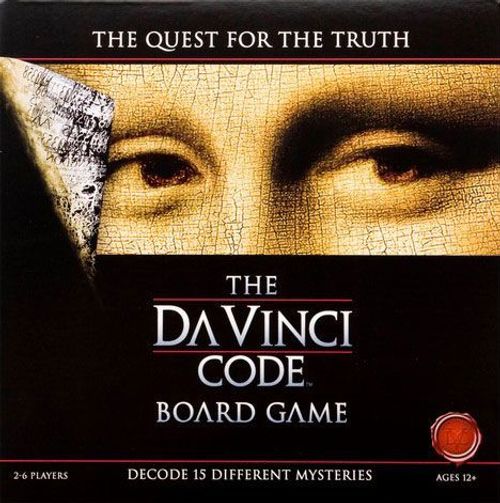
The Da Vinci Code Board Game: The Quest for the Truth
The Da Vinci Code Board Game: The Quest for the Truth Rulebook
Table of Contents
Table of Contents
- Components
- First-Time Players
- Cards
- Decoding Tools
- Answer Sheet
- Game Board
- Game Set-Up
- Playing the Game
- Clue Card Hints
- Winning
- Mystery Game Card Placement
- Sample Mystery (Clue Cards 40 to 49)
- Mystery One (Clue Cards 50 to 59)
- Mystery Two (Clue Cards 60 to 69)
- Mystery Three (Clue Cards 70 to 79)
- Mystery Four (Clue Cards 80 to 89)
- Mystery Five (Clue Cards 90 to 99)
- Mystery Six (Clue Cards 100 to 109)
- Mystery Seven (Clue Cards 110 to 119)
- Mystery Eight (Clue Cards 120 to 129)
- Mystery Nine (Clue Cards 130 to 139)
- Mystery Ten (Clue Cards 140 to 149)
- Mystery Phrase Solutions and Mystery Questions
- Answers to Mystery Questions
Components
- 200 cards (numbered 0 to 199)
- Game Board
- Cryptex Decoder with 10 letter strips
- Sidebar Decoder
- Mirror Decoder
- Pad of answer sheets
- 6-sided die
- 30-second timer
- 6 pyramid play pieces in assorted colors
- Instructions
- Instructional Guide DVD
First-Time Players
If this is the first time you have played this game, you might want to view the Sample Mystery Instructional Guide DVD. The DVD opens with the official movie trailer and a short introduction on how the game is played. You will then see a Menu Screen with four titles: Components, Game Board, Game Set-up and Play and Sample Mystery Game. The DVD uses the Sample Mystery, with Clue cards 40 to 49, to explain how the game is played. It will serve as a training guide, giving you helpful hints that will make the game easier to play.
Cards
There are five different types of cards: Taxi cards, Depository cards, Code-breaking cards, Art cards, and Clue cards.
Taxi Cards (numbered 0 to 5)
There are 6 Taxi cards that may be used when speed is of the essence. If you have a Taxi card, you may save it and use it on any future turn. You may then move to a game board space of your choice. A Taxi card is used in lieu of a die roll.
Taxi cards have four different symbols on the backs. These symbols correspond to a different landmark location on the game board and are where the Clue cards should be placed to set up the game. (The printed text says "Clue cards" in this sentence; this is as printed.)
Depository Cards (numbered 6 to 11)
There are 6 Depository cards that may give you a peek at an opponent's answer sheet. After getting a card, you may play it on any future turn.
When playing a Depository card, select one opponent, and then roll the die.
If you roll any one of the numbers found in that opponent's Depository Code, you may look at the opponent's notes. You may NOT look at the player's 20-space Mystery Phrase area. (Folding down the top of the answer sheet should cover this area.) Your turn then ends.
If the number doesn't match one of the Depository Code numbers, you may NOT look at the opponent's answer sheet, and your turn ends.
Depository cards have four different symbols on the backs. These symbols correspond to a different landmark location on the game board and are where the Clue cards should be placed to set up the game. (As printed: the sentence says "Clue cards".)
Always remember to return used Taxi cards and Depository cards to the bottom of the appropriate piles.
Code-Breaking Cards (numbered 12 to 19)
There are 8 Code-breaking cards. These cards have a key symbol on the backs and are found in the Louvre Library. Each time you land there, you are given 30 seconds to flip through these cards, searching for vital information that will help you decipher clues you have collected.
Art Cards (numbered 20 to 39)
There are 20 Art cards. These cards have a chalice symbol (a triangle) on the backs and are located in the Louvre Gallery. Each time you visit the Gallery, you will have 30 seconds to flip through the Art cards, searching for the one needed to unravel the clues you have collected.
Clue Cards (numbered 40 to 199)
There are 160 Clue cards, made up of 16 sets of 10 cards each, including one Sample Mystery set. Clue cards contain valuable information needed to solve the Mystery Phrase and answer the final five Mystery Questions. Each 10-card set corresponds to a different mystery that you will be called upon to solve. Cards 40 to 49 offer a Sample Mystery for first time players. Ther notes and instructions on each card. (Printed as "Ther" in the source.) This mystery is explained on the Sample Mystery Instructional Guide DVD.
The remaining mysteries use card sets numbered 50 to 59, 60 to 69, 70 to 79, 80 to 89, and all the way up to 190 to 199.
Each 10-card set of Clue cards has four different symbols on the backs. These symbols correspond to a different landmark location on the game board and are where the Clue cards should be placed to set up the game.
The majority of Clue cards have numbers along the top of the card. These numbers represent spaces on the 20-space Mystery Phrase at the top of the answer sheet. When you have solved the clue found on the Clue card, you will have the letters (or blank spaces) that go on your answer sheet. At the bottom of the Clue card, and on the back, is the number of the Clue card. You may want to jot down, on the notes section of your answer sheet, which Clue cards you have seen so you don't pick them up again while traveling around the game board.
Decoding Tools
There are three additional tools that will assist you in deciphering clues.
Cryptex Decoder
To use the Cryptex Decoder, first solve for your keyword. Place the Clue card on the Cryptex Decoder and align the card symbol with the Alignment Marker. Spell out your keyword with the Cryptex Strips. For example, the keyword used above is "D-E-G-A-S." When the Cryptex Strips are placed over the Clue card, your new word and solution will be revealed. The solution above is revealed as "I-S-A-A-C."
Sidebar Decoder
To use the Sidebar Decoder, first solve for your keyword. Align your Clue card with the Sidebar Decoder, matching the colored arrows. The keyword in this example is the word "D-R-Y." When transposed on the Sidebar Decoder, the answer and your solution is the word "W-E-T."
Mirror Decoder
You may find Clue cards where the clue is written backwards. You will need to use the Mirror to decipher these types of Clue cards.
Answer Sheet
During the game you will write notes and keep track of clues on an answer sheet. Along the top of the answer sheet are 20 spaces, each corresponding to a number 1 through 20. This is the Mystery Phrase you will try to identify, letter by letter.
Since the Mystery Phrase is not likely to be one 20-letter word, you will also need to find blank spaces used to separate individual words.
Along the right side of the answer sheet are spaces for the 5 Mystery Questions you will have to answer. For each correct answer to the Mystery Phrase and Mystery Questions, you will win points which are written down on the answer sheet. You will subtotal your score and subtract points for cards still held in your hand at the end of the game.
At the bottom of the answer sheet is a Depository Code that must be filled in before you can start the game. Pick three different numbers from 1 to 6. Write one number in each of the three blank spaces. REMEMBER: Each number must be different. The Depository Code works with the Depository cards as discussed on page 3.
The answer sheet layout is as follows:
- Your Mystery Phrase answer goes in the spaces numbered 1-20. Your Mystery Phrase score goes in the "Score from Part One" column.
- The answers to your 5 Mystery Questions go in the spaces labeled Q1 to Q5. Your Mystery Question scores go in the column beside them.
- Sub Total: your score so far.
- Minus for Cards Held: deduct points for cards held here.
- Final Score: your grand total.
- Depository Code: your 3-digit Depository Code goes here.
- The Notes space (a large open area) is for general note taking.
Game Board
On each corner of the game board you will find a world landmark:
- L'Église de Saint-Sulpice
- Temple Church
- Westminster Abbey
- Rosslyn Chapel
You'll notice that each landmark is associated with a special symbol. These symbols are found on the game board in front of each landmark, as well as on the backs of the Clue, Taxi, and Depository cards. Use the symbols as a guide to placing cards on the landmark locations. The symbols also represent the entrances to each of these landmarks. Each landmark has three entrance spaces to select a corresponding card.
In the center of the game board you will find the Louvre. There are two sections to the Louvre, the Louvre Library and the Louvre Gallery. The Louvre Library is represented with a key symbol on the board and on the corresponding Code-breaking cards. The Louvre Gallery is represented with the chalice (triangle) symbol on the board and on the corresponding Art cards.
If you land on any of the three entrance spaces to either the Library or the Gallery, you may look through all the cards placed in that specific location. Thus, you may only look at the Code-breaking cards in the Library and only the Art cards in the Gallery. You are allowed 30 seconds to study the cards.
START spaces are located at the Louvre. There are six total START spaces: three at the Library and three at the Gallery.
METRO spaces are located on the Game Board marked with an M. Metro spaces may be used to move around the game board more quickly. You need not land on an M space by exact count. If you land on a Metro space, you may immediately move your playing piece to any other Metro space on the board. For example, if you roll a 6, you could land on an M space 4 spaces away, jump to a new M space and then complete your turn by moving 2 additional spaces.
Game Set-Up
Place the game board and the decoding tools (Cryptex Decoder with letter strips, Sidebar Decoder and Mirror) within easy reach of all players.
Take an answer sheet from the pad and be sure to have a pen or pencil. To work "undercover," fold down the top of the answer sheet to keep the Mystery Phrase area secure, hiding it from prying eyes. At the bottom of the answer sheet is the Depository Code that must be filled in before you can start the game. The Depository Code works with the Depository cards as explained earlier.
Select one of the 15 mysteries to play. Each of the 15 mysteries has a set of 10 cards. For example, Mystery One corresponds to card set 50 to 59. See page 13 for a listing of where cards should be placed for each mystery.
Each player selects a pyramid play piece and places it on one of the six START spaces located next to the Louvre. There are three spaces at the Louvre Library and three spaces at the Louvre Gallery. You may start on any one of these spaces.
The oldest and wisest player will start the game.
Separate the cards and place them on their appropriate game board spaces.
First, Clue cards for your selected mystery should be separated by symbol and placed in four piles.
Next, the number of Taxi cards used in the game will depend on the number of players. With 2 to 4 players or teams, use 4 Taxi cards. One card is placed on each of the four piles. Set the extra two Taxi cards aside. If there are 5 to 6 players or teams, all 6 Taxi cards are divided into four piles by symbol. Two piles will have one more Taxi card than the others.
Then, the number of Depository cards used in the game will depend on the number of players. With 2 to 4 players or teams, use 4 Depository cards. One card is placed on each of the four piles. Set the extra two Depository cards aside. If there are 5 to 6 players or teams, all 6 cards are divided into four piles by symbol. Two piles will have one more Depository card than the others.
Finally, shuffle the Clue, Taxi, and Depository cards in each pile and then place each pile, face down, on each of the four landmarks indicated on the game board corners. Each landmark will have a different symbol that matches the cards.
Shuffle the Code-breaking cards and place them, face down, in the Louvre Library. Shuffle the Art cards and place them, face down, in the Louvre Gallery.
REMEMBER! All cards in a pile must have matching symbols. For example, all Code-breaking cards must have a matching key symbol. Once all the cards are in place, it is time to start the fun!
The symbol strip printed in the rulebook shows the six landmark/location symbols, in order from left to right: a quatrefoil (Westminster Abbey), a rose with a star (Rosslyn Chapel), a cross (Temple Church), a fleur-de-lis (L'Église de Saint-Sulpice), a key (Louvre Library), and a triangle (Louvre Gallery).
Playing the Game
In turn, you will roll the die and move the corresponding number of spaces. You may move in either direction, but in only one direction per turn. Your goal is to visit landmarks and read as many Clue cards as you can. You may only take the top card from any pile on each of the four sections of the game board. Whenever you take a Clue card, you may take notes from it until your next turn or until an opponent arrives at the same location, at which time you must then immediately return the card you are holding to the bottom of its pile. Keep cards in the correct pile, making sure that all the cards in a pile have the same symbol.
Clue Card Hints
Keep an eye out for Clue cards that have numbers at the top. These numbers refer back to the Mystery Phrase spaces on your answer sheet.
Some Clue cards will ask you to use the Mirror Decoder to read a clue.
Other Clue cards will request that you use the Sidebar Decoder. To see how this decoder works, turn to page 6.
A few fun Clue cards may ask you to use the Cryptex Decoder. For mastering this simple but effective device, turn to page 5.
There are some Clue cards that will ask you to decode a word or message. Remember, to crack a code, check out the Code-breaking cards at the Louvre Library.
There are also Clue cards that will refer to a painting. For art-reference information, go to the Louvre Gallery and review the Art cards.
Winning
Once you have solved the Mystery Phrase AND feel you have collected enough information to answer the Mystery Questions, you will need to race back to one of the six Louvre (START) spaces. There you will announce that you are going to solve the Mystery Phrase. If you solve it correctly, the game ends, and everyone tallies their scores for this part of the game. Mystery Phrase solutions are found starting on page 19 of this booklet. All players score 1 point for every correct letter and blank space they have completed. The maximum number of points is 20. The player who solves the complete Mystery Phrase first receives an additional 5 points, for a total of 25 points.
It is now time to see how many clues you've found during the game. The player who solved the Mystery Phrase reads the five Mystery Questions for the that [sic: "for the that game"] game to all players. The Mystery Questions start on page 19 of this booklet. All the answers to these questions were given on the cards you read during the game. So, check your notes, and jog your memory, to come up with the answers. Write your answers on the spaces provided on the answer sheet. Check your answers, starting on page 27.
You score 5 points for each correct answer, and an additional 5 points for correctly answering all five.
Now total your scores for the Mystery Phrase and the five Mystery Questions. Subtract 5 points for each Taxi card or Depository card that is still in your possession. The player with the highest number of points wins the game.
Mystery Game Card Placement
Sample Mystery (Clue Cards 40 to 49)
Place the following cards on the locations as listed below:
- Temple Church (cross symbol): Cards 0, 4, 8, 42, 48
- Westminster Abbey (quatrefoil ring symbol): Cards 1, 5, 9, 43, 44, 45
- Rosslyn Chapel (rose symbol): Cards 2, 6, 10, 40, 41, 47
- L'Église de Saint-Sulpice (fleur-de-lis symbol): Cards 3, 7, 11, 46, 49
- Louvre Library (key symbol): Cards 12 to 19
- Louvre Gallery (triangle symbol): Cards 20 to 39
Mystery One (Clue Cards 50 to 59)
Place the following cards on the locations as listed below:
- Temple Church: Cards 0, 4, 8, 51, 55
- Westminster Abbey: Cards 1, 5, 9, 52, 56, 59
- Rosslyn Chapel: Cards 2, 6, 10, 50, 53, 57
- L'Église de Saint-Sulpice: Cards 3, 7, 11, 54, 58
- Louvre Library: Cards 12 to 19
- Louvre Gallery: Cards 20 to 39
Mystery Two (Clue Cards 60 to 69)
Place the following cards on the locations as listed below:
- Temple Church: Cards 0, 4, 8, 63, 67, 69
- Westminster Abbey: Cards 1, 5, 9, 61, 62, 68
- Rosslyn Chapel: Cards 2, 6, 10, 65, 66
- L'Église de Saint-Sulpice: Cards 3, 7, 11, 60, 64
- Louvre Library: Cards 12 to 19
- Louvre Gallery: Cards 20 to 39
Mystery Three (Clue Cards 70 to 79)
Place the following cards on the locations as listed below:
- Temple Church: Cards 0, 4, 8, 70, 71, 76
- Westminster Abbey: Cards 1, 5, 9, 73, 77
- Rosslyn Chapel: Cards 2, 6, 10, 72, 74, 78
- L'Église de Saint-Sulpice: Cards 3, 7, 11, 75, 79
- Louvre Library: Cards 12 to 19
- Louvre Gallery: Cards 20 to 39
Mystery Four (Clue Cards 80 to 89)
Place the following cards on the locations as listed below:
- Temple Church: Cards 0, 4, 8, 84, 88
- Westminster Abbey: Cards 1, 5, 9, 85, 86, 89
- Rosslyn Chapel: Cards 2, 6, 10, 81, 83
- L'Église de Saint-Sulpice: Cards 3, 7, 11, 80, 82, 87
- Louvre Library: Cards 12 to 19
- Louvre Gallery: Cards 20 to 39
Mystery Five (Clue Cards 90 to 99)
Place the following cards on the locations as listed below:
- Temple Church: Cards 0, 4, 8, 95, 96, 97
- Westminster Abbey: Cards 1, 5, 9, 90, 91
- Rosslyn Chapel: Cards 2, 6, 10, 92, 93, 94
- L'Église de Saint-Sulpice: Cards 3, 7, 11, 98, 99
- Louvre Library: Cards 12 to 19
- Louvre Gallery: Cards 20 to 39
Mystery Six (Clue Cards 100 to 109)
Place the following cards on the locations as listed below:
- Temple Church: Cards 0, 4, 8, 101, 105, 109
- Westminster Abbey: Cards 1, 5, 9, 103, 106
- Rosslyn Chapel: Cards 2, 6, 10, 102, 104, 108
- L'Église de Saint-Sulpice: Cards 3, 7, 11, 100, 107
- Louvre Library: Cards 12 to 19
- Louvre Gallery: Cards 20 to 39
Mystery Seven (Clue Cards 110 to 119)
Place the following cards on the locations as listed below:
- Temple Church: Cards 0, 4, 8, 114, 115
- Westminster Abbey: Cards 1, 5, 9, 111, 112, 119
- Rosslyn Chapel: Cards 2, 6, 10, 110, 116, 118
- L'Église de Saint-Sulpice: Cards 3, 7, 11, 113, 117
- Louvre Library: Cards 12 to 19
- Louvre Gallery: Cards 20 to 39
Mystery Eight (Clue Cards 120 to 129)
Place the following cards on the locations as listed below:
- Temple Church: Cards 0, 4, 8, 123, 127
- Westminster Abbey: Cards 1, 5, 9, 122, 124, 125
- Rosslyn Chapel: Cards 2, 6, 10, 120, 126
- L'Église de Saint-Sulpice: Cards 3, 7, 11, 121, 128, 129
- Louvre Library: Cards 12 to 19
- Louvre Gallery: Cards 20 to 39
Mystery Nine (Clue Cards 130 to 139)
Place the following cards on the locations as listed below:
- Temple Church: Cards 0, 4, 8, 134, 135
- Westminster Abbey: Cards 1, 5, 9, 130, 131, 133
- Rosslyn Chapel: Cards 2, 6, 10, 132, 138
- L'Église de Saint-Sulpice: Cards 3, 7, 11, 136, 137, 139
- Louvre Library: Cards 12 to 19
- Louvre Gallery: Cards 20 to 39
Mystery Ten (Clue Cards 140 to 149)
Place the following cards on the locations as listed below:
- Temple Church: Cards 0, 4, 8, 144, 146, 147
- Westminster Abbey: Cards 1, 5, 9, 141, 142
- Rosslyn Chapel: Cards 2, 6, 10, 140, 143, 148
- L'Église de Saint-Sulpice: Cards 3, 7, 11, 145, 149
- Louvre Library: Cards 12 to 19
- Louvre Gallery: Cards 20 to 39
Mystery Eleven (Clue Cards 150 to 159)
Place the following cards on the locations as listed below:
- Temple Church: Cards 0, 4, 8, 154, 155, 159
- Westminster Abbey: Cards 1, 5, 9, 153, 157
- Rosslyn Chapel: Cards 2, 6, 10, 151, 156, 158
- L'Église de Saint-Sulpice: Cards 3, 7, 11, 150, 152
- Louvre Library: Cards 12 to 19
- Louvre Gallery: Cards 20 to 39
Mystery Twelve (Clue Cards 160 to 169)
Place the following cards on the locations as listed below:
- Temple Church: Cards 0, 4, 8, 160, 164
- Westminster Abbey: Cards 1, 5, 9, 163, 165, 166
- Rosslyn Chapel: Cards 2, 6, 10, 161, 167
- L'Église de Saint-Sulpice: Cards 3, 7, 11, 162, 168, 169
- Louvre Library: Cards 12 to 19
- Louvre Gallery: Cards 20 to 39
Mystery Thirteen (Clue Cards 170 to 179)
Place the following cards on the locations as listed below:
- Temple Church: Cards 0, 4, 8, 175, 176, 178
- Westminster Abbey: Cards 1, 5, 9, 171, 172
- Rosslyn Chapel: Cards 2, 6, 10, 173, 179
- L'Église de Saint-Sulpice: Cards 3, 7, 11, 170, 174, 177
- Louvre Library: Cards 12 to 19
- Louvre Gallery: Cards 20 to 39
Mystery Fourteen (Clue Cards 180 to 189)
Place the following cards on the locations as listed below:
- Temple Church: Cards 0, 4, 8, 185, 186
- Westminster Abbey: Cards 1, 5, 9, 182, 183, 189
- Rosslyn Chapel: Cards 2, 6, 10, 180, 181, 188
- L'Église de Saint-Sulpice: Cards 3, 7, 11, 184, 187
- Louvre Library: Cards 12 to 19
- Louvre Gallery: Cards 20 to 39
Mystery Fifteen (Clue Cards 190 to 199)
Place the following cards on the locations as listed below:
- Temple Church: Cards 0, 4, 8, 196, 199
- Westminster Abbey: Cards 1, 5, 9, 190, 193, 195
- Rosslyn Chapel: Cards 2, 6, 10, 192, 194, 198
- L'Église de Saint-Sulpice: Cards 3, 7, 11, 191, 197
- Louvre Library: Cards 12 to 19
- Louvre Gallery: Cards 20 to 39
Mystery Phrase Solutions and Mystery Questions
The Mystery Phrase Solution and Mystery Questions for each mystery are given below, as printed on pages 19 to 30 of the booklet. The Mystery Phrase is solved letter by letter on the answer sheet; the Mystery Questions are answered from the Clue cards read during play.
Sample Mystery
Mystery Phrase Solution: Sir Isaac Newton
Can you discover these answers?
-
What weight did you discover in the Caesar box?
-
What is a Hamadryad?
-
From which Shakespeare play does the quote "Eye of newt and toe of frog. Wool of bat and tongue of dog" come from?
-
What is Degas' first name?
-
In which hand is "The Girl with a Rose" holding the rose?
Mystery One
Mystery Phrase Solution: The Knights Templar
The Knights Templar was an order of Masonic knights, also known as The Knights of the Temple of Solomon, a name derived from the fact that they were headquartered on the site of King Solomon's Temple. They formed during the Crusades to protect pilgrims traveling to the Holy Land, but, later, their order grew into the one of the richest and most powerful forces in Europe. Their power and riches were rumored to be linked to their secret knowledge of King Solomon's lost treasures, which included the Holy Grail.
What else did you discover?
-
Who painted "Mary Magdalene with a Night Light"?
-
Who painted "The Vitruvian Man"?
-
The Seal of Solomon is also known as what?
-
What is the value of Phi?
-
Who was the last leader of "The Knights Templar"?
Mystery Two
Mystery Phrase Solution: Westminster Abbey
Westminster Abbey is Britain's most important national shrine and official religious site. Almost every English monarch and many of their most distinguished subjects have been crowned, wedded, and buried within its walls. This Gothic masterpiece is known as the "Church of God and Kings."
What other connections have you made?
-
Sir Isaac Newton was known as the genius who explained what?
-
From what Bible verse does this quote come from? "And the Lord changed the wind to a very strong West wind, which caught up the locusts and carried them into the Red Sea..."
-
In the painting by Nicolas Poussin, "Truth Stolen Away...," there is a hidden message, a name. What is it?
-
In what year was William Shakespeare born?
-
What date refers to the "Ides of March"?
Mystery Three
Mystery Phrase Solution: The Priory Keystone
The Priory Keystone was, according to Priory of Sion lore, an encoded map... a map that reveals the hiding place of the Holy Grail.
What other secrets have you uncovered?
-
If Alpha is one, what number is the letter in the Greek Alphabet for Pi?
-
What is the three-letter Celtic word for hill?
-
Who is alleged to be on the right of Christ in DaVinci's "Last Supper"?
-
Clef de Vote means "key to the vault." What else does it mean?
-
Write down the CORRECT Fibonacci Sequence.
Mystery Four
Mystery Phrase Solution: The Golden Rectangle
The ratio of the length to the width is the Golden Ratio Phi or 1.618 found within a Golden Rectangle. Shapes defined by the Golden Ratio have long been considered aesthetically pleasing in Western cultures, reflecting nature's balance between symmetry and asymmetry.
What other "truths" did you unveil?
-
Galena is another name for what metal?
-
Which King and Queen commissioned the initial voyage of Columbus to the New World?
-
Name one of the three people scholars have speculated may have written some or all of Shakespeare's plays?
-
What was the alleged 25th Grand Master of the Priory of Sion also known as?
-
Diamonds are a crystalline form of what element?
Mystery Five
Mystery Phrase Solution: Edward the Confessor
Edward the Confessor came to the throne of England late in his life and was never considered a dynamic ruler. Like the legendary King Arthur, his piety and sound judgment helped him control the warring and rival nobles to unite England and create peace. He used his power to build Westminster Abbey into the most important cultural and religious centerpiece of Britain. Sainted in the 12th century, he continues to live today through his "good work."
Has your search lead you to these answers?
-
What was the date of the Battle of Hastings?
-
What was the name of William the Conqueror's mother?
-
What two languages became the official languages of England after the Battle of Hastings?
-
In what part of France is Bayeux?
-
What was the old Celtic word for Dover?
Mystery Six
Mystery Phrase Solution: Magdala Tower
Magdala Tower is the site around which myths, legends, and rumors constantly swirl. The priest of Rennes-le-Château, of which Magdala Tower is a part, made some mysterious discoveries during a renovation on the chapel in 1891. He discovered ancient scrolls, hidden chambers and unexplained human remains. Shortly after these discoveries he appears to have acquired a great unexplained wealth. Where is the truth in these rumors? You decide!
Search for the Truth in these questions:
-
King Edgar was known as King Edgar the what?
-
What is the inscription written over the door of the chapel at Rennes le Château?
-
What is a "Reda"?
-
What was the name of the 19th-century priest who was alleged to have found vast wealth at Rennes le Château?
-
What was is the English translation of the word "Bergers" as used in the Poussin painting "Les Bergers d'Arcadie"? (As printed: "What was is".)
Mystery Seven
Mystery Phrase Solution: The Cathedral of Codes
The Cathedral of Codes is the nickname for Rosslyn Chapel, a chapel that is believed to have been built by the Freemasons to preserve and conceal great secrets. The entire structure is laden with elaborate symbols and intriguing codes.
What other "truths" did you unveil?
-
Who ordered the building of Holyrood Abbey?
-
How many dragons guard the base of the "Apprentice Pillar"?
-
Rosslyn Chapel is correctly called the collegiate Chapel of which Saint?
-
The Roman Senator Cato was always asking for what or where to be destroyed?
-
What flower does a Fleur-de-lis represent?
Mystery Eight
Mystery Phrase Solution: Emperor Constantine
Emperor Constantine was the Roman Emperor who embraced Christianity after experiencing a "vision" of Jesus' cross inscribed with the words, "In this sign thou shalt conquer." This "vision-prophecy of victory" came true, resulting in his conversion to Christianity. This marked the end of Christian persecution, and religious tolerance began within the Roman Empire.
Can you rule over these questions?
-
In which cathedral is the "Shrine of the Three Kings"?
-
Who was the Father of Saint Helena?
-
What is the process of cleaning the vessels of the Eucharist called?
-
What was the so called edict by Constantine that legalized Christianity in the Roman Empire?
-
What was the profession of "Arago" after whom the "Arago plaques" were named?
Mystery Nine
Mystery Phrase Solution: Glastonbury Abbey
Glastonbury Abbey is located on the site of the first Christian church in Britain, a place of great mysteries and myths. This place is thought to have been visited by Christ in his youth, and is the site where legend says Joseph of Arimathea buried the Holy Grail. This site is tangled and crisscrossed with pagan myths, Christian mysteries, and medieval legends.
What other links have you unraveled?
-
Joseph of Arimathea traded in which metal?
-
Glastonbury Tor was said to be the entrance to what?
-
In what year did Alexander Serverus become Emperor of Rome? Remember YYY!
-
Give either (or both) meanings of "Sangreal."
-
What disability was caused by an illness later in Goya's life?
Mystery Ten
Mystery Phrase Solution: Temple of Solomon
The Temple of Solomon is called the First Temple, according to the Bible and the Torah, and is a place mentioned in history and lore in almost every culture. Built by the first Freemasons, it is said to have housed priceless treasures and held countless secrets within its lavish and elegant walls and court yards.
What other "real truths" did you find?
-
In what year did Emperor Aurelian introduce the official cult of Sol Invictus?
-
What tree was especially sacred to Diana?
-
How did Moses receive his calling?
-
What does the pomegranate in the Botticelli painting "Madonna of the Pomegranate" symbolize?
-
What was housed in The Temple of Solomon?
Mystery Eleven
Mystery Phrase Solution: The Priory of Sion
The Priory of Sion was a secret society organized to protect and promote the interests of the descendents of Jesus and Mary Magdalene that the Priory considered to be the rightful rulers of Europe.
Discover these secrets:
-
What did St. Boniface do to advance Christianity in pagan Germany?
-
Thor was the Norse god of what?
-
Who founded the Order of Sion?
-
In what year was the Council of Troyes, where the Knights Templar were recognized by the Pope?
-
Where were the headquarters of the Knights Templar in England situated?
Mystery Twelve
Mystery Phrase Solution: Joseph of Arimathea
Joseph of Arimathea was said to be the wealthy merchant great uncle and legal guardian of Jesus who reportedly donated his own tomb to the crucified Christ after rescuing his dead body from Roman authorities. He is also credited with being the first person to bring Christianity to Britain, making him one of the most important and mysterious figures in British religious history.
Solve these mysteries, if you can:
-
In which two seasons does the Glastonbury Thorn flower?
-
Which pope imposed the Arabic number system on the Christians?
-
Who wrote the lines, "'Til we have built Jerusalem in England's green and pleasant land"?
-
In which year was Goya born?
-
Judges 9:15 referred to the Cedars of where?
Mystery Thirteen
Mystery Phrase Solution: The Shroud of Turin
The Shroud of Turin is alleged to be the image of Christ imprinted on the shroud that covered him after his death. Generations of pilgrims have worshipped the Shroud as the image of Christ, but modern testing and technology has revealed another possibility. What is your view: fact or fraud?
Unwrap the mysteries within these questions:
-
In Durer's painting, "Lamentation Over The Dead Christ," who was supporting Christ's body?
-
In Hebrew and Arabic languages, which way are numbers written?
-
According to the Bible, the pig is unclean even though it has a what?
-
Who was alleged to have created the "Shroud of Turin" by early photographic methods?
-
Who painted "Mary Magdalene With A Night Light"?
Mystery Fourteen
Mystery Phrase Solution: Ark of the Covenant
The Ark of the Covenant is a gold-plated box containing the two tablets of the Law given to Moses by God. At one time, it was housed within the Temple of Solomon, but its present location is a mystery yet to be solved.
Did you locate these answers?
-
What is the old Hebrew word in the Bible to describe an Ark, Chest, or Coffer?
-
Where did the Caladrius Bird live, according to legend?
-
From what peoples did the Ankh symbol originate?
-
What does the Ankh symbolize?
-
Which Commandment is "Thou shalt not steal"?
Mystery Fifteen
Mystery Phrase Solution: The Line of the Rose
The Line of the Rose is a phrase that contains many mysteries, secrets, as well as logical meanings. One meaning for the "Rose Line" is known as the Paris "Rose Line," which marks the North-South meridian line through Paris. Another Roslin (Rose Line) meaning is the Gaelic translation of the word as, "ancient knowledge passed down through the generations," or it could mean a "stone falling from heaven" when translated into the Celtic language. More interestingly, "The Line of the Rose" can refer to the bloodline of Jesus Christ via Mary Magdalene, a Rose Line around which has developed an entire universe of secrets, mysteries, and profound Truths.
Unwrap the mysteries within these questions:
-
What year was "Arago" the French astronomer born?
-
Who was prevented from taking treasure from the temple of Jerusalem by three angels?
-
Where is the painting of the "Expulsion from the Temple" by Delacroix situated?
-
What was the brass meridian line in Saint Sulpice constructed to do?
-
By what other name is the Collegiate Chapel of Saint Matthew known?
Answers to Mystery Questions
The printed answers to the Mystery Questions, as given on pages 27 to 29 of the booklet (page 30 is blank).
Sample Mystery
- Ton
- Snake or King Cobra
- Macbeth
- Edgar
- Right hand
Mystery One
- Georges de La Tour
- Leonardo Da Vinci
- Star of David or Magen David
- 1.6, 1.61, or 1.618
- Jacques de Molay
Mystery Two
- Gravity
- Exodus 10:19
- Dagobert
- 1564
- March 15th
Mystery Three
- 16th
- Tor
- A Woman, Mary Magdalene
- Keystone
- 1-1-2-3-5-8-13-21
Mystery Four
- Lead
- King Ferdinand and Queen Isabella
- Sir Francis Bacon, Christopher Marlowe, Edward de Vere
- Nostradamus
- Carbon
Mystery Five
- 1066, October 1066, or 14th October 1066
- Herleva
- French and Latin
- Normandy
- Dubra
Mystery Six
- Peaceful or peaceable
- This place is terrible or Terribilis Est Locus Est
- An ancient four wheeled chariot
- Berenger Sauniere
- Shepherds
Mystery Seven
- David I of Scotland
- 8
- Saint Matthew
- Carthage
- Iris or lily
Mystery Eight
- Cologne Cathedral
- King Cole
- Ablutions
- The Edict of Milan
- Astronomer
Mystery Nine
- Tin
- The Underworld
- 222
- Holy Grail or Holy Blood
- He became deaf
Mystery Ten
- AD 270
- The Oak Tree
- At the Burning Bush
- Christ's Passion
- The Ark of the Covenant
Mystery Eleven
- Chopped down an Oak Tree or Chopped down Thor's Oak Tree
- Thunder
- Godfrey of Bouillon
- 1128
- Temple Church, London
Mystery Twelve
- Spring and Winter
- Sylvester, Sylvester II or Gerbert
- William Blake
- 1746
- Lebanon
Mystery Thirteen
- Joseph of Arimathea
- Left to right like English
- Split hoof
- Leonardo da Vinci
- Georges de la Tour
Mystery Fourteen
- Aron
- The Kings House
- Egyptians
- Life or nh (as printed)
- 8
Mystery Fifteen
- 1786
- Heliodorus
- The Church of Saint Sulpice
- Determine the date of Easter or Determine the time of the Equinoxes
- Rosslyn Chapel or the Cathedral of Codes