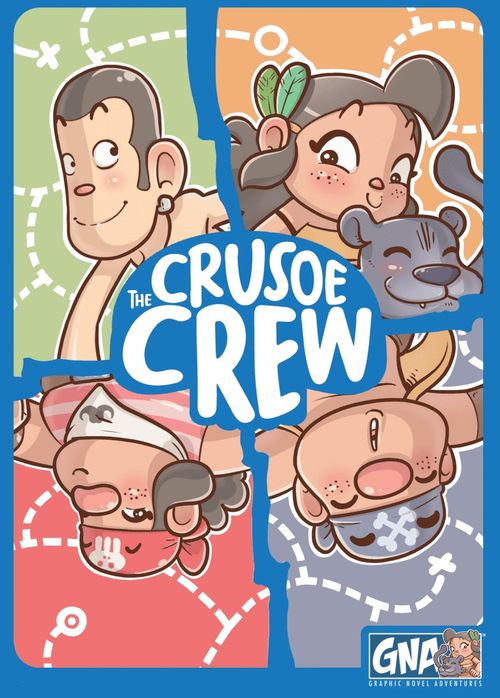
The Crusoe Crew
The Crusoe Crew Rulebook
Table of Contents
Table of Contents
Welcome
Welcome to the wonderful adventure of The Crusoe Crew, the first cooperative graphic novel gamebook in which YOU are the heroes! Here is how to play and how to make the most of the experience.
Communication
Communication between the players is essential: solving the riddles you meet, exploring buildings, taking decisions — everything must be done collectively, and in good humour, of course! You form a team and you have a common goal: it is up to you to make sure you all reach it together. Decide as a group where you go, and live the adventure together.
Making Decisions and the Game Leader
To avoid any argument, every decision is voted on by the whole group and settled by a majority. If you cannot reach a majority, your game leader decides. The game leader is either the oldest player or a player chosen by the group.
For a Better Immersion
We advise you to appoint a reader, who reads the whole adventure out loud so that everyone can get into the story. This only works if all of your characters are in the same place!
Number of Players and What It Changes
You can play The Crusoe Crew alone, with two, with three or with four players. Each player takes the part of a character with their own particularities and, sometimes, specific actions, which are listed on the back of each book.
If you are not playing with four, you may come across an action that has to be performed by a character who is not in the game. Suppose a passage looks dangerous to you and, in your view, only Neta could take it: simply turn back the way you came.
Do not worry — the scoring takes the number of players in the adventure into account. For example, you will not be able to reach certain treasures if you play solo. The total number of treasures to be found is therefore smaller than if you play with four.
In the same way, the treasure hunt will be more or less difficult depending on who is in your team. Some riddles can be hard to solve for a team made up mostly of young players. But do not worry, all of that is taken into account when the points are worked out at the end of the adventure. You will not be penalised!
Objects and Treasures
During your quest, you may find objects that look useful to you. Each character may carry two of them. If you want to pick up a new object and your pockets are full, get rid of one or two items to make room. Of course, you can only take objects that can be carried — so no boats, rocks or trees, for example.
If you happen to pass back through places you have already visited, do not count the objects or the treasures you have already picked up.
Character Specificities
During the adventure, each player may spot specific elements that only they can see, depending on the character they play. When that happens, the player concerned may go to the panel number matching that specific element. The other players then wait for their instructions:
- If the panel shows a pictogram with that player's initial in the corner, their companions must stay where they are.
- If there is no pictogram with their initial, their companions may join them.
If two players spot a specific element at the same time (that is, when the whole team is on the same panel), only one player may go to the matching panel number. Talk it over to work out which option looks the most interesting for the group.
You can, however, get around this rule with the "Super Search" mode (called Fouyezitou in the original edition). This mode of play, decided at the start of the adventure, lets you explore several hidden panels at the same time. Take it into account when you work out your points, as it makes the game easier and so lowers your score.
The Riddles
The Crusoe Crew has many riddles! They are marked with a pictogram at the top of the panel. If you solve them, you will almost always get numbers that tell you which panels to go to. The panel you go to must carry the same pictogram as the one drawn on the riddle panel. If it does not, you have gone the wrong way and must return to the riddle panel to try to solve it again.
Players may not make more than 2 attempts at solving a riddle. Making more attempts takes the tension and the fun out of the game. (The original French edition words this more strictly still: "Careful! Sometimes you will only have a single try at finding the right answer!") No cheating: if you cannot find the answer, look for another route.
Sometimes only one player is faced with a riddle. That player may lean on the help of their team if the book says so. If the book does not say they may be helped, they must rack their brains alone and may not talk to the team about it!
The Journey
Raloo Pali has given you 5 days to complete your mission. Therefore, every time you see the pictograph shown here you have to tick one day off your mission sheet. Only one day will be deducted on the mission tracker unless otherwise specified regardless how many times you visit that panel. To track this you may tick the box next to the pictograph or note the panel # on your sheet, so as not to count the same day passing several times.
A Few Tips
- At the beginning of the game you may choose to play the Great Explorer variant. This will enable you to extend your adventure for as long as you need to, even past the 5 days Raloo Pali has given you. Remember to take this into account on your final score.
- If you are with young adventurers, you may wish to interrupt the game every so often and come back to it later. Another alternative could be to shorten the adventure (end the adventure once 3 days have passed).
- Look at each panel VERY CAREFULLY as many things may be hidden in it: secret passages, objects, traps. The more players, the more opportunity for unique interactions there will be.
- Do not hesitate to make notes on your mission sheet whenever needed. It will make it easier to retrace your steps, solve a riddle, etc.
- Please do not cheat! You will only cheat yourself out of the fun of the adventure.
- If you are stuck because you cannot solve a riddle despite your best efforts to do so, just go to our page www.VanRyderGames.com and you will find a document with all the answers.
Starting the Adventure
You're ready! Please open your books to page 5 to begin your adventure!
The Mission Sheet
Each group tracks its progress on the mission sheet. The sheet has these tracks and boxes:
- Treasure — three separate tracks, one per treasure type:
- Rubies
- Pearls
- Statues
- Days — five boxes, one for each of the 5 days Raloo Pali has given you. When all the day boxes are ticked, go to 204.
- Inventory — a list of the objects you are carrying (remember: two per character at most).
- Various Notes — free space for anything you want to write down.
To print additional copies of this mission sheet, visit www.VanRyderGames.com.
The Characters
Each player has their own book and plays one of Robinson Crusoe's four children. Their special actions are listed on the back of each book.
- Gabby — the queen of puzzles. She gets extra clues for solving them.
- Kik (pronounced like "Kick") — he has exceptional strength, not to mention a hammer and explosives for select circumstances.
- Neta — he is incredibly agile and can reach otherwise difficult or impossible to reach spaces.
- Sarah — she can talk to animals, and her cat Purr sometimes sniffs out secrets.
Most panels are the same in every book, but a portion of them differ from book to book, which is why the abilities above matter and why communication is essential. For example, a player may see a hidden number on an object that the others simply do not see in their own books, opening a route to a treasure only that character can reach.
The Map
The rules sheet includes a map of the Kuala archipelago, drawn by Raloo Pali. It shows where you are (marked with a cross), the way to the Isle of Atma, and a number of islands marked with the panel number you go to when you sail there.