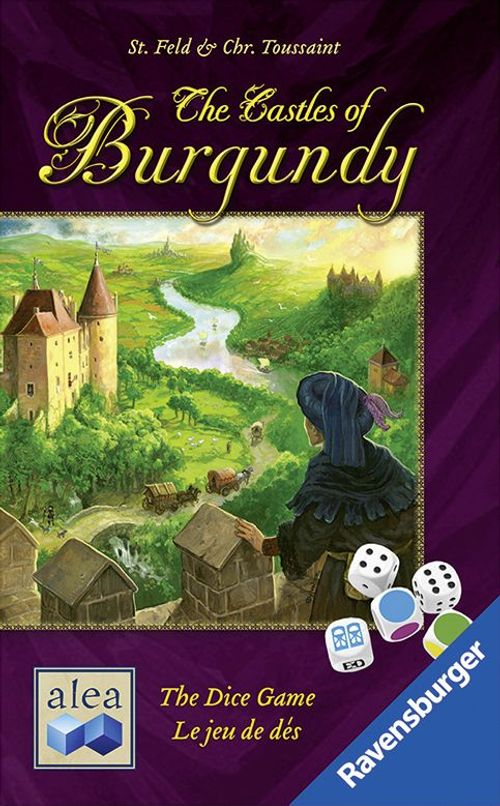
The Castles of Burgundy: The Dice Game
The Castles of Burgundy: The Dice Game Rulebook
Table of Contents
Table of Contents
Game Idea
15th century France, the Loire valley. As influential nobles you do your best to lead your duchies to prosperity through careful trade and diplomacy.
Combine the die roll results to your advantage and find a strategy that will lead you to victory. Your options are endless - trade commodities or raise cattle, build mighty cities or support the church … There are many paths to prestige and prosperity!
The player who ends the game with the most victory points wins.
Game Idea (summary)
Increase your wealth, influence and territory as a 15th century noble by cleverly combining die roll results to your advantage, and collect as many victory points as possible.
The player with the most victory points wins the game.
Game Components
- 1 writing pad (approx. 100 pages (= 50 x 4 different duchies A, B, C and D))
- 5 pencils
- 5 dice (2x pips, 2x colors, 1x hourglass)
Before You Start
Before you start, here are a few general rules. Each player tries to fill their duchy as quickly as possible by marking his hex fields one by one with a pip value that was rolled.
Your Duchy Page
Top left - Circle each bonus you are granted for completing a purple area (= monks). Next are the bonuses for filling gray areas (silver), blue (commodities), orange (workers) and green (various). Completing a yellow area will grant you double the victory points for that area. This also shows you the die results that are needed to fill a hex of a particular color.
For example, you can only enter 1s and 2s to fill a purple hex. Gray hexes need 3s and 4s, blue hexes 5s or 6s.
Next to your duchy you will find the amount of victory points you will receive if you are the first (or second) player to mark all hexes of that color.
For example, the first player to mark all seven yellow hexes will get 4 victory points, the second player will get 2.
Center - Your duchy, consisting of 37 hexes in a number of differently assembled colored areas. For duchy A, these are 3 river beds (2 blue hexes each), 2 mines (2 gray hexes each), 4 cities (1x4, 1x3, and 2x1 orange hex) 4 monasteries (3x2 + 1x1 purple hex), 4 castles (4x1 green hex) and 4 pastures (3x2 + 1x1 yellow hex).
Bottom center - This shows what you get for using (checking off) a bonus.
For example, by selling a commodity you will receive 1 silver (gray circle) plus 2 victory points.
Top right - Mark the game progress in these three time columns (I, II, and III). When the hourglass die is rolled, check off that many boxes. Once a column is complete, the current phase ends. The game ends after three phases.
Center right - This shows the amount of victory points you will receive whenever you complete a colored area (consisting of 1, 2, 3, or 4 hexes). The quicker you do this, the more victory points you will get.
For example, completing a 3 hex area during phase 1 will grant you 8 victory points, but only 6 points in phase 2 and 4 points in phase 3.
Bottom right - Use these columns to add up each phase's victory points. There's space to enter the three subtotals, and a big star for the final result, as well as the duchy's letter.
Try to focus on completing areas consisting of one, two, three, or four neighboring hexes of the same color. In addition to victory points, those areas will also grant you bonuses that might be useful throughout the game.
Game Setup
Each player gets one page from the writing pad (= their duchy) and a pencil.
(It's recommended that new players start with duchy A. Later, your play group may decide to play also with duchy B, C, or D. All players get always the same duchy!)
The owner of the game gets the 5 dice. For the rest of the game, that player rolls the dice. They are not passed on after each die roll.
Before you start the game, each player must mark one of their four castles (green hex) on their duchy by checking off its colored square (see illustration). Then, circle the corresponding bonus on the left side of the page (next to the green hex). You are starting the game with this bonus (see illustration). Each player now owns one bonus, either a monk (purple), silver (gray), commodity (blue) or worker (orange).
Attention: Players choose their starting castles at the same time, i.e. no player knows what the other players choose. Multiple players may start with the same castle.
Note: Since marking the final hex of a colored area grants you victory points, your first victory point for the starting castle has already been entered in the first victory point column in the bottom right corner of your duchy.
Game Setup (summary)
Each player gets 1 duchy (= page) and 1 pencil.
One player rolls all 5 dice for the rest of the game.
Each player marks a starting castle and gets the appropriate bonus.
This player chose the castle with the blue square as starting castle, so they start the game with one commodity bonus.
Game Play
The game consists of three phases (I, II, and III). Each phase consists of multiple rounds of die rolling (minimum 5 and max. 10 rounds). Die rolling works like this:
First, the owner of the game rolls all 5 dice, then they check off the amount of rolled hourglasses (1 or 2) in the current phase's time column, from top to bottom (see illustration). If they roll the double hourglass (blue), they have to announce it (see section "Commodity").
Note: Every other player may check off the hourglasses, but they don't have to.
Then, all players use the die roll results of the remaining 4 dice – at the same time! Each player builds one combination out of exactly one pip die and one color die to mark exactly one additional hex in their duchy by entering the rolled pip value. That hex must always be next to a hex that has already been marked (at the beginning of the game, the hex has to be next to the starting castle).
Note: If a player cannot build a useful combination, they will gain a worker instead. (Circle an unused worker next to the orange hex on the left side of the page.)
Attention: Players choose their combinations without touching the dice. Every player is free to choose any of the 4 dice.
Once all players marked their hex, the owner repeats the process. They roll all 5 dice and check off the amount of rolled hourglasses, then all players choose their combinations.
Note: If there is only a single hourglass space left in the current time column and the owner rolls the double hourglass, only that last space is checked off. Do not start the next column. The double hourglass will still trigger a commodity sale (see below).
Play the second and third phase in the same way. Then the game ends and the winner is determined.
Game Play (summary)
The game consists of 3 phases of die rolling (5-10 rounds per phase).
First, check off the rolled number of hourglasses …
… then each player builds a combination of 1 color die plus 1 pip die and marks the respective hex in their duchy.
All subsequent rounds of die rolling work the same way, until the current phase ends.
The second and third phase works the same way.
Monastery hex
To mark a monastery hex, players need one colored die showing purple plus a pip die with 1 or 2. If that combination was rolled, they enter 1 or 2 (respectively) in the small square space of the selected monastery hex.
If this was the final vacant hex of a monastery area, the player receives the respective bonus, i.e. they draw a circle around one of the available purple monk circles in the top left of their duchy, next to the purple hex. Additionally, they enter the corresponding amount of victory points in the bottom right corner of the duchy page (depending on size and phase) (see example on page 8).
Monasteries can only be marked by combining purple with a 1 or 2.
Final hex of a monastery area: victory points + 1 monk
To clarify: You only get a bonus when you mark the final hex of a colored area. In case of one-hex areas (like a castle) you get the bonus immediately.
Mine and river hexes
These hexes are marked in the same way as the monastery hexes, but for mines you need a combination of gray and 3 or 4, and for rivers you need a combination of blue and 5 or 6.
The bonus for a complete mine or a complete river area are the corresponding amount of victory points plus one silver (= gray circle) or one commodity (= blue circle). (See example on page 8.)
Mines can only be marked by combining gray with a 3 or 4, rivers by combining blue with a 5 or 6.
Final hex of a mine or a river: victory points +1 silver / +1 commodity
City hex
To mark a city hex, players need to use a combination of orange plus any number. However, any subsequent number must be different from the numbers that have already been entered in that particular city area! In other words: All hexes in a particular city area must have different numbers. (Each city area has its own independent numbering.)
For a completed city you get the respective amount of victory points, plus a worker (= orange circle). (See example on page 8.)
Cities are marked by combining orange with different numbers.
Final hex of a city area: victory points +1 worker
Castle hex
To mark a castle hex, players can use a combination of green and any number. However, that number must already have been marked in an adjacent hex of that castle.
The bonus is 1 victory point, plus either a monk, a silver, a commodity, or a worker, depending on the color of that castle's square. Circle the appropriate bonus next to the green hex, not next to one of the bonus colors (see example on page 8).
Castles are marked by combining green with an "adjacent" number.
Bonus depends on marked castle: 1 victory point + 1 monk / 1 silver / 1 commodity / 1 worker
Pasture hex
To mark a pasture hex, use a combination of yellow plus any number. However, all numbers in this pasture area must be the same number. (Each pasture area has its own independent numbering.)
The bonus for completing a pasture area is doubling the amount of victory points (see example below).
Pastures are marked by combining yellow with identical numbers.
Final hex of a pasture area: victory points x 2
This player has lots of options to use the rolled dice. For example, they can check off a worker and then use yellow + 3 to complete the pasture area in the bottom right of their duchy (A). They would note 3 victory points (for completing a 2-hex area in the 2nd phase), plus 3 additional victory points for the pasture for a total of 6 victory points.
Another option would be saving the worker for later and entering a 4 or 6 in one of the hexes in the top pasture (B).
They can't use orange because they don't have a vacant city hex that is adjacent to an already marked hex. The only option would be to check off one of their two monks to use blue (together with 6) (C) / (D) or gray (together with 4) (E).
How to Use Bonuses
(Please also refer to the bottom area on your duchy page for a summary)
Players may only use up to one bonus during one complete round (i.e. up to two different die combinations), never more!
Bonuses (summary)
Each player may only use up to 1 bonus per turn.
To clarify: This rule makes sure that you cannot change both a color and a pip value in the same round. You also won't be able to mark a second hex if you need to change a die for doing so, or if you used already a bonus in your first turn.
spend 1 monk = change a die's color to any color
spend 1 silver = use 2 die combinations (mark a second hex)
Monk
Use a monk by checking off one previously circled purple space (either next to the purple hex or next to the green hex). Using a monk lets you change the color of a die to any other color to build a useful combination with a pip value.
Attention: You don't actually change the color of a die; other players may only use the rolled colors! The same rule applies when using a worker bonus.
Silver
By checking off a silver that has been circled previously, you may use a different die combination to mark a second hex during the same turn.
Attention: You can't use the same two dice you combined to mark your first hex. You must use at least one other die.
Example 1: The player marks a city hex with a 2, then pays a silver and marks a second city hex with a 4.
Example 2: The player marks a pasture hex with a 1, then pays a silver to mark another pasture hex using the other 1. (This is not a rules violation since they use two different 1s! They could do the same if both color dice showed yellow.)
Commodity
If the owner rolls a double hourglass (blue symbol) at the beginning of a round, each player may sell (= check off) all their circled blue spaces (= commodities). For each checked off commodity you gain 1 silver (by circling a space next to the gray hex), plus 2 victory points that you note in the victory point column.
Attention: Selling commodities does not count as using a bonus. The one-bonus-per-round rule applies during the subsequent step, when players build their combinations.
commodity = 1 silver + 2 victory points
Worker
These work similar to monks. By checking off a worker you may change one pip value to whatever you like.
worker = change a die's pip value to any value
Extra Victory Points for Completed Colors
When a player marks the final hex of a particular color in their duchy (e.g. the 4th gray hex or the 6th blue hex), they announce it publicly at the end of the current round.
That player gets extra victory points according to the appropriate small hexes and adds them to their victory point column. Then all players check off that number as a reminder that these victory points have already been claimed.
Attention: If multiple players manage to mark the final hex of a particular color during the same round, they all gain the full amount of victory points.
The second place points remain available, i.e. players who complete that color in a subsequent round can still gain those points. If the second place victory points have been claimed by a player (or multiple), all players check off that number as well. No other player will get extra points for that color anymore.
If you are the first (respective second) player to mark the final hex of a particular color you gain extra victory points.
If multiple players manage to complete a color during the same turn, they all get the full amount of extra points.
Game End
The game ends in phase 3, after completing the final round of die rolling. That's the round in which you checked off the final hourglass square of the third time column. Each player adds up the subtotals of each phase and then enters the total amount in the big star space.
Whoever has the most victory points wins the game. If there is a tie, the player with the most remaining bonuses (circled spaces that haven't been checked off) wins. If there is still a tie, the game ends with multiple winners.
Game End (summary)
The player with the most victory points wins the game.
Variants
All different (up to 4 players)
In this variant, each player begins the game with a different starting castle. The owner of the game chooses first, then all other players choose their starting castle in turn order.
Variant 1: All players begin the game with a different starting castle.
All the same
You may also agree that all players begin the game with the same starting castle. Choose as a group. If you can't agree on a starting castle, the owner of the game chooses.
Variant 2: All players begin the game with the same starting castle.
One and only
In this single player variant you try to gain as many victory points as possible. Each phase consists of 8 rounds. (You still roll the hourglass die to enable commodity selling.)
In phases 1 and 2 you gain the higher amount of extra victory points for completing a color. In phase 3 you gain the lower amount.
Will you achieve more than 50 victory points? Well done. More than 60? Excellent! 70 or more points? Incredible!
Solo variant (summary)
8 rounds per phase.
Extra victory points for completed colors: Higher amount in phases 1 and 2, lower amount in phase 3.