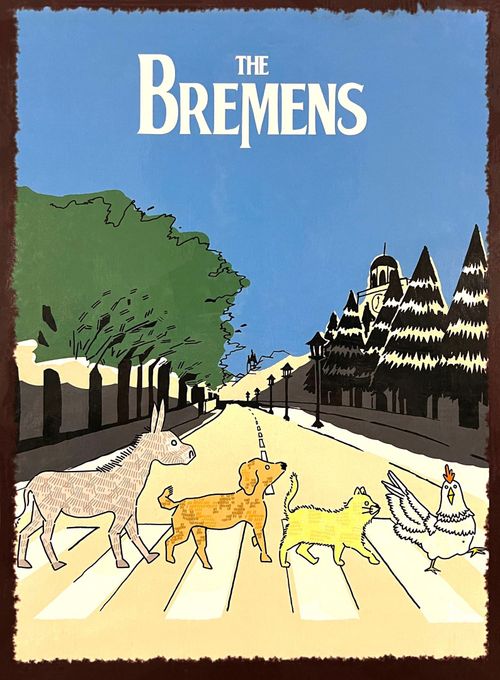
The Bremens
The Bremens Rulebook
Table of Contents
Table of Contents
Contents
- Number Cards x 35 (1-7 in 5 different colors)
- Special Cards x 7
- Animal Cards x 15 (cat, dog, and donkey each in 5 different colors)
- Chicken Card x 1
- Chicken piece x 1
- Animal Pieces x 15 (small to medium sized)
- Sticker Sheet x 1 (Animal stickers for pieces x 15) — Apply stickers to the pieces before your first game.
- Game Board x 1 (One side for 3-4 and another for 5)
- Start Player Badge x 1
- Instructions
There are five sets of animal pieces (circular wooden discs) that come in three sizes - small, medium, and large. The respective stickers are - small = cat, medium = dog, and large = donkey. Adhere stickers to the pieces of corresponding color and size before your first game.
Setup
- Each player chooses a color and receives the corresponding 3 animal pieces, 7 number cards, and 3 animal cards.
- The 7 special cards are shuffled and one card is dealt face down to each player. Any remaining cards are set beside the board in a face-down pile.
- Players secretly combine all their cards into a single 11 card hand.
- Based on the number of players, place the correct side of the board in the center of the table.
- All players place their three animal pieces in the Start squares of the board.
- Place the chicken piece on the space marked with a chicken symbol.
- The first player to name a four person band, becomes the start player and receives the start player badge along with the chicken card.
A Game Round
- Each player chooses a number or special card from their hand and places it face down on the table. Players then simultaneously turn their cards face up.
- Compare values and hand the chicken card to whoever played the highest number or special card. Players then either start a new personal discard pile or add the card to their existing one.
- If more than one player is tied for the highest value, the chicken card is given to the player closest to the current holder of the card in clockwise order.
The next three steps are performed by one player at a time in turn order:
- Players pick an animal card from their hand to show which piece they would like to move and place it on the table next to their discard pile.
- The animal piece matching the chosen card moves the number of spaces shown on their number card.
- The player receiving the chicken card does not move any of their animals. Instead, they move the chicken piece equal to the number shown by the symbol on their card. The chicken may either move forwards towards the goal or back towards the start.
- After all players complete their movement, the player with the chicken card becomes the new start player and receives the start player badge. Repeat steps 1-6.
When a player runs out of Animal cards: After all three animal cards have been played to the table, players simply pick them back up and add them to their hand.
When all players run out of Number and Special cards: After players have used their 8 number and special cards, each one takes their number cards back into their hand. The used special cards are collected, added to the pile of special cards set beside the board, and are shuffled. Each player is then dealt face down a new special card which is added to their hand. The remaining special cards are then set in a pile next to the board.
Movement
The Animals
Pieces matching the animal card that was played are moved the full amount shown on the number card. The only exception to this is the [5 ONE TO FIVE] special card. All animal pieces, with the exception of the chicken, must advance towards the Goal.
There is a size order to the pieces: Chicken < Cat < Dog < Donkey.
Animal pieces encountered while moving are not treated as an obstacle unless they're in the final space. Then as long as the piece being move is smaller, the move is permitted. The player simply sets his animal piece on top of the others. If the piece being moved is the same or larger, the entire move cannot be carried out.
Depending on a player's choice of number card and their place in turn order, they may not be able to move an animal on their turn. When this occurs, the player still has to decide whether or not to play an animal card.
Riding Along
If an animal piece is moving and has other animals on its back, all of the pieces move along together towards the Goal.
Chicken Piece
The chicken piece has two special features:
- Animal pieces that the chicken is resting on may not move.
- Only the chicken is allowed to move forwards towards the Goal or back towards the Start.
The chicken card and the chicken piece's movement are handled by whoever plays the highest value number card during the round. If two or more players tie, the chicken card is passed to the player closest to the current holder of the card in clockwise order. The chicken player for the current round becomes the start player next round. On their turn, they move the chicken piece the number of spaces shown by the symbol on the number or special card. The chicken piece may not enter the Start or Goal spaces. In addition, with the exception of the [7 SEVEN] special card, chicken must move the full number of spaces. If he cannot be moved the full amount in a direction due to the Start or Goal spaces, the move may not be carried out and the opposite direction is used.
If there are any animals pieces in the final space of the chicken's move, he will rest on top. No animal piece may rest on the Chicken.
Animal pieces that the chicken is resting on are unable to move. (If the chicken is resting on top of more than one animal piece, none of them may move.)
Special Cards
If a special card is used in place of a number card, first the value is compared just like a normal number card. When it has the highest value, whoever played the card moves the chicken instead of their own animals. If a player moves their own animals, the ability of the special card will trigger. For details on the Special cards, see the Special Cards section below.
An Example of Gameplay
The players in clockwise order are: Red, Blue, Yellow, then Green. Red is the start player for the current round. In front of Red, is the start player badge and the chicken card.
Red plays [7], Blue a [3], Yellow goes with the [7 SEVEN] special card, and Green chooses their [2]. Red and Yellow are tied for the highest value, but the chicken card goes to Yellow. He is closest to the start player in clockwise order.
The selection of animal cards and piece movement begins. Red has all three animal cards available and decides to play the donkey card in front of him. His corresponding piece moves 7 spaces towards the Goal. Since Yellow's dog is riding on the donkey, it moves along too.
Next up is the Blue player. Blue chose [3] and originally intended on moving her donkey. Now that Red has taken the spot, that move is no longer possible. So, Blue decides to play her cat card instead. Because the pieces on the final space of her move are larger, the cat moves three and rides on top of Yellow's dog and Red's donkey.
Since Yellow received the Chicken card, he'll be moving the Chicken instead of his pieces this turn. The chicken movement symbol on Yellow's card shows [1-5] (the printed text here reads "The on Yellow's card shows [1-5]"; the symbol itself is an icon that does not survive text extraction). So, the chicken moves 3 spaces backwards to rest on Green's dog.
Green played [2] and was planning on moving her dog this turn, but that's no longer an option thanks to the chicken. Since the dog is her only remaining animal card, there aren't any possible moves. However, discarding the dog allows her to take all the three animal back into her hand and provides more movement options for the next round.
Now that all of the players have had a turn, Yellow receives the start player badge and the next round begins.
Goal
When an animal piece makes its way into the Goal space, place the piece on top of the matching animal card. This animal has made it to Bremen, and his card is no longer used. Do the same when other animal pieces reach the Goal.
End of Game
Once all three of a player's animal pieces have made it to the Goal, the game immediately ends and that player is declared the winner. If an animal reaches the Goal with other pieces riding on its back, the riding pieces arrived first.
If you want to determine the ranking of the other players, use the following conditions:
- The most pieces to reach the Goal.
- If there is a tie, the pieces furthest along the path determines a player's rank. Pieces riding on top of others are considered to be further ahead.
Special Cards
[1 SHAKE] This card allows an animal piece to shake off any other animals on its back. When played, riding pieces move one space back towards the Start. If there are two pieces riding, their order is not changed (the two remain stacked) and both are moved to the same free space. Then if possible, the animal who performed the shake is moved ahead one space. If Chicken is riding on the chosen animal, this effect does not trigger.
[2 SKIP] Counting only the free spaces without other pieces, move 2 spaces towards the GOAL.
[3 DOUBLE] Allows two animals to move this turn. The two chosen animal cards are played one after the other, and each piece moves three spaces towards the Goal. If the player has using the card has only one animal in their hand, the second card is played after returning all three cards to their hand. In cases like this, the same piece may move twice in a row.
[4 ANYONE] A player may choose any of their pieces and move it 4 spaces towards to Goal without playing an animal card.
[5 ONE TO FIVE] This card allows an animal piece to move anywhere from 1-5 spaces towards the Goal.
[6 NINE] It may say 6, but when using this card, an animal piece moves 9 spaces ahead.
[7 SEVEN] This card works like a regular 7 unless being used with the chicken piece. In that case, the chicken may move anywhere from 1-5 spaces in either direction.
Caution
Please keep this game out of the reach of small children (especially 1-3 years of age). The small wooden parts could prove to be a choking hazard.