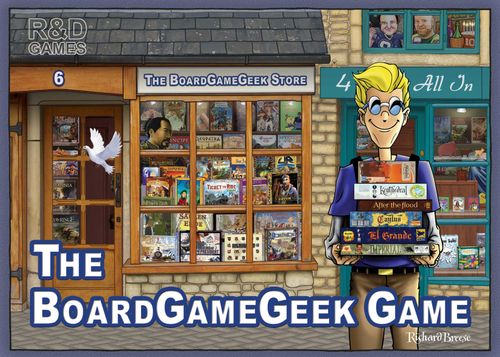
The BoardGameGeek Game
The BoardGameGeek Game Rulebook
Table of Contents
Table of Contents
Components
1 game board — depicting 6 stores with games on Broadway.
- Fan gold (GG) score track.
- A slot for charity-shop tiles (off the game board).
- Bottom shelf.
- 9 display windows for showing games in each store.
- Top shelf.
- Game price shown in that column.
- Light area, where the fans (dice) will go.
- Slot for played tiles (off the game board).
- Numbers on the games that can be sold in that store.
- Store number.
120 game tiles — each tile shows a game for sale, or nothing. There are 3 tiles with the numbers 1, 2, 3, 4, 5 and 6, plus 2 blank tiles (to represent a publisher's temporary financial troubles) for each of the 6 colors. One side shows a game (or nothing), and the other shows the publisher's logo.
18 fans — 3 wooden dice of each of six colors.
6 wooden score markers — to track each player's GG.
6 screens — publisher warehouses.
1 rulebook. 6 cellophane bags — for storing tiles, dice and markers by color.
1 Ernie with stand — first-player marker.
Initial Setup
Choose the first player. Each player rolls 1 die. The player with the highest number becomes the first player. On a tie, roll again.
Or use the fan method (see page 16).
Each player takes 3 dice, a screen, and 20 tiles of their color.
Each player shuffles their 20 tiles and places them face down in front of their screen.
It is recommended to also keep the dice in front of the screen during play, to save room for tiles behind the screen.
Set the score markers of the first player and the next two players to 10 GG — a gift in honor of BoardGameGeek's tenth anniversary. The remaining players get 1 extra GG and set their score markers to 11 GG.
Goal of the Game
First, in the role of board game publisher, each player supplies their games to six stores over the course of six rounds and earns GG for the games sold.
Second, using their 3 fans (dice), players try to collect the games they need. Players are awarded GG at the end of the game depending on which games they have collected and whether they have completed the sets they need.
The player with the most GG at the end of the game becomes the winner.
How to Play
The game lasts six rounds. Each round consists of the following six actions:
- Games arrive in the warehouse.
- Games are supplied to the stores.
- Fans go to the stores.
- A new first player is chosen.
- Fans choose games.
- GG is received for games sold.
1: Games Arrive in the Warehouse
In the first round, each player takes 8 tiles from their stack and places them face up behind their screen.
In rounds 2–5, each player takes 3 new tiles from their stack and places them face up behind their screen.
In the sixth round, players do not take any new tiles.
Round 1: 8 tiles. Rounds 2–5: 3 tiles. Round 6: 0 tiles.
2: Games Are Supplied to the Stores
Starting with the first player and continuing clockwise, each player may place one of their tiles from their warehouse onto a lit display window of one of the stores, or pass.
Tiles are placed face down. Tiles continue to be placed until all players have passed. Once a player has passed, they can no longer supply games to a store in that round.
A player may decide not to supply any games in that round.
A player may not have more than 12 tiles in their warehouse at the end of a round.
For all the stores to prosper, each store sells a limited range of games from each publisher. So...
For games to be sold in a store, the games supplied must fall within the store's range. The range of games sold by each store is shown on the flag next to the store. A store sells games with numbers: the same as the store's own number (except Store One), one less than the store's number, and one more than the store's number (except Store Six). For example, Store Six will only sell games numbered 3, 4 or 5.
Blank tiles can be placed in any store. (Blank tiles and tiles placed with an unsuitable number are removed in action 5.)
A game's price is shown on the store's door opposite the corresponding display window.
Games lying on the bottom shelf of a display window sell for the most and remain in place the longest. A game placed on the top shelf can be bought in action 5, because the seller will earn fewer GG for it, or because that will be the only chance for another player to obtain that copy of the game (which they may want in order to complete a set of tiles with that number).
Note that if a player always places their tiles in the most expensive spot in the stores where that type of game sells for the most, it will be easier for other players to figure out where best to take that player's games from.
Note that each player only has 3 dice with which to make purchases. If, during a round, players place more games than the total number of dice, some games will not be sold that round.
Since players do not receive new games in the sixth round, they will most likely want to keep some tiles at the end of round five in order to use them in round six. A player should play all of their tiles in round six.
3: Fans Go to the Stores
All players roll their three dice. Then place the dice in the lit areas below the display window of the store with the matching number.
Advertising and Promotion
Now players may promote their own dice to other stores by advertising and promotion. Clockwise, starting with the first player, players may:
- Advertise — reroll one or more of their dice, paying one GG. Place the rerolled die in the store matching its new number. Move the score marker back one space.
- Promote — move one die to an adjacent store, paying one GG. (The number on the die does not change.) Adjacent stores are those orthogonally and diagonally adjacent, i.e. a die may be moved from Store 1 to Stores 2, 3 or 4. A die from Store 4 may be moved to any other store. Move the score marker back one space.
- Pass — free.
Score markers may go below zero (but this will most likely not happen).
This continues until all players have passed, i.e. players may pass and then advertise or promote again in response to other players' actions.
4: A New First Player Is Chosen
The player who placed their dice in the stores with the lowest number becomes the new first player and takes the first-player marker.
Example: red dice are in stores 1, 2 and 5; yellow dice are in 1, 3 and 4; and blue dice are in 2, 2 and 3. First, compare the dice in store 1. Red and yellow each have one die in store 1. If they have the same number, compare these two players' dice in the store with the next-lowest number. Red has one die in store 2, and yellow has none. Red becomes the new first player. If all three dice of two or more players are in the same stores, then the new first player is whichever of those players sits next clockwise from the current first player.
5: Fans Choose Games
Turn all game tiles face up. Remove any blank tiles from play. They are placed face up in the played-tiles areas next to the game board.
If a tile does not fall within the range of games sold by the store it is placed in (in most cases this will not happen), it is removed and placed in the charity shop next to the board. Games do not fall within a store's range if the number on the game tile does not match the numbers sold by the store. For example, if a game tile numbered 6 was placed in Store Two, which only sells games numbered 1, 2 and 3, that tile goes to the charity shop.
Note that the charity shop exists so that players intentionally do not place games in stores unsuited to them.
Then, starting with the first player, each player may place one of their dice on a game tile in a store with a matching number, or pass.
Choose the game tile optimally. A die should not go unassigned when there is a suitable game tile available for it. By not choosing a game, the publisher earns no income from it. However, this may make it easier for other players to complete their own set of tiles.
Note there is a significant risk — by not completing a full set of tiles with small numbers, a player will earn few points for an incomplete collection. However, it is possible that for this reason few players will attempt to collect this set, making it easier for another player to collect that set. A player collecting tiles with small numbers has a better chance of becoming the first player and having a wider choice of tiles.
If a player(s) placed a tile in a store that does not sell games of that range, that tile then goes to the charity shop. Instead of placing a die on a game tile with the matching number, a player may choose to place one of their dice on a tile in the charity shop.
Dice may be assigned in any order. It's possible that in some rounds there will be more dice than games in one or more stores (especially after blank tiles are removed), in which case not all dice will be able to be assigned. This action continues until all players have assigned all the dice they want to, or wish to pass.
Only one die may choose a game tile.
6: Receiving GG for Games Sold
First, remove the dice and tiles where a die is placed on a game tile belonging to the same player. Place these tiles face up in the played-tiles area. The dice return to their owners. (These games are removed from play by their publisher and earn no income.)
In this round the first player calculates the players' income.
The first player first calculates their own income. Look at the prices shown on the store's windows opposite the store's door; the first player calculates what income they will earn for games sold in this round. Then moves their score marker along the track by that number of GG.
Then the first player calculates the other players' scores, going clockwise.
Example: 1 + 2 + 4 = 7 GG.
It is recommended that all players pay close attention during scoring, since the first player can easily make a mistake!
Players do not receive income for games that were sold from the charity shop.
After scoring, each player takes back their dice and the game tiles that were acquired by their dice. Game tiles go behind the screen, and dice go in front of the screen.
Dice that did not make any acquisitions simply return to their owners.
Note: players will always have, behind their screen, a set of tiles with games of their own production (which they have not yet delivered to stores) and games from other publishers (which they have acquired).
Move any games that have gone stale in the stores up one shelf. If games become stale on the store's top shelf, they are removed from play and placed in the played-tiles area.
If game tiles go stale in the charity shop, they are also removed from play and placed face up in the played-tiles area.
End of the Game
The game ends after 6 rounds.
Scoring for 4–6 Players
Each player has already counted the GG they earned for games sold during the game. At the end of the game they receive additional GG (representing the 'happiness' achieved) for the games they have acquired.
Keep game tiles behind your screen until the number on the game tile is called. (It's more fun this way.) Points for tiles are counted in numerical order.
Choose a player to keep score. First, each player counts up the tiles numbered 1. Players place their acquired tiles numbered 1 in front of their screen and announce their score. The player keeping score should note all the scores.
Points are scored as follows:
- Each tile in a set (a tile with the same number in each of the other players' colors) — 6 GG.
- Each other tile (not counting duplicates of the same color and number) awards GG equal to the number on the tile.
- No points are awarded for duplicate tiles (i.e. the same color and number).
Example scoring for 4 players:
18 GG for the "1" tiles; 2 GG for the "2" tile; 18 GG for the "3" tiles; 8 GG for the "4" tiles; 10 GG for the "5" tiles; 18 GG for the "6" tiles — total 74 GG.
No points are scored for a player's own tiles. Note: players should already have discarded these (see action 6).
Once all points have been counted for the tiles numbered 1, the procedure is repeated for tiles numbered 2, and so on, until points have been counted for all tiles.
If a player's score exceeds 100, continue counting from 0/100.
The player with the most points wins.
If 2 or more players have the same number of points, the player with more tiles numbered 1 (not counting duplicates) becomes the winner. If still tied, then the player with more tiles numbered 2, and so on. It is unlikely that two players would end up with an identical set.
Scoring for 3 Players
The BoardGameGeek Game can be played with three. All the rules are the same as for 4–6 players, except for the GG awarded at the end of the game for games acquired.
Points for tiles are counted immediately by color, clockwise, starting with the first player's color. As in the game for 4–6 players, keep your game tiles behind your screen during scoring until it's time to count the tiles of that color.
Points are scored as follows:
- Each tile in a numerical set (1 through 6) of one color awards 6 GG. (A complete set of 1, 2, 3, 4, 5 and 6 of one color awards 36 GG.)
- Each other tile (including duplicates of the same color and number) awards GG equal to the number on the tile.
Example: 6, 36, 22, 58 GG for the four colors shown.
Players do not score points for their own tiles, and they should have already discarded them in action 6.