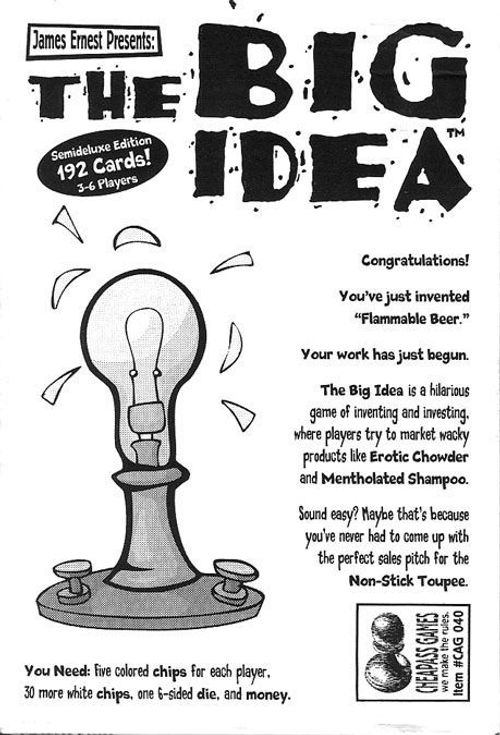
The Big Idea
The Big Idea Rulebook
Table of Contents
Table of Contents
Players and Components
Players: 3 to 6
Playing Time: 1 hour
You Need: One 54-card Deck, five colored Chips for each player, Money, and one 6-sided Die.
Setup
You're all venture capitalists, trying to make the most money off the IPOs of new one-shot companies who make stuff like "Disposable Cats" and "Old Fashioned Pants." Since it's just a game, you also get to make up the new products.
To Begin: Shuffle the deck, and deal a starting hand of three cards to each player. The deal will pass to the left after each round, and a full game consists of ten rounds, or twelve rounds if there are six players. The dealer acts first in some of the phases, and also handles the bank and the die rolling.
Each player takes 5 chips in his own color. These chips represent millions of dollars of Venture Capital (VC) which you control, but don't own. In addition, give each player $10 in money. This money represents your actual cash. The rest of the money starts in the Bank. The object is to accumulate as much cash as possible.
On Each Round
Rounds are composed of four phases: The Seed Phase, in which everyone has the option to launch a new product; the Venture Phase, in which players silently invest in new products; the Mezzanine Phase, in which players invest openly in any products; and the Offering Phase, in which all products have the chance to pay their investors in cash, through a successful public offering. These phases are also called the Product, Secret, Open, and IPO phases, since Seed, Venture, Mezzanine, and Offering make no sense unless you're a venture capitalist.
Phase One, Seed
The dealer gives two cards to each player, bringing their hand up to five. Each player can now invent a new product by combining two cards from his hand, one Item and one Description card (Marked "1" and "2"). Each player plays two cards face down, and once all the players are ready, the new products are revealed together. Note: when you can read the product description ("It's like a hat...you can eat!") everyone else can read the name ("Edible Hat").
If you do not wish to create a new product, or if you are unable to do so because your hand is all the same rank, you can play two cards of the same rank. Those cards will be discarded when you reveal them, and you will create no new product this round.
Describe Your Product: Starting with the dealer, each player reads the description of his new product, and is welcome to expand on its virtues in hopes of attracting investors. In addition, each player must put one of his own VC chips on the new product. Investing in your own product is mandatory unless you have no VC chips available. If you play no product, you invest nothing in this phase.
Phase Two, Venture
Each player now secretly decides which other new product he will invest in. Usually, you will want to invest in the product you think will grow quickly, which means you want to pick the same product other players will pick.
You can not invest in your own product in the Venture phase, and you cannot invest in old products left over from previous rounds. However, you are allowed to skip this round entirely by simply holding on to your chip instead of investing it.
Once everyone is ready, everyone throws a VC chip onto the new invention of their choice. This phase works on the honor system; if you are playing with indecisive or finicky people, make sure they have made their decision before you throw your chips!
Shares: All the products on the table have chips on them, representing investments from the players. Each chip on a product is called a "share," and the more shares are on a product, the more likely it is to pay big money.
Phase Three, Mezzanine
In this phase, players can either invest in, or divest from, any of the products on the table, including older ones. Start with the Dealer and proceed to the left, once around the table.
Investing: To invest, put one of your VC chips onto any product. This can be your own product, other new products, or products left over from previous rounds. When you invest during the Mezzanine Phase, you must pay $1 to each share already on the product. For example, if you are Yellow, and Old Fashioned Clock already has chips from you and Red, as well as two chips from Green, you must pay $1 to Red, $1 to yourself (that's free), and $2 to Green when you add another chip to the pile.
Divesting: You can withdraw an investment if you want to free up a VC chip, or if you want to get out of a product that's no good for you. To divest, withdraw your chip and pay nothing. Divesting can be a strong offensive weapon, especially if you act last in the round.
Whether you invest or divest, you will move a maximum of one chip in the Mezzanine phase. You can also decide to skip this phase altogether.
Phase Four, Offering
Now it's time to see whose investments will pay off. Every product on the table now has a chance to "go public" and pay its investors a random amount of money. In any order you choose, roll the 6-Sided die once for every product on the table. This includes the products invented on this round, as well as those left over from previous rounds.
If you roll greater than the number of shares on that product, nothing happens. The product remains on the table, and all the VC chips stay on it.
If you roll equal to or less than the number of shares on a product, its IPO succeeds, and the product pays out and leaves the table. Players get cash equal to twice the die roll per share they own, and recover their VC chips.
For example, suppose "Desktop Sushi" has 4 chips on it, including 2 from Red and 1 each from Blue and Yellow. The roll is a 3, which means the product's offering is successful. (Since it has 4 shares, it would be successful on a 1 through 4.) Each share pays twice the roll, which is $6 per share. Red gets $12 from the Bank, and Blue and Yellow each get $6. Each player retrieves his VC chips, and the two cards are discarded.
Random Details
Dead Products: During the Offering phase, if any product has no chips on it, discard it.
Next Dealer: After each round, the deal passes to the left.
Empty Deck: When the deck empties, shuffle the discards and replace it. In a large game, you may wind up going through the deck several times.
Winning
The game ends after ten rounds, or twelve rounds if there are six players. Then, the player with the most money wins.
Strategy
Unlike in the real world, everyone's score is usually going up, because it's more fun that way. Final scores can be very close, however, so it's important to play the margins and fight for every dollar you can get.
It's also important to create products that other people will invest in. It's especially smart to play a popular product when you will act early in the Mezzanine phase, because if it's popular you can get your second chip into the product earlier and cheaper, and earn more money from those who come in after you.
Value of Shares
To get a rough idea of what your shares in something are worth, you can calculate their expected value. It's based on the performance of a share based on a random die roll. For example, if you own the only share in a 1-share product, the product will pay $2 on a roll of 1, and nothing on any other roll. Since it has a 1/6 chance of paying $2, we say it has an expected value of $.33. A 6-Share product is guaranteed to pay off, and will pay (on average) $7 per share. However, it could still be as low as $2 or as high as $12. Changing the number of shares in a product will change the expected value of every share in it.
When investing, pay close attention to the number of shares of the product you already own. The more you have, the cheaper your buy-in will be, and the better the money you stand to make. If every player is equally invested in a product, no one makes more money, and the product is a wash no matter how much it pays.
Variant
For a different game, try this: You can make larger products with more than one Description (i.e., "Gigantic Erotic Edible Pants"), or smaller ones with no descriptions at all (just "Pants"). When it pays, each product pays the die roll times the number of cards that comprise it. In other words, 2-card products still pay 2x the die roll, 3-card products pay 3x the die roll, and so on. Buying a share of a product during the Mezzanine phase costs $.50 per card, so you'll need a way to track half dollars. Players still draw exactly two cards each round, so your hand can grow and shrink as you play products of different size.
Or: For a tight game, give each player only 4 VC Chips.