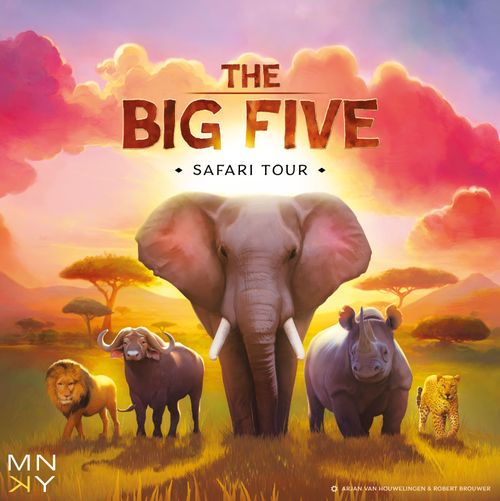
The Big Five
The Big Five Rulebook
Table of Contents
Table of Contents
Goal of the Game
Each of the players must spot all five of the animals belonging to the Big Five, before the forest fires chase away so many animals that they are nowhere to be found, or before too many players run out of fuel or food.
Contents
- 9 two-sided board pieces
- 2 park entrances
- 5 player boards
- 10 player cubes (fuel and food)
- 5 safari vehicles
- 1 six-sided die
- 1 ten-sided die
- 10 fire markers
- 45 event cards
- 48 tokens: 1 extra action token, 4 food tokens, 2 park entrance tokens, 15 animal tokens, 1 buffalo token, 25 Big Five tokens
Setup
A. Take the 9 board pieces from the box and connect them so they form a diamond-shaped board. It doesn't matter which side of each board you use, or where you place each piece.
B. Place a park entrance at each of the two outer ends of the board.
C. Place a park entrance token on each of the two outer spaces of the board.
D. Each guide/safari vehicle has special abilities (see "Special Abilities"). Each player chooses a color and takes the corresponding safari vehicle and player board, as well as two player cubes. In games with fewer than 5 players, return the unused safari vehicles to the box.
E. If someone chooses Anna, the overseer, that player also receives the extra action token.
F. Place your safari vehicle on a space of your choice on the game board. You must place it on a space with a number, and each player has to start on a different board piece. This is your starting location.
G. For each safari vehicle in play, place 5 different Big Five tokens next to the board.
H. Place the fire markers next to the board.
I. Remove two monkey tokens if you're playing a beginner game, or remove one monkey token if you're playing a normal game. For an expert game, use all three monkey tokens. Shuffle the monkey tokens and all other animal tokens (except the buffalo token) together, and place them face down next to the board.
J. Place the buffalo token next to the board.
K. In the normal game, remove one food token. In the expert game, remove two food tokens. Place the remaining food tokens face up next to the board.
L. Each player places two player cubes in the slots of their player board, in the single-diamond slot (beginner game), in the two-diamond slot (normal game) or in the three-diamond slot (expert game). The blue cube represents fuel, and the yellow cube represents food.
M. Shuffle the event cards and place them in a face-down pile next to the board.
| Beginner game | Normal game | Expert game | |
|---|---|---|---|
| Player cubes in | single-diamond slot | two-diamond slot | three-diamond slot |
| Monkey tokens | one monkey token | two monkey tokens | three monkey tokens |
| Food tokens | four food tokens | three food tokens | two food tokens |
For your first game, we recommend playing a beginner game.
Starting Locations
Use the dice to determine the starting locations. Place the following items on the board, in order:
- 2 fire markers
- 3 animal tokens (these are placed face down on the board)
- the buffalo token
- the food tokens
Keep the dice rules in mind when doing this.
Dice Rules
It doesn't matter who rolls the dice during the game. Each board piece features a symbol and numbered spaces, ranging from 1 to 6. Whenever you are instructed to place a fire marker or an animal token on the board - or to place or move a food token or the buffalo token - roll both dice. Place the corresponding item on the position with the number and the symbol shown on the two dice. The following rules apply when placing an item on a space that already contains an item:
Placing fire markers
- Several fire markers may share the same space.
- Fire markers may share a space with safari vehicles and food tokens.
- If Jack, the ranger, is on one of the nine spaces of the same board piece, he immediately extinguishes the fire. In that case, the fire marker isn't placed: leave it with the other fire markers.
- If a fire marker is placed on one of the nine spaces of a board piece containing one or more animal tokens (face up or face down), those animal tokens are removed from that board piece and discarded face up next to the board. These animals are out of the game. The buffalo token is an exception to this rule (see "Placing the buffalo token").
- If the X is rolled while placing a fire marker, the fire marker isn't placed.
Placing animal tokens
- An animal token cannot be placed on a space that already contains a token. Reroll both dice as many times as needed until the animal token can be placed on a space that doesn't already contain a token.
- Animal tokens may share a space with a safari vehicle.
- If an animal token is placed on one of the nine spaces of a board piece containing a fire marker, that animal token is not placed on the board. Instead, it is discarded face up next to the board. The animal token is out of the game. The buffalo token is an exception to this rule (see "Placing the buffalo token")
- If the X is rolled while placing an animal token, the animal token isn't placed. In that case, it remains face down with the other animal tokens.
Placing the buffalo token
- The buffalo token cannot be placed on a space that already contains a token. Reroll both dice as many times as needed until the buffalo token can be placed on a space that doesn't already contain a token.
- The buffalo token may share a space with a safari vehicle.
- If the buffalo token is placed on one of the nine spaces of a board piece containing a fire marker, the buffalo is chased off. Reroll the dice as many times as needed until you roll a space on a board piece that doesn't contain any fire markers.
- If the X is rolled while placing or moving the buffalo token, reroll the dice as many times as needed until a different symbol is rolled.
Placing food tokens
- Food tokens cannot be placed on a space that already contains a token. Reroll both dice as many times as needed until the food token can be placed on a space that doesn't already contain a token.
- Food tokens may be placed on a space that already contains a safari vehicle or a fire marker.
- After a safari vehicle has replenished its food supply next to a food token, the food token is immediately moved by rolling a new location with the dice.
- If the X is rolled while placing or moving a food token, reroll the dice as many times as needed until a different symbol is rolled.
PLEASE NOTE! Two tokens can never share the same space.
The Landscape
The Big Five live on the savanna. The savanna landscape consists of different types of terrain:
PLEASE NOTE! Whenever the term "clear view" is used throughout this rulebook, it means that in order to carry out certain actions, no bushes can be between the tokens and/or safari vehicles and/or fire markers in question.
- Bushes: safari vehicles can move from space to space, but they can't move through bushes (except for David, the mechanic). Animals cannot be spotted through the bushes from the ground, but they can be spotted over the bushes from the top of a hill.
- Hill: safari vehicles can drive to the top of a hill. From the hills, guides/safari vehicles can see over the bushes. Kate, the spotter, can even do this over long distances.
- River: safari vehicles can cross rivers without spending an extra action. However, some event cards might prevent this. Guides/safari vehicles have a clear view across rivers.
- Forest: safari vehicles cannot drive through forests, not even David, the mechanic. Kate, the spotter, can see over a forest from the top of a hill.
- Watering hole: safari vehicles cannot enter a watering hole. Guides/safari vehicles have a clear view across watering holes, but they can't see through bushes surrounding a watering hole.
- Mountains: guides/safari vehicles cannot drive up mountains or see over them.
The Game
The oldest player starts. The game is played in turns, and the starting player goes first. After that, the other players take their turns in clockwise order. Start each turn by drawing an event card and immediately carrying out its effects. Then, you may carry out activities up to a cost of four actions (unless an event card changes this amount). You are allowed to carry out fewer actions, but any actions you don't use are lost.
Actions
On your turn, you can carry out the following activities, with a maximum cost of four actions. Some guides have special abilities that may alter these actions (see "Special Abilities").
- Moving (1 action): Moving from a space to an adjacent space. Driving up a hill does require one additional action. Crossing a river does not require an additional action. You cannot drive through bushes, forests, mountains, or watering holes.
- Refueling (1 action): If a safari vehicle is on a park entrance token or an adjacent space with a clear view of the park entrance token, that safari vehicle can be refueled. Move the corresponding fuel cube on your player board all the way to the top.
- Replenishing food (1 action): If a safari vehicle is on a space with a food token, or on an adjacent space with a clear view of the food token, that safari vehicle can replenish its food supply. Move the food cube on your player board two steps up, then roll the dice to determine the food token's new location.
- Spotting an animal (1 action): If a safari vehicle is on a space with an animal token, or on an adjacent space with a clear view of the token, that safari vehicle can spot the animal. The first player to spot the animal flips the token face up. If it's a monkey, it mocks you. Immediately discard the monkey token next to the board. If it's an animal that hasn't been spotted by this safari vehicle yet, that player takes the corresponding Big Five token from the Big Five tokens next to the game board, and places it on their player board. The buffalo is spotted in the same way, with the buffalo token. The animal token remains face up on the space. It can be spotted by other safari vehicles until it's chased off by a fire.
- Extinguishing a fire (1 action): If a safari vehicle is on a space with a fire marker, or on an adjacent space with a clear view of the fire marker, that safari vehicle can extinguish the fire. Return the fire marker to the other fire markers next to the board. If there are several fire markers on the same space as the safari vehicle or an adjacent one, you must spend 1 action per fire marker you wish to extinguish.
- Driving up a hill (2 actions): Moving to a hill space costs 1 extra action, i.e. 2 actions in total.
- Repairing a malfunctioning safari vehicle can either be done by that guide, or by a different guide (on that player's turn), from the same space or an adjacent space with a clear view of the malfunctioning safari vehicle. David, the mechanic, can repair safari vehicles without having to spend an action. To repair the gate of a park entrance, a safari vehicle must be on the space with the park entrance token, or on an adjacent space with a clear view of that token.
Free action
Exchanging food or fuel. If two or more safari vehicles are on the same space or on adjacent spaces with a clear view of each other, they may freely exchange food or fuel without spending any actions. Move the player cube of the first safari vehicle up a number of steps, and move the player cube of the second safari vehicle down the same number of steps.
PLEASE NOTE!
- If your fuel cube is in the bottom slot, you're no longer able to drive. You'll have to depend on other players to bring you fuel!
- If the food cube of any safari vehicle reaches zero, all players immediately lose the game.
- You can never have more food or fuel than your player board allows for.
Special Abilities
Each guide/safari vehicle has a special ability:
- Jack, the ranger. The ranger can extinguish fires from a greater distance, by driving onto any of the nine spaces of the board piece where the fire is located. The ranger doesn't have to spend any actions to extinguish fires.
- David, the mechanic. The mechanic is the only character who can drive through (but not look through) bushes. He doesn't have to spend any extra actions for this. The mechanic can also repair safari vehicles (including his own) or gates, without spending any actions. However, in order to do this, the mechanic must be located on the space where the repair is needed, or on an adjacent space with a clear view of that space.
- Anna, the overseer. On Anna's turn, she can either spend 1 extra action herself, or give the extra action token to another player. That player must then use the extra action token on their turn and give it back to the overseer.
- Kate, the spotter. The spotter can spot an animal from any distance, and without spending an action. From the space where the spotter is standing, she can spot in six directions, and only in straight lines. She must have a clear view of the animals. If the spotter is on a hill, she can see over forests and bushes, but not over mountains.
- Sam, the supplier. The supplier can drive onto hills without spending an extra action. He also has a larger storage capacity for food and fuel. When the supplier replenishes food through a food token, he may move his player cube up four steps instead of two. The supplier doesn't have to spend any actions to replenish food or fuel. When replenishing fuel, he may move his player cube all the way to the top, just like all the other guides.
End of the Game
If all safari vehicles have spotted all 5 of the animals, you have won the game!
There are three ways you can lose the game:
- The buffalo can always be spotted. All of the other Big Five animals have three animal tokens. If at any point during the game, all three animal tokens of a certain species have been discarded face up next to the board and there's at least one guide who hasn't spotted this species yet, the players immediately lose the game.
- If any player's food cube ever reaches zero, the players immediately lose the game, even if that player had already spotted all the animals.
- If a player's fuel cube is at zero, their safari vehicle can no longer move until it exchanges fuel with a different safari vehicle. However, if all safari vehicles run out of fuel simultaneously, or if for any other reason none of the safari vehicles are able to move, the players can no longer help each other out and immediately lose the game.
Event Cards
Below is a full explanation of each of the event cards. Please note! Whenever you have to roll dice, the dice rules always apply (see "Dice Rules").
- Fire card (11 cards): roll the dice and place a new fire marker on that location.
- Herd of wildebeest (3 cards) / giraffe (2 cards): you encounter a herd of wildebeest or a giraffe. You may carry out 1 or 2 extra actions this turn.
- Animal card (8 cards): roll the dice and place a new animal token on that location. If there are no animal tokens left, place this animal card on the discard pile without activating its effect. Do not draw another event card to replace it.
- Lost food (2 cards) / Stolen food (3 cards) / Overheated engine (4 cards) / Leaky engine (2 cards): lower the fuel or food level of your safari vehicle, by moving the corresponding player cube down the indicated amount of steps. If you draw a card that shows several safari vehicles, all safari vehicles in the game must move their player cubes down.
- Heavy rain (3 cards): none of the safari vehicles can cross rivers this round (one turn for each player). Place this card next to the active player's player board. When the turn comes back around to this player, discard the event card. All players are then allowed to cross rivers again.
- Herd of hippos (3 cards): a herd of hippos is blocking the river. You can't cross any rivers this turn.
- Flat tire (2 cards): the active player's safari vehicle is unable to drive this round, the active player's safari vehicle is unable to move around. It can't be repaired this round. Place the card next to the active player's player board. When the turn comes back around to this player, their tire can be repaired. They can repair it themselves by spending 3 actions (or 0 actions if they are David, the mechanic), or wait for another safari vehicle to move onto (or adjacent to) its space. On its turn, the assisting safari vehicle can carry out the repair for 3 actions (or 0 actions if the repair is carried out by David, the mechanic). The card stays next to the corresponding player board until the safari vehicle has been repaired. Only then can it be discarded.
Event cards are discarded to a discard pile. If the event cards run out, shuffle the discard pile to create a new draw pile.
Variant
If you'd like to play a shorter game, remove all animal tokens of one or two species from the game. All players receive a Big Five token of each of the removed species and place it on their player board. Then continue the game according to the normal rules.