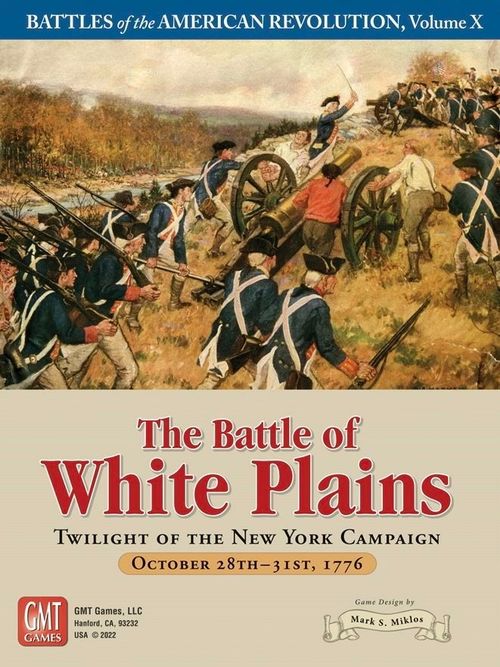
The Battle of White Plains: Twilight of the New York Campaign October 28th–31st, 1776
The Battle of White Plains: Twilight of the New York Campaign October 28th–31st, 1776 Rulebook
Table of Contents
Table of Contents
I. Prepare for Play
The Battles of the American Revolution is a series of ten games with a core set of rules common to them all. Therefore, it is strongly suggested that players read the Series Rules booklet first.
Introduction
The full campaign game covers all four days and spans 42 game turns. Players wishing a shorter game experience can play either the 4 ½ turn historical scenario, the Battle for Chatterton Hill, or the 10 ½ turn Grand Assault scenario. The latter is a hypothetical scenario in which players can model what might have plausibly happened if General Howe had attacked the main American lines at White Plains. Could Howe have crushed the Continental Army and ended the Rebellion barely three months after American Independence had been declared or would the Continentals hold their own and embarrass the British juggernaut?
White Plains offers extensive Opportunity Card Notes and Design Notes that, together with the comprehensive Historical Summary, recover a forgotten 18th century battlefield that has faded into a highly urbanized modern environment.
The White Plains battle flag features a “liberty cap” hanging on a staff. The inspiration for the liberty cap was the “Phrygian cap” from ancient Rome. A master would give the cap to a freed slave as a symbol of his new found freedom. The Phrygian or liberty cap was a common symbol in colonial politics. The sword speaks for itself.
1.1 Game Length
The game begins at 9:30 AM (Turn 1) on October 28 and ends at 5:00 PM (Turn 42) on October 31 unless either player achieves an automatic victory OR unless a “Game Ends” Opportunity Card is played.
OPTIONAL RULE: Players who want to guarantee that the game will last a full 42 game turns must agree before play begins to set aside the “Game Ends” card from their respective decks. Playing the campaign game with the Game Ends cards included has the potential of shortening play by as much as eleven game turns although there is no guarantee.
1.2 Player Order
Only the British player moves on Game Turn 1. The American player moves first on Game Turns 2 and 3. Thereafter, player order is determined randomly per Series Rule 6.0.
1.3 At-Start Army Morale
British 19; American 18
1.4 Momentum
Neither player begins the game with Momentum. OPTIONAL RULE: For play balance against a stronger British player, the American player may start with 1 Momentum chit.
1.5 Strength Points Lost Table
SP losses are recorded on the Strength Point Lost Track located on the map using the appropriate marker. Lost SPs are tracked even for flipped units on the map. See the Player Aid Card for exceptions.
At the beginning of the game, set the British SP Lost Marker to 0. The American marker is only used in the October 31st scenario.
1.6 Deployment
Both sides deploy their units according to their at-start hex number. Opportunity units labeled “Opp” are placed in the Opportunity Units Box on the game map and enter the game through card play. Reinforcements are placed on the Game Turn Track according to the turn of entry noted on the counters. Three American units have **** in lieu of at-start hex numbers. They deploy as follows:
- Major General Spencer on or within two hexes of 3327.
- Brigadier General Wadsworth on or within two hexes of 2629.
- Van Wyck Rangers anywhere on or east of hex row 29xx stacked with or adjacent to any NY Militia (excluding the 6th Dutchess County) or any NY State infantry units, subject to stacking limits.
1.7 Determine Washington’s Combat Modifier
The American player rolls a die to determine the value of Washington’s Combat Modifier for the duration of the game according to Exclusive Rule 5.3. Deploy the appropriate counter from the counter mix. See Design Note 9.1 for an explanation of this rule. OPTIONAL RULE: For play balance against a stronger British player, Washington’s Combat Modifier may be set at “1”.
1.8 Ruse de Guerre
The American player secretly designates a certain number of his fieldworks hexes as containing a Ruse de Guerre according to Exclusive Rule 4.9.
1.9 Draw Opportunity Cards
See Exclusive Rule 4.2
II. How to Win
2.1 British Victory
2.1.1 Decisive
Control hex 2103 at the end of any game turn signifying a breakthrough to the Hudson Highlands and the encirclement of the American army. See Exclusive Rule 2.4.2 for the definition of control.
2.1.2 Substantial
Either side can achieve a Substantial Victory as indicated in Series Rule 16.3.
2.1.3 Marginal
If neither player achieves a decisive or substantial victory by the end of the game, the British player wins by having a margin of at least six victory points more than the American player while the British control Chatterton Hill (hex 2024).
2.2 American Victory
2.2.1 Decisive
Eliminate or capture 23 SPs of British Player non-artillery combat units, excluding Loyalists and Tory Militia.
2.2.2 Substantial
Either side can achieve a Substantial Victory as indicated in Series Rule 16.3.
2.2.3 Marginal
If neither player achieves a decisive or substantial victory by the end of the game, the American player wins by having a margin of at least three victory points more than the British player.
2.3 Draw
If conditions are not met for any levels of victory described above, the game ends in a draw.
2.4 Victory Point Schedule
2.4.1 Combat Unit & Leader Casualties
See the Victory Point Schedule on the Player Aid Card and the Leader Summary Table on the game map. Important: The VP and Army Morale (AM) impacts for the named demi-leaders (Rall, Haslet, Glover) are in addition to those for the unit casualties themselves.
2.4.2 Objective Hexes and Control
At the start of the game, the American player controls Chatterton Hill, Horton’s Mill and Tarrytown while the British player controls the British Headquarters.
- In order to take control of an objective hex, a player must occupy (or be the last to pass through) the given hex with a combat unit other than artillery while there are no enemy combat units adjacent. Place the proper control marker when this occurs. The enemy player may regain control in the same manner. Flip the control marker in this case.
- Neutralizing Control: The presence of adjacent enemy combat units neutralizes friendly control of an objective hex, whether occupied or un-occupied. In this case, neither side controls the hex. If the adjacent enemy units move away without occupying the objective hex, friendly control is reestablished.
- Tarrytown Control: Control is granted to the only player to have a combat unit other than artillery in Tarrytown. If opposing forces coexist in Tarrytown, control is neutralized until only one side meets the condition for control. (See Exclusive Rule 4.3 for details on movement and combat in Tarrytown.) CLARIFICATION: The British player cannot win a marginal victory unless he controls hex 2024.
- British Headquarters (hex 2538)
- Worth 1 VP to the American player while American-controlled—the British player never gains a VP for the British HQ.
- The American player gains +2 Army Morale, while the British player loses –1 Army Morale. These AM adjustments are made only once, no matter how often the hex changes hands.
- Chatterton Hill (hex 2024)
- Worth 1 VP to the American player while American-controlled
- The following events occur upon initial British control:
- The British player draws one Opportunity Card
- The American player loses –1 Army Morale (this is regained upon the American player reestablishing control, and can be lost and regained multiple times)
- The British player needs to control this hex in order to win a marginal victory
- The British player loses –1 Army Morale if he fails to control this hex by the end of Game Turn 9
III. Series Rules Variations
3.1 Leaders
- American Seniority (rank denoted by #) All American leaders can command any combat units unless specified otherwise.
- #1 General George Washington
- Washington has a Morale Modifier labeled “3/1” which is interpreted to mean 3 when stacked with units attempting a morale check and 1 when adjacent to those units.
- When adjacent his modifier of “1” would be applied in addition to the modifier provided by a commanding leader in the unit’s hex and any other applicable modifiers.
- #2 Major General Charles Lee
- Appears as a replacement in the event Washington is a casualty. Flip the Washington counter over and deploy Lee at American HQ (hex 1905). If this hex is British controlled, deploy stacked with any American leader.
- #3 Major General Israel Putnam (“Old Put”)
- #4 Major General William Heath
- #5 Major General Joseph Spencer
- #6 Major General John Sullivan
- #7 Brigadier General William Alexander, Lord Stirling (October 31 Scenario only)
- #8 Brigadier General Alexander McDougall
- May only command the units in his brigade signified by white combat, movement and unit morale values plus any units on or adjacent to Chatterton Hill.
- #9 Brigadier General James Wadsworth
- May only command the units in his brigade signified by dark blue combat, movement and unit morale values.
- Colonel John Hazlet (Delaware Blues) is a demi-leader (denoted by the gold star on the counter) for Tactics Chit play for himself (at all times) and any Patriot militia with whom he is stacked or adjacent to while on or adjacent to Chatterton Hill only.
- #1 General George Washington
3.2 Retreat Priorities
- While Tarrytown is American Controlled:
- British Player Retreats toward the south, southeast or southwest edges of the map if possible.
- American Player Retreats toward the north, northeast or northwest edges of the map if possible.
- While Tarrytown is British Controlled:
- British Player Retreats toward the south, southeast, southwest or northwest edges of the map if possible.
- American Player Retreats toward the north or northeast edges of the map if possible. NOTE: See the retreat priority illustration on the map, noting the colors on the hexsides.
3.3 American Sortie Restriction
- Movement Only those American units with MPs shown in parentheses may move freely when the game begins. All other American units are restricted to their at-start hexes until released to sortie. SPECIAL RESTRICTION: Units that begin the game on Chatterton Hill or arrive there as reinforcements may only move without restriction in hexes on or adjacent to the hill. Except as specified in the “British Army Moves North” or “Sortie Die Roll” subsections below, these units are only released from this restriction on the first friendly movement phase after enemy close combat against any of these units. Remaining American units are released from sortie restriction in one of three ways:
- Close Combat along Forward American Defense Line The entire American Army is released from sortie restriction on the first friendly movement phase following enemy close combat against any American units occupying the Forward American Defense Line (defined as the connected line of fieldworks from hex 2320 through hex 3115.) Place the American Army Sortie marker on the Game Turn Track of the appropriate turn as a reminder.
- British Army Moves North The entire American Army is released from sortie restriction on the first friendly movement phase after any British player combat unit moves north of the Sortie Trigger Line while west of the Bronx River or north of the line of Flat Meadow Brook and the Mamaroneck River while east of the Bronx River. The Sortie Trigger Line is depicted by subtle dashed outlines within each hex beginning in hex 1422 and extending to hex 2222. Place the American Army Sortie marker on the Game Turn Track of the appropriate turn as a reminder. CLARIFICATION: British player combat units must cross the Sortie Trigger Line to trigger release. Merely entering the Trigger Line hexes will not trigger release.
- Sortie Die Roll The entire American Army is released during the friendly movement phase of any game turn in which the American player successfully rolls for Sortie. The range needed for a successful sortie roll is printed on the Game Turn Track beginning on Turn 10. Place the American Army Sortie marker on the appropriate turn as a reminder. Important: A successful die roll on Turns 10-20 will depend upon General Washington’s Combat Modifier as determined in Exclusive Rule 5.3. If Washington’s Combat Modifier is 0 then only a roll of 0 will trigger the sortie. If his modifier is 1, then a roll of 0 or 1 will trigger the sortie.
- Fire Combat While Sortie Restricted
- While restricted, American units may still conduct Defensive Artillery Fire and Rifle Fire if enemy units come within range and LOS.
3.4 American Tactical Doctrine
Victorious American lead units are never required to advance after combat out of fieldworks or from behind map-depicted stone wall hexsides if in so doing they would cross those hexsides. This also applies to fieldworks constructed according to Exclusive Rule 4.8. This is an exception to Series Rule 12.23, step 9.
3.5 First Fire Recovery
Rifle and Amusettes units recover their First Fire markers at the start of each day if they are not adjacent to an enemy combat unit. This First Fire Recovery Phase occurs prior to initiative determination on Game Turns 10, 21, & 32.
- This is an exception to Series Rule 10.6
- Players should place used First Fire markers on the 7:00 AM turn of the next day on the Game Turn Track as a reminder that they may recover them if they qualify.
3.6 Reinforcements
Arriving reinforcements and opportunity units may move normally unless specified otherwise. If an entry hex for arriving reinforcement or opportunity units is occupied or in an enemy ZOC, the arriving units may be placed in any adjacent space free of enemy units and their ZOC paying normal terrain cost. If no such hex exists the arriving units are delayed on the Game Turn Track until permitted to enter.
- Delaying Reinforcements Reinforcements may not be voluntary delayed by the owning player. This is an exception to Series Rule 9.11.
- American Variable Reinforcement The 1st NYC Independent Battalion may enter the game beginning on the American movement phase of Game Turn 2. Roll 1 die and check the range printed on the Game Turn Track for that turn to see if the unit qualifies for entry.
- If not, advance it one turn down the turn track. Once the unit is permitted to enter, place it on or within 5 hexes of Maj. General Heath, subject to stacking limits.
- This unit enters automatically on Turn 7 if it hasn’t already entered play.
- Once placed, the unit must conform to sortie restrictions as specified in Exclusive Rule 3.3
- American Turn 2 & 3 Reinforcements These units are deployed on Chatterton Hill subject to stacking limits and not adjacent to enemy combat units and may not move on their turn of placement.
- Turn 2: Delaware Blues stacked with or adjacent to Brooks or Mosely militia—these two units may move prior to the Delaware Blues being placed (this is an exception to Series Rule 9.11).
- Turn 3: Maryland Immortals adjacent to the Delaware Blues. 1st NY, 3rd NY, 19th Continental, Hamilton Artillery and McDougall in hex 2024.
- American Turn 7 Reinforcements: If the American player has at least one Parade Order infantry combat unit on Chatterton Hill, these units arrive together in any hex on the hill on or north of the Dobb’s Ferry Road, subject to stacking limits and not adjacent to enemy combat units. These reinforcements may not move on their turn of placement. If these conditions are not met or if hex 2024 is enemy-occupied, the reinforcements are deployed as follows:
- Beale’s Flying Camp in any hex on or adjacent to Purdy Hill subject to stacking limits and not adjacent to enemy combat units.
- 16th Continental on or within 2 hexes of hex 2916 and north of the Forward American Defense Line inclusive, subject to stacking limits and not adjacent to enemy combat units. (See Exclusive Rule 4.7)
3.7 Rain Game Turns
Rain fell throughout the day on October 29th, intermittently during the morning of the 30th, and for several hours on the morning of the 31st.
- Rain is automatically in effect on Turns 10-20 and 32-35 inclusive.
- During Turns 21-24, prior to rolling for Initiative, the American Player rolls a die each turn and consults the range printed on the Game Turn Track to determine if there is rain. Use the Rain marker to mark the game turn accordingly. The following rules modify play during rain:
- Initiative If the initiative die roll is tied, the turn is skipped. EXCEPTION: If either player used momentum to influence the initiative roll, re-roll for initiative. A skipped game turn still counts toward morale recovery as described in Exclusive Rule 4.1.
- Movement Units moving during rain game turns do so with –2 MP. Strategic movement is halved (rounded up). Rain Movement Allowance Calculation Example: A 4 MP infantry unit is adjusted as follows:
- MP of 4 is rain-adjusted to 2 MP. If the unit intends to use strategic movement, it would normally get 4 MP (doubling the adjusted base MP of 2) but in this case the strategic movement allowance is halved because of rain and only equals 1 more MP for a total of 3 MP if using strategic movement.
- By the same logic cavalry has a base rain-adjusted MP of 4 and a strategic movement allowance of 6 MP.
- Field artillery has a base rain-adjusted MP of 1 and a strategic movement allowance of 2 (1.5 rounded-up.)
- Heavy artillery, whose normal MP is 2 is rain-adjusted to 0 and thus is not entitled to any strategic movement but it may move 1 hex according to Series Rule 9.2. EXCEPTION: In the October 31 Scenario, all units must be able to pay the cost to cross swollen Bronx River hexsides according to Exclusive Rule 7.11
- Fieldworks Construction The American player may not initiate or complete the construction of fieldworks during rain game turns (See Exclusive Rule 4.8)
- Rally Combat units subtract –1 DRM to rally die rolls. Momentum may not be used to purchase additional Opportunity Cards during the rally phase on rain game turns. This is an exception to Exclusive Rule 4.2, Method 3.
- Fire Combat Artillery/Amusettes range is reduced by one hex. Defensive Artillery Fire, Amusettes Fire and Rifle Fire suffer –1 DRM on the To-Hit Table. Patriot militia targeted by enemy artillery fire as specified in Exclusive Rule 4.5 must still perform a morale check incorporating the additional –1 DRM for rain.
IV. Special Rules
4.1 Restoring Army Morale
During rain game turns, players whose combat units do not move during their movement phase or attack during their close combat phase may begin the process of restoring army morale. Leaders are not restricted and may move normally.
- The player announces his intention to restore morale and places his Morale Restoration marker three turns ahead on the Game Turn Track. As long as his units neither move nor attack for three consecutive rain turns, he gains 1 point of army morale at the beginning of his player turn on which the Morale Restoration marker was placed. The Morale Restoration marker may then be advanced another three turns along the Game Turn Track and the process repeats. EXAMPLE: On Turn 12, place the marker on Turn 15. Units that do not move/attack during Turns 12-14, gain 1 AM at the beginning of their Turn 15 Player Turn.
- Interrupting Morale Restoration If at any time a player elects to move units or attack in close combat (including through Opportunity Card play), he immediately loses any accrued time spent in morale restoration and the marker is immediately removed from the turn track.
- The process of morale restoration may begin again commencing on the first turn during which his units meet the preconditions for morale restoration.
- Other Considerations Rally attempts, Defensive Artillery Fire, Rifle Fire and defending in Close Combat (regardless of combat result) do not affect the morale restoration process.
- October 29-October 30 Transition If there are less than three game turns remaining on October 29, continue counting with turns beginning on Turn 21 (7:00 am on October 30.) In the event that clear weather is rolled during Turns 21-24, any progress toward restoring morale as described above is interrupted and the Morale Restoration marker is removed.
- October 31 There are four turns of rain in the morning on October 31 (Turns 32-35.) It is possible for a player whose units do not move or attack on Turn 32 (7:00 am, October 31) to once again attempt to restore 1 point of army morale during this interval using the procedures described above.
4.2 Opportunity Cards
- Prior to Play Each player possesses three decks of Opportunity Cards of ten, eight, and eight cards-each labeled Deck 1, Deck 2, and Deck 3 respectively. EXCEPTION: British Deck 2 only consists of 7 cards. The British player has one special card labeled “Probe.” This card is held aside and only added to the British player’s hand when an American Ruse de Guerre is revealed as specified in Exclusive Rule 4.9 (see Method 6 below).
- After your opponent shuffles your cards in Deck 1 you draw two into your hand prior to beginning play.
- Obtaining Additional Cards
- Method 1: After new decks have been introduced into each player’s draw deck as specified in the “Introducing New Decks” bullet below, each player draws two Opportunity Cards.
- Method 2: Each player draws one Opportunity Card at the start of a game turn as indicated by the Game Turn track.
- Method 3: During each friendly rally phase except during rain game turns, prior to making rally rolls, players may spend one momentum chit to draw a new Opportunity Card from their decks.
- This is an additional use of momentum to those indicated in Series Rule 12.62.
- Method 4: BRITISH PLAYER ONLY
- The British player draws one Opportunity Card the first time he gains control of the objective hex on Chatterton Hill (hex 2024)
- The British player draws one Opportunity Card the moment he clears seven of ten hexes in the Forward American Defense Line as described in Exclusive Rule 4.7.
- The British player draws two Opportunity Cards the first time he takes control of Horton’s Mill (hex 3412)
- The British player draws one Opportunity Card the first time he takes control of Tarrytown.
- Method 5: AMERICAN PLAYER ONLY
- The American player draws one Opportunity Card at the beginning of his friendly Movement Phase if he controls Horton’s Mill (hex 3412) on Game Turn 9
- The American player draws two Opportunity Cards at the beginning of his friendly Movement Phase if he controls Horton’s Mill (hex 3412) on Game Turn 31.
4.3 Tarrytown
See Design Note 9.2 for background information regarding the importance of Tarrytown.
- Movement
- Entering the Tarrytown Transition Box: Units may only enter Tarrytown by first passing through the Tarrytown Transition Box. Units that begin their movement phase in either hex 1419 or 1415 enter the Transition Box by spending their entire movement allowance to do so.
- Exiting the Tarrytown Transition Box: At the beginning of the next friendly movement phase units that begin in the Transition Box may stay there or leave in one of three directions; they may enter Tarrytown itself or exit via hexes 1419 or 1415. Note that a unit may exit onto either of the two available roads regardless of which road was used to enter the Transition Box. Units may exit using either normal or strategic movement according to the standard Series Rules.
- Units can re-enter the map into enemy ZOC, but must stop and initiate Close Combat normally. If hexes 1419 and 1415 are both occupied by enemy combat units (including lone artillery), units must stay in the Transition Box or move on to Tarrytown.
- Units that enter Tarrytown must remain there for the duration of the game.
- Combat
- Tarrytown Transition Box: Opposing units coexist in the Tarrytown Transition Box. Combat in this box is not allowed because the units are not considered adjacent.
- Tarrytown: Combat in Tarrytown is mandatory and conducted normally, but with the following special conditions:
- Artillery fire range is considered adjacent.
- Any “R” result is treated as “No Effect”.
- Any “D” result is treated as a “Capture”.
- In Close Combat, individual unit morale checks for units other than lead units are not required.
- Diversion is not permitted.
- Pins cannot be broken.
- Militia Resolve and British Artillery Targeting Bonus (Exclusive Rule 4.5) do not apply.
4.4 Scorched Earth
One time in the game only, the American player may attempt to set fire to the terrain in hex 2126, 2027, or 2028.
- Procedure If an un-pinned Parade Order American combat unit (other than artillery) begins the friendly Movement Phase of a clear weather game turn adjacent to one of these hexes, whether the hex is occupied or not, he may roll a die as follows: 0-3 = no effect, 4-9 = success. The American unit conducting this procedure may not move during its turn. If successful, place the Scorched Earth marker in the hex with its flame-side up. While the marker is flame-side up, no units of either side may enter the hex and LOS through the hex is blocked. If either player has a unit in an affected hex, that unit must immediately retreat as follows:
- British Player units retreat one hex across the Bronx River.
- American Player units retreat one hex up slope on Chatterton Hill.
- If any unit is unable to retreat in the specified direction, the unit(s) is captured. This is an exception to Series Rule 13.21.
- Residual Effects At the end of the next game turn, flip the marker over to the smoldering side. Henceforth movement into the hex costs +1 MP. The hex no longer provides a defensive modifier against fire combat. Attacking units are granted a +1 DRM when attacking units solely in a smoldering hex during Close Combat. Important: If playing the campaign game, the marker is removed at the end of the first rain turn. NOTE: ZOC does extend into a smoldering hex.
4.5 Patriot Militia Considerations
See Design Note 9.1 for background information regarding the Patriot Militia present at White Plains.
- Militia Resolve When Patriot militia combat units are located in or adjacent to defending close combat hex(es) where the lead unit suffers a “D” result, they are impacted in the following ways:
- Patriot militia in the defending hex(es) have their close combat morale checks modified by –1 DRM, in addition to other close combat modifiers.
- Patriot militia adjacent to the attacked hex(es) but not involved in the close combat, ALSO check for morale as if they were defending units (therefore, prior to Advance after Combat), but without the –1 modifier above.
- If these adjacent militia units are stacked with Continental infantry, they receive a +1 DRM to their morale checks, in addition to other applicable modifiers. Any Patriot militia unit that fails its close combat morale check (whether in the attacked hex or adjacent to it) must retreat one hex. If unable to do so, they are captured.
- Friendly Artillery Stacking Exception Continental or State artillery stacked with Patriot Militia do not waive the negative militia modifier in close combat against enemy Regulars. This is an exception to the note in step 3 of Series Rule 12.23.
- British Artillery Targeting Bonus Whenever a Patriot militia unit is targeted by British player artillery fire it performs a morale check. If it is stacked with Continental infantry add +1 DRM to the roll in addition to other applicable modifiers. If it passes, the militia stands to receive the fire normally, and if it fails it retreats one hex and cannot be fired upon or targeted again in the same phase. If unable to retreat, it is captured. The firing unit may not select a new target regardless of the outcome. Important: The British player may not “target” Patriot militia as described in this rule if the artillery is ineligible to hit the target in the first place. Example: 1SP artillery firing at a range of 3 hexes against a militia target in the woods. This would require a die roll result of 10 to hit and so this artillery unit would be ineligible.
- British Dragoon Charge Bonus In addition to other applicable modifiers, British Dragoons receive +1 DRM (total) in close combat when attacking alone (or with each other) against an all-Patriot militia force. CLARIFICATON: +1 is the maximum DRM even if both Dragoons are attacking together.
- VP Calculation Each captured or eliminated Patriot militia unit is worth ½ VP. Shattered Patriot militia on the board at the end of the game are worth zero points. These are exceptions to the VP Clarifications in Series Rule 4. Important: Militia SPs are not counted on the Strength Point Lost Track.
4.6 American Screening Force
The four combat units in Brigadier General Wadsworth’s command, in hexes 2430, 2529, 2630, and 2729, as well as the six combat units in Major General Spencer’s command, in hexes 3228, 3328, 2428, and 3527, constitute the two American screening forces deployed by General Washington to disrupt the British approach to White Plains.
- Screening Force Movement All 12 units in the American screening force (10 combat units and 2 leaders) receive a bonus +2 MP on their first turn of movement only. Place a Bonus Movement marker under each unit individually and surrender it once each specific unit has moved. Units that begin on a road hex are eligible for strategic movement while using their bonus movement points.
- Screening Force Combat Each screening force is entitled to a 1-time column shift in its favor on the CRT when defending for the first time in close combat.
- The column shift applies to every combat directed against a specific screening force during the British close combat phase.
- To qualify for the column shift, each combat unit in a specific screening force must be in its at-start hex when that screening force is attacked.
- If any combat unit within a screening force has moved prior to that screening force being attacked, that screening force no longer qualifies for the column shift.
- It is possible for one screening force to qualify for the column shift while the other does not, depending on which units, if any, have moved prior to being attacked.
4.7 Forward American Defense Line
The British player gains 1 army morale point and draws 1 Opportunity Card the moment seven of the ten fortified hexes in the Forward American Defense Line (defined as the connected line of fieldworks from hex 2320 through hex 3115) have been vacated by American combat units whether voluntarily or as a result of combat.
4.8 Building American Fieldworks
Beginning on October 30th, the American player may build fieldworks in any playable hex that is not adjacent to an enemy combat unit, excluding swamp hexes or hexes with fieldworks already depicted on the map. Important: Fieldwork construction or completion may not occur during rain game turns. When constructing fieldworks, the American player is limited by the counter mix.
- Construction Procedure Fieldworks may be built by Putnam’s Engineers. They may first expend up to 2 MP but may not use strategic movement and then may place a construction marker. Fieldworks hexsides do not need to be connected.
- Construction Completion Construction markers are flipped to their completed side at the end of the friendly movement phase following the turn of placement unless adjacent to enemy combat units. The completed fieldwork marker should be aligned in the hex so that the hexsides to be fortified correspond with the white symbols on the marker. The Engineer must remain in the hex for the fieldworks to be completed.
- Destroying Fieldworks under Construction Construction markers are immediately removed if enemy Parade Order combat units other than artillery enter the hex. Completed fieldworks may never be destroyed.
- Attributes Completed fieldworks provide the defender with a –1 DRM to enemy fire and close combat if attacked exclusively across fortified hexsides. This modifier is cumulative with any other terrain modifiers in the hex or across the hexsides. Completed fieldworks may not be moved or their fortified hexsides realigned. Fieldworks under construction offer no defensive advantage. Victorious American lead units are not required to advance after combat out of constructed fieldworks according to Exclusive Rule 3.4.
4.9 Ruse de Guerre
NOTE: Ruse de Guerre translates from the French as Trick of War. See the last paragraph in the historical summary section, “The Armies Converge on White Plains,” found on page 25 of these Exclusive Rules, as well as Design Note 9.3 for descriptions of the American effort to deceive the enemy by improvising some of their fieldworks with cornstalks.
- Before the game begins the American player secretly designates 1-5 of his fieldworks hexes as containing a Ruse de Guerre according to the following procedure:
- The American player secretly rolls a die and jots the number down on a fresh copy of the American Ruse de Guerre Template located on the inside back cover (page 35) of this manual. Players are encouraged to make copies of this page.
- The American player consults the Ruse de Guerre Table located on the game map. This table will identify how many fortified hexes must be secretly designated as Ruse de Guerre and where to locate them based on the secret die roll number. These hex locations are secretly written on the same American Ruse de Guerre Template as the secret die roll number.
- Whenever the British player fires across or attacks across a fieldworks hexside in a designated Ruse de Guerre hex, the American player must announce the Ruse de Guerre and place a Ruse de Guerre marker on the hex. The normal –1 DRM for enemy fire combat and close combat across a fieldworks hexside is cancelled for the duration of play for each hexside in that specific fieldworks hex.
- At the end of the game the American player must reveal his secret information to the British player confirming the secret die roll number and the location of all the Ruse de Guerre hexes. If the American player is found to be in default because he misidentified the correct results on the Ruse de Guerre Table or he incorrectly located the required Ruse de Guerre hexes, or if he failed to reveal a Ruse de Guerre hex when the British player attacked it as described above, he will forfeit the game.
- Probing Enemy Defenses Once the British player encounters the first Ruse de Guerre hex he may add the “Probe” Opportunity Card to his hand at the beginning of his next friendly movement phase. Probing enemy defenses occurs during the friendly movement phase, as specified on the card, according to the following procedure:
- Parade Order British Lt. Infantry or Hessian Jaegers may attempt to probe the American defenses. To attempt a probe the probing unit must be no more than 2-hexes away, counting the hex to be probed but not the hex containing the unit that is conducting the probe.
- A unit that attempts a probe may not move during the friendly movement phase. If the probing unit is already adjacent to the fortified hex it is probing it may still participate in fire or close combat.
- After announcing the hex to be probed the British player rolls a die on the Probe Success Table (located on the map). The probe is successful on a roll of 4-9 if adjacent or 7-9 if probing from 2-hexes. If probing during a rain game turn, modify the probe die roll by –1 DRM.
V. Special Units
5.1 6th Dutchess County Militia
This unit must pass a morale check applying modifiers as normal each time it wishes to move during the movement phase. If it fails it must retreat one hex. If unable to retreat, it is captured.
- This unit’s morale is printed in red and highlighted in a white circle for ease of recognition.
- Movement Restriction Removal
- Once the 6th Dutchess is involved in either fire or close combat it may move normally for the rest of the game.
- This unit is not permitted to enter the Tarrytown Transition Box.
5.2 Delaware Blues & 2nd Jaeger
The Delaware Blues and the Hessian 2nd Jaeger are special one-step units with combat values on their reverse side. When these units take their first step loss they are flipped as usual, but there are no adjustments to army morale, victory points, momentum, or strength points lost.
5.3 General George Washington
Before the game begins, the American player must roll a die to determine Washington’s combat modifier:
- 0-6 = a modifier of 0
- 7-9 = a modifier of 1
Select the appropriate counter from the counter mix. Important: In addition to close combat, Washington’s combat modifier is also used to identify the range for acceptable sortie die rolls in Exclusive Rule 3.3.
5.4 Amusettes
Amusettes are heavy caliber, crew-operated weapons. See Design Note 9.1.
- Attachment Amusettes must always end their friendly movement phase attached to a Hessian combat unit. They begin the game “attached” to the 1st Jaeger.
- Place the Amusettes under the 1st Jaeger to indicate that it is attached.
- To attach to another unit simply stack the Amusettes under the new unit during the friendly movement phase.
- This may occur as often as desired. Important: If the Amusettes move to stack with another Hessian unit in order to attach to it before that unit moves, the new parent unit will not be able to move that turn since no unit may move more than once per turn and the Amusettes will have already moved.
- Stacking Amusettes never count against stacking and may stack with or move through Hessian artillery.
- Movement The Amusettes movement rate depends upon whether it is attached or not.
- When attached it moves with that unit and adheres to its movement costs.
- When alone it moves as light infantry indicated by the (LT) label on the counter.
- When alone the Amusettes may not voluntarily move adjacent to an enemy combat unit.
- If it begins its movement phase alone and adjacent to an enemy combat unit, it must move to a non-adjacent hex if possible. If unable to move away due to enemy units or ZOC it is captured.
- Zone of Control Amusettes exert a ZOC in the standard way. Unlike rifle units, there is no additional movement point cost for entering or leaving an Amusette ZOC.
- Fire Combat Amusettes fire during the Rifle Fire Phase. Important Distinction: Amusettes only fire when the British player is the phasing player and not simultaneously during the Rifle Fire Phase when the American player is the phasing player.
- Maximum range for Amusettes is 2 hexes and line of sight rules apply.
- Amusettes fire separately and may not combine fire with friendly units, even if attached to them.
5.5 Westchester Lt. Horse (a.k.a. “Cow Boys”, a.k.a. DeLancey’s Refugees)
This unit receives a +1 DRM in close combat when attacking alone against any lone Patriot militia combat unit. It cannot be selected as the lead unit when stacked with friendly infantry.
5.6 Stockbridge Scouts
These Indian scouts are considered militia. Their SP of 1 is in parenthesis indicating they cannot attack when alone unless they are part of a multi-hex attack. It may never be selected as the lead unit unless defending alone.
5.7 Tarrytown Garrison
This unit is a permanent garrison in Tarrytown and cannot move.
5.8 Putnam’s Engineers
The American player has an Engineer unit with the following capabilities.
- Stacking and ZOC This unit does not count against stacking limits which is an exception to Series Rule 7.1, but it does project a ZOC.
- Combat The Engineer has an asterisk in place of a SP value.
- It has no combat value in the normal sense but when alone in a hex it defends with a provisional strength of 1 SP.
- Therefore, the Engineer may not be selected as the lead unit when stacked with friendly combat units in close combat.
- Building Fieldworks Weather permitting, the Engineer can construct fieldworks beginning on October 30th. See Exclusive Rule 4.8 for construction procedure.
5.9 British Heavy Artillery - Naval Battery
This unit always suffers a –1 DRM on the Ranged Fire “To Hit” Table. This applies whether the unit is firing alone or combining fire with other eligible British player artillery units. The white ship’s anchor symbol on the counter serves as a reminder that this unit is a naval battery and is treated uniquely. See Design Note 9.1 for details concerning this battery and its gun crew.
VI. Historical Scenario: The Battle for Chatterton Hill October 28, 1776
6.1 Game Length
Four and a half game turns beginning on the bottom half of Turn 4 (12:00 pm) through the end of Turn 8 (4:00 pm), October 28 unless either player achieves an automatic victory.
6.2 Player Order
The first turn consists of British Defensive Artillery Fire only. Thereafter turns are random player order.
- Scorched Earth: Prior to the initiative phase on Turn 5 (1:00 pm) the American player automatically places the Scorched Earth marker on hex 2028. See Exclusive Rule 4.4 for the effects of scorched earth and for the procedure to flip the marker to its smoldering side. NOTE: Placing scorched earth in hex 2028 supersedes the normal procedures for attempting to place scorched earth that are outlined in Exclusive Rule 4.4.
6.3 Army Morale
British 19, American 18.
6.4 Momentum
The British player begins the scenario with 1 momentum chit.
6.5 Deployment
- American
- Hex 1828, Brooks Militia
- Hex 1927, Mosely Militia
- Hex 1926, Delaware Blues
- Hex 2026, Maryland Immortals
- Hex 2025, 3rd NY
- Hex 2124, 19th Continental
- Hex 2024, 1st NY, Hamilton Artillery, Brigadier General McDougall
- Hex 1827, 1st Bn CT Levee or stacked with either Brooks or Mosely militia
- American Reinforcements Place Beall’s Flying Camp and the 16th Continental on Turn 7 of the Game Turn Track (3:00pm).
- During the American movement phase of the 3:00pm turn these units arrive together in any hex on Chatterton Hill on or north of the Dobb’s Ferry Road subject to stacking limits, not adjacent to enemy combat units, and may not move on their turn of placement. If no available hex exists or if hex 2024 is enemy-occupied when the units are due to arrive, they are forfeited.
- British
- Hex 1932, 3rd Bn Hessian Grenadiers
- Hex 2034, 17th Lt. Dragoons
- Hex 1729, Regiment Rall & Rall Artillery
- Hex 1830, Regiment Knyphausen
- Hex 1730, Leib Company
- Hex 2129, Lossberg Fusiliers & Lossberg Artillery
- Hex 2327, 35th Foot, 28th Foot, & Brigadier General Leslie
- Hex 2228, Regiment Prinz Carl & British Heavy Artillery
- Hex 2326, 5th Foot, Royal Berkshire & 2nd Brigade Artillery
- Hex 2329, Ditfurth Fusiliers & Colonel von Lossberg
6.6 Opportunity Cards
- American Player Starting Deck Make a draw deck consisting of the following twelve cards: 1, 2, 3, 5, 6, 7, 8, 10, 12, 15, 19 and 25. After your opponent shuffles the deck, draw the top two cards.
- British Player Starting Deck Make a draw deck consisting of the following twelve cards: 1, 2, 3, 4, 5, 6, 7, 8, 9, 16, 19 and 23. After your opponent shuffles the deck, draw the top two cards.
- Card Draws During Play
- The British player immediately draws one Opportunity Card the first time he occupies hex 2024 regardless of the presence of adjacent enemy combat units.
- The American player immediately draws one Opportunity Card the first time he re-occupies hex 2024 following British occupation regardless of the presence of adjacent enemy combat units.
- Subsequent changes of possession do not produce further card draws.
- Each player draws one Opportunity Card prior to rolling for Initiative on Game Turn 6 as indicated on the Game Turn Track.
6.7 Retreat Priorities
Tarrytown is assumed to be American controlled for purposes of determining retreat directions (see Exclusive Rule 3.2).
6.8 Special Scenario Rule
- Hessian Grenadiers The 3rd Battalion Hessian Grenadiers must pass a morale check each time they wish to move during the British player’s movement phase. Once the 3rd Battalion is involved in Close Combat it may move normally for the rest of the scenario.
6.9 Victory Conditions
- Decisive Victory The player who occupies or was the last to occupy hex 2024 at the end of the scenario wins decisively.
- Substantial Victory Either player can win substantially the moment he causes the enemy’s army morale to waver.
- Marginal Victory Neither player is eligible for marginal victory in this scenario.
6.10 Rules Not Used in This Scenario
- Strength Points Lost Table (1.5)
- Objective Hexes (2.4.2) except as specified in this scenario
- American Sortie Restriction (3.3)
- First Fire Recovery (3.5)
- Reinforcements (3.6) except as specified in this scenario
- Rain Game Turns (3.7)
- Restoring Army Morale (4.1)
- Tarrytown (4.3)
- American Screening Force (4.6)
- Forward American Defense Line (4.7)
- Building American Fieldworks (4.8)
- Ruse de Guerre (4.9)
VII. Hypothetical Scenario: Howe’s Grand Assault October 31, 1776
7.1 Game Length
Ten and a half game turns beginning on the bottom half of Turn 32 (7:30 am) through the end of Turn 42 (5:00 pm), October 31 unless either player achieves an automatic victory.
7.2 Player Order
The scenario begins with the British player turn on the bottom half of game Turn 32. The American player has the initiative on Turn 33. Thereafter turns are random player order.
7.3 Army Morale
British 19, American 17
7.4 Momentum
Neither player begins with momentum. The play balance option presented in Exclusive Rule 1.4 should not be used.
7.5 Strength Points Lost Table
American 3, British 3 (reflecting losses since October 28th)
- These losses count toward both sides’ victory conditions
7.6 Deployment (As shown on the Player Aid Card)
The American Player deploys first.
7.7 Determine Washington’s Combat Modifier
See Exclusive Rule 5.3. The play balance option presented in Exclusive Rule 1.7 may be used.
7.8 Ruse de Guerre
See Exclusive Rule 4.9
7.9 Opportunity Cards
- American Player Starting Deck Make a draw deck consisting of the following twelve cards: 1, 2, 6, 7, 8, 9, 10, 12, 13, 18, 19 and 25. After your opponent shuffles the deck draw the top two cards.
- British Player Starting Deck Make a draw deck consisting of the following twelve cards: 1, 2, 3, 4, 5, 6, 7, 12, 19, 22, 24 and 25. After your opponent shuffles the deck draw the top two cards. NOTE: The British Player will also have the Probe card available to add to his hand according to Exclusive Rule 4.9.
- Card Draws During Play
- The British player automatically draws one card the first time he occupies Horton’s Mill (hex 3412) regardless of the presence of adjacent enemy combat units. Subsequent changes of occupation do not produce further card draws.
- Each player draws one Opportunity Card prior to rolling for Initiative on game Turns 36 and 40 as specified on the Game Turn Track.
7.10 Retreat Priorities
Tarrytown is assumed to be American controlled for purposes of determining retreat directions (see Exclusive Rule 3.2).
7.11 Special Scenario Rules
- Pre-game Patriot Militia Attrition After initial deployment but before the game begins, the British player rolls on the Patriot Militia Attrition Table according to Exclusive Rule 4.5. EXCEPTION: The –1 Army Morale penalty prescribed in the rule is waived. American at-start Army Morale has already been adjusted downward in this scenario.
- Swollen River Due to days of heavy rain the Bronx River is swollen, affecting both movement and combat.
- MP crossing penalties of +1 and +2 are treated as +2 and +3 respectively. All units must be able to pay the terrain cost to move across a swollen river hexside. See movement exceptions in Rule 3.7
- Close Combat modifiers of –1 and –2 are similarly treated as –2 and –3 respectively
- Units may not disrupt nor retreat across an unbridged secondary Bronx River hexside, nor may they disrupt across an unbridged tertiary Bronx River hexside
7.12 Victory Conditions
- British Player
- British Decisive Control hex 2103 at the end of any game turn or eliminate or capture 15 infantry SP of Continental or State Troops or eliminate or capture General Washington and 10 SP of Continental infantry.
- British Substantial Cause the American army morale to waver.
- British Marginal If neither player achieves a decisive or substantial victory by the end of Turn 42 the British player wins by having a margin of at least 6 more VP than the American player.
- American Player
- American Decisive Eliminate or capture 23 SP of non-artillery combat units excluding Loyalist infantry and Tory militia.
- American Substantial Cause the British Army Morale to waver.
- American Marginal If neither player achieves a decisive or substantial victory by the end of Turn 42 the American player wins by having a margin of at least 3 more VP than the British player.
- Draw If conditions are not met for any levels of victory described above, the game ends in a draw.
7.13 Rules Not Used in This Scenario
- There are no objective-hex victory points awarded in this scenario (2.4.2)
- American Sortie Restriction (3.3)
- First Fire Recovery (3.5)
- Reinforcements (3.6)
- Restoring Army Morale (4.1)
- Opportunity Card Draws (4.2, Methods 4 & 5 except as specified above)
- Tarrytown (4.3)
- Scorched Earth (4.4)
- American Screening Force (4.6)
- Forward American Defense Line (4.7)
VIII. Opportunity Card Notes
8.1 British Cards
-
(Deck 1, Card 8: “First Charge”) The British 17th Light Dragoons are credited by some accounts with conducting the first cavalry charge of the American Revolutionary War during the Battle of White Plains.
-
(Deck 1, Card 9: “Wiederhold & Briede”) In some accounts of the battle the Hessian Regiment Prinz Carl either had difficulty crossing the Bronx River or was reluctant to do so. Eager to earn glory, Hessian Lieutenants Wiederhold and Briede crossed the river alone, proving to the watching troops on shore that it could be safely passed. Their example either inspired or shamed the reluctant troops into action and they soon crossed. This card may not be used to cross a prohibited hexside.
-
(Deck 2, Card 14: “Loyalist Spy”) White Plains was a community of divided loyalties. Whigs gathered freely and espoused rebellion and later independence in places like Oakley’s Tavern. Meanwhile, across the street at Hatfield’s Tavern, the Tory elements met to proclaim their loyalty to the Crown, some going so far as to sign a document known as the “Declaration of Dependance” in which they formally declared, “...notwithstanding the tumult of the times, and the extreme difficulties and losses to which many of us have been exposed, we have always expressed, and do now give this Testimony of our Zeal to preserve and support the Constitutional Supremacy of Great Britain over the Colonies...” In the months and years that followed, Westchester County became a no-mans-land of internecine warfare that rivaled in its brutality the civil war that later raged in South Carolina in the period after the fall of Charleston in May, 1780. Desertions from both armies were common as the protagonists spent over a week in close proximity. Each commander benefited or at least was intrigued by the intelligence gained from deserters and sympathizers alike. This card seeks to abstract these dynamics in favor of the British player.
-
(Deck 2, Card 17: “Royal Proclamation”) By the King A Proclamation for a General Fast in England, Wales & Scotland George R. “We, taking into our most serious consideration the just and necessary measures of force which we are obliged to use against our rebellious subjects in our colonies and provinces in North America, and putting our trust in Almighty God, have resolved and do hereby command that a publick [sic] fast and humiliation be observed throughout that part of our kingdom of Great Britain called England, Scotland and our dominion of Wales so that we and our people may humble ourselves before Almighty God in order to obtain pardon of our sins and for imploring His intervention and blessing speedily to deliver our loyal subjects within our colonies and provinces in North America from the violence, injustice, and tyranny of those daring rebels who have assumed to themselves the exercise of arbitrary power; to open the eyes of those who have been deluded by specious falsehoods into acts of treason and rebellion and finally to restore our people in those distracted provinces and colonies to the happy condition of being free subjects of a free state, under which heretofore they flourished so long and prospered so much.” Given at our Court of St. James, the 13th day of October, 1776 in the 17th year of our reign. God Save the King!
8.2 American Cards
-
(Deck 1, Card 4: “Redeploy”) Redeployed American leaders do so instead of moving during the movement phase. Leaders that are sortie restricted may be redeployed but continue to be sortie restricted. This card does not apply to demi-leaders.
-
(Deck 1, Card 5: “Remember Gowanas Creek!”) This card can be used in one of two ways; as +1 DRM to one American player close combat if the Maryland Immortals are the lead unit and the defender has at least one Hessian combat unit or cancel “Lt. General Philip de Heister” found in British Deck 3, Card 25 which provides a +1 or –1 DRM to the British player when de Heister is commanding an all-Hessian force. NOTE: The Maryland Immortals do not have to be involved in the battle in order to cancel card 25. At Gowanas Creek during the Battle of Long Island (aka Battle of Brooklyn Heights) Hessian forces slaughtered scores of retreating Maryland troops, even those who attempted to surrender.
-
(Deck 2, Card 15: “Cadence Count”) “Doodle, doodle, doodle dandy; corn-cob pipe and homemade brandy; Indian pudding and a piece of pie; and that’ll make the Yankees fly… Every Yankee will have on his back; a great big pumpkin in a sack; a little molasses and a piece of pork; and away we’ll march straight for New York.”
-
(Deck 2, Card 16: “Howe Vacillates”) The British movement phase is skipped entirely. Where opposing combat units are adjacent, they must either conduct close combat normally or the British player may disengage his units by retreating them 1-hex according to normal retreat rules. The British player may alternate fighting and retreating across the board as each circumstance dictates. He may also partially retreat where more than one unit is adjacent to the enemy leaving certain units in place to conduct close combat. All such retreats must precede any close combats to be resolved. Reinforcements may not enter play since that occurs as part of the movement phase. Any reinforcements due to arrive are advanced one game turn along the turn track. Rally, Defensive Artillery Fire and Rifle Fire Phases are conducted normally.
-
(Deck 2, Card 17: “Recruiting Bounty”) This card is only intended to restore one reduced unit of Continental Regulars to full strength. State troops and Patriot militia do not qualify for this benefit.
-
(Deck 3, Card 22: “Stockbridge Scouts”) General Washington requested that General Gates provide a contingent of Stockbridge Scouts from the Northern Army but this request was not fulfilled; Gates preferring to keep his Indian allies close at hand. Although this event never happened it is offered as a random event through the play of this Opportunity Card.
8.3 Cards Held by Both Players
-
(Deck 1, Card 2: “Counter Attack”) The leader or demi-leader in command referred to on this card does not have to be stacked with but merely adjacent to the units in order to allow for the full selection of Tactics Chits. The leader must be able to command all troops engaged, however, hence the reference to “in command.” This modifier is in addition to the tactics modifier already obtained.
-
(American Deck 1, Cards 6 & 7 and Deck 3, Card 25 and British Deck 2, Card 16: “Stone Walls” and “Rail Fence”) Stone walls can provide a defensive benefit against fire combat or against close combat but not both at the same time. As the defender, the American player has two of these cards in his deck while the British player has one. Additionally, the American player has one Rail Fence card which affects movement. The histories are full of descriptions about the abundance of stone walls and rail fences in the area which is why these cards are shuffled back into the draw decks after playing. These cards cannot be used in conjunction with fieldworks or printed stone walls and rail fences.
-
(Deck 2, Card 11: “Fraternization”) The opposing armies remained in place from October 28 through November 1. While there was some probing and skirmishing and exchange of long-range artillery fire the British never launched a follow up attack after their success at Chatterton Hill on October 28. Much of the time it rained. Howe, for his part, vacillated between a passive and aggressive posture and waited for the arrival of reinforcements. Washington expected another attack and so improved his defenses and remained in place. Through it all the troops on both sides had occasion to fraternize, the spirit of which is captured in this quote by American Major General William Heath who commanded the American left flank. The card reads, “Units remain adjacent” which should be interpreted as no further action occurs among all the units in all the hexes comprising that one declared attack. Morale is not checked and no unit moves from its position.
-
(Deck 3, Card 19: “Chaos on the Battlefield”) The reference to units stacked with Washington and Clinton are literal. If they are commanding multi-hex attacks, those units not actually stacked with them are subject to the morale check required by this card and will retreat before combat if they fail it. Washington is still able to apply his +1 DRM to the morale check die roll of adjacent units however.
-
(Deck 3, Card 26: “Game Ends”) General Washington, as he did on Long Island and was to do again repeatedly throughout the war, silently withdrew from his lines at White Plains and proceeded north into the Hudson Highlands prior to dividing his army and crossing with a portion of it over the Hudson River to begin the long retreat through the Jerseys and into Pennsylvania in order to screen Philadelphia; the seat of Congress. General Howe, upon learning this, let Washington go and chose instead to march south and secure his control of New York City by mopping up operations against Fort Washington. He then threw elements of his army across the Hudson at Fort Lee to begin the pursuit of Washington southward. Both players have this card in their decks. It cannot be held and will force the game to end immediately upon playing. This adds a degree of uncertainty and variability to the end of the game and reproduces in spirit Washington’s ability to break off contact. See Exclusive Rule 1.1 for the optional removal of both “Game Ends” cards before play begins. This will ensure all 42 turns are played (barring a substantial or decisive victory by one side).
Sequence of Play
Prior to the Game: Determine General Washington’s modifier (Rule 5.3), choose Ruse de Guerre hexes (Rule 4.9) and Draw Opportunity Cards (Rule 4.2)
Once per game: Prior to the Initiative Segment of Game Turn 32, the British Player rolls for Patriot Militia Attrition (Rule 4.5)
A. Opportunity Card Deck Update Phase (Turn 21 and Turn 32 only)
- Rule 4.2 - Add new Opportunity Card Decks
B. Weather Phase (Turns 21-24 only)
- Rule 3.7 - American Player rolls for rain, using the die roll range on the Turn Track
C. First Fire Recovery Phase (Turns 10, 21 and 32 only)
- Rule 3.5 - First Fire Recovery
D. Initiative Segment (Series Rule 6.)
- Rule 4.2 - Prior to rolling for Initiative, draw Opportunity Cards as indicated by the Turn Track
- Rule 1.2 - Turn 1: British Player Turn only; Turns 2 & 3: American Player has initiative
- Rule 3.7 - Turn is skipped if Initiative die rolls are tied on a Rain Game Turn (except if momentum used)
Flip the Game Turn marker to indicate the correct Player Turn.
E. Initiative Player Turn
Movement Phase (Series Rule 9.0)
- Start of Movement Phase (American Only - Turns 9 and 31) - Draw Opportunity Cards for control of Horton’s Mill (Rule 4.2)
- Start of Movement Phase Rule 3.6 - Reinforcements
- Rule 3.3 - American sortie restrictions
- Rule 3.3 - Roll for sortie during Game Turns 10-28; ranges are on the Game Turn Track
- Rule 3.7 - Rain turn impacts
- Rule 4.1 - Restoring Army Morale
- Rule 4.3 - Tarrytown
- Rule 4.4 - Scorched Earth (One Time Event, American Turn Only)
- Rule 4.7 - Forward American Defense Line
- Rule 4.8 - Fieldworks Construction (starting October 30th - American Turn Only)
- End of Movement Phase: Complete fieldworks placed during the previous turn’s American movement phase (Rule 4.8)
Rally Phase (Series Rule 15.0)
- Rule 3.7 - Rain turn impact
- Rule 4.2 - Spend Momentum to purchase an Opportunity Card
Defensive Artillery Fire Phase (Series Rule 11.0)
- Rule 3.7 - Rain turn impact
Rifle Fire Phase (Series Rule 10.0)
- Rule 5.4 - Amusettes
Close Combat Phase (Series Rule 12.0)
- Rule 3.2 - Retreat Priorities
- Rule 3.4 - American Tactical Doctrine
- Rule 3.7 - Rain turn impact
- Rule Sections 4 and 5 - Various Cases and Unit Benefits; see 4.2 specifically for Opportunity Card play specifics
Advance the Game Turn marker to the bottom half of the Game Turn and flip it over.
F. Second Player Turn
G. End-of-Turn Victory Check Segment (Final Game Turn of each Scenario)
Advance the Game Turn marker to the top half of the next Game Turn.
See the Expanded Sequence of Play on the back cover of the Series Rules for a listing of all action steps.