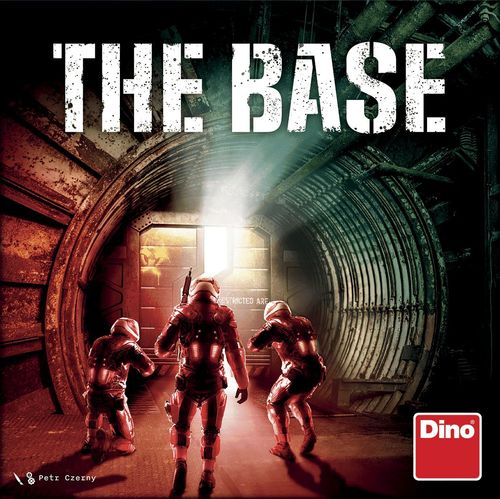
The Base
The Base Rulebook
Table of Contents
Table of Contents
Game Contents
- 25 board tiles (referred to as tiles)
- 10 tiles of starting slots
- 6 wooden pieces with stickers in two different colours (3 pieces each)
- 1 two-piece countdown board
- 1 countdown token
- 4 bonus tokens (+1)
Goal of the Game
The goal is to get all your three pieces to the other side of the Base before the opponent does. A piece is considered to have achieved the final position once it reaches any of the opponent's starting slots.
Time is limited to 20 rounds. After this period, the Base explodes. If none of the players manages to save all their pieces before the time runs up, the one with the higher number of saved pieces is the winner.
Game Setting
- Put the double-sided tile with four exit points in the middle of the gaming area.
- Shuffle the remaining tiles and put them face-down to form a 5 by 5 grid (with the central tile in the middle). Leave some space between the tiles for easier manipulation. Now the Base is ready.
- The players choose or draw a unit and take their three pieces representing its members. Before the first game, complete the pieces with the stickers – red for explorers, green for mutants.
- The player controlling explorers (red pieces) takes and shuffles all their 5 red starting slots. Then they place them face-up, lined by the edge of the board. These are the starting slots for their team members. The Mutant-side player follows the same instruction on the other side of the Base using the green starting slots.
- Place your pieces in the numbered starting slots so that the numbers of the pieces and starting slots match. The remaining (unnumbered) starting slots are empty.
- Prepare the countdown board and place the countdown token on number 20.
- Reveal the 3 tiles neighbouring with the occupied starting slots (the pieces can see the room they are entering). Tiles can be oriented as wished, with the condition that their entrance is directed towards the starting slots.
- Prepare the bonus tokens and keep them at hand.
How to Play
-
The mutant-controlling player starts the game. Players take turns.
-
Each player can use 3 actions in their turn. There are two types of actions: a) Moving pieces b) Manipulating the tiles
In their turn, the player can combine both action types as needed. Moving a piece is not compulsory within a turn. The player needs to use up all three actions, with the exception of a situation where such a thing is impossible due to the circumstances (see Locking a piece).
-
Once the opponent finishes all their three actions, the round is up. Reduce the remaining time by moving the token one time unit down.
It is recommended that the second player controls the countdown. Once they finish their turn, they end the current and start the following round by moving the time countdown token one step down.
The starting slots are not fields of free move. Pieces cannot switch between them directly. The only move allowed is a move from or to the neighbouring position (one of the Base tiles). Starting slots cannot be re-positioned or otherwise manipulated.
Moving Pieces
One action can be used to move one piece by one position.
- It is only possible to move across the revealed tiles and starting slots.
- A neighbouring tile can be accessed only if both the tiles are connected with a passage at the relevant edge of each particular tile. This rule includes the starting slot tiles. If the tile you intend to enter is oriented with a wall towards the piece, the player must use one of their actions to rotate the target tile with a passage towards the piece (see Manipulating the Tiles).
- Only a single piece can be placed on the initial and the target tile.
- Each tile can only contain up to one single piece at a moment.
- A tile can be crossed only if another piece belonging to the same unit is placed there. The target tile needs to be empty (free of other pieces) and rotated with the passage towards the entering piece. For conflicting situations, see Eliminating Pieces.
- Any piece which has left its starting slot can enter any other of the team's starting slots, following the rules described above (it can be a necessity to unblock a tile before rotating it) and free the slot again within a next action or turn.
- If a piece gets to the target line (one of the opponent's starting slots), it is out of danger but cannot move out of the particular slot any more.
Mutants' starting slots are explorers' target positions and vice versa.
Manipulating the Tiles
Manipulating tiles is a key action. Players need to get familiar with the tiles and plan their actions with respect to their current and their possible position to succeed in this game.
There are two options of how to manipulate the tiles, each consuming one action:
- Reveal a tile
- Rotate a revealed tile
Manipulation starts with revealing the tile, i.e. turning the tile face up. Unrevealed tiles cannot be manipulated.
Tiles can only be flipped horizontally or vertically. The player cannot adapt the position or orientation.
Once revealed, the tile stays so until further manipulated.
Each tile has a yellow edge. A full line represents a wall while an interrupted line represents a passage.
- Players can only manipulate (including revelation) such tiles which are connected to at least one of their pieces with a passage. It is not allowed to manipulate a neighbouring tile which is hidden behind a wall on the tile the piece is placed on. Orientation of the manipulated tile is not important. It does not matter whether it neighbours the occupied tile with a passage or a wall.
- Tiles can never be manipulated if there is any piece placed on it.
- Tiles can never be moved. They can be only flipped or rotated.
- It is possible to use one action to rotate it in any way (by 90°, 180° or 270°).
Tip: The strategy is to rotate the tiles to open your way to get your pieces to target positions and to block your opponent's way. Cleverly rotated tiles make the opponent's way more difficult or even temporarily impossible.
Tiles which are rotated in a way which disables your opponent from accessing it and there is also your piece placed on them are, technically speaking, locked and cannot be manipulated. Although it will certainly get unlocked later in the game, a temporarily locked tile can represent an annoying obstacle!
Eliminating Pieces
It is very rare to have the chance to transport one's pieces across the Base peacefully, without any fight. Players mutually intervene in the other's plans, block each other's way and make their opponent's life harder. Sooner or later, there will be a situation where fight is unavoidable and the passage must be won in a battle.
If a player is currently taking their turn and any of their pieces is up to three tiles far, not hindered by walls, is an immediate threat.
In their turn, the player can attack and eliminate opponent's pieces by entering the same tile within one of the three actions. Pieces are eliminated automatically upon entering the tile, no extra action is needed. If a piece is placed nearer than three tiles away, it can eliminate the piece 'on the go' and continue moving in any direction, including turning back.
Eliminated pieces are placed back on the starting slot with the corresponding number and is ready for the game again.
If the corresponding starting slot is occupied by another piece (either opponent's or their own), the eliminated piece is placed on an unnumbered starting slot closest to the original position. If two slots meet this condition, the player can choose. If there is no unnumbered slot free, the piece is placed on a numbered slot originally reserved for a piece which has already reached the target. If this condition cannot be met either, the piece is placed on any starting slot of the player's will.
Note: Eliminating pieces is part of the strategy how to advance or how to block the opponent. There are no points or other bonuses.
Tip: Sometimes, in the name of revenge, fierce battles can be seen around the Base, while the countdown is running mercilessly. Don't forget your goal – to transport all your pieces to your safe zone.
Guarding Pieces
A piece guards another piece if it is not further than three tiles from it. A piece can guard another piece from the starting slot.
Pieces are guarded by other pieces of the same team if it is close enough, reachable within one turn. Guarding is actually a threat to the opponent. If they dare eliminate a guarded piece, they are risking to get eliminated themselves in the upcoming opponent's turn.
Tip: It is recommended to advance carefully and use as much guarding for your pieces as possible. Fast advancing lonely pieces can become easy prey and get sent back to its starting position effortlessly.
There is a situation where a piece is self-guarded. This happens in any distance up to three from its starting slot. If the piece gets eliminated and the opponent's piece stays unprotected within the reach from the eliminated piece's starting slot, it can be easily eliminated back right away.
Locking a Piece
An eliminated piece can be blocked in its starting position by a wall on its neighbouring tile and another piece placed there. There are no options for a locked piece. It is necessary to get the tile unblocked first. It is recommended to keep this in mind, as such a situation is a major tactical advantage for the opponent.
If all the other pieces of the player have already reached their target position and the remaining piece is blocked by the opponent, it is necessary to pass the turn without any action used. The opponent can continue playing as wished. The player must wait for the opponent to unlock the tile.
If a piece gets locked inside the Base by opponent's pieces, the same rule applies.
Countdown
The countdown board with the token keeps record of the auto-destruction mode of the Base. The countdown gets running at the beginning of the game and it cannot be stopped, only extended.
At the beginning of the game, the token is placed on number 20. After each round, move the token one step down towards zero.
If one of the players manages to transport their pieces to their target positions, they win the game and the countdown is stopped unless the remaining player wants to try to finish their mission (see Time Challenge).
If the token gets to zero, the game is over (see End of Game).
The countdown can be extended by using the '+1' bonus token (see Bonus Actions).
The countdown token does not stop moving down towards zero!
Bonus Actions
Upon reaching the goal with any of their pieces, the player is given a '+1' bonus token. The player takes the bonus token and keeps it. This token can be used at the beginning of any following turn (not in their actual turn) by using one of the bonus actions available.
Types of bonus actions:
- The player can use one extra action. In the turn they decide to use the token, the player can use four actions instead of the basic number of three. It is, of course, possible to use two tokens in a single turn to get five actions.
- The player moves the countdown token on the counter one number up, towards twenty.
Each player can get up to two bonus tokens during the game. Once they place their third piece in its target position, the game is over.
The token is discarded when used for a bonus action.
Bonus actions may have the winning factor so it is recommended to use them wisely. Bonus tokens can be used separately or within a single turn and the bonus actions chosen can be combined as wished (an extra action or/and time countdown extension). If the time is extended, the token is moved one step down towards zero at the end of the round anyway.
Tip: If your opponent has a bonus token, keep in mind their extended options within every turn. This might be a bit more demanding for planning and choosing the best strategy.
End of Game
The game may end in several ways. It ends immediately in any of the variants:
-
One of the players has managed to get all their pieces to the target positions.
The struggle is over. Everybody on the team has made it to the exit section at the other side of the Base. Everything behind them is in blaze. The fire is devouring those who didn't make it in time.
-
The countdown is over. The time token has reached zero. The player with higher number of their pieces in their target zone is the winner. If there is a match, the player with their remaining piece closer to the target position is the winner.
The distance from the target position is calculated from their current position in the base. A piece placed in the first column from the target line is closer than a piece in the second, third, etc. Number of columns is now the key, not the number of actions possibly needed for reaching a target position.
If there are two pieces remaining for every player, the position of the further piece is the key. This means that even if one of the player's pieces is just close to its target position, the player loses the game if the other is the furthest from their goal in the entire game.
Those who managed to reach the exit area in time can hear noise echoing in the corridors – shouting and heavy footsteps of the others, those who cannot make it. The time is up. The survivors leave the Base perimeter last minute, running into dark tunnels, out of the explosion's reach. A brief flash saved those left behind from further suffering.
-
If the number of columns between their further remaining pieces and their target position is equal, the game is tied.
Time Challenge
If the game was ended regularly by the victory of one of the players and there are still some numbers left in the countdown, the losing player can decide to finish the game in the 'Time Challenge' mode, i.e. to save their pieces from destruction. After every turn (a sequence of three actions) the token is moved down by one. The player can get no bonus tokens any more. If they manage to leave the Base with all members of their unit before the counter reaches zero, they save the team's lives and escape the fatal explosion.
Just a fraction of time back the last remaining living creature has left the Base. The Base is motionless and abandoned. Everybody is making their way deeper underground to get safe from the blazing explosion. But there is no explosion. Once the last remaining living creature left, the countdown ceased. The lights went out and the Base sank back into its long, still silence.
Good luck and enjoy the game!