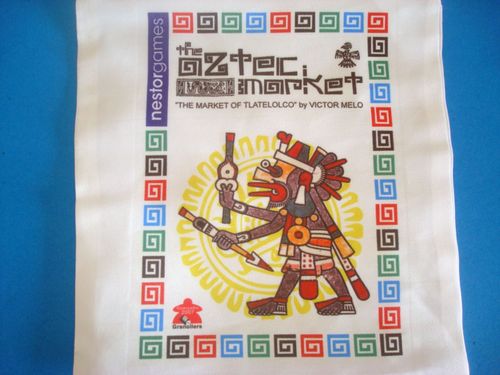
The Aztec Market
The Aztec Market Rulebook
Table of Contents
Table of Contents
Introduction
The Aztec Market is a partnership game for four players, in which the members of each partnership should sit facing one another. It can also be played with two or three players. In a two-player game, you should sit beside each other (not facing one another). In a three-player game, players can sit wherever they like.
Components
The Aztec Market includes:
- 15 market tiles: 4 vendors (black, blue, red, and green), 4 crowds, 2 porters, 2 governors, 1 ambassador, 1 messenger (greys), and 1 king (multicolor).
- 16 buyer tiles (brown).
- 1 bag for the commodities and to protect the game.
- 80 commodity tokens: 20 in each color (black, blue, red, and green).
- 16 coins (grey money).
- 1 start player marker (yellow).
Preparation
Market tiles: These are the individuals that are usually encountered at the market (all the tiles except the brown border).
Starting with any player and continuing clockwise, each player places a market tile anywhere in the market, such that the market will comprise a 4 by 4 square, with a hole. (This 4x4 array of tiles is the market.)
Buyer tiles: These are the buyers, who seek commodities at a good price.
Each player has four buyer tiles on her side of the table, one in each column of the market.
Coins: These are the money used to pay for the commodities the buyers purchase.
Place all the coins somewhere accessible to all the players. (This is the money supply.) Each player takes a coin from the supply and puts it on one of her buyer tiles.
Commodities tokens: These are the commodities sold in the market of Tlatelolco: jewels (red), fabric (blue), pottery (black), herbs (green).
Put all the commodity tokens in the game bag that doubles as the commodities supply. Without looking, remove 4 commodities from the supply and set them aside, out of sight. If you want a shorter game, remove more commodities (always a multiple of 4). If you don't want any randomness, remove the same number of each color of commodity, or don't remove any at all.
Gameplay
Give any player (the youngest, for example) the start player marker. The other players will take their turn in clockwise order. On your turn, choose one of the following options: Pass or play.
Pass
Execute the following steps in order:
-
Replenish commodities: The vendors are obsessed with having the best commodities each day.
You must draw 4 random commodity tokens from the bag. Each one must go on the vendor tile of the corresponding color. A vendor can only have tokens that match its tile's color. Important: When there are no tokens left in the bag, you don't perform this step.
-
Move the market: The market of Tlatelolco is different each day.
You must move two market tiles. In order to move a tile, take any tile from the marketplace and move it to the hole in the market.
-
Obtain money: A buyer without money has nothing to do.
You must take a coin from the money supply and place it on one of your buyer tiles. A buyer tile can only have one coin on it. Important: If you already have coins on all four of your buyer tiles, you don't perform this step.
-
Utilize the king: The king satisfies his cravings at his whim.
If there are any vendor tiles with one or more commodity tokens on them in the same row or column as the king, then you may choose a total of one such token and place it on the king's tile. The king can have any number of commodity tokens on him, even of different types. Important: Crowds do not impede your ability to transfer a token to the king in this fashion.
Play
Take the following actions in any order or quantity you like:
1. Move the market (optional)
You may spend one or more of your buyers' coins in order to move the same number of market tiles. In order to move a tile, take any tile from the marketplace and move it to the hole in the market. Return the spent coins to the money supply.
Messenger: The messenger tile can be moved as many times as you like during this phase without spending money.
2. Buy commodities
You must use one or more of your buyers with money to buy commodities from the vendors. A buyer can't buy if it doesn't have a coin on its tile. In order to make the purchase, take all the commodity tokens from the vendor's tile, and place them on the tile of the buyer that made the purchase. For each purchase (but not for each commodity) return one coin from the corresponding buyer's tile to the supply.
In order to purchase commodities, the following conditions must be met:
- The buyer's tile must have a coin.
- The buyer must be in the same column as the vendor.
- The buyer must be empty or have commodity tokens of the same color as the vendor's tile. Two or more buyers belonging to the same player could buy commodity tokens of the same color.
- There can't be any crowd tiles between the buyer and the vendor.
The following could occur during a purchase:
- There is a porter tile between the buyer and the vendor: The porter returns one of the purchased commodities to the vendor's tile.
- There is a governor tile between the buyer and the vendor: The governor puts one of the purchased commodities on the king's tile.
- There is an ambassador tile between the buyer and the vendor: Don't return the coin to the reserve (although the buyer must still have one in order to make the purchase).
End of the Game
The game ends when the player to the right of the start player finishes her turn and there are no commodity tokens remaining in the supply. Each partnership evaluates their score as follows: For each color of commodities, the player with more tokens of that type of commodity multiplies the number she has on her buyer tiles by the number of that type that the king has. When the king has none of a commodity, you get no points for it. The partnership with the highest total wins. In the event of a tie, the partnership of the player with more coins wins. If the tie persists, the partnership of the player with more commodity tokens wins. With two or three players, the winner is the individual with the highest total.
Example: Yolanda and Victor are playing against Laura and Raquel. The following table shows the commodities obtained by each player (and in parentheses, the points earned). When there's an asterisk beside 0 points, it is because the player's partner has more commodities of that color, which means only the partner's score points. Yolanda and Victor amassed 53 points, while Laura and Raquel scored 60, winning the game.
| Black | Blue | Red | Green | Total | |
|---|---|---|---|---|---|
| Yolanda | 9 (18) | 0 (0) | 0 (0) | 6 (6) | 15 (24) |
| Victor | 5 (0*) | 5 (20) | 3 (9) | 0 (0) | 13 (29) |
| Laura | 3 (6) | 6 (24) | 4 (0*) | 4 (0*) | 17 (30) |
| Raquel | 0 (0) | 0 (0) | 8 (24) | 6 (6) | 14 (30) |