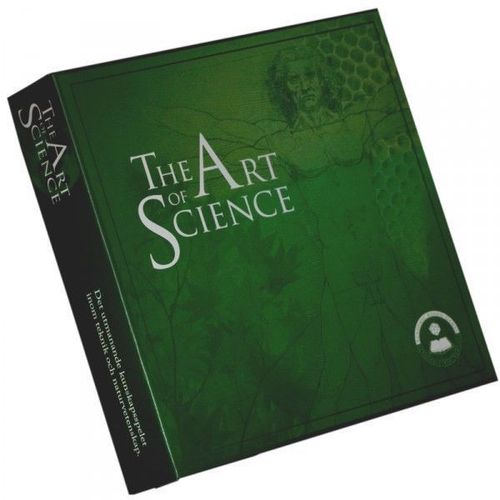
The Art of Science
The Art of Science Rulebook
Table of Contents
Table of Contents
Preparation
The players start by agreeing on the game length: short, medium or long. Note that a game with many players takes longer, but time also passes faster when everyone is having fun.
Each player (or team) then receives a score card. The six question categories (Mathematics, Biology, Chemistry, Physics, Engineering and Other Science) are written on the score card in the order each player chooses.
Finally, the player who will start is chosen. The tradition is that the player with the most university credits (högskolepoäng) sits last in the turn order. Players may also use random methods such as rolling a die, using a random number from the nearest formula book, or drawing lots. Whatever the method, the players take turns placing their pieces on any square of the board (but not on a special square). The square a piece is placed on determines the first question for that player.
The turn order runs counterclockwise (motsols, if you live in the northern hemisphere).
Game Length
- Long: 42 points, about 90 minutes
- Medium: 30 points, about 60 minutes
- Short: 20 points, about 30 minutes
Course of Play
Each round (except the first) begins with the player rolling the die and moving their piece as many steps as the die shows. The player then receives a question from the category shown on the square they landed on (or acts according to the rules for a special square, if that is what they landed on).
If the player answers correctly, they receive as many points as the square shows in the current category, or take a new round (that is, roll and get a new question). If the player answers incorrectly, their turn passes to the next player.
Filling Categories and Winning the Game
Certain actions in the game can cause a player to lose points or move points between categories. Points can never be moved or lost from a category that has been filled. A filled category is locked, which is marked on the score card (see the example on the source page, which shows a medium-length game).
The game is won by filling all of one's categories. (In a long game, this also means reaching the answer to life, the universe and everything.)
Pencils are recommended, since you may lose points and have to erase them from the card. If your score cards run out, they can be downloaded for printing from the publisher's website.
Special Squares
Universal Genius (Universalgeni): Choose a category and answer one question within it. A correct answer gives three points, which you distribute as you wish among your categories.
Duel (Duell): Choose a duel opponent and a number of points to duel for. This may be at most as many points as you have in your unlocked categories (you cannot duel if you have nothing to lose). The opponent then chooses the question category. The first player to answer correctly wins the duel, but each player (or team) may give only one answer. The winner distributes the points freely among their categories, and the loser must strike out the same number of points (also freely chosen from among their unlocked categories). If both players answer incorrectly, the turn passes on without any points being moved.
Replication Chance (Replikationschans): Determine the question category by rolling a die and reading the table beside it. Then choose a number of points to wager, freely chosen but no more than the total you have in your unlocked categories. If you answer correctly, you receive the same number of points, which you distribute freely among your categories. If you answer incorrectly, you lose the wagered points. If your score card is empty, you wager three points and cannot lose any points on this occasion.
Turnabout (Omslag): Roll the die again and move on.
Suggested Extra Rules
Feel free to play with one or more of these extra rules, or design your own!
• Advice (Rådgivning): If you wish, you may ask an opponent for help when you cannot answer a question. If you answer correctly, you share the points equally, where half points are rounded in your opponent's favour (avrundas till din nackdel, that is, rounded against you). Advice is not allowed on special squares.
• Relativistic shove (Relativistisk stöt): If you land on the same square as an opponent, you may push them to any square on the board. This movement replaces the opponent's next die roll.
• Winning spree: Each time you answer a question correctly, you receive both the points and the right to keep rolling the die for a new round.