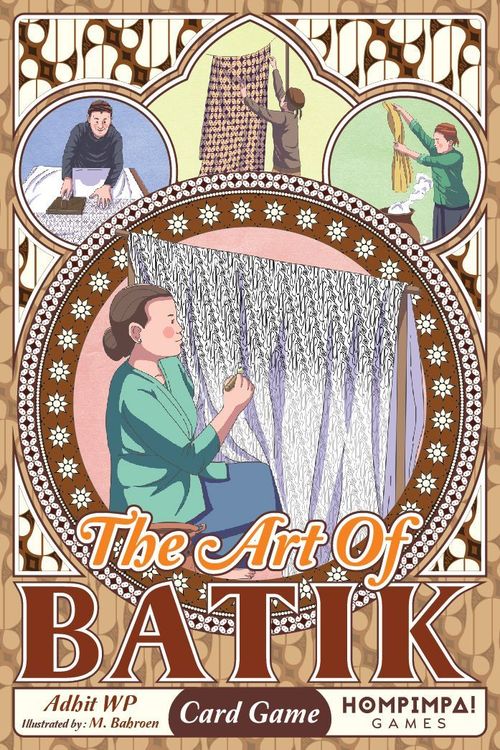
The Art of Batik
The Art of Batik Rulebook
Table of Contents
Table of Contents
Game Components
- 1 Scoring Board
- 2 Rulebooks (Indonesian and English)
- 36 Market Cards
- 2 Drying Cards
- 9 Designer Cards
- 4 Batik Training Cards
- 4 Player Reference Cards
- 16 Batik Process Cards
- 52 Player Markers (13 per player colour)
Advance Module:
- 16 Customer Cards
- 4 Timer Cards
Anatomy of the Cards
Batik Training Card
Labelled parts of the card: Player Reference, Move Back Effect, Batik Name, Single Slot Process, Skill Cost, Rewards Upon Completion, and Time Slot for Advance Game.
Batik Process Card
Labelled parts of the card: Batik Name, Double Slot Process, Single Slot Process, Ingredient Cost, Skill Cost, Rewards Upon Completion, and Reward When Two Slots Are Filled on the Same Turn.
Market Card
A Market Card is used as either a Worker Card (in the Open Market) or an Ingredient Card (in a hand).
- Ingredient: shows a Resource Icon.
- Worker: shows a Skill Icon and a Free Action Icon.
Designer Card
A Designer Card is labelled with its Reward When Filled, its Single Slot Process, its Skill Icon, its Card Effect (which affects the Batik Card attached to it), and its Cover Up Space (the part that is attached to the Batik Card).
Setup
a. Give 1 Batik Training Card, 1 Player Reference Card and 13 Tokens with matching colour to each player.
b. Put one of each player's Tokens in the Start slot on their Batik Training Card.
c. Put one of each player's Tokens on the Scoring Board on the 0 slot, and put an additional token on the 0+ slot. (Now each player only has 10 tokens available on their side.)
d. Shuffle all the Market Cards, then give each player 4 Cards.
e. Open another 4 Cards to form an Open Market, then put the rest of the Market Cards face down beside them to form a Closed Market Deck.
f. Put Drying Card(s) beside the Open Market row based on: 1 Card for 2-3 Players, 2 Cards for 4 Players.
g. Shuffle all the Designer Cards and put them face down beside the Closed Market Deck.
h. Shuffle all the Batik Process Cards, then take 2 Cards for 2-3 Players, or 3 Cards for 4 Players, and flip them open on the table to form the Batik Workshop. Put the rest beside them face down.
i. Pick the first player by age (the youngest player starts first) or by the player who wears any batik attire. Then the game is ready to begin.
(The printed setup diagram shows the layout for a 4-player game, with lettered markers a to j that correspond to the steps above.)
How to Play
On your turn, do the following steps:
a. Open a new Batik Process Card to the Workshop if it is not in full capacity (2 for 2-3 players, and 3 for 4 players). If you open a Batik Process Card that needs a Designer Card, then additionally you must take the topmost Designer Card from its deck and attach it to the left of that Batik Process Card.
b. Do one Basic Action from the following actions:
- Draw Card(s).
- Work on a Batik Process / Batik Training Card and do the Free Action.
- Work on a Batik Process Card by moving back one step on your Batik Training Card.
c. End your turn. Play continues clockwise to the next player.
Basic Actions
A. Draw Card(s)
Draw a Card from the Open or Closed Market, or draw 3 if you have no Card in your hand. Every 1 card on the Open Market that has been drawn by a player is replaced immediately with a new card from the Closed Market.
(The action-choice diagram on the printed page notes: hand limit is 7 Cards at the end of a turn.)
B. Working on a Batik Training / Batik Process Card and Do the Free Action
Make sure you have the ingredient(s) needed as indicated in a slot on a Batik Process or Batik Training Card. Then pick one worker from the Open Market that has the skill needed for that slot, discard them, then put your player token on that slot. You may do the Free Action as indicated on that Worker Card afterwards.
Batik processes are worked from Start to Finish, and every process must not be skipped (unless a Designer Card attached to it says otherwise).
Note: When you are working on a Batik Process Card, put your unused player Token. But if you are working on your Batik Training Card, you move forward your existing player token instead.
(Diagrams on the printed page show the Start slot, the slots of a Batik Process Card, and a Batik Training Card.)
Scoring when the last slot is filled. When you fill the last slot on a Batik Process Card, the scoring phase happens:
- Give reward to each player that has been working on that Batik Process Card, based on the majority of their tokens. The reward for each rank is printed on that Batik Process Card.
- In case of a tie, the player who has a token in the leftmost slot of the process (the player who started first) gets the reward.
- Then return all of the tokens to their owners.
- Put the completed Batik Process Card above (or in any available space beside) the Open Market Space to indicate the finished Batik toward the end game.
(The printed example, a Batik Cap - Kawung Pattern card, shows rewards of 2, 3 and 6 for the three ranks. In a 3-player game the Purple player gets the First reward and the Cream player the Second. In a 4-player game the Yellow player gets the Third reward.)
When your token reaches the last slot on your Batik Training Card, get one of the available rewards printed on the Card, then move your token back to the Start slot. On the next turn, you can work again on your Batik Training Card from the Start.
C. Working on a Batik Process Card by Moving Back Your Batik Training Card
(The printed heading for this action reads "B. Working on a batik process card". It is basic action c in the How to Play list above and is labelled as such here.)
In this action, you can move back your token on your Batik Training Card one step to get the printed skill. You still need to pay the required ingredients from your hand to do this action and put your player marker on that slot.
- By moving back your token, you got the depicted Skill.
- Then by discarding the required ingredients, you can work on a Batik Process Card.
- Place your token on that slot.
End Game
The game ends immediately after the fifth Batik Process Card has finished.
For every player token on an unfinished Batik Process Card, that player gets 1 VP each.
The player with the most points is the winner. In case of a tie, they share the victory.
Advance Game
This Advance mode is recommended for a player who has tried the Base Game or wants a more challenging experience.
When setting up the game, do the same as the base game with the following additions:
a. Each player uses 1 of their player tokens as a Timer token, and puts it on the Batik Training Card's Advance slot.
b. Each player's Victory Points start at 10 points.
c. Prepare the Customer Cards and Timer Cards on the side of the Workshop.
d. For the setup, the Batik Process Cards must all be Batik Cap (orange background).
e. Whenever you open a new Batik Process Card (including in the setup), also take 1 Customer Card from the deck and attach it to that Batik Process Card.
f. If the Customer has a timer icon, get the Timer Card and attach it to that Customer Card, and take the current player's Timer Token (or the next player's) and put it in the slot on the Timer Card as indicated on the Customer Card.
g. When a Batik Process Card has been completed, whether it is Finished or Failed (because of the time limit), instead of putting that Batik Process Card as the indicator of the finished Batik, put the Customer Card attached to that Batik Process Card in a row above the Open Market Cards to form the Completed Customer Card row.
Turn Order in the Advance Game
On your turn, do the following steps:
-
Move down your Timer Token on one of the Customer Cards if available. You shall not move down your Timer Token if it has just been deployed this turn. If the time marker is already on the 0 spot, discard the Batik Process Card and put its Customer Card in the Completed Customer Card row upside down, and apply its penalty effect.
-
Open a new Batik Process Card to the Workshop if it is not in full capacity. The capacity of the Workshop is the same as the base game at the beginning of the round, but it can be modified by the completed Customer Cards while in the game.
-
Open a new Customer Card, then attach it to that Batik Process Card. If the Customer Card has a Time icon, additionally take a Timer Card and put it on the left of that Customer Card, then put your player timer token on the designated time slot based on that Customer Card. If your Timer token is already on another Customer Card in the Workshop, then put the next player's Timer token instead (and so on).
-
Do 1 Basic Action (see the Basic Action section for detail). If the Batik Process Card is finished on this step, the rewards are given to the players based on the reward printed on that card AND the reward printed on the Customer Card attached to that card. If players failed to finish a Batik Process Card within the time limit, you have to put its Failed Customer Card upside down in the Completed Customer Card row to differentiate it from the Finished one.
-
Do 1 of the Available Bonus Actions. Bonus Actions are available after you complete certain Customer Cards. If there is more than one completed Customer Card that has a Bonus Action, you can only pick and use one of them each turn.
-
End your turn. Play continues clockwise to the next player.
Completed Customer Card Row
The printed diagram shows a Completed Customer Card row with four cards labelled Finished, Finished, Failed and Finished. One Customer Card in the row shows its Active Bonus Action and effect.
End Game for the Advance Game
The game ends immediately after the fifth finished Customer Card, or the seventh Customer Card has been put in the Completed Customer Card row.
For every player token on an unfinished Batik Process Card, that player gets 1 VP each.
The player with the most points is the winner. In case of a tie, they share the victory.
2-Player Variant
(Printed heading: "Variasi 2 Pemain".)
Give each player tokens from 2 player colours and 3 random Batik Process Cards from 3 different types (Cap, Tulis, and Kombinasi). The flow of the game is still the same as the Basic game, only that now each player has their own Batik Process Cards and cannot put their token on their opponent's.
The game ends when one player manages to complete all of their Batik Process Cards.
Glossary
- Nyorek: a process of making a pattern on fabric.
- Ngecap: a process of applying wax to fabric with a batik stamp as the main tool.
- Ngelir: a process of colouring the waxed fabric by dyeing.
- Nglorod: a process of releasing wax from the fabric with boiling water.
- Njemur: a process of drying the fabric with the help of sunray.
- Nglowong: a process of applying wax to a batik pattern frame using a Canting (a pen-like tool).
- Nemboki: a process of applying wax using a Canting on a specific place so that the colour of the fabric will not be changed later.
- Isen-isen: a process of applying wax using a Canting in the space that has a small line or circle pattern, so that the colour of the fabric will not be changed after being washed away. This small pattern is an ornament to fill in the big pattern.
- Nitik: a process of applying wax using a Canting in the space that has a dot pattern.
- Fiksasi: a process of locking colours in fabrics, so they will not fade when washed with water.