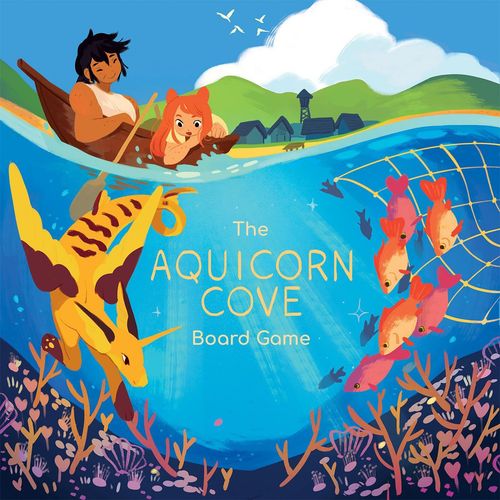
The Aquicorn Cove Board Game
The Aquicorn Cove Board Game Rulebook
Table of Contents
Table of Contents
Components
- 1 Game Board
- 1 Fishing Bag
- 1 Fishing Boat
- 4 Boat tiles
- 16 Fish
- 3 Empty Nets
- 4 Aquicorns (tiles)
- 15 Pollution tiles
- 16 Building tiles
- Food Tokens (20 Small / 10 Large)
- Building Supply Tokens (6 Small / 4 Large)
- 3 Aquicorn Meeples
- 4 Storm Dice
- 4 Player Aid cards
- 9 Event cards
- 40 Character cards
- 28 Villager cards
- 9 Aquicorn cards
Setup
- Place the game board in the center of the table. Place three food in the Village supply, and the remaining resources next to the board.
- Cover four spaces in the Boat with the four Boat tiles.
- Place the North and South Village Building tiles, damaged side up, on their indicated starting locations. (In a 2- or 3-player game, flip the North Village to its intact side.)
- Shuffle the Building tile stack, draw the top three, and place them next to the stack. These three, and the top Building, form the market.
- Put all Fish tiles, Empty Net tiles, and one Aquicorn tile into the Fishing Bag. Place the remaining Aquicorn tiles in the bay.
- Place the Pollution tiles next to the board. Put 1-3 Pollution tiles into the Fishing Bag, depending on the difficulty level desired for the game (1 is the easiest; 2 is medium; 3 is the most difficult).
- Put one Aquicorn meeple each on the "Start" positions of the Season, Reef Health and Village Prosperity tracks.
- Shuffle the Event, Aquicorn, and Villager decks and place them next to the game board.
- Each player chooses a character and takes their Player Aid card and Starting deck, shuffles it, and draws three cards. (In a 2-player game, shuffle the unused Starting decks together to create a Helper deck.)
- The first Head Fisher is the most recent player to have helped an Aquicorn (or any other creature). They take the Fishing Bag and Boat.
Gameplay Overview
A game of Aquicorn Cove consists of two years and an Epilogue. Each year has three rounds of play representing the Spring, Summer, and Fall, followed by a Winter storm. Each round, you work together to catch fish, plant food, build the town, and restore the reef. The Epilogue is a special final round of play.
A round is composed of seven phases:
- REVEAL EVENT & CHOOSE CHARACTER CARDS.
- VILLAGE FISHING. The Head Fisher draws tiles from the Fishing Bag until the Boat is full or they choose to stop.
- GATHER & CLEAN. If the bay is free of pollution at the end of this phase, increase the reef health and return an Aquicorn to the Bag.
- FARMING. Players plant food and add the Season bonus.
- VILLAGE. If it is Fall, harvest the Farm. Players must spend food equal to the number on the Village Prosperity track to feed the Village.
- BUILDING. Players build or repair Buildings to increase the Village Prosperity.
- END OF ROUND. Buildings produce income, each player draws a card, and excess food is lost.
1. Reveal Event & Choose Character Cards
Reveal Event
Draw the top card from the Event deck. If the Event has a Pollution number, put that number of Pollution tiles from the bay into the Bag. If there are less than the indicated number of Pollution tiles in the bay, put as many as you can into the Bag.
Then place the Event card on the Action Track, in the phase shown on the card. The rest of the Event will be resolved at that time.
Event card anatomy: Card Name, Phase Number, Pollution number (how much Pollution seeps from the bay into the Fishing Bag), Event Card Icon. Example — Village Feast: Spend 4 Food to gain 1 Prosperity. If you don't, lose 1 Prosperity.
Choose Character Cards
Each player chooses a card from their hand to play, freely discussing it with other players. Each card has one or more Options showing what actions the character will take, and when they will happen during the turn.
In clockwise order, starting with the Head Fisher, each player places a card on the Action track in the phase matching the Option they would like to take. More than one card may be played to a phase.
Character card anatomy: Card Name, Option 1, Option 2, Action Icon, Number of times you do the action, Character.
Actions in a 2-Player Game: In a 2-player game, before actions are selected, the Head Fisher draws the top card from the Helper deck, chooses an Option, and places it in the corresponding space of the Action Track. This is the action the other villagers will take this round and the players can plan accordingly.
Taking Actions
In later phases, players will take their Actions from the card Option they chose earlier. Each Action is represented by an icon and a number. The icon tells you what to do, and the number tells you how many times to do it. Each action may also have a Pollution in the corner. If it does, add one Pollution to the bay. Note: You may always choose to skip an action.
- Cards in the Fishing phase can happen before or after Village Fishing.
- All phases are resolved, even if there are no cards played.
- When there are multiple cards in a phase, the players choose the order they want to take their actions in.
Example: Andrew chose the first option for his card, and placed it in the Farming phase. He will only take the action in that option. An Aquicorn card (Splash of Smiles: Gain +1 Food from each Tuna caught. Gain 1 Prosperity.) is resolved during the Building phase.
Food & Building Supplies
Food is needed to feed the Village, but may also be used to pay for Buildings. However, only 4 food may be stored between rounds, and any excess is lost.
Building Supplies may only be used to build Buildings, but the Village can store any number of them, and they are never lost.
Reef Health
The Reef Health track indicates the health of the ocean and how punishing the Winter storm will be.
Reef Health decreases when a Pollution tile is drawn from the Fishing Bag during Fishing.
Reef Health increases if the bay is free from Pollution at the end of the Gather & Clean phase, and from some Aquicorn and Player cards.
2. Village Fishing
The Fishing Bag: The Head Fisher draws Ocean tiles from the Fishing Bag until they choose to stop, or they have filled all the empty spaces on the Fishing Boat. Then the Village gains food equal to the total value of all the fish in the Boat.
Overfishing: If multiple fish of the same type are drawn, you've overfished. When returning fish to the Bag, only return one of each type of fish, and set the others aside; they are out of play for the rest of the game.
Example:
- Lana is the Head Fisher. Her first draw is a Tuna, which she places in the Boat.
- Her second draw is a Pollution. She places it in the bay and lowers the Reef Health by one.
- Her next three draws are Empty Nets, a Snapper, and another Tuna, and she places them in the Boat.
- She draws one more, and gets an Aquicorn! She draws an Aquicorn card, and places it onto the Action Track. Then she gently puts the Aquicorn tile in the bay.
- She decides to stop fishing and collects 7 food. She returns one of each type of Fish and all Empty Net tiles in the Boat to the Bag. The remaining Tuna is overfished, so she sets it aside, out of the game.
Ocean Tiles
- FISH: Place these on empty spaces in the Boat. You'll gain food for them at the end of the round.
- EMPTY NETS: Place this on an empty space in the Boat. It is worth no food.
- POLLUTION: Lower Reef Health by one, and place it in any empty space in the bay. Then, if either column in the bay is full, put that entire column into the Bag.
- AQUICORN: Draw an Aquicorn card and place it on the Action Track. Place the Aquicorn tile in the bay.
Aquicorns
Aquicorns are magical sea creatures that live in the reef with the wondrous Reef Guardian, Aure. Occasionally, they need our help and will seek out human boats.
Finding an Aquicorn: If you find an Aquicorn, it will grant the Village a magical boon. Draw an Aquicorn card from the deck and immediately place it on the Action Track in the space matching its phase number.
Returning an Aquicorn to the Sea: It is important to heal rescued Aquicorns and return them to the ocean. If you keep the Reef clean, your Aquicorns will heal, and return to the ocean.
Aquicorn card anatomy: Card Name, Phase Number, Main Effect, Aquicorn Card Icon. Example — Aure's Protection (phase 1): Discard this round's Event card, or gain 2 Food.
3. Gather and Clean
- Gather (food icon): Gain one food from the supply. Food may be used to feed the Village or spent to construct Buildings.
- Clean: Remove one Pollution tile from the bay and return it to the Pollution supply. If there is no Pollution in the bay, this action has no effect.
Reef Healing: At the end of the Gather and Clean phase, if there is no Pollution in the bay, increase Reef health by one and return one Aquicorn to the Bag (if there are any available).
4. Farming
- Plant: Plant one food from the supply in an empty farm space.
Season Bonus: If at least one player plants food, the Village plants bonus food as shown beneath their current location on the Season track. This bonus is only gained once, even if more than one player plants food.
5. Village
Harvest: Each Fall and during the Epilogue, the Village harvests the Farm. Take the food from the Farm and add it to the Village supply.
Feed Village: Players must feed the Village each round. The amount required to feed the entire Village is the number next to the current position on the Prosperity track. If the Village does not have enough food, they spend the food they have, and move the Aquicorn meeple down one on the Prosperity track.
6. Building
To help your Village recover and grow, you must repair existing Buildings and build new ones.
- Build (hammer): Choose one of the four available Buildings, pay its cost in food and/or Building Supplies, and place it in the Village, intact. OR Repair any damaged Building for free, and flip it to its intact side.
- Supply: Gain one Building Supply.
Building tile anatomy: Cost in food or Building Supplies, Matching fence and icon, Building Reward.
Placing a New Building
- Buildings may only be placed to the right of an intact Building or the shore.
- Buildings must be placed with their left fence connected to a fence of the same color.
- Buildings cannot be rotated (their tops should be closest to the top of the board).
After placing your Building, refill its space in the market with the top building from the stack.
NOTE: The top building space on the shore has a fence of two colors. A Building with either color of fence may be placed there.
What if no Buildings can be placed? At any time during Building, if none of the Buildings in the market can be legally placed, put all four on the bottom of the stack and refill the market.
Prosperity and Villager Cards
When a new Building is built, advance the Aquicorn meeple on the Village Prosperity track by one.
If the Aquicorn meeple moves onto a space showing a shell icon, each player draws one card from the Villager deck and places it on top of their Character deck, without looking at it.
NOTE: When a Building is damaged, you do not move down on the Prosperity track.
Example:
- The Village has finished feeding and has some food left, as well as some Building Supplies. Luckily, Mae and Florian played Build cards.
- Florian repairs the Lumber Mill (at no cost), gains one Building Supply for the Village, and adds one Pollution to the bay.
- Mae builds the Greenhouse for four resources. She chooses to spend three food and one Building Supply, since the Village can only store four food each round.
- Mae advances the Aquicorn once on the Prosperity track. It lands on a shell, so each player draws a Villager card and places it on top of their Character deck.
Building Rewards
In addition to increasing the Village Prosperity, each building grants either income, or an immediate reward.
- Buildings with income icons grant income each round (see End of Round).
- Buildings with the Boat icon allow you to remove a Boat tile from the Fishing Boat when they are built or repaired. However, when a Building with this icon is damaged, return the tile to the Fishing Boat.
7. End of Round
Collect Building Income: Collect rewards for each income icon on the left side of an intact Building.
Store Food: The Village may store up to 4 food for the next round, and must return the rest to the Supply.
Prepare for The Next Round:
- Discard all cards from the Action Track.
- Advance the Round Marker on the Seasons track.
- The Head Fisher passes the Fishing Bag and Boat to the player on their left.
- Each player draws a card from their deck.
Pollution
Managing Pollution is important for maintaining a healthy Reef. During the game, Pollution will move from the supply to the bay, and then to the Fishing Bag if it is ignored. Once it is in the Bag, you will not be able to Clean it until you find it during the Village Fishing phase.
Pollution in the Bay: The Pollution in the bay is divided into two columns.
- Whenever you add or remove Pollution tiles to or from the bay, you may choose either column.
- If, at any time, all three spaces of a column are full, immediately move all of its tiles to the Bag.
Pollution on Character Cards: Some Actions add 1 Pollution tile to the bay. You may always choose to skip an action.
Pollution in the Fishing Bag: When a Pollution tile is drawn from the Fishing Bag during Village Fishing, reduce the Reef Health by one and place the tile in the bay. If this fills a column in the bay, immediately put all Pollution from that column into the Fishing Bag.
Pollution on Events: Some Events have a Pollution number in the upper right corner, indicating how many tiles to put from the bay into the Fishing Bag.
Winter
After each Fall, there is a Winter storm. The Head Fisher rolls dice equal to the next number above the Aquicorn meeple on the Reef Track (how many dice to roll for the Storm).
Placing Storm Dice: For each die rolled, find the row with the yellow warning sign shown on the die. Place the die in that row, on the space closest to the shore that does not already have a die on it.
Storm Effects
After all dice have been placed, resolve the storm effect for each die.
- If there is no Building, remove the die with no effect.
- If the Building is intact, flip it to its damaged side. You do not move down on the Prosperity Track.
- If the Building is already damaged, add 2 Pollution to the bay. You do not move down on the Reef Health track.
Once the storm is resolved, advance the Season tracker to the next Season.
Example:
- The Village consults the Reef track and determines they must roll 3 Storm Dice.
- They roll two waves and a whirlpool and place the dice in the corresponding rows.
- They remove the die from the North Village and flip the tile to its damaged side.
- The second wave die didn't hit a Building, so has no effect.
- The whirlpool hit the South Village. It was already damaged, so they add two pollution to the bay.
Epilogue
The Epilogue is the final round of play. It is a quiet season in the aftermath of the final storm that allows you to rebuild the Village. During the Epilogue:
- The Farming bonus is +2.
- Players Harvest as they would in Fall.
- There is no Storm.
At the end of the Epilogue, the game ends.
Game End
Aquicorn Cove is a game about finding a balance between growing a thriving Village and keeping the ocean healthy and clean. In this game, your scores determine how your story ends, but not whether you win or lose.
To find the end of your story, first determine your final Prosperity and Reef Health, then read aloud the ending that matches your score from each.
Prosperity Score: Before scoring, reduce Prosperity by one for every two damaged Buildings, rounded up.
Reef Health Score: Before scoring, reduce Reef Health by 1 for every 3 Pollution in the Bag, rounded up. Then reduce it 1 for every 2 overfished Fish tiles rounded up (each tile counts, not each type of fish).
Prosperity
- 15-16: The Village has banded together to recover, and has built beautiful new homes and buildings. The Villagers can take pride in creating a community that will be strong for many generations.
- 13-14: The Village met the hardships of the storm headfirst and grew and blossomed. The Village is filled with old and new faces, all lit with hope and energy for the future.
- 11-12: The storms were strong, but the Village worked hard to recover and grow. Almost everyone who had left returned, and some brought new friends to the Village.
- 9-10: The Village recovered from the storm and rebuilt. The members of the Village were happy and some people who had left returned to their homes.
- 7-8: The Village was barely able to fish and grow enough food for everyone. There wasn't much, but people shared what they had and the Village survived.
- 5-6: The Village suffered from great hardships and was not able to provide for the residents. Many people were forced to move to the big cities to look for work.
Reef Health
(Each ending matches a weather symbol on the Reef Health track, from sunny at the top to the worst storm at the bottom.)
- Sun: The Reef is stronger than ever before. The Fish are jumping, the Aquicorns are happy and healthy, and the villagers have a greater understanding and appreciation of the sea.
- Cloud: The Reef and Fish populations have improved immensely. The Village is setting an example of how a balance between fishing and protecting nature is possible.
- Dark cloud: The Reef has prospered under the care of the villagers. They have learned to dedicate the same energy to caring for the reef as they have always dedicated to fishing.
- Rain: The Reef is damaged but the Village is now aware of the problem and can work to help the fish survive and to keep the Reef healthy.
- Heavy rain: Sadly, the Reef is severely damaged, but a few fish remain. With very careful stewardship, the Villagers may be able to protect it, but they will need to make some sacrifices to do so.
- Thunderstorm: Tragically, the Reef has been filled with pollutants. The fish have disappeared and the water is not even safe to swim in. Despite their efforts, the Villagers may not be able to sustain their way of life.
Icon Reference
- Add one food to the Farm.
- Gain one Building Supply.
- Remove one Pollution tile from the bay and return it to the supply.
- Remove a Boat tile from the Fishing Boat when built, or return a tile to the Boat when damaged.
- Connect to any Building.
- Gain one income of any type.
- Build or repair a Building.
- Add one food to the Village supply.
- Each player places a Villager card on top of their Character deck.