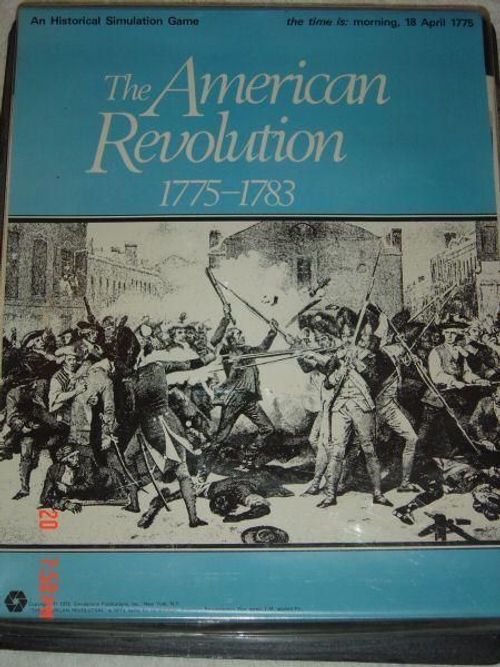
The American Revolution 1775-1783
The American Revolution 1775-1783 Rulebook
Table of Contents
Table of Contents
- Game Equipment
- Definition of Terms
- Game Charts and Tables
- Game Inventory
- Sequence of Play
- To Begin the Game
- Land Movement
- Sea Movement
- Combat
- Reinforcements and Additional Forces
- Irregular Forces
- Control and American Militia
- Supply
- Fortifications
- Major Success
- French Arrival
- Victory Conditions
- Variable Forces Options
- Option Compatibility Chart
- Option A. Additional British Mercenaries (+11)
- Option B. No British Mercenaries (-14)
- Option C. Prussia Attacks Hanover (-7)
- Option D. Increased British Effort in North America (+9)
- Option E. Increased French Effort in North America (-6)
- Option F. Stronger American Central Government (-21)
- Option G. Less Efficient Militia (+4)
- Option H. Better British Politics (+3)
- Option I. Irish Rebellion (-2)
- Variable Forces Victory Point Adjustment Summary
- Designer's Notes
- Errata and Addenda (SPI, as of 30 June 1973)
Game Equipment
The Game Map: The 17½" x 22" mapsheet depicts the eastern part of North America where the campaigns of the American Revolution were fought. Movement is governed by territorial divisions (called "Regions") roughly analogous to river drainage basins. Much of the western part of the map is Wilderness, which slows movement.
Solid boundary lines separate Regions. Regions are subdivided by broken lines into Movement Areas. Those Regions which are not subdivided are treated as one Movement Area, in entirety. Movement Areas are hereafter referred to as Areas; do not confuse Areas with Regions.
Coastal Areas have a Land Portion (for Combat Unit movement) and a Sea Portion (for Fleet Marker placement). Note that the eastern Virginia area is a Coastal Area. There are two types of basic terrain represented on the map: "clear" and "wilderness." (See: Terrain Effects Chart.)
Each Region has various characteristics represented by four (or fewer) coded numbers:
- Victory Point Value (shown as "8" in the sample Region).
- Continental Strength Point Allowance (shown as "c5").
- Militia Strength Point Allowance (shown as "m9").
- Tory Strength Point Allowance (shown as "t3").
-
Victory Point Value: the number of Victory Points awarded to the Player who controls the Region. (See: How to Win the Game; Victory Conditions.)
-
Continental Strength Point Allowance: the number of Continental Strength Points created in that Region when called for by the Continental Levy Chart. (See: Sequence of Play, Continental Levy Interphase.)
-
Militia Strength Point Allowance: the number of Militia Strength Points created when the British Player moves units into a Region. They may be placed in any Area in that Region, and may be divided up as long as all are placed.
-
Tory Strength Point Allowance: the number of Tory Strength Points created the first time the British Player moves into a given Region. They may be placed in any Area of that Region. They may be placed all in one Area, or divided up, so long as all are placed.
Some Regions have only a Victory Point Value; they cannot raise Strength Points of any kind. Three Regions are worth zero Victory Points; they are useful only for movement.
The Playing Pieces: Five different sets of playing pieces (henceforth known as "units") are supplied and identified on the die-cut counter sheet. There are two types of pieces: combat units representing the actual forces, and markers which indicate various game functions. The units are ahistorical, merely representing quantitative groupings of men and material engaged in the campaign. The special markers for each Player are Fleet, Fort, Besieging, and Tory Depletion markers.
Each Combat Unit has two pieces of information printed on it. The first is Combat Strength, the relative strength of a unit with regard to attack and defense, expressed in terms of Strength Points. The second is an identity letter-code which indicates which of the five different types of military unit is being represented.
Sample unit: a counter showing "2 M". The number is its Strength Points; the letter is its Type (Militia).
Each Combat Unit has a Movement Allowance, which is the maximum number of Areas a unit may move in one Game-Turn, subject to the Movement Rules, the Terrain Effects Chart, and special rules for Movement by Sea. The Movement Allowance is the SAME, five, for all Combat Units (it is therefore not printed on the playing pieces).
All Combat Units come in various denominations of Combat Strength. They are completely interchangeable within type, and act purely as quantitative representations. At any time, they may be broken down (without penalty) into smaller denominations, like making change with money. Additional Units may be brought into play in the proper amounts when called for by the Continental Levy Chart, Time Record/Reinforcement Chart, or such time as Militia or Tories are caused to appear in a particular Region.
Counter types (as printed on the counter sheet):
- British: British Regular (10 B); Tory (5 T).
- American: Continental (5 C); Militia (5 M).
- French: Regulars (10 F); Seasonal (5 SF).
- Non-combat markers: Fortified (x3); Besieging; Fleet (40); Tory Depletion (TD).
Definition of Terms
Combat Strength refers to the basic offensive and defensive value of a particular unit; this strength is composed of Combat (Strength) Points. Thus a unit with a Combat Strength of "5" has five Combat Points available.
Movement Allowance is the basic maximum number of Movement Areas which a unit may move during one Friendly Movement Phase. This allowance is composed of Movement Points; basically, a unit expends one Movement Point of its total Allowance to enter one Area. Wilderness Areas require more than one Movement Point to enter (See the Terrain Effects Chart). Since all Combat units have a Movement Allowance of "5," this information has not been printed on the counters (unlike most other games).
Game Charts and Tables
Various visual aids are provided for the Player to simplify and illustrate certain game functions. The Combat Results Table provides the method of resolving combat, and is fully explained where presented. The Terrain Effects Chart details the effects of terrain on movement and combat. The Turn-Record Chart lets Players know how far they have progressed in the game; this is integrated with the Reinforcement Chart, which gives the appropriate additional units that the British receive, depending on which scenario is being used. The Continental Levy Chart details the appearance of additional Continental units in the appropriate Interphase. The Winter Attrition Table shows the proportions of Continental Strength Points to be lost each Winter Game-Turn in the proper Interphase.
Game Inventory
Your copy of American Revolution should contain the following material:
- One Mapsheet
- One Rules Folder
- One set of die-cut counters
- One Die
If you are missing any game parts or if you have any questions concerning American Revolution, please write to the publisher. (The publisher's postal address is omitted here.)
Sequence of Play
The Game-Turn
American Revolution is played in Game-Turns. Each complete Game-Turn represents one season; Game-Turn 1 is Spring, 1775. There are four seasons (Game-Turns) each year, repeated year after year of the Game. Any reference in the rules to a particular season refers to that season in every year of the Game. A complete Game-Turn includes:
- The American Player-Turn (composed of four Phases)
- The British Player-Turn (composed of four Phases)
- Continental Levy Interphase
- Winter Attrition Interphase (applicable during Winter Game-Turns only!)
THE SEQUENCE OF PLAY is as follows:
American Player-Turn
-
American Movement Phase: the American Player moves his forces as desired within the restrictions of the Movement rules. Each individual Strength Point may be moved by land or sea in one Movement Phase, but not both. All land movement is completed before any sea movement.
-
American Overseas Reinforcement Phase: the French units are placed on the map if the French Arrival has been triggered in the course of the Game. (See: French Arrival.)
-
American Combat Phase: the American Player executes all attacks using his own units against British forces in the same Area. Attacks are allocated and resolved immediately in the order of the American Player's choice, before proceeding to another combat.
-
American Fortification Phase: the American Player may construct Forts or besiege British forts with units that have not been employed in any movement or combat in the current Game-Turn.
British Player-Turn
-
British Movement Phase: British Player attempts to move his forces in the same manner as the American in his Movement Phase.
-
British Overseas Reinforcement Phase: British Player places any additional units on the map as indicated by the Turn Record/Reinforcement Chart. In any one Game-Turn, all additional units must arrive in a single Coastal Area. They may not move further or construct Fortifications in the arriving Game-Turn. They may join existing Fortifications. They may have combat, if it is not a Winter Game-Turn.
-
British Combat Phase: British Player executes all attacks using his own units against American forces in the same Area. Attacks are allocated and resolved immediately in the order of the British Player's choice before proceeding to another combat.
-
British Fortification Phase: British Player may construct Forts or besiege American forts with units that have not been employed in any movement or combat in the current Game-Turn.
Continental Levy Interphase
C. The American Player rolls the die for the Continental Levy Chart and places the appropriate number of Continental Strength Points in the indicated Regions. They may be placed in any Area of the Region indicated on the Chart. They may not be moved until the following American Player Movement Phase.
Attrition Interphase
D. If it is a Winter Game-Turn, the Winter Attrition Table is consulted to see what portion, if any, of Continental Strength Points must be removed. Losses are computed Area-by-Area and include the most recently-added Continentals (from the Continental Levy Interphase). If the loss fraction does not divide into the total Area Strength Points evenly, one or two Strength Points may be left over. There is a die roll for each such left-over Strength Point, consulting the die numbers needed for survival listed on the Winter Attrition Table.
NOTE: Die rolls for survival are only for fractions that are not divided evenly. There will be no more than 2 survival rolls for any one Area. In the case of a game with the Historical Scenario: when 1/3 or 2/3 are eliminated, a maximum of 2 Combat Points could be left over that would not be divisible evenly. The American Player would roll for survival for these two Combat Points.
Turn Record
E. The Players indicate the passage of one complete Game-Turn (one season) by moving the Game-Turn Marker one space forward on the Turn Record/Reinforcement Chart. The Players repeat these procedures until either Player fulfills his Victory Conditions or the conclusion of the Winter, 1783 Game-Turn, whichever comes first.
To Begin the Game
The Americans begin with all 27 Strength Points of the Massachusetts Bay Militia outside of Boston (in the eastern Massachusetts Bay Colony Area).
The British begin with ten Strength Points of Regulars and three of Tories in a Fort at Boston in the eastern Massachusetts Bay Colony Area; the British Fleet off Massachusetts Bay Colony; three Strength Points of Regulars in Nova Scotia; and one Strength Point of Regulars at Quebec (easternmost Area of Canada).
The Americans move first. See Sequence-of-Play Summary on the Mapsheet.
Land Movement
General Rule: During the Movement Phase of a Player's turn, the Player may move as many or as few of his units as he wishes. Combat Units may move by land or sea, but not by both in the same Game-Turn. Fort and Siege markers do not move; Fleets have special rules governing their movement. The British Player suffers two special restrictions on his movement (see: Cases "J" and "K").
Procedure: Units are moved from contiguous Areas to Areas, expending one Movement Point for every non-Wilderness Movement Area entered. All land combat units have a Movement Allowance of "5."
Cases:
- (A) Movement is calculated in terms of Movement Areas. Basically each unit expends one Movement Point of its basic Five Point Movement Allowance by entering a Clear Terrain Area. To enter a Wilderness Area requires more than one Movement Point; see the Terrain Effects Chart.
- (B) Movement is never required; it is always voluntary.
- (C) Units are moved individually or in groups, at the Player's discretion, in any direction or combination of directions. A unit may be moved as many or as few Movement Areas as the Player wishes, as long as the unit's Movement Allowance is not exceeded and as long as movement is from Area to adjacent Area. Unused Movement Points are not accumulated from Game-Turn to Game-Turn, nor may they be transferred from unit to unit.
- (D) Each Player may only move his own units in his Movement Phase; the opposing Player may never move his units in the Friendly Movement Phase. Units may only be moved in the Movement Phase, never in any other Phase or Interphase.
- (E) Friendly units may pass through an Area containing solely Friendly units at any time during the Friendly Movement Phase, without penalty. Areas containing Enemy units may be entered or left freely, without penalty, in a given Movement Phase; however this is not true of entering and leaving an Area containing Enemy units in a single Movement Phase. When passing through an Enemy occupied Area in a single Movement Phase, the moving Player must leave a sufficient number of Strength Points in that Area to be able to engage the Enemy forces in a One-to-One combat action. Units beginning a Movement Phase in an Area may remain to cover this restriction, but they may not then leave the Area in the same Movement Phase in which they covered the movement of a Friendly group through the Enemy occupied Area. To restate this, any Area containing Enemy units which is passed through during a Friendly Movement Phase must have enough Friendly Strength Points at the time of moving through the Area, and at the end of that Movement Phase, to engage the Enemy force in a 1-1 combat action. These forces are not required to attack; rather, they must simply "shield" the movement by being able to attack at even odds.
- (F) Units may move over different types of terrain in the same Movement Phase, as long as they have a sufficient number of Movement Points to expend as they enter each Area.
Each Group, as it attempts to leave its initial Area, must designate which Area it is moving toward (its target destination for that Movement Phase), and the path of Areas to be moved through. The Group must then move towards that designated path of Areas; it may cease its movement at any Area along that path at the discretion of the British Player.
Each Group, after leaving its initial Area, may not be further split into sub-groups as it moves along, nor may it "pick up" other Friendly units along its path of movement. The Group is treated as a unitary, exclusive whole after leaving its initial Area. Note that the requirements of Case E do not constitute the forming of another group; the moving Group merely "sheds" the required number of Strength Points, and continues its movement.
Two Groups may leave the same initial Area with the same Target Area goal in order to increase the likelihood of getting some Strength Points to the Target Area (see Case K). Each Group must complete its movement before moving any other Group. These restrictions apply solely to British controlled units.
- (K) Each time that a British Group attempts to enter an Area by land, or move by sea, the die must be rolled by the British Player. A die result of "1" or "2" indicates that the Group may not enter that Area, and may move no further in that Movement Phase. The British Group must remain in its present Area. This applies solely to British Regular and Tory units.
- (L) The British Player, after forming the Groups at the beginning of his Movement Phase, may move these Groups in any order he wishes.
- (M) As soon as any British units enter a particular Region, the American Player must place the Regional Militia on the map, in any Movement Area within the Region. Then the British Player must place the Tory units in the map in any Movement Area he wishes in that Region. After placement, British movement is resumed.
- (N) American Militia may never leave their original Region. As soon as British forces leave the Region, the Militia is removed from the map. Whenever the British return to the Region, or at the end of a Game-Turn, when the former British Control of a Region is disputed (see: Control), the militia comes back at full strength regardless of earlier losses during a prior activation. Militia may move freely within the Movement Areas of their own Region.
- (P) Tories are allowed to leave their original Regions; if Tories do so, they are converted permanently into Regular Units as soon as they leave their original Region. A thwarted British land or sea move (die roll of 1 or 2) does not count as leaving. Tory losses are never replaced. The British activate the Tories as soon as Regulars enter a Region; however, the activation is only once per Region per game, and is never repeated, unlike the American Militia.
- (Q) As soon as Tories are raised in a Region, place a Tory Depletion Marker anywhere convenient in the Region. This is merely a convenience to remind both Players that the Tories have already been activated, and are depleted so that no further Tory units may be activated.
- (R) During the Winter Game-Turn, there is no British (Regular or Tory) land or sea movement, or combat, allowed.
Sea Movement
General Rule: Units may be moved from one Coastal Area to one other Coastal Area by Friendly fleets within the Transport Capacity of the fleet. This transfer takes place in a Friendly Movement Phase, and occurs at the end of all Friendly land movement. Fleet markers (British and French) are not units in any combative sense; rather, they are indicators of a game function (transport), and as such are never in combat with each other.
Procedure: Sea movement occurs after all land movement has ended, in the Friendly Movement Phase. The Player simply designates which units in which Coastal Area are going to be moved to another Coastal Area, specifying the destination. The British Player must roll a die in the same fashion as for land movement (see Movement, Case K) to complete the sea transfer; if a die roll of "1" OR "2" occurs, the units may not be moved nor may any other British sea movements be attempted.
Cases:
- (A) Fleets may only transfer (transport) units in a given Movement Phase whose total Strength Points do not exceed the Transport Capacity of the fleet. The British fleet has a Transport Capacity of forty Strength Points; the French fleet has a Transport Capacity of twenty Strength Points.
- (B) Fleets must always be positioned in the sea portion of a particular Coastal Area. The initial position of a fleet at the beginning of a Friendly Movement Phase has no bearing on its game function. It may leave its initial Area, move to any other Coastal Area, pick up the units to be transported, and deliver them to their destination Area, in the land portion. Units may never remain on the fleet at the end of a Movement Phase.
The fleet marker must end its movement in the Coastal Area that was the destination of the transported units. In the case of the British fleet, if an attempted sea movement has been negated by the die roll, the fleet must remain in the Area where the units of the abortive transfer remain. It may make no further sea movement attempts.
- (C) Each Player may make (or attempt) only one sea movement in each Friendly Movement Phase. Note that Fleets have no Movement Allowance, as such: they may move from any Coastal Area to any other Coastal Area in a single Movement Phase.
- (D) If, in a Friendly Movement Phase, a fleet does not transport land units, it may be placed in the sea portion of any Coastal Area on the map at the end of the Movement Phase. This does not constitute movement, and the British Player need not roll the die to reposition his fleet.
- (E) Land Units may not be moved by sea transfer from or into Areas containing an Enemy fleet marker. A fleet may move through an Area containing an Enemy fleet marker.
- (F) Overseas reinforcements may not be brought onto the map in an Area containing an Enemy fleet marker.
- (G) Units moved by sea may not be moved by land after landing (since all sea movement is done last in the Movement Phase), nor may they build forts or besiege Enemy forts in the same Player-Turn. However, they may join existing forts and sieges.
- (H) Units besieged in Coastal Area Forts may be withdrawn by Sea despite their besiegers, unless an Enemy Fleet is in that Area.
- (J) No Sea Movement of land units is permitted in Winter Game-Turns, although the Fleets may move from one Coastal Area to another.
- (K) It is important to keep in mind the distinction between Sea Movement and Overseas Reinforcement. Sea Movement is a local transfer of forces. For the British, it is as unpredictable as their Land Movement. Overseas Reinforcements, on the other hand, always arrive on their appointed Game-Turn (See: Turn Record/Reinforcement Chart). Overseas Reinforcements must all land in the same Area in a given Game-Turn; they may not build Fortifications, but they may have Combat (except, of course, in Winter Game-Turns, when the British may not have Combat). Overseas Reinforcement arrival has no effect on the Fleet Transport Capacity.
Combat
General Rule: Combat occurs between opposing units in the same Area at the discretion of the Player whose Combat Phase it is. The Player whose Combat Phase it is, is considered to be the Attacker; the other Player is considered to be the Defender.
Procedure: Combat is resolved by comparing the total Combat Strength of the Attacker to that of the Defender. The comparison is stated as a probability ratio: the Attacker's Combat Strength to Defender's Combat Strength. The ratio is simplified to conform to the odds given on the Combat Results Table (the ratio is always rounded off in favor of the Defender if it does not conform exactly to the ratios given in the Table). A die is rolled by the Attacking Player. The die roll is cross-indexed with the proper odds column on the Combat Results Table. Both Players apply the results before the Attacker proceeds to the next battle.
The first Combat Strength Point eliminated in every battle must be (if possible) a Tory or Militia Strength Point. The second Combat Strength Point eliminated must be (if possible) a Regular or Continental Strength Point. Type of further loss is up to the affected Player. When there is only one type of unit engaged in combat, full losses are extracted from that one type.
Example: In the Massachusetts Bay Colony (Coastal Area), fifteen Combat Points of Militia and eight Combat Points of Continentals attack three Combat Points of Tories and eight Combat Points of British Regulars. The odds of the attack are 23-to-11, simplified (and rounded off in favor of the Defender) to an odds-situation of TWO-to-ONE. The American Player rolls the die and cross-indexes the result under the "TWO-to-ONE" column of the Combat Results Table. The results are applied immediately.
If the die roll were a "6" (½ Ex), one half of the Defender's forces would be eliminated: six Combat Strength Points must be removed by the British (losses are always rounded up). The first Strength Point to be removed must be a Tory Combat Strength Point; the second must be a Regular Strength Point. If the remaining four Strength Points taken out were chosen by the British Player to be Regulars, at the end of the Turn there would be three Combat Points of Regulars and two of Tories left in the eastern Massachusetts Bay Area.
Since the Combat Results called for an ½ Ex, the American Player must remove an equal number of Strength Points to that lost by the British. The American's first loss must be in Militia; his second in Continentals. Assuming the American Player took the rest of his loss (four more Combat Points) in Continentals, he would be left with three Strength Points of Continentals and fourteen of Militia after the attack.
Cases:
- (A) The minimum odds of an attack are ONE-to-ONE. If a Player has fewer Combat Points in an Area than his opponent, he may not attack in that Area in that Game-Turn.
- (B) In a given Area, a Player may have his units in any of three conditions: "fortified," "besieging," or "open." A Player's units in one or more conditions may always attack those Enemy units in a single condition, or in more than one condition. Thus if the British Player had units in an "open" condition, and the American had units in an "open" condition and a "fortified" condition, one of the American groups could be attacked or both (or none). The attacks may be combined (totalling Fortified strength with unfortified, defensively) or treated separately. If attacks are made separately upon units in different conditions, combat odds and the die roll for Combat Results are computed and performed separately as well.
- (C) The Attacker may employ units in different conditions. The Attacker's units remain in their original conditions after combat.
- (D) Defensive strength is tripled for units in Forts; it is doubled for besieging units attacked solely from Forts. Besieging units attacked from a Fort and from units "in the open" are NOT doubled. See the Terrain Effects Chart.
- (E) Players may have only one fortified group of units in any one Area. The number of Forts that can be constructed is limited only by the number of Areas.
- (F) The American Player is limited to placing five Strength Points in a Fort. For the Americans, there must always be at least a 1:1 ratio of Continental to Militia Strength Points in a Fort.
- (G) All Combat Results are resolved at the basic Combat Strength regardless of the defensive-strength changes which affected computation of the odds. For example, 35 British Strength Points would attack 5 American Strength Points in a Fort at 35-to-15, which reduces to TWO-to-ONE. If a "5" were rolled calling for an ½ Ex, the Americans would remove 3 Combat Points (fractional losses are always rounded up) and the British would remove an equal amount.
Combat Resolution Table
Probability Ratios (Attacker's Strength to Defender's Strength)
| Die Roll | 1 to 1 | 2 to 1 | 3 to 1 | 4 to 1 |
|---|---|---|---|---|
| 1 | De | De | De | De |
| 2 | ½De | De | De | De |
| 3 | ½De | ½De | De | De |
| 4 | ½Ex | ½De | ½De | De |
| 5 | ½Ex | ½Ex | ½De | ½De |
| 6 |
Attacks executed at greater than 4:1 odds are treated as 4:1. Attacks at odds of less than 1:1 are not permitted. All fractional elimination is rounded up. All losses are incurred at basic (i.e., not doubled or tripled) strengths regardless of fortifications effect on odds.
Explanation of Results:
- De = Defender Eliminated. The defending unit(s) is eliminated (destroyed) and is immediately removed from the map.
- ½De = Half of the defender eliminated. One half of the Defender's Strength Points are eliminated; the attacker suffers no loss.
- ½Ex = Half Exchange. One-half of the Defender's Strength Points are eliminated, as computed at basic Strength Points; the Attacker loses an equal amount as computed at basic Strength Points.
Reinforcements and Additional Forces
General Rule: The Americans obtain additional Combat Strength Points during the game through the Continental Levy Chart, Regional Militia activation, and French Reinforcements. The British have Regular units arrive as Overseas Reinforcements, and raise Loyalists (Tories) in the Regions they enter.
Cases:
- (A) During the Continental Levy Interphase, the American Player rolls the die once for the additional Continental Units. The American Player places the dictated number of Combat Strength Points in any of the indicated Region's Areas. (See chart on mapsheet.)
- (B) American Regional Militia must appear as soon as the British Regulars enter a Region. They may not leave their Home Region. They are removed from the map as soon as all British forces (Tories included) leave that Region.
- (C) Once the British have secured control of a Region (see: Control), subsequent results on the Continental Levy Chart calling for additional units in the now British-controlled Region are ignored. Consequently, the Regions which produce the most Continental Strength Points are critical to the Americans (Potomac, Virginia, Massachusetts Bay Colony, New Jersey).
- (D) There are two groups of French reinforcements: Permanent and Seasonal. (See: French Arrival.) The Permanent French Reinforcements (twelve Combat Strength Points) become a part of the Continental Army, except that they are not subject to Winter Attrition Losses. They may go anywhere on the map, subject to normal movement limitations. The Seasonal French Reinforcements (six Combat Strength Points and the Fleet) is more limited in movement. The Combat Points must remain in Coastal Areas with the French Fleet offshore of the same Movement Area.
- (E) Since the French Fleet is the only way for Americans to have Sea Movement, as long as there are seasonal French Reinforcements on the map, the only Sea Movement possible for the Americans will be to the same Area as the French Seasonal Reinforcements. The exception to this is if the British Fleet is in the same Coastal Area as the French Fleet's starting Movement Area. If this happens, no Sea Movement is possible for either side until one Fleet leaves. British Overseas Reinforcements is also prohibited in this situation, although Overseas Reinforcement is not counted as more "local" Sea transfer. The Reinforcements could be brought in at any other Coastal Area.
- (F) British Regulars arrive during the Overseas Reinforcement Phase of the British Player's Game-Turn. Their arrival cannot be delayed. Each Game-Turn's reinforcements must all land in the same Area, although the landing Area may be changed each Game-Turn.
Irregular Forces
American Militia and British Tories
General Rule: American Militia are local units which appear in the game only when the British Player has units in their Region. They may never be used outside their Home Region. British Tory units are raised when the British Player first enters their Home Region, and remain on the map thereafter. The number of Strength Points for each type in a given Region is printed on the map as the "Militia/Tory Strength Point Allowance." Each Region has its own separate allocation of Militia and Tories.
Procedure: There are three ways in which Militia and/or Tory units appear on the map.
-
The first time in the game that any British land units enter a given Region, the entering units immediately cease movement (temporarily). Then the American Player places in any one Movement Area of the entered Region the number of Militia Strength Points as given in that Region's Allowance. Then the British Player places in any one Movement Area of the entered Region the number of Tory Strength Points as given in that Region's Allowance. A Tory Depletion marker is also placed in that Region or in a Coastal Area (the sea portion) of that Region to show that the Region's one-time appearance of Tories is completed. This number is placed regardless of any losses that the Militia of that Region have incurred in prior appearances on the map. After their placement, the entering British units may resume movement.
-
Any time (except for the first time; see above) that the British Player moves any units into a Region which is not controlled by the British Player and where the American Militia is not already on the map, the full number of Militia Strength Points (as printed on the map) is placed in any one Movement Area of that Region. This number is placed regardless of any losses that the Militia of that Region have incurred in prior appearances on the map. After their placement, the entering British units may resume movement.
-
At the end of any Game-Turn (after the Attrition Interphase is completed) that the British Player loses control of a Region (having controlled it up to that point), the full number of American Militia Strength Points may be placed in any one Movement Area of that Region. Since the Region must have been depleted of Tories, no Tories are raised.
Militia are removed from the map if, at any point in the Game-Turn, due to movement, supply, or combat, there are no British (Regular or Tory) units in that Region. Simply remove that Region's Militia Strength Points. Thus the British Player may enter a Region, raising the Militia, and leave it, removing the Militia, in the same Movement Phase.
Cases:
- (A) Both Militia and Tory units become fully active once they are placed on the map. They have no special restrictions on them (except Case B), regardless of when they appear. Thus Tory units raised in the British Movement Phase may move in that phase, although they may not join any existing group of units; they must move independently (see: Land Movement, Case J).
- (B) Militia units may never leave their Home Region. They may only move and engage in combat in the Movement Areas of the Region in which they are created. Thus it is impossible for a Militia unit to cross a Regional boundary.
- (C) Tory units may not move out of their Home Region as such; however, at any point in the Game-Turn, these units may be converted to British Regular units, Strength Point for Strength Point in the same Area. These units may of course leave that Region.
- (D) The American Player must satisfy the requirements for a Major Victory (see those rules) by eliminating British Regular Strength Points. Eliminated Tory Strength Points never count towards a Major Victory. Tories converted to Regulars are considered Regulars in every respect.
- (E) The total number of Militia Strength Points which may be raised in a given Region is always equal to the Militia Strength Point Allowance of that Region. While the Militia units are in play on the map, their Strength may of course be reduced; however, if at any time the Militia is removed from the map (whether through combat, supply, or movement), and then they are raised once again, the full Strength Point Allowance is re-placed on the map, regardless of any losses in prior appearances.
- (F) Militia units on the map and Militia Strength Point Allowances of the Regions are never affected by the Attrition Phase.
- (G) Tory units, like all British Player units, may not move or attack in a Winter Game-Turn. Militia units have their Movement Allowances reduced to "two."
Control and American Militia
General Rule: Players must control Regions on the map to win the game (See: Victory Conditions). Control is always judged at the end of the Game-Turn. Fortified or Besieging Strength Points never count toward control of a Region.
Procedure: The British control a Region at the end of a Game-Turn if: (1) they have destroyed all the Region's American Militia Strength Points; and (2) they maintain British Strength Points in that Region equal to the total of the Region's Victory Points plus the Combat Strengths of any American (Continental or French) forces in the Region that are not fortified or besieging.
In effect, the British must garrison a conquered Region with a Combat Strength total equal to the Victory Points of the Region. Whenever American forces enter the Region, the British, by the end of that Game-Turn, must increase their garrison accordingly, or eliminate the Americans, to maintain control.
Cases:
- (A) The Americans control a Region if there are no unfortified British forces in the Region. (EXCEPTION: Canada is controlled by whoever has more Strength Points in Canada. The British control Canada if there are no Combat Points or an equal amount there.)
- (B) A Region's control is disputed if neither side can fulfill its control conditions.
- (C) American Militia reappear in full strength (regardless of earlier losses when the British first entered) when the British return to a Region. The Militia is put on the map as if it were the first British entry into the Region.
- (D) American Militia reappear in full strength (regardless of any previous losses) if the former control of a Region by the British is disputed or broken. The reappearance is done at the very end of the Game-Turn. British control is disputed by insufficiency of the British garrison to cover the total of Region Victory Points and American Continentals or French. With an uncontested Region (i.e., no American units), the British can get by with a minimum garrison of Regular and/or Tory Combat Points equal to the Region's Victory Points. Any American forces entering would make the British garrison insufficient and the American Militia would reappear at the end of the Game-Turn. NOTE, however, that the British will always have their full Player-Turn to attempt to re-establish Control requirements. (In Winter, since the British may not move or attack, the "raising of a Region's Militia" is much easier. In this case, the British do have their full Player-Turn, but can only move Overseas Reinforcements and cannot fight.)
- (E) Although American Militia in a Fort do not count toward American control, they must still be eliminated before the British can claim control of a Region.
Supply
General Rule: American Continentals and Militia, French Permanent Reinforcements, and Tory units are always considered to be in supply. French Seasonal Reinforcements must remain in a Coastal Area accompanied by the French Fleet (in the sea portion of the Area) to be in supply. British Regular units are always in supply in Coastal Areas. If British Regular units move away from Coastal Areas, they must trace a supply line to the Coast through any number of Areas that are either (1) vacant of any American forces, in a Region controlled by the British Player; or (2) through an Area or Areas where the British Player's Combat Strength Points are greater than the American Player's Combat Strength Points. Any British Regular units not in supply at the conclusion of the Game-Turn are eliminated.
Procedure: The British always have their Player-Turn (with Movement and Combat) before suffering the effects of supply. They will always have a chance to re-establish supply if the Americans impair it. The exception to this is Winter, when the British have no Movement or Combat capacity; for this reason, the Winter Game-Turns are the ideal time for the American Player to attempt to cut off British Regulars not on the Coast.
Cases:
- (A) British Regular units not in supply do not suffer any penalties in respect to Movement or Combat.
- (B) No units (of any type) may end a Winter Game-Turn in a Region with a zero Victory Point Value. Any units in a zero Victory Point Region at the end of the Winter Game-Turn are eliminated (without exception).
- (C) All units (both sides) are in supply in Canada at all times, regardless of which Player controls Canada.
- (D) As long as Canada is controlled by the British, British Regular units are considered in supply in any Area adjacent to any part of Canada.
- (E) British Regular units in Forts must meet normal supply requirements (i.e., in or adjacent to Canada, in a Coastal Area, or capable of tracing a suitable supply line to a Coastal Area).
- (F) If supply is cut, it must be restored by the end of the Game-Turn. If it is not, all unsupplied units are eliminated at that time.
- (G) If lack of supply results in the elimination of five or more British Regular (not Tory) Combat Points in a single Movement Area, the loss counts as an American Major Victory (See: Major Success).
- (H) French Permanent Reinforcements are treated like American Continental units for Supply purposes.
- (J) French Seasonal Reinforcements must remain on a Coastal Area accompanied by their Fleet offshore. Unlike the British, they are not allowed to trace a supply line to the shore.
- (K) The presence of the French Fleet alone in a Coastal Area negates the supply capacity of that Coastal Area for the British. If the British Fleet joins the French in that Area, supply is restored for the British, but Sea Movement of land units into or out of the Area for either side is prohibited until one Fleet or the other leaves.
Fortifications
General Rule: The Fort and Siege markers are considered Fortifications. Forts triple the defensive Combat Strength for the units in them. Siege markers double besieging units' defensive Combat Strength when attacked solely from units in the besieged Fort.
Procedure: During any Spring, Summer, or Fall Fortification Phase of a Player's Game-Turn, a Player may set down Fort or Siege markers. No Fortifications may be built in Winter Game-Turns.
Cases:
- (A) Each Player is allowed a maximum of one Fort in each Area at any point in the Game.
- (B) Siege works are only to besiege a particular Fort; they cannot be constructed as defensive earthworks without the presence of an Enemy Fort to besiege.
- (C) All fortifications are removed whenever no Friendly units remain in them, whether they have moved out or been destroyed in combat.
- (D) Fortifications do not alter occupying units' Combat Strength for the attack.
- (E) The American Player may have no more than five Strength Points in any one Fort. In each American Fort, if any Militia is present, there must be at least a 1:1 ratio of non-Militia Strength Points to Militia. This means there could be only two Strength Points (at most) of American Militia in a Fort with two or three Strength Points of Continentals or French.
- (F) Fortifications are subject to the normal Supply rules.
- (G) Forts are removed from the map when (1) all occupants are eliminated in combat; (2) all occupying units leave by movement; (3) the occupants choose to attack non-besieging Enemy units; or (4) only one Strength Point of Militia and no Strength Points of Continentals or French remain.
- (H) Units in Coastal Area Forts, even if besieged, may be withdrawn by sea movement, if this evacuation is consistent with normal Sea Movement rules.
- (J) Units must always leave Forts in order to be able to attack Enemy units that are not besieging them.
Major Success
General Rule: The Americans achieve a Major Success whenever the British lose five Regular (not Tory) Strength Points in a single combat as a result of either a DE or ½DE (not of an ½ Ex) Combat Result, in an American attack. The Americans force a British Partial Withdrawal the first time they eliminate fifteen or more Regular (not Tory) Strength Points in a single combat as a result of either a DE or ½DE (not of an ½ Ex) Combat Result.
Cases:
- (A) After the first American Major Success the French arrival is triggered. (See: French Arrival.)
- (B) After the second American Major Success, the British need to control Regions totalling 25 or more Victory Points in order to continue the game. If so, from then on, the American Player rolls the die twice each Game-Turn for the Continental Levy Table, getting additional units from both rolls each time. If the British do not have 25 Victory Points accrued after the second Major Success, the Americans have won the game and play ceases.
- (C) After the third American Major Success, the Americans have won the game and play ceases.
- (D) British Partial Withdrawal requires the British to remove from the map one-sixth of all Regular Strength Points on the entire map within two Game-Turns or forfeit the game. They must depart from Coastal Areas in the manner of Units moving by Sea. In addition, all future British Overseas Reinforcements are reduced by one-sixth (all fractional losses are rounded up). All of these forces were in reality sent to the West Indies.
French Arrival
General Rule: The first American Major Success triggers the French Arrival. SIX Game-Turns after the first American Major Success, the French Permanent Reinforcements (twelve Combat Strength Points) arrive. Two Game-Turns after the first American Major Success, or the next Spring Game-Turn, whichever comes last, the French Seasonal Reinforcements (six Combat Strength Points and the Fleet) arrive. French Seasonal Reinforcements leave at the end of every Fall Game-Turn and return every Spring Game-Turn.
Procedure: Both types of French Reinforcements appear during the Overseas Reinforcement Phase of the American Player-Turn. They may land in any Coastal Area that is unoccupied by British Units (on the Land Portion) or the British Fleet. French Units may never move on the Game-Turn they land.
Example: If the Americans eliminated five Combat Strength Points of Regulars by a DE or ½DE Combat Result during the Winter, 1778 Game-Turn, the French Seasonal Reinforcements would arrive during the Overseas Reinforcements Phase of the American Player's Spring, 1779 Game-Turn (which comes later than the two turns following the Success. The French Permanent Reinforcements would arrive in Summer, 1779 (six Game-Turns after the Major Victory).
Cases:
- (A) The French Seasonal Reinforcements are capable of combat only during Summer and Fall Game-Turns. Their Spring Game-Turn arrival cannot be in an Area containing British Units or the British Fleet. French Seasonal Reinforcements are always removed from the Map directly before the beginning of the Winter Game-Turn regardless of British Fleet placement. They are returned during the American Player's Overseas Reinforcements Phase the following Spring Game-Turn, though they may never attack until the Summer Game-Turn.
- (B) French Seasonal Reinforcements must end their Game-Turn in a Coastal Area with the French Fleet offshore. They are allowed, however, to move through any Area (consistent with standard Movement rules) as long as they end their Movement with their Fleet offshore of the Combat Units' Coastal Area.
- (C) The original French Combat Strength Points (Seasonal and Permanent) are never replaced or reinforced.
- (D) The French have a Movement Allowance of two Movement Points in each Winter Game-Turn; they do not suffer Winter Attrition losses.
Victory Conditions
(How the Game is Won)
The British win by having control of Regions totalling at least 51 Victory Points at the end of any Game-Turn.
The Americans can win in any of three ways:
- Americans achieve three Major Successes against the British; play ceases immediately.
- Americans achieve two Major Successes against the British and limit the British to no more than 24 Victory Points; play ceases immediately.
- Americans avoid British Victory Conditions by the end of Winter, 1783 Game-Turn.
Variable Forces Options
The Historical Game assumes the actual situation from 1775 to 1783. For those who care to experiment with "what-if" possibilities, there are twelve Variable Force Options. Each Option has a Victory Point Adjustment Figure appearing after the Option title which is applied to the Historical Game's 51-Victory Point British goal. When the Victory Point goal is thus altered, the number of points the British need to continue the game after two American Major Successes is changed from 25 or more to one-half the new Victory Point goal (or more). The total variation from 51 Victory Points may never exceed 21 Victory Points added or subtracted.
Example: If Option F is decided upon (Strong American Central Government), the Victory Point adjustment is -21. This is the maximum negative adjustment allowed. The British need control of Regions totalling only 30 Victory Points to win the Game; they need only 15 Victory Points to continue the game after two American Major Successes.
Regardless of the Options used, the first American Major Success still triggers the French Arrival; the second American Major Success allows the Americans to roll the die twice every Game-Turn for Continental Levy; and the third Success is always the final American Victory.
Any number of Optional Rules may be employed in a game, provided (1) the maximum correction is never greater than plus or minus 21 Victory Points, and (2) no two Optional Rules are incompatible according to the Option Compatibility Chart.
Option Compatibility Chart
A "•" means the two Options are compatible; an "X" means they are incompatible.
| A | B | C | D | E | F | G | H | I | J | K | L | |
|---|---|---|---|---|---|---|---|---|---|---|---|---|
| A | • | X | X | X | • | • | • | • | • | • | • | • |
| B | X | • | • |
(Transcription note: the printed example under "Variable Forces Options" states that Options H and K may not be combined, but the printed chart above shows H and K as compatible and lists K as incompatible with C, D and E. The chart is transcribed as printed; the example is reproduced as printed below.)
To use the Option Compatibility Chart, select the Option desired and when another Option is chosen, check to see whether there is an 'X' in the intersection of the two Optional Rules; if so, they are incompatible and may not be combined. In each Game, cross-reference each Option used with every other Option. For Options with conflicting (i.e., plus and minus) Victory Point Adjustments, add all the adjustments together and apply their net total to the Historical Game requirement of 51 Victory Points for the British to win.
Example: Option D is selected (Increased British Effort in North America) with a Victory Point Adjustment of +9. In addition, the Players wish to use Option H (Better British Politics) with an adjustment of +3. By checking the Option Compatibility Chart, it is seen that the two rules are compatible (there is no 'X' in their column intersection). The Players wish also to use Option K (Invasion Threat of England); but the Compatibility Chart shows that Options H and K are not allowed together. Instead, the Players choose Option B (No British Mercenaries) with an Adjustment of -13. Totalling +9, +3 and -13, the over-all adjustment is -1; and so the British Victory Point goal is revised down to 50; and their second Major Victory threshhold remains at 25 (one-half of 50).
Regardless of where the British Victory Point level may be revised to, one of the American Victory possibilities remains "Americans win if they avoid British Victory Conditions."
Option A. Additional British Mercenaries (+11)
Mercenaries were relatively cheap compared to His Majesty's total War cost. Yet the British always wanted a superior number of British troops compared to the number hired from foreign powers. Assuming Britain hired 15,000 more mercenaries, she would have had some trouble getting them across the Atlantic all at once. The following forces are added to the historical British Overseas Reinforcements; see Option A on the Reinforcement Chart.
| Win. | Spr. | Sum. | Fall | |
|---|---|---|---|---|
| '76 | • | • | • | 4 |
| '77 | 4 | 10 | 12 | • |
Option B. No British Mercenaries (-14)
If the Whigs had been strong enough or if Prussian pressure on certain German states had been too great, Britain might have been unable to recruit any mercenaries at all. The following forces are deducted from the historical British Overseas Reinforcements; see Option B on the Reinforcement Chart.
| Win. | Spr. | Sum. | Fall | |
|---|---|---|---|---|
| '76 | • | • | -20 | -6 |
| '77 | -4 | • | • | • |
Option C. Prussia Attacks Hanover (-7)
Had Prussia attacked Hanover, there would have been no troops whatsoever available for hire by Britain. In this case, there would have been no relief for 3,500 British troops in India and the Mediterranean. All British Overseas Reinforcements for the year 1780 are deducted; see Option C on the Reinforcement Chart.
Option D. Increased British Effort in North America (+9)
If the British had decided to strip the Caribbean and hold Britain, Ireland and India with skeletal forces, they could have sent another 13,000 Regulars to the Colonies. The following forces are added to the historical British Overseas Reinforcements; see Option D on the Reinforcement Chart.
| Win. | Spr. | Sum. | Fall | |
|---|---|---|---|---|
| '76 | • | +10 | • | • |
| '77 | • | +2 | • | • |
| '78 | • | • | • | • |
| '79 | • | • | +2 | • |
| '80 | • | • | +4 | • |
| '81 |
Option E. Increased French Effort in North America (-6)
If the French had been able to find the requisite shipping, they could have sent another 4,000 troops to North America. Increase the Permanent French Reinforcements from 12 Combat Strength Points to 18; increase the Seasonal French Reinforcements from 6 Combat Strength Points to 10; see Option E on the Reinforcement Chart.
Option F. Stronger American Central Government (-21)
If Congress had been granted more authority or respect, the raising of Continentals would have been far more efficient. Americans roll the die twice for Continentals every Spring and Summer Game-Turn beginning Summer '75. After the second American Major Victory, the American Player will roll twice for Continentals in Fall and Winter Game-Turns and three times in Spring and Summer.
Option G. Less Efficient Militia (+4)
The American Militia was a startlingly effective fighting force against European Regulars. It is entirely reasonable that they might not have been so good, in which case reduce the size of every Region's Militia and Tory Strength Point Allowance by ⅓ (all fractional loss is rounded up). For example, New York Militia and Tory Strength is reduced from 5 Combat Strength Points to 3.
Option H. Better British Politics (+3)
If the British occupation had been less abrasive, they would not have needed huge garrisons to protect rear areas. Reduce the minimum garrison for an uncontested Region from its Victory Point Total to its Victory Point Total minus the Tory Strength Point Allowance. Tories and Militia still appear in the usual way; only the minimum garrison is reduced. (EXCEPTION: the Susquehanna Region requires a minimum garrison of one Combat Strength Point.)
Option I. Irish Rebellion (-2)
The occasional Irish Rebellion was, at best, only an irritant to the British. Nevertheless, an uprising would delay the sending of British troops to North America since they were usually shipped from Irish ports (e.g., Cork). Allow the American Player to pick any four consecutive Game-Turns and delay the arrival of any British Overseas Reinforcements by one Game-Turn. The only troops the Americans may not delay are the Reinforcements of Summer, 1776 and Fall, 1778. At this time, with so huge a number of troops in port, not even the Irish would have rebelled.
Option J. British Militia Holds Ireland (+5)
During the Napoleonic Wars, British Militia regiments volunteered to garrison Canada and Ireland to relieve Regulars there. Assuming the American War were more popular, this might have happened. The following forces are added to the historical British Overseas Reinforcements; see Option J on the Reinforcement Chart.
| Win. | Spr. | Sum. | Fall | |
|---|---|---|---|---|
| '77 | • | • | • | 2 |
| '78 | 3 | • | 4 | • |
| '79 | 4 | • | • | 5 |
| '80 | • | 5 | • | • |
Option K. Invasion Threat of England (-11)
France and Spain were threatening to invade England during 1779–1780. At this time, the Militia was called out and Fencible regiments recruited. (Fencibles were special Militia who could not serve outside their country.) Assuming a real invasion panic, rather than an ordinary one, the British would have held back most North American reinforcements; the French would have had to do the same. All British Overseas Reinforcements after Summer 1778 are deducted. The French Permanent Reinforcements are eliminated.
Option L. Canadian Participation (-15)
The Americans expected the French Canadians to rise as soon as the Colonies demonstrated a willingness to help out. As soon as the Americans invade any Areas in Canada with four or more Combat Strength Points, Canada rebels. Rebellion means ten Combat Strength Points of Canadian Militia are created whenever British forces invade (just like an American Region); two Combat Points of Continentals are created in Canada when a '1' is rolled for the Continental Levy Chart.
There are no Tories for Canada. Canadian Militia and Continentals are treated in all respects like American Units (including Winter Attrition). After the Rebellion has begun, Canada can be controlled by the British in the same manner as any American Region. Once rebellion has begun, the British have no supply privileges from Canada, but must trace a supply line to a Coastal Area if they operate inland.
Note: Nova Scotia always stays loyal. No American, Canadian, British or French units may ever enter or leave Nova Scotia by land (from Canada or Upper Massachusetts). The only way for the Americans to have units in Nova Scotia is by Sea Movement (via the French Fleet).
These adjustments for victory are actually a method for Players to balance the game so that each Player still has the same chance to win as in the Historical Game. The Players should realize that the British would still have needed the full 51 Victory Points (no more or less) to win historically. Thus the Players may wish to play for an historical victory, regardless of the indicated adjustments. They may also wish to play for a game victory. It is conceivable that the British Player could win an historical victory (51 Victory Points) but nevertheless lose the game. The game Victory Point adjustments are meant to supplement, not to replace, the historical Victory Conditions.
Variable Forces Victory Point Adjustment Summary
- A — Additional British Mercenaries (+11)
- B — No British mercenaries (-14)
- C — Prussia Attacks Hanover (-7)
- D — Increased British effort (+9)
- E — Increased French effort (-6)
- F — Strong American central government (-21)
- G — Less effective Militia (+4)
- H — Better British politics (+3)
- I — Irish rebellion (-2)
- J — British militia in Ireland (+5)
- K — Invasion threat (-11)
- L — Canadian Revolt (-15)
(Transcription note: the Option B heading prints (-14) while the worked example above it uses an adjustment of -13; both are reproduced as printed.)
Designer's Notes
All wars are not alike... and revolutions have the added parameter of political conflict. The American Revolution was further complicated by the period in which it took place. All this contributed to a rather unusual and unique game system for the American Revolution game.
Campaigns in the Eighteenth Century were rather ponderous affairs. They took a long time to get started, moved at a snail's pace once begun and often tapered off with nothing accomplished. This was the usual style of the campaigns in the American Revolution. For this reason the turns in the game cover three months each.
The forces involved in the campaign were quite small. Ten thousand men was a large army during the war. The area covered was enormous. From Maine to Georgia, over 600 miles. Plus a hundred miles or more inland. If an Eighteenth Century army did nothing but march for a month it might cover 200 miles (as the crow flies; if the crow walked with the troops it would be more like 300 miles). On the atrocious roads in America even less progress would be made. The supply situation was even more of a problem. Most British supply (including food) came all the way from Britain.
And then there was the difference in mentality. One did not move "x" miles in "y" time in order to coordinate with force "z" in taking objective "b" as a part of phase "c" of plan "a." More often one simply moved five thousand men into the Roanoke Valley in order to roust out the damn rebels. Moreover, the objective of the war WAS to restore the king's rule to a rather large area. This required the destruction (or other form of removal) of rebel forces from geographic areas... and then the British had to occupy those areas themselves. Thus far, the task at hand was simple enough and well within the capabilities of the forces Britain had available. Why then did they lose the war? There was the Idiocy Factor. British commanders made mistakes few rational people would make. It was as much mentality and ignorance as sheer stupidity. The "Idiocy Factor" was critical. It cost Britain her American Colonies.
The American Revolution game has been designed to account for the above factors, plus numerous other minor ones. It may well have been possible to simulate the Revolutionary War using other game systems, but we feel that the result would have been a game of less simplicity and less realism. The game has to fit the situation.
Errata and Addenda (SPI, as of 30 June 1973)
The scan includes SPI's consolidated errata sheet, which covers three games. Only the American Revolution section is transcribed here; the sections for Spitfire and Lee Moves North are omitted as they belong to other games.
Land Movement
Case E: To further illustrate, if the British Player enters a region, thereby raising the American Militia, and the American Player places the Militia in the same Movement Area with the British forces, the British Player must leave behind sufficient forces to achieve a 1 to 1 combat action to leave that Area. If Enemy units in the area are in a Fort, their increased strength (tripled) is used to calculate the necessary 1 to 1 odds. If, however, Enemy units in a Fort are besieged or are themselves besieging, they may be ignored. There is no need to leave any units to achieve 1 to 1 combat action.
Sea Movement
General Rule and Case H: Units may leave a coastal area by fleet and land again in the same Movement Area. The reason for doing this would be to leave a besieged fort and land outside of the fort. Then they would not have to attack the besieging units at double their value. The British would of course have to roll the die prior to accomplishing the movement; a "1" or a "2" roll indicates that the British movement may not be accomplished.
Combat
Case A (last sentence): A player who has fewer Strength Points in an area than his opponent may attack, under the provisions of case G. It is simply not allowed in any individual combat action for the attacker to have fewer Strength Points than the defender.
Case B: This rule implies that the same Friendly unit may attack Enemy Units in the same movement area in different conditions sequentially. This is not the case. A given Strength Point may only engage, and be engaged in a single combat in a given Combat Phase. A group of Friendly units in the same Movement Area as Enemy units in different conditions may attack a single group, or all the groups together; if, however, the groups are attacked separately, the attacking units are separately allocated to each of the attacks, and the attacks are resolved separately. In addition, units in forts must attack units which are besieging them, at least. Other groups additionally may be attacked, in the same Combat Phase, at the option of the attacker. If any of the besieging units survive the combat, the attacking units remain in the fort.
Case C: If units in a fort attack non-besieging groups of units, and the attacking units are not besieged at the end of the Combat Phase, the fort would be removed and the units no longer fortified.
Supply
The British must not only trace supply through an American vacant Area of a Controlled Region, an area where the British Player has a superiority of Strength Points, but the Coastal Area must fulfill one of these two conditions: British units in coastal areas are always in supply, unless the French Fleet is in that area and the British Fleet is not. Then units trace supply as if they were inland.
Movement and Fortifications
Sea Movement, Case G, is actually applicable to land movement also. Thus units entering an area by land movement or sea movement or as reinforcements, may join other Friendly units in either forts, or Siege which already exist. Exception: units may not enter a Friendly Fort if it is besieged.
Major Success
Major Success is also occasionally called Major victory in the rules. The terms are identical for rule purposes.
Combat Results Tables
Under the 1 to 1 Probability Ratio, a die roll of "3" the "½ De" is a misprint, it should have been a "½ De."
Victory Conditions
The British Victory Conditions should be amended as follows:
- 1775-1776: British must control Regions worth a total of 41 Victory Points to win.
- 1777-1778: British must control Regions worth a total of 51 Victory Points to win.
- 1779-1783: British must control Regions worth a total of 61 Victory Points to win.