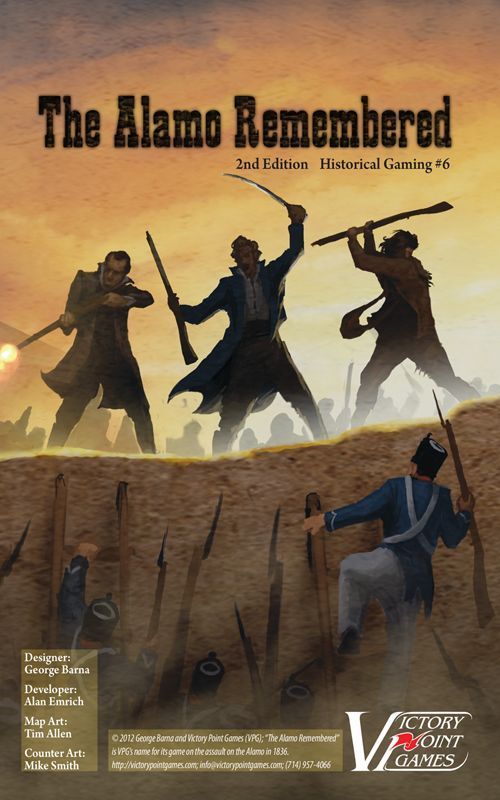
The Alamo Remembered
The Alamo Remembered Rulebook
Table of Contents
Table of Contents
- Using These Rules
- Game Equipment
- Set Up
- Sequence of Play
- Texian Deployment
- Mexican Approach
- Texian Ballshot
- Texian Movement
- Mexican Reinforcement
- Texian Grapeshot
- Texian Rifle Fire
- Mexican Assault
- Breach Determination
- Texian Rally
- The Last Stand
- Victory
- Game Variants
- The Solitaire Game
- Last Stand Resolution (Quick Reference)
- Historical Notes
Using These Rules
New gaming terms, when they are initially defined, appear in dark red san-serif lettering for quick referencing. Important information is in bold text. Rules emphasis is in italics. Examples of a rule or case are in blue blocks. Text in grey boxes provides the voice of the game's designer, who is addressing you to explain an idea or concept that is not, itself, a rule or a case.
The instructions for this game are organized into major "Rules" sections, represented by the number to the left of the decimal point (e.g., rule 4.0 is the fourth rule). These rules generally explain the game's subject matter, components, procedures for play, its core systems, how to set it up, and how to win.
With each Rule, there can be "Cases" that further explain a rule's general concept or basic procedure. Cases might also restrict the application of a rule by denoting exceptions to it. Cases are an extension of a Rule shown in the way that they are numbered. For example, Rule 4.1 is the first Case of the fourth Rule.
Game Equipment
2.0 Game Equipment
Parts Inventory:
- 1 - 8.5" x 16.5" map
- 54 - 3/4" square game pieces (some slight soot and discoloration can occur during the laser cutting process)
- 1 Rules booklet
2.1 The Game Map: The game map depicts the Alamo and is divided into six named areas or "Walls," each with a Breach Value (number inside a yellow circle). The map also includes a Turn Track and other boxes and notes helpful for playing the game.
2.2 The Playing Pieces: The square playing pieces come in two basic flavors: military units with a large number on their front and a flag on their back (in two color shadings: blue for the Texians and green for the Mexicans), and information markers. Military units represent the leaders, soldiers, riflemen and cannon (as shown by their symbols) that participated in the fighting. Each has a Battle Strength representing its relative fighting strength, with '1' being normal, a red '2' being strong, and a white '0' being a decoy (or "dummy") unit deployed on the map to confuse the enemy and hide your true strength. The information markers tell the time (measured in Game Turns) and the approach conditions for the Mexican army (i.e., the brightness of the moon and the alertness of the Texian sentries).
Set Up
3.0 Set Up: Follow these steps to set up the game:
- Place the three 2-strength (red print) Mexican units in their respective boxes on the Game Turn Track, and then place the Game Turn marker in the '1' box.
- Place the four Texian Relief Column units in their box next to the Turn Track. These units do not normally enter play.
- Place the Jim Bowie unit in his Illness box. There are conflicting stories about his health and participation at the battle.
- In the Approach Conditions area, place the Cloudy Night and Sentries Asleep markers in their respective boxes.
- Set aside (out of play) the Texian "We'll give 'em hell!" and "No rendirse, muchachos!" variant units (see 17.2).
- The Texian Player gathers his remaining 24 units (ten 0-strength Decoys; seven 1-strength Riflemen; five 1-strength Cannon; one 2-strength Cannon; and Davey Crockett), and the Mexican player his 17 units (three 0-strength Decoys – Approach under cover of dark, Element of Surprise, and "Viva Santa Anna!"; thirteen 1-strength Infantry; and one 1-strength Banners & Bugles).
Play then proceeds according to the Sequence of Play, below.
Sequence of Play
4.0 Sequence of Play: Each Turn is conducted in a series of Phases performed in strict order. All of the actions of the current Phase must be completed before the next can commence. If the Mexican Player achieves a breach at the end of the Turn, a special Last Stand Phase is conducted and the winner determined.
- Texian Deployment Phase: The Texian Player places his forces, face-down, as desired among the six Wall sections of the Alamo, no more than six (6) units total per Wall section.
- Mexican Approach Phase: The Mexican Player places his forces, face-down, as desired, outside the Wall sections of the Alamo, no more than four (4) units total per Wall section.
- Texian Cannon Ballshot Phase: Texian Cannon units eliminate Mexican units approaching their Wall sections.
- Texian Movement Phase: Texian Riflemen and Dummy units can move between Wall sections.
- Mexican Reinforcement Phase: The Mexican Player receives and places his Reinforcements for that Turn.
- Texian Cannon Grapeshot Phase: Texian Cannon units eliminate Mexican units approaching Wall sections that were just reinforced by the Mexican Player (only).
- Texian Rifle Fire Phase: All Texian units are revealed, and Texian Riflemen units eliminate Mexican units approaching their Wall sections.
- Mexican Assault Phase: All Mexican units are revealed, and Mexican units eliminate Texian units on the Wall sections that they are assaulting.
- Breach Determination: If it is the end of Game Turn 3, OR if a Mexican force Breaches a Wall section, then skip to the Last Stand Phase*.
- Texians Rally: The Texian Player can reclaim one eliminated Texian unit per Hero he has in play.
*The Last Stand Phase: The game is ending; see Rule 15.0.
Texian Deployment
5.0 Texian Deployment: First, turn all the Texian units in play face-down. Texian units in the Eliminated Units box are not considered "in play." These units are deployed with their Texian flag side showing to keep them hidden from the Mexican Player.
Then the Texian Player must place them distinctly in any or all of the six separate Wall sections of the Alamo within the following restrictions:
5.1 Elbow Room: No more than six (6) Texian units total can be located at a given Wall section. This includes Cannon, Riflemen and Dummy units.
5.2 Cannon Placement: Cannon units cannot be deployed during this Phase after the first Game Turn; only available Texian Riflemen, Hero and Dummy units can be redeployed. Cannon units are immobile once initially deployed during this Phase on Turn 1.
Example: It is Game Turn 1 and here you see the Texian Player has secretly deployed (face-down; although they are shown here face-up and half-shaded to symbolize that they are hidden from the opponent) his 2-strength Cannon unit and three Dummy units on the South Wall.
Mexican Approach
6.0 Mexican Approach: The Mexican Player begins by taking all of his units and placing them in front of him to ready the next assault. On Game Turns 2 and 3, this includes all of his on-map units – including those in the Eliminated Units box except for the (red) 2-strength units (which are permanently eliminated, along with most Texian units).
These "recycled" Eliminated Mexican units actually represent fresh troops committed and, together, this newly regenerated Mexican force becomes the next "wave" of attackers storming the Alamo.
He then turns all of these units face-down, so that the Mexican flag side is showing to keep them hidden from the Texian Player.
Then the Mexican Player must place them anew each Turn, distinctly outside of and adjacent to any or all of the six separate Wall sections of the Alamo within the following restriction:
Columns of Maneuver: No more than four (4) Mexican units total can approach a given Wall section.
Example Continued: During this Phase, the Mexican player secretly approaches with three Infantry and his Banners & Bugles unit toward the South Wall.
Texian Ballshot
7.0 Texian Ballshot: On Game Turn 1, begin this Phase by revealing (i.e., turning face-up) all Texian Cannon units. They remain face up in their Wall section for the remainder of the game.
Each Texian Cannon unit eliminates a number of Mexican units equal to its Battle Strength from among those approaching its Wall section.
Procedure: Count the number of Cannon units' Battle Strength points at a wall where there are Mexican units approaching opposite it. For each point, the Texian Player selects one Mexican unit at random from the force approaching that wall and turns it face-up, eliminating it, and removing it from the map to the Eliminated Units box.
Example Continued: During this Phase at the South Wall, the Texian Player reveals his one Cannon unit and opens fire. Because it is his 2-strength 18 Pounder Cannon unit, two Mexican units from among the four approaching the South Wall are revealed by the Texian Player. These are discovered to be the Banners & Bugles unit and an Infantry unit (shown with red borders), both of which are placed in the Eliminated Units box.
Texian Movement
8.0 Texian Movement: The Texian Player may move Riflemen, Heroes and Dummy units only (Cannon units, once initially deployed, are immobile) to or from Wall sections as desired. These units remain face-down once moved.
Restrictions:
- Directing Traffic: Each Wall section can either have units move to it or from it, but not both in the same Turn.
- Elbow Room: There can be no more than six (6) units total per Wall section.
Think of each Wall section as having a one-way door. If something goes in that Turn, then nothing can go out; if something comes out that Turn, then nothing can go in.
Example Continued: Sensing some threat to the South Wall, the Texian Player scrounges up his one Infantry unit (with its 1-strength) to send there, bringing that Wall up to five (out of a maximum of six) units (i.e., 1 Cannon, 1 Infantry and 3 Dummy units). As much as he would like to pull out a Dummy unit that is already there, he can't – because he brought pieces in this Turn, none can go out.
The Mexican Player is counting on most of the unrevealed Texian units to be Dummy units (i.e., the Texian Player is "bluffing" a lot of strength on this Wall), and that further Texian fire will miss his 2-strength Cazadores unit; if both of those suppositions hold true, he should be able to breach the South Wall this Turn!
Mexican Reinforcement
9.0 Mexican Reinforcement: The Mexican Player receives his 2-strength unit for that Turn from the Game Turn Track, plus any combination of up to three Mexican 0-strength Dummy and/or 1-strength Infantry units from the Eliminated Units box, and places them, face-down, as desired, distinctly outside any Wall section or sections, without limit, where there is already at least one Mexican unit, if possible.
Thus, a maximum of eight Mexican units could be deployed outside a single Wall section by being reinforced thus.
Example Continued: The Mexican player receives his Turn 1 reinforcement (the Cazadores unit) and recoups three lost Infantry units from the Eliminated Units box. Placing these four units face-down, he decides to place them all against the South Wall. He hopes that his revitalized assault of six units (with a total Battle Strength of 7) can overwhelm this Wall even though it has a credible, medium-strength Breach Value of 4.
Texian Grapeshot
10.0 Texian Grapeshot: This Phase is performed like the Texian Ballshot Phase (see 7.0) except that only Texian Cannon units on Wall sections whose assaults were just reinforced by the Mexican Player can fire.
Example Continued: The Mexican Player has reinforced the South Wall, so the Texian Cannon unit located there fires again, this time with grapeshot (i.e., during this Phase). The Texian Player flips over two Mexican units. Both are revealed to be Infantry units and are placed in the Eliminated Units box.
Texian Rifle Fire
11.0 Texian Rifle Fire: First, turn all the Texian units in play face-up. Thus, they are now all revealed.
Then, using the same procedure as firing Ballshot (see 7.0), each Texian Riflemen and Hero (not Cannon) unit eliminates a number of Mexican units equal to its Battle Strength from among those approaching its Wall section.
Example Continued: The Texian Player reveals three Dummy and only one Infantry unit, which is what the Mexican Player was hoping, but both players are anxious as the Texian Infantry unit fires into the four remaining Mexican units. Knowing that the Mexican Cazadores (a 2-strength unit) are among the Mexican group, the Texian Player nervously flips over one Mexican unit hoping to hit them.
Luckily for the Texian Player, the one unit he reveals is the Cazadores unit as both players exclaim interjections at this turn of events. The Cazadores unit is removed to the Eliminated Units box (and will remain there permanently).
Mexican Assault
12.0 Mexican Assault: First, turn all the Mexican units in play face-up. Thus, they are now all revealed.
Then, each Mexican unit eliminates a number of Texian units equal to its Battle Strength from among those defending the Wall segment it is approaching.
Procedure: Count the number of Mexican units' Battle Strength points at each wall where there are Texian units defending opposite them. For each point, the Texian Player loses one Dummy unit from his force defending that wall. If not enough Dummy units are there to satisfy these losses, then Riflemen units present on that Wall segment are lost next, followed by Hero units. Cannon units are never lost in this manner. Eliminated units are placed in the Eliminated Units box.
The loss of Dummy units represents the degrading of resources, morale, and defense works within the Alamo.
Example Continued: There on the South Wall, three Mexican Infantry units survive to assault the Wall. The Texian player must lose all three Dummy units. Fortunately, there are enough there to shield his Infantry unit and keep it in play. He places these lost Dummy units in the Eliminated Units box.
Breach Determination
13.0 Breach Determination: If it is the end of Game Turn 3 OR if, during this Phase on Game Turns 1 or 2, a Mexican force's total Battle Strength equals or exceeds the Wall's Breach Value that it is assaulting, the Mexicans have broken through and are inside the Alamo; skip ahead to the Last Stand Phase.
If no Breach occurs thus at this time during Game Turns 1 or 2, proceed to the Texian Rally Phase.
Example Continued: The three surviving Mexican Infantry units, with their combined Battle Strengths of 3, are (barely) not enough to equal the Breach Value of the South Wall, which is 4. Assuming no other Wall section was Breached that turn, play proceeds to the Texian Rally Phase and then to Game Turn 2.
Had the 2-strength Mexican Cazadores unit survived (instead of a 1-strength unit), then the strength of the assault on this Wall would have been 4, a Breach would have been made, and play would skip to the Last Stand Phase.
Texian Rally
14.0 Texian Rally: If no breach has occurred and another Game Turn is to be played (see 13.0), for each Texian Hero unit in play, the Texian Player may Rally (recover) one eliminated Riflemen or Dummy unit (only, not another Hero or Cannon unit) of his choice from the Eliminated Units box and return it to active duty on the map. Simply place that Rallied unit among all the other face-up Texian units in the Alamo.
Example: With Jim Bowie ill and thus not in play, but Davey Crockett having survived his fighting on the South Wall during this first Game Turn, the Texian Player can Rally one eliminated Texian Riflemen or Dummy unit. Since all of his losses are currently Dummy units, he takes one and returns it to his forces at the Alamo.
The Last Stand
15.0 The Last Stand: Whether collapsing after a Wall is Breached or if Overrun by sheer numbers after an exhausting (3 Game Turn) defense without a Breach, the Texians must all be eliminated before the winner is determined. Perform the following Steps in order:
- A. Jim Bowie Step: If the Jim Bowie Hero unit is in his Illness box, flip this unit (like a coin). If it lands face-up, Jim Rallies himself from his cot and joins the fray with the other Texian units still fighting at the Alamo.
- B. Texian Fall Back Step: All Texian Cannon units not at a Breached Wall section (see 13.0) are placed in the Eliminated Units box. Cannon units at Breached Wall sections remain; they have been "captured" by the Mexicans! The remaining Texian Dummy, Riflemen and Hero units (only) are placed at the center of the Alamo, face-down, and are mixed together.
- C. Mexican Incursion Step: This Step allows the Mexican Player to rush in as much firepower as possible at the decisive Wall segment and is handled in one of two ways:
- If any Wall segments were Breached (13.0), then up to two Mexican units (total) may be added to each Breached Wall segment from either or both adjacent Wall segments (only), if available.
- If Game Turn 3 was completed and no Wall segment was Breached (12.0), the Mexican Player must select the forces surviving at any one Wall segment instead and "Overrun" it. Then, one Mexican unit (total) may be added to that Overrun Wall segment from either adjacent Wall segment (only), if available.
- D. Mexican Fire & Charge Step: Total the Battle Strength of the Mexican (and captured Cannon) units at these points of entry into the Alamo (i.e., Breached or Overrun Wall segments). For each point, the Mexican Player selects one Texian unit at random from among the remaining Texian units (i.e., in the center of the Alamo) and turns it face-up, eliminating it, and removing it from the map to the Eliminated Units box.
- E. Texian Hand-to-Hand Fighting Step: Reveal the surviving Texian units in the center of the Alamo and eliminate a number of Mexican (and captured Cannon) units equal to their Battle Strength. These eliminated units are of the Mexican Player's choice from among all the Mexican units still in play (even those at non-Breached Wall sections); place them in the Eliminated Units box.
Example: The Northwest Wall segment is Breached. A total of up to two Mexican units that survived their approach to either the adjacent North or Southwest Wall segments can be moved over and added to the force that Breached the Northwest Wall.
Victory
16.0 Victory: The Mexican Player scores Victory Points (VPs) according to the following schedule:
- +1 VP for each Battle Strength point among the surviving Mexican units (i.e., not in the Eliminated Units box); this includes Reinforcement units that have not yet entered play plus any captured Texian Cannon units
- +6 VP if a Breach was achieved and the game ended on Game Turn 1, or
- +3 VP if a Breach was achieved and the game ended on Game Turn 2, or
- -2 VP if no Breach was achieved and the game ended with a Wall segment being Overrun at the end of Game Turn 3
Total these Victory Points and compare them to the following schedule to determine the battle's outcome:
- 15+ = Mexican Triumph: The rapid collapse of the Alamo and negligible Mexican losses provide Santa Anna's army great impetus to crush the rebellion in Texas. ¡Viva Santa Anna!
- 12-14 = Mexican Decisive Victory: The sure collapse of the Alamo with relatively light Mexican losses raises Mexican morale and demoralizes Texian forces at their next battle.
- 8-11 = Mexican Victory (historical result): The eventual collapse of the Alamo after suffering appreciable losses raises a Texian battle cry ("Remember the Alamo!") and puts some caution into the Mexican commanders invading Texas.
- 5-7 = Mexican Pyrrhic Victory: After sustaining heavy casualties capturing the Alamo, Santa Anna must regroup and await the arrival of reinforcements that are en route, buying the Texians time that they desperately need to prepare for the Mexicans' invasion.
- 4 or less = Mexican Humiliating Victory: The "butcher's bill" was so high from the eventual capture of the Alamo that Santa Anna must halt the invasion of Texas and await the arrival of a second army from Mexico. By the time it arrives later in the year, the Texians are ready for them.
Game Variants
17.0 Game Variants: These game variants can be used together or separately and are added by mutual agreement of both players before play. When there is a conflict, these rules take precedence.
17.1 Texian Relief Column: During Step 2 of the Set Up, the Texian Player adds the one 0-strength and three blue 1-strength units. They function as normal Texian units for all purposes for the duration of the game.
A relief column of 320 men, four cannon and supplies was anticipated at the Alamo but failed to arrive. What if they had?
17.2 Variable Assault Conditions: During Step 4 of the Set Up, the Mexican Player flips each of the two Approach Condition markers (like a coin) and places them in their respective boxes on whichever sides land face-up, with its associated Game Turn 1 Dummy unit being received by that side (and not the opponent's).
Everything seemed to be working for the Mexican Army's approach that fateful morning. Clouds covered a bright moon and the three Texian sentries were silently killed as the Mexicans moved toward the Alamo. But things could have gone differently.
17.3 Santa Anna Waits for Reinforcements: During the Mexican Reinforcement Phase (9.0) each Turn, the Mexican Player receives any combination of up to four (not just three) Mexican 0-strength Dummy and/or 1-strength Infantry units from the Eliminated Units box.
So now, a maximum of nine Mexican units could be deployed outside a single Wall section by being reinforced thus.
17.4 Jim Bowie's Illness: At the end of the Texian Rally Phases on Game Turns 1 and 2, if the Jim Bowie Hero unit is in his Illness box, the Texian Player may flip this unit (like a coin). If it lands face-up, Jim Rallies himself from his cot and joins the fray with the other Texian units still in play. If it lands flag-side-up, he remains ill in his cot for the time being.
17.5 Spiking the Guns: During the Texian Fall Back Step of the Last Stand Phase, remove all of the Texian Cannon units including those at any Breached Wall sections.
In their haste to depart the Walls as the Mexicans were coming over them, the Texian defenders failed to spike their cannons, which the Mexicans promptly turned and fired into the Alamo itself. But what if they had spiked their guns?
The Solitaire Game
18.0 The Solitaire Game: In the solitaire version of The Alamo Remembered, the player commands the Texian defenders and "the system" leads the Mexican forces, using a single six-sided die (not provided) to make key decisions.
No game variants (Rule 17.0) are used when playing the solitaire game. Play is conducted normally except that your Texian units are always placed face-up (you don't need to hide them from yourself!) and the Mexican Player's decisions during the Mexican Approach and Reinforcements Phases are handled thus:
18.1 Mexican Approach Phase: The first Game Turn is handled a bit differently as a probing action to spot the Texian Cannon units, while Game Turns 2 and 3 are risk-based assaults. These are handled as follows:
18.1.1 Turn 1 Approach (Probing): First, place one 1-strength Infantry unit, face-down, against each of five of the six Wall segments, rolling a die and consulting the map to determine which Wall segment does not get "probed" in this manner.
Second, take the remaining 12 available Mexican units, turn them face-down and mix them together. Now make four groups of three units each and assign one of these groups to each of the Wall segments being probed (see above) but one. Roll a die and consult the map to determine which Wall segment that is being probed does not receive an additional group of Mexican units (re-rolling if necessary).
Example: On the first Game Turn, a roll of 3 means that only the South Wall is not probed with a 1-strength Infantry unit. A second roll of 6 means that only the North Wall is not brought up to a full group of three units.
18.1.2 Turn 2 and 3 Approaches (Assaults): First, take all the available Mexican units (there will be 17 of them, plus any surviving 2-strength units received on the previous Game Turns), turn them face-down, mix them up, and form them into stacks of four groups of four units each, and a final group with the remaining units in it.
Calculate the Weak Spots in the defenses by checking each Wall segment and adding the Wall Strength to two times (i.e., "2x") the Battle Strength of the Cannon units on that Wall segment.
Place a full group of four units against these Wall segments, starting with the weakest – then proceeding to the next-weakest and so on. If more than one Wall segment ties for the next-weakest and there are not enough full groups of four units to cover them all, randomly determine which is assaulted. Finally, place the group of remaining Mexican units against the weakest wall that is not already being assaulted (again, rolling if two or more are tied for next weakest).
Example: The player has placed the 2-strength Cannon unit on the North Wall and one 1-strength Cannon unit on each of the other five Wall segments. Their Weak Spot values are:
- East Wall: 1 (Cannon) x 2 = 2 + 3 (Wall) = 5
- Southeast Wall: 1 x 2 = 2 + 5 = 7
- South Wall: 1 x 2 = 2 + 4 = 6
- Southwest Wall: 1 x 2 = 2 + 3 = 5
- Northwest Wall: 1 x 2 = 2 + 4 = 6
- North Wall: 2 x 2 = 4 + 4 = 8
18.2 Mexican Reinforcement Phase: There is nothing too subtle about the placement of Mexican Reinforcements. Take three Riflemen units from the Eliminated Units box and combine them with the 2-strength Reinforcement unit for that turn. This entire force then reinforces one Wall segment based on the following formula and die roll:
18.2.1 Smelling Victory: Reveal all of the Mexican units for that turn and calculate the Breach Value for each Wall segment based on the following formula:
- Wall Strength Value
-
- 2x Cannon Battle Strength on that Wall
-
- 1/2 per other (still hidden) Texian unit on that Wall
- – the Mexican Battle Strength at that Wall
- = the Breach Value for that Wall segment
Example: The North Wall segment has a strength of 4, plus a 1-strength Cannon unit (doubled to a 2), plus three Texian units also present (times 1/2 for a total of 1.5). All summed that would be 4 + 2 + 1.5 = 7.5. Three Mexican units with a total Battle Strength of 3 survived the Cannon Ballshot Phase and that is subtracted thus: 7.5 – 3 = 4.5.
Designate which wall has the lowest Breach Value, second-lowest and third-lowest. When there are ties, randomly determine which of them will be designated the "lowest" (with the other being the next-lowest), etc. until the three lowest Breach Value Wall segments have been designated first-, second- and third-lowest.
18.2.2 Determining Which Wall Segment is Reinforced: Roll a die on the following table to determine exactly which target Wall segment receives all of the Mexican Reinforcements for that Turn:
- 1, 2 or 3: The lowest Breach Value
- 4 or 5: The second-lowest Breach Value
- 6: The third-lowest Breach Value
Last Stand Resolution (Quick Reference)
The Last Stand Resolution procedure. Perform the following Steps in order:
- A. Jim Bowie Step: If Jim Bowie is in his Illness box, flip it. If it lands face-up, Jim Rallies himself from his cot and joins the fray.
- B. Texian Fall Back Step: All Texian Cannon units not at a Breached Wall are placed in the Eliminated Units box. Cannons at Breached Walls remain; they are "captured." The remaining Texian Dummy, Riflemen and Hero units (only) are placed at the center of the Alamo, facedown, and are mixed together.
- C. Mexican Incursion Step: If any Wall segments were Breached, then up to two Mexican units (total) may be added to each Breached Wall segment from either or both adjacent Wall segments (only), if available. If Game Turn 3 was completed and no Wall segment was Breached, the Mexican Player must select the forces surviving at any one Wall segment instead and "Overrun" it. Then, one Mexican unit (total) may be added to that Overrun Wall segment from either adjacent Wall segment (only), if available.
- D. Mexican Fire & Charge Step: Total the Battle Strength of the Mexican (and captured Cannon) units at these points of entry into the Alamo (i.e., Breached or Overrun Wall segments). For each point, the Mexican Player selects one Texian unit at random from among the remaining Texian units (i.e., in the center of the Alamo, from Step B) and turns it face-up, eliminating it, and removing it from the map to the Eliminated Units box.
- E. Texian Hand-to-Hand Fighting Step: Reveal the surviving Texian units in the center of the Alamo and eliminate a number of Mexican (and captured Cannon) units equal to their Battle Strength. These eliminated units are of the Mexican Player's choice from among all the Mexican units still in play (even those at non-Breached Wall sections); place them in the Eliminated Units box.
- F. No Quarter Step: Eliminate the last surviving Texian units (place them all in the Eliminated Units box). Declare, "Remember the Alamo!"
- G. Victory Determination Step: See below.
Scoring: The Mexican Player scores Victory Points (VPs) according to the following schedule:
- +1 VP for each Battle Strength point among the surviving Mexican units, including Reinforcement units not in play and captured Cannons.
- +6 VP if Breach achieved on Game Turn 1, or +3 VP if Breach achieved on Game Turn 2, or -2 VP if no Breach achieved (i.e., the game ends with an Overrun at the end of Game Turn 3).
Total these Victory Points and compare them to the schedule below to determine the outcome.
Victory Levels:
- 15+ = Mexican Triumph: ¡Viva Santa Anna!
- 12-14 = Mexican Decisive Victory.
- 8-11 = Mexican Victory (historical result): "Remember the Alamo!"
- 5-7 = Mexican Pyrrhic Victory.
- 4 or less = Mexican Humiliating Victory.
Historical Notes
Traditionally, white Americans, and Texans in particular, believed that the defeat and slaughter of the defenders at the fortified mission known as the Alamo at San Antonio, Texas, in early 1836 was a heroic last stand by a gallant group of men fighting for liberty. It was also accepted as fact that the defenders' sacrifice bought time for Sam Houston to build his army that eventually defeated the Mexican force under the command of Antonio López de Santa Anna and thereby won independence for Texas from Mexico. U.S. journalists of that period, and American literature from then through today, all contributed to these myths that helped make the Alamo one of America's most iconic historical locations. The most influential modern depiction of the siege was the 1960 motion picture directed by famous movie star John Wayne, who also played the role of Tennessee frontiersman, politician and folk hero David Crockett (who was killed in action at this battle).
"Thermopylae had her messenger of defeat; the Alamo had none." This quote by Edward Burleson, a 19th century statesman of the Republic of Texas, is typical of the hyperbole surrounding the Alamo legends. Cultural and political motives compelled writers and politicians to compare the Alamo defenders with the outnumbered Spartans at Thermopylae. Just as the Spartans were viewed as sacrificing themselves to delay vast hordes of Persians commanded by their god-king Xerxes, and thereby gain time for the rest of Greece to gather the forces needed to save Western civilization, a popular interpretation of the siege of the Alamo saw it, too, as a symbolic confrontation between freedom-loving defenders and the tyrant Santa Anna.
The 1960 movie, as well as many books, presented the story of the siege as days of repeated assaults by Mexican soldiers who eventually overwhelmed the defenders by sheer numbers rather than by any military skill. The movie credits the men inside the mission-fort, under the command of William Barret Travis, with killing or wounding 10 or more of the attackers for every defender lost. When Santa Anna demanded the immediate surrender of the fort or he would give no quarter to the defenders, Travis drew a line in the sand and asked who would cross over and stay with him to a certain death. In the movie, everyone stays, but legend has all but one man crossing the line. This romanticized version of the siege is the basis for the multiple assault turn procedure of our game The Alamo Remembered.
Although the Alamo myths and legends inspired the original game design by George Barna, this Victory Point Games' edition map was created by Tim Allen using the latest archeological and historical interpretations of how the Alamo may have actually appeared during the battle. In 2008, State House Press published Mark Lemon's beautiful pictorial The Illustrated Alamo 1836: A Photographic Journey. Using old sketches, diagrams, and archeological digs, Lemon created an amazingly detailed illustrated book on what he claims is the most accurate appearance of the Alamo in 1836 ever produced. Jesus Francisco de la Teja, State Historian of Texas, endorsed the work, writing that "…Alamo enthusiast Mark Lemon has produced the single most comprehensive volume on the Alamo as it was at the time of its rendezvous with history... to anyone wishing to gain an understanding of how a dilapidated Spanish mission became the stage for the most famous event in Texas history."
Sadly, if we wanted to portray a more historically accurate simulation of the siege of the Alamo, it would not be much of a game. That's because the latest information indicates that the defenders were overwhelmed by one pre-dawn surprise attack after 12 days of desultory siege. In fact, rather than fight to the last man, there is strong evidence that a large number of the defenders attempted to escape when they realized that the north wall had been quickly breached. Santa Anna's cavalry and infantry that had been positioned to intercept this anticipated break out attempt killed every man that tried to flee. A few defenders managed to get away to tell of the fall of the Alamo, and several women and children inside the mission along with the slave of renowned knife fighter James Bowie (who also died in the Mexican's one and only assault) were spared. Every defender inside the fort, including Travis, Bowie, and Crockett, were killed after a savage melee.
In 2010, a very controversial myth-busting book was released by Casemate Publishers. Phillip Thomas Tucker, a historian for the U.S. Air Force and author or editor of more than 20 books on the American experience such as the Civil War and Southern history, wrote Exodus from the Alamo: The Anatomy of the Last Stand Myth. Tucker wondered how, if every defender was killed, did anyone know what really happened inside the Alamo? His research included the printed eyewitness reports of Jim Bowie's slave (who was not considered credible at the time because he was a slave) and a few men who escaped, plus Mexican army records that were ignored by white scholars for 170 years until Tucker investigated the Archivo Historico Militar Mexicano in Mexico City.
Tucker's version of the Alamo story included an incompetent, drunken Sam Houston doing nothing to help the Alamo defenders, and militarily inept defenders holding an indefensible and strategically irrelevant fort who inflicted few casualties on the attacking Mexicans. Needless-to-say, Tucker's book presented an interpretation of the battle that outraged many Texans and other Americans. (Dr. Tucker told me in a podcast interview of him that I conducted for the Weider History Group that he had received death threats as a result of his book.)
To its credit, the official website of the Alamo (www.thealamo.org) presents the single assault story and dispels some of the myths about the siege. However, the site also continues to emphasize the Alamo as a symbol: "People worldwide continue to remember the Alamo as a heroic struggle against impossible odds — a place where men made the ultimate sacrifice for freedom. For this reason, the Alamo remains hallowed ground and the Shrine of Texas Liberty."
The Alamo Remembered is more mythic than historical, with its purpose as a game to be a fun and engaging. To that end, we believe we have succeeded.