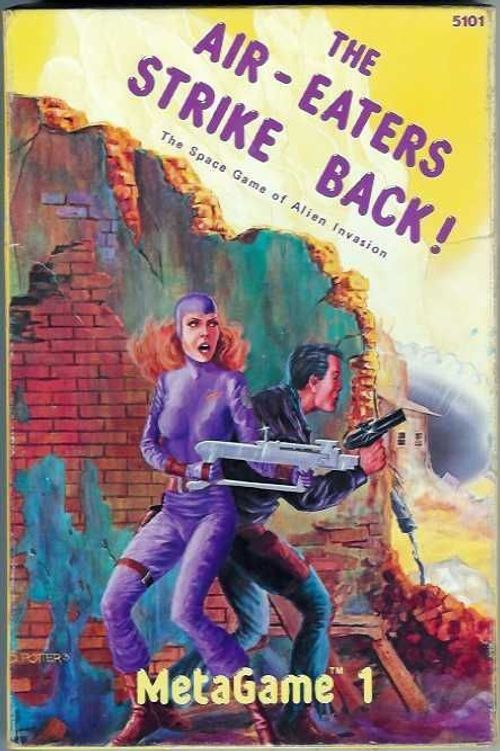
The Air-Eaters Strike Back!
The Air-Eaters Strike Back! Rulebook
Table of Contents
Table of Contents
- INTRODUCTORY GAME
- 1.0 Introduction
- 2.0 Map
- 3.0 Counters
- 4.0 Preparation for Play
- 5.0 Sequence of Play
- 6.0 Movement
- 7.0 Stacking
- 8.0 Combat
- 9.0 Orbital Bombardment
- 10.0 Terran Production
- 11.0 Terran Research and Development (R&D)
- 12.0 Alien Reinforcements (Introductory Game Only)
- 13.0 Victory Conditions (Introductory Game)
- INTERMEDIATE GAME
- ADVANCED GAME
- OPTIONAL RULES
- MULTIPLAYER GAMES
- OTHER SCENARIOS
- CHARTS AND TABLES
INTRODUCTORY GAME
1.0 Introduction
The Introductory Game is a two-player game, although the Multi-player rules can be added to it. This Introductory Game is recommended for novice players. Experienced players will find the Intermediate Game more interesting because it offers both sides more strategic choices. Gamers who have played INVASION OF THE AIR EATERS (a Metagaming MicroGame) might be able to move directly into the Intermediate Game. They should skim over the Introductory rules first since they are incorporated into the Intermediate Game.
The Quasarship Assault solitaire scenario (rule 35.0 in the other rulebook) is no more complex than the Introductory Game and is also a good version to begin with. The Martian Revolt scenario is only slightly more complex. You can read rule 35.0 or rule 36.0 first, if you wish, and then read the rules needed for those scenarios.
For more complete background information, see the Introduction in the other rulebook with this game.
Note to players familiar with INVASION OF THE AIR EATERS: Many rules in THE AIR EATERS STRIKE BACK are identical or very similar to those in its predecessor. These are Stacking (7.0), Combat (8.0), Terran Production (10.0), Terran Research and Development (11.0), and, in the Intermediate Game, Deployment of Bases and Atmospheric Converters (18.0), Beaming (19.0), and Atmospheric Conversion (21.0). Movement (6.0) and Alien Production (22.0) are somewhat similar.
2.0 Map
The mapsheet has several sections. The section with the circles and the boxes within the circles, with the star at the center, represents the Solar System out to the orbit of Jupiter. The dotted spaces in this section represent the asteroid belt. The planets themselves are not printed on this map, because they are counters which move.
The various smaller maps with hex grids represent the planetary surfaces. Maps are included for Mercury, Earth, Luna, Mars, the three largest asteroids (Ceres, Pallas, and Vesta), and the four largest moons of Jupiter (Ganymede, Callisto, Io, and Europa). The polar regions of Venus are also represented. Jupiter is represented by a box rather than a map. All of these will be referred to as planets. The heavy lines between hexes on the maps represent mountains or other impassible obstacles. The shaded areas on Earth represent seas. The black numbers indicate how many Industrial Units (IUs) the Terrans have in each hex at the start of the game. Other markings or details on the planetary maps have no effect on play.
Each planetary system has a box for units in orbit around it. (Earth and Luna together have an In Orbit box, as does Jupiter, Europa, Io, Callisto, and Ganymede). Two additional boxes are for Alien units on the Motherships. The track of numbers is for recording Terran Production, and, in the Intermediate and Advanced Games, Alien Atmospheric Conversion. The sequence of play is also printed on the map.
3.0 Counters
Counters used in the Introductory Game consist of units, planets, and Devastation markers.
3.1 Units
Each Alien and Terran unit bears a silhouette, an abbreviation for its type, and its Movement Factor. Movement Factors refer to Solar System spaces for space units and surface hexes for ground units. A Movement Factor of U indicates that the unit has unlimited movement. The unit types are as follows:
ALIENS
- MS: Mothership
- QS: Quasarship
- NS: Novaship
- ESC: Escort spaceship
- LN: Lander
- CW: Crawler ground attack vehicle
- (BASE and AC: See Introductory Game, rule 15.0) [as printed]
TERRANS
Space Units:
- CORV: Corvette
- DD: Destroyer
- CA: Cruiser
- BB: Battleship
- FTR: Fighter Squadron
- TR: Transport
- ITR: Improved Transport
Ground Units:
- Army: Land army and air force
- DT: Disintegrator Tank Battalion
- BI: Bounce Infantry Battalion
- SF: Submarine Fleet
- ISF: Improved Submarine Fleet
3.2 Planets
Each of these counters bear a name and the number of Industrial Units (IUs) that the Terran player initially has on that planet and its satellites. These counters (Mercury, Venus, Earth, Mars, Ceres, Pallas, Vesta, and Jupiter) move on the Solar System map. Each has an In Orbit box corresponding to it. Note that the asteroids Ceres, Pallas, and Vesta are considered planets for all purposes. No counters are provided for Luna, Ganymede, Callisto, Io, and Europa, since they are always in the same Solar System space as Earth or Jupiter. Jupiter also functions as a Game-Turn marker.
3.3 Devastation Markers
A Devastation marker shows the number of devastated Industrial Units in that hex.
3.4 Terran Production Marker
3.5 Counters not used in the Introductory Game
Base units, Atmospheric Converter (AC) units, Trojan Asteroids, Space Colony, Martian Moons, Atmospheric Index markers, and Inertia markers.
4.0 Preparation for Play
4.1 Terran Set-up
The Terran player places two armies, one Transport (TR), and four Disintegrator Tanks (DTs) in any land or part-land hexes on Earth. Two Sub Fleets (SFs) are placed in any sea or part-sea hexes on Earth. Two DTs and one TR are placed anywhere on Mars. Three Corvettes (CORVs) are placed in Earth's In Orbit box, three CORV are placed in Mar's In Orbit box, one CORV is placed in Jupiter's In Orbit box. The Terran Production marker is placed at 53 on the track of numbers on the map.
4.2 Alien Selection of Forces
The Alien player takes the two Motherships and 14 Escorts (ESCs), Landers (LNs) or Crawlers (CWs), or any combination of these units. The Aliens may also select up to two Novaships (NSs). Each Novaship counts as three of the 14 total units. EXAMPLE: The Aliens could start with a Novaship, five Escorts, three Landers, and three Crawlers.
No Quasarships (QSs), Bases, or Atmospheric Converters (ACs) may be taken.
4.3 Planet Set-up
Mercury is in space A-1 and Jupiter starts in space L-48. A die is rolled for each of the other planets: Venus, Earth, Mars, Ceres, Pallas, and Vesta. The planet is placed in the space indicated on the Initial Placement table. The Trojan Asteroids, Asteroid Mining Bases, Space Colony, and Martian Moons are not used. Venus, Pallas, and Vesta may be set aside as well, if desired; they have little effect on play in this scenario.
4.4 Alien Set-up
The two Motherships and all Novaships, Escorts, and Landers are placed in any one or more Solar System spaces or In Orbit boxes of the Alien player's choice. All Crawlers are placed in the On Mothership boxes.
5.0 Sequence of Play
5.1 Game-Turn
Each turn consists of several phases which must be performed in order. Each phase's activity will be described briefly below and in detail in the rules.
I. Solar Orbit. Everything moves one space clockwise on the Solar System map.
II. Movement.
A. Terrans Move. Each Terran unit on Earth may move an unlimited distance on the Earth planetary map. Each Disintegrator Tank (DT) and Bounce Infantry (BI) on another planet may move one hex on that planetary map, though DTs may not move through mountain hexsides.
Next, each transport (TR or ITR) in a ground hex may load one DT or BI in its hex.
Next, each Terran space unit in a ground hex may move to the In Orbit box of the planet it is on.
Next, each space unit now in an In Orbit box may land on that planet.
Next, each transport in a ground hex must unload.
Lastly, each Terran space unit in space may move a number of Solar System spaces equal to its Movement Factor.
B. Aliens Move. First, each Crawler (CW) on a planet may move one hex.
Next, each Lander (LN) may load one CW in its hex or In Orbit box, move to any other place connected to that In Orbit box, and unload.
Lastly, each Mothership, Escort, Novaship, and Quasarship may move an unlimited distance to another Solar System space or In Orbit box. Landers may do space movement also if they are accompanying a Mothership.
III. Combat.
A. Aliens Fire. Each Alien unit may fire at one Terran unit in its hex, space, or box.
B. Terrans Fire. Each Terran unit may fire at one Alien unit in its hex, space, or box.
IV. Orbital Bombardment. Each Novaship in an In Orbit box may fire twice at Terran units or IUs on that planet. Each Quasarship may fire four times. Each DD, CA, and BB may now make one or more attacks on Alien units on a planet connected to its In Orbit box.
V. Reinforcements.
A. Terran Production. The Terran player determines the number of undevastated Industrial Units (IUs) and then allocates them to Research and Development support and production of new units. New units are then placed on the map.
B. Terran Research and Development. The Terran player rolls a die for each R&D project for which the prerequisites have been fulfilled and for which 10 IUs have been allocated this turn. On a die roll of 1 or 2 (1, 2, or 3 if the die roll modifier applies), the R&D is successful.
C. Alien Reinforcements. Each Mothership in a Solar System space B-1, C-1, D-1, or E-1 may receive one Alien reinforcement unit, as indicated on the Alien Reinforcement chart.
5.2 Simultaneous Movement and Reinforcements
Often the order of movement is unimportant. On any turn, players may agree to move and/or receive reinforcements at the same time.
6.0 Movement
6.1 General
Each unit type has its own type of movement and must be moved at the proper time during the Movement phase. In some cases, a unit may be moved more than once per turn. EXAMPLE: A Crawler could be moved under its own power, transported by a Lander, and then transported by a Mothership in a single turn.
6.2 Other Units
Any unit may freely move into, out of, or through a hex, space, or box occupied by a friendly or enemy unit.
6.3 Solar Orbital Movement
All planets and units of all types must be moved one space clockwise on the Solar System map at the beginning of each turn. (See diagram)
6.4 Terran Ground Movement
6.4.1 Air Transport on Earth. Any number of Terran units of any types, except submarines, may be moved from any land or part-land hex on Earth to any other land or part-land Earth hex.
6.4.2 Submarines. Each Submarine Fleet (SF) and Improved Submarine Fleet (ISF) may move an unlimited distance to any Earth hex which is all or part sea.
6.4.3 Ground Movement on other Planets. Each Disintegrator Tank (DT) and Bounce Infantry (BI) may move to an adjacent hex each turn. DTs may not cross mountain hexsides, but BIs can. Armies may not be on planets other than Earth.
Planets are spherical. Hexes on the east edge of each planetary map are considered adjacent to corresponding hexes on the west edge. All hexes on the north edge are considered adjacent to all other hexes on the northern map edge, and all hexes on the southern map edge are considered adjacent to each other.
6.5 Liftoffs
Each Terran space unit on a land hex may move to the In Orbit box of that planet. EXAMPLE: A Corvette on Luna could move to the In Orbit Around Earth box.
6.6 Landings
Each Terran space unit in an In Orbit box may move to any land hex of any planet connected to that box. EXAMPLE: A unit In Orbit Around Earth may move to any hex of Luna or any land (or part land) hex of Earth. A unit may land in the same turn that it lifted off, if it does not move on the Solar System map.
6.7 Terran Transports
After Terran ground movement and before Terran space movement, each Transport (TR) and Improved Transport (ITR) that is in a land hex may load one Disintegrator Tank (DT) or Bounce Infantry (BI) unit. Both the transport and passenger unit must be in the same hex at the time of lift-off. The passenger unit may have already performed ground movement that turn. The transport then moves normally that turn and on subsequent turns, with the passenger unit placed beneath it. If it ends the Movement phase in a land hex, it must unload the DT or BI in that hex. Transports may not lift-off again in the same turn that they unload, nor may passengers do ground movement after they unload. EXAMPLE: If a TR and DT were in the same Earth hex, the TR could load the DT, move to Luna, and unload.
6.8 Terran Solar System Movement (Introductory Game Only)
Fighters (FTR) may not do Solar System movement. Other Terran space units may do Solar System movement, which consists of three steps:
A. Boosting out of Orbit: Units in an In Orbit box may be placed in the Solar System space which that planet is currently in. EXAMPLE: If Earth is currently in C-3, units In Orbit Around Earth may be placed in C-3. This may be done even if enemy units are in that box.
B. Acceleration: Each unit now in a Solar System space may move a number of spaces equal to or less than its Movement Factor. This movement may be in any direction or combination of directions. A unit may move diagonally between spaces that touch only at a corner. The asteroid belt does not affect movement.
C. Entering Orbit: Each unit in a Solar System space that has a planet in it MAY be placed in that planet's In Orbit box. The unit may not land on the planet this turn. EXAMPLE: If a Terran space unit and Earth are both in C-3, the space unit may be transferred to the In Orbit Around Earth box.
6.9 Alien Crawlers
Each Crawler (CW) may move to an adjacent hex, as long as it does not move through a mountain hexside. A CW may operate on any planet and may go into or through Earth's seas. Like Terran ground units, CWs may cross the poles of planets and move across the east and west edges of maps (see 6.4.3).
6.10 Alien Landers
After Crawlers move, each Lander (LN) in a surface hex (land or sea) or the Jupiter box may first load one crawler (CW) in its hex. Each LN in an In Orbit box with a Mothership (MS) in it may load one unit from the On Mothership box. Each LN may then move to any land or sea hex or the On Jupiter box connected to that In Orbit box, or to the In Orbit box itself. Each passenger unit must then be unloaded in the hex in which the LN ended its movement (if on a planetary surface) or into the On Mothership box (if in space). Passenger units may not end the movement phase on any planet. They may not move between planets by themselves, except between Earth and Luna and between Jovian moons.
EXAMPLE: The Lander could load a Crawler from either Mothership, move to any hex in the Jupiter system and unload, move to Jupiter and unload, or not move and unload onto the other Mothership.
6.11 Alien Solar System Movement
After Landers move, each Mothership (MS), Escort (ESC), Novaship (NS), and Quasarship (QS) may boost out of orbit (see 6.8A), move an unlimited distance on the Solar System map, and enter orbit (see 6.8C). EXAMPLE: An Escort orbiting Mercury could move to any In Orbit box or any Solar System space on the map.
Landers (LN) may do this also if they begin their Solar System movement in a space or box with a Mothership and end their movement in the same space or box as the MS. The Landers may not land that turn. Other Alien space units must always remain in space.
7.0 Stacking
An unlimited number of Alien and Terran units may occupy a single hex, In Orbit box, or Solar System space. Alien and Terran units may occupy the same hex, box, or space. An unlimited number of Alien units, but no Terran units, may occupy an On Mothership box or the On Jupiter box.
8.0 Combat
8.1 General
Crawlers, Escorts, Novaships, and Quasarships may attack Terran units in their hex, box, or space during the Alien Fire phase. Then, Terran units which have not been destroyed may attack Alien units in their hex or box during the Terran Fire phase. Each attack is resolved by using the following steps:
A. Determine the Combat Environment (Space, Land, or Underwater), the Firing Unit Type, and the Target Unit type.
B. Consult the proper Combat Results Table (CRT) to determine the die roll needed for that firing unit to destroy the target unit.
C. Roll a die to determine the result of combat.
EXAMPLE: If the CW fired at the BI during the Alien Fire phase, the Land CRT would be consulted. Indexing the CW line with the BI column, one finds that a die roll of 1 is necessary for the CW to destroy the BI. If the BI survived, it could attack the CW. It would need a 1-3 to destroy the CW.
8.2 Combat Environment
Combats in which the attacker and target occupy the same In Orbit box or Solar System space are considered to be Space Combat. Combats in which the units occupy a hex which is all or part land (on any planet) are considered to be Land Combat. Combats in which the units occupy an Earth hex which is all sea are considered to be Underwater Combat. Note that subs in hexes which are part sea and part land cannot attack.
8.3 Multiple Units
If several enemy units occupy the same hex, space, or box as one attacking unit, the attacker may select any one of the enemy units as a target. If several attacking units occupy the same hex as a single enemy unit, each of them may separately attack the target unit. If several attackers occupy the same hex as several enemy units, any attackers may attack any target units, with one separate attack for each attacking unit. Individual attacks never involve more than one attacker or target. No unit may attack more than once per Fire phase. (Orbital Bombardment, see 9.0, does not count.) However, a unit may be attacked more than once per combat phase. The attacking player does not have to announce all of his attacks at the beginning of his Fire phase; he may resolve one attack and then decide what the target of his next attack will be.
EXAMPLE: First the ESC fires at a CORV and misses. Then one CORV fires at the ESC and misses. Next, a second CORV fires at the ESC and destroys it. The last CORV then fires at the MS.
8.4 Industrial Unit Devastation
A Crawler may attack an IU in its hex rather than a Terran unit. If a 1-3 is rolled, a Devastation marker is placed in the hex. Each hit devastates ONE IU, not all IUs in the hex. This is indicated by a Devastation marker in the hex, and by adjusting the Terran Production marker. More than one CW may attack the IUs in a hex. CWs which attack IUs may not attack Terran units in that Fire phase.
8.5 Units on Motherships and Terran Transports
If a Mothership is destroyed, all units in that On Mothership box are destroyed also. If a Terran Transport (TR) or Improved Transport (ITR) is destroyed, its passenger is destroyed also.
8.6 No Attacks by Transports
TRs and ITRs may not attack Alien units, even to fulfill R&D prerequisites (see 11.2).
9.0 Orbital Bombardment
9.1 Aliens
Each Novaship or Quasarship (NS or QS) in an In Orbit box may attack units or Industrial Units on that planet. For each attack, the attacking player announces the target and rolls a die. If the die roll is one of those shown on the Orbital Bombardment table, the target unit is destroyed or the target IU is devastated. Each Novaship (NS) may make two attacks per turn and each Quasarship may make four attacks per turn. These attacks may be at the same or different units. Units may participate in Space Combat and also Orbital Bombardment in a single turn. Enemy space units may be in the same In Orbit box. Friendly units may be in the bombarded hex without being hurt. EXAMPLE: A Quasarship is orbiting Earth and bombarding Industrial Units. The die is rolled four times, yielding a 1, 4, 3, and 6. Two IUs anywhere on Earth or Luna are devastated.
9.2 Terrans
Terran Orbital Bombardment is exactly like that of the Aliens. For each attack, a one must be rolled to destroy the target, which may be an Alien unit of any type which is on any hex of that planet. Each Destroyer (DD) bombards once per turn, each Cruiser (CA) bombards twice, and each Battleship (BB) may attack four times. Corvettes and Fighters (CORV and FTR) may not bombard. Alien units on Jupiter or in sea hexes may be bombarded.
10.0 Terran Production
10.1 Counting Industrial Units (IUs)
The Terran player first determines how many undevastated IUs are on the map. This number should be kept track of on the Terran Production track on the map, to save having to count them each turn. IUs on all planets and asteroids are counted. IUs in Alien-occupied hexes may be counted.
10.2 Allocation of IUs
The Terran player next decides how IUs are to be used during the current Game-Turn. IUs may be allocated towards new unit production (see 10.3) or Research and Development Support (see 11.0). IUs may not be accumulated. However, IUs may be allocated towards unit production on a later turn, as long as the necessary R&D has been completed (see 11.0) and sufficient counters of that type are available. The balance of the IUs necessary to produce that unit may be allocated on a later turn.
10.3 New Unit Production
Each unit type has an IU cost indicated on the Terran Production chart. This number of IUs must be allocated to produce each unit. Units may not be produced in excess of the counter-mix, nor may IUs be allocated towards production of a unit if all counters are in play. Units may be voluntarily dismantled at any time so that new units of that type can be built at a better location. Destroyed units are rebuilt at their original cost.
EXAMPLE: If the Terran player had 50 IUs, he could build three DDs (15 IUs each) and one DT (5 IUs). If he had 52 IUs, he could also allocate 2 IUs towards production of a DD on a future turn.
10.4 Placement of New Units
New units may be placed on the map the same turn that their IU cost is completed, or they may be held off the map for placement on a later turn. One of the new units may be placed on a hex of Mars that has one or more undevastated IUs. This unit may be of any type except an Army or submarines. No units may be placed on Mars if all Martian IUs are devastated. All other new units are placed on undevastated IUs on Earth.
11.0 Terran Research and Development (R&D)
11.1 General
Many types of Terran units (indicated on the Terran Production chart) may not be produced unless the Terran player has successfully done R&D for that type of unit. R&D involves allocation of 10 IUs and a die roll.
11.2 Prerequisites
R&D may not be attempted until all prerequisites for that R&D Project have been fulfilled. (See Terran R&D chart.) Prerequisites involving combat in a particular environment require only that one Terran unit or IU be either the target or attacker for one attack in that environment on that turn. Prerequisites involving an attack on a particular type of Alien unit require that a Terran unit survives the Alien Fire phase and that the indicated type of Alien unit be the target unit for a Terran attack that turn. The Terran unit does not need to destroy the Alien unit, or even have a chance of doing so. (EXAMPLE: A Corvette may attack a Quasarship, even though it can't destroy it.) A single attack may fulfill the prerequisites (or die roll modifier conditions, see 11.4) for more than one R&D Project.
11.3 IU Costs
Each R&D Project needs, allocated to it, 10 IUs per turn that it is researched. These IUs must have been allocated during the Terran Production phase of the current turn. No more than 10 IUs may be allocated towards any one project each turn, but IUs may be allocated to more than one project in a Game-Turn.
11.4 R&D Die Roll
The die is rolled separately for each R&D Project. If a one or two is rolled, then that unit type may be produced NEXT turn. However, each project has certain conditions under which a die roll of one, two, or three, rather than just a one or two, will be successful, as described under the Die Roll Modifiers on the Terran R&D chart.
12.0 Alien Reinforcements (Introductory Game Only)
At the end of each turn, the Alien player receives one new unit for each Mothership in the Solar System space B-1, C-1, D-1, or E-1. The Mothership may be on the Solar System map or it may be in the In Orbit box for a planet in one of those spaces. New Crawlers are placed in the On Mothership box. New Landers, Escorts, Novaships, and Quasarships are placed in the space or box that the Mothership occupies. The unit types are determined by the Alien Reinforcements chart.
If only one Mothership is in position, the Alien player may receive one of the two reinforcement units, of his choice. The other unit is lost. If neither Mothership is in position, both reinforcements are lost. If no counter is available for a reinforcement unit, the unit is lost or an existing unit may be dismantled so that its counter can be used for the reinforcement.
(Alien reinforcements are units which were beamed at the speed of light from a colony on a planet of Altair, 17 years earlier. The Motherships must be in line with Altair to receive them. "Beaming" is used within the Solar System in the Intermediate Game.)
13.0 Victory Conditions (Introductory Game)
The Aliens win if all Terran Industrial Units are devastated by the end of turn 24 (when Jupiter has completed one half of a revolution). If not, the Terrans win.
For charts and tables, see the Advanced Rules Booklet.
INTERMEDIATE GAME
14.0 Introduction
A century has passed since the invasion, when mankind found, to its dismay, that it was not alone in the universe. For two years, the Earth had suffered terrible devastation as Alien crawlers disintegrated its cities and atmospheric converters changed the chemistry of its air. Fortunately, technological breakthroughs had come about as the result of captured Alien equipment, and Earth was saved from total destruction. However, the damage was great.
The war had one beneficial effect: it helped the human race to achieve political, economic, and religious unification. The pooled resources of all the continents enabled the rebuilding of the ruined cities and reconversion of the polluted atmosphere. Then Man went forth to other worlds of his solar system that were not overcrowded and ruined by war. He built cities on Mars and mined the asteroid belt and Mercury.
The Terran government maintained military forces, to await the possible return of the invaders. But, as in all peacetimes, the forces dwindled. The sub fleets lay mothballed in port. The land forces declined to militias and a few battalions of disintegrator tanks. R&D on military spaceships was abandoned not long after the war. Soon Mankind's memory of the Aliens became obscured by the dust of history.
The Alien Mothership escaped at the end of the war, when Terran disintegrator tanks were stopping the Aliens on the ground and Terran corvettes were attacking the Alien escort spaceship in orbit. The first assault on the solar system was by then doomed to failure. Perhaps, with warships and more forces and with a knowledge of their enemy, a second attack might be successful. The Terrans would be a threat to the Race someday. Humanity had to be destroyed before their technology made them unstoppable.
After some searching, the Mothership found its way to another, more successful colony at Altair. There it was restocked and resupplied, and was joined by one of its sisterships. The Motherships set out, back to Sol, 17 light-years away. They were accompanied by two Novaships with powerful beams and missiles. This time the Aliens were going not just to colonize a planet, but also to fight a war.
First contact was made by a corvette on patrol in the asteroid belt. It sent a terse message to the Military Council headquarters on Earth: "They're back!"
THE AIR EATERS STRIKE BACK is a strategic simulation of the Alien invasion of the inner Solar System in the 21st Century. Although the background and rules of the game are based on those of an earlier game, INVASION OF THE AIR EATERS, players do not need the first game to play the second.
Each turn represents three months. The planets move in their proper orbits on a Solar System map. Terran and Alien spaceships move between the planets on this map. The radial width of each space on the Solar System map represents 13 million km. Ground units move and fight on maps of Earth, Mercury, the poles of Venus, the Moon, Mars, and the four large satellites of Jupiter. Each hex of the planetary maps represents 2670 km if it is at the equator of that planet and less if it is in a polar region. All of the planetary maps (except Jupiter) are on the same scale.
All spaceship counters, except Terran fighters, represent single ships. The Aliens have Motherships, escorts, and Novaship warships. The Aliens can build giant Quasarships once they have an established colony in the Solar System. All of these ships have engines that work by antimatter annihilation, which enable continuous acceleration until the speed of light is approached. Thus, Alien spaceships have unlimited movement within the inner Solar System.
At first, the Terrans have only corvettes and unarmed troop transports. However, they can develop faster and more powerful destroyers, cruisers, and battleships as well as the well-armed but short-ranged fighters. The weapons and force-fields are based on those of the Aliens. Non-military freighters, mining ships, etc. are not represented by units.
The Alien ground units are crawlers, bases, and atmospheric converters, each representing a single vehicle or machine. The Terrans have armies, large bodies of militia armed with obsolete weapons, and battalions of disintegrator tanks developed during the first invasion. The Terrans can develop and build Bounce Infantry battalions, soldiers with armored, and powered spacesuits carrying hand-held disintegrators. The Aliens can go underwater on Earth, so the Terrans also have submarine fleets. Submarines were not used in the previous war (or, for that matter, since World War II), so they are obsolete, but can be improved through research.
The ultimate goal of the Aliens is to conquer or convert Terra. To achieve this goal, they can convert other planets, which reduces Terran production and increases Alien production.
The basic game is for two players, but scenarios are included so that up to five people can play.
INTERMEDIATE GAME. The Alien invasion force consists not only of combat units, but also production and teleportation bases and Atmospheric Converters. The Aliens are attempting not only to destroy Terran industry, but also to convert the planets for their own use.
The Intermediate Game has a more realistic and interesting system for Terran space movement than the Introductory Game does.
The Intermediate Game is a two-player game, although the multi-player rules can be added to it.
Note on Play-Balance. As in INVASION OF THE AIR EATERS, the two players have equal chances of winning if both are familiar with the game and its strategy. However, strategy is complex. In the Intermediate and Advanced versions of THE AIR EATERS STRIKE BACK, the Aliens are more difficult to play well than are the Terrans. Thus, new players should place Devastation markers on eight Industrial Units (IUs) on Earth before play begins (reducing Terran Production to 50). (Assume that the Aliens did a surprise asteroid bombardment of Earth.)
15.0 Additional Counters
15.1 Base, Atmospheric Converter Units (AC)
These are Alien ground units which have a Movement Factor of 0.
15.2 Trojan Asteroids (Two Counters) and Asteroid Mining Bases (Four Counters)
Like planets, these move on the Solar System map. However, they have no planetary maps and cannot be landed on. The Trojan Asteroids can be used for Alien production and the Asteroid Mining Bases have Industrial Units (IUs).
15.3 Space Colony
This is an Industrial Unit placed In Orbit Around Earth rather than on Earth.
15.4 Atmospheric Index Markers
15.5 Inertia Markers
An Inertia marker shows a Direction arrow and a Velocity number.
15.6 Advanced Game Counters
The Martian Moons and Free Asteroids are used only in the Advanced Game, as is the Atmospheric Index marker for Venus.
16.0 Preparation for Play
16.1 Terran Set-up
The Terran player first sets up as in the Introductory Game: One CORV orbiting Mercury; three CORV orbiting Earth; two Armies, four DTs, one TR, and two SFs on Earth; three CORV orbiting Mars; two DTs and one TR on Mars, and one CORV orbiting Jupiter. Then the Space Colony is placed In Orbit Around Earth. Terran Production is at 58.
16.2 Alien Selection of Forces
The Alien player takes two Motherships, two Bases, and any 14 other units. However, the Aliens may not take any Quasarships (QS), and may not take more than two Novaships (NSs). Each NS counts as three of the 14 units.
16.3 Planet Set-up
A die is rolled and the Initial Placement table is consulted for each planet and Asteroid Mining Base. The Trojan Asteroids are then placed in spaces L-40 and L-8. Then the Atmospheric Index markers other than Venus' are placed in the indicated positions on the Atmosphere Index track on the map.
16.4 Alien Set-up
The two Motherships and all Novaships, Escorts, and Landers are placed in any Solar System spaces or In Orbit boxes of the Alien player's choice. Other units are set up in the On Mothership boxes. One Base is deployed face-up on each Mothership. Other Bases and all Atmospheric Converter units are initially face-down, indicating that they are undeployed (see 18.0).
17.0 Sequence of Play
The sequence of play is the same as that in the Introductory Game, except that the Reinforcements phase has different subphases.
I. Solar Orbit
II. Movement
A. Terrans Move (Ground Movement, Lift-offs, Landings, Solar System Movement)
B. Aliens Move (Crawlers, Landers, Spaceships)
III. Combat
A. Aliens Fire
B. Terrans Fire
IV. Orbital Bombardment
V. Reinforcements
A. Terran Production
B. Terran Research and Development
C. Alien Atmospheric Conversion
D. Alien Production
E. Alien Deployment of Bases and Atmospheric Converters
18.0 Deployment of Bases and Atmospheric Converters
18.1 Deployed and Undeployed Units
All Bases except one on each Mothership and all Atmospheric Converters (ACs) start the game facedown (undeployed). When new Bases and ACs are produced, they are placed facedown on the map. During the deployment phase, face-down units may be turned face-up. ACs may be deployed in the same turn that they are produced, but Bases may not be. Deployed units must remain deployed.
18.2 Movement of Bases and Atmospheric Converters
Undeployed Bases and ACs may be beamed (see 19.0) and transported by Landers (see 6.10), but deployed Bases and ACs may not be beamed or transported.
18.3 Functioning
Only deployed Bases may produce or be used to beam units. Only deployed ACs cause the Atmospheric Index to decrease. Both deployed and undeployed Bases and ACs defend normally.
18.4 Locations
No more than one Base AND one AC may be deployed in a single hex. An AC may only be deployed in a land hex of a planet which has an Atmospheric Index. A Base may be deployed in a land or sea hex of any planet. Only the already-deployed Bases in the Alien set-up may be deployed on the Motherships. Neither ACs nor Bases may be deployed in In Orbit boxes or Solar System spaces.
19.0 Beaming
19.1 General
At any time during Alien movement, units may be moved between deployed Bases anywhere on the map. Units may be beamed between Bases on different planets. A unit may move in other ways before or after being beamed. A unit may be beamed more than once during an Alien Movement phase. EXAMPLE: During a turn a Crawler could be beamed, moved under its own power, transported by a Lander, transported by a Mothership, and beamed again.
19.2 Capacity
An unlimited number of Crawlers (CWs), Landers (LNs), undeployed Bases, and undeployed Atmospheric Converters (ACs) may be beamed each turn through each Base. Motherships (MSs), Escorts (ESCs), Novaships (NSs), and Quasarships (QSs) may not be beamed.
19.3 Procedure
The units being beamed must be in the same planet hex or the same On Mothership box as the transmitting Base, or the same Solar System space or In Orbit box as the Mothership with the Base. Landers go to the Mothership's In Orbit box or Solar System space and other units go into the On Mothership box, if beamed to a Mothership.
20.0 Terran Solar System Movement
The three-step procedure in 6.8 is replaced with a six-step procedure.
A. INERTIA. Each space unit which is already in a Solar System space (not an In Orbit box) must move towards or away from the Sun the same distance that it did on the previous turn. EXAMPLE: If a unit moved from a space in ring C to a space in ring E on the previous turn (counting all steps of the previous Solar System movement), it must move to a space in ring G in the Inertia step of this turn. All inertia is relative to the Sun; revolutional movement within a ring is irrelevant.
Inertia is lost when units reach space A-1. Units which leave the map during this step are considered to be in off-map spaces. Units which leave the map and do not return during the Acceleration or Solar Gravity step are eliminated. The asteroid belt does not affect movement.
Inertia movement must be directly towards or away from the Sun, as determined by a straightedge placed through the Sun and the center of the starting space. The unit must end its inertia movement on this line. If the line runs through a border between two spaces, the moving player decides which space to move to. EXAMPLE: The CORV below could move to either of the two spaces indicated. The DD has only one legal Inertia move.
B. BOOSTING OUT OF ORBIT. Units in an In Orbit box may be transferred to the planet's Solar System space.
C. ACCELERATION. Each unit now in a Solar System space may move a number of spaces equal to or less than its Movement Factor, in any direction or combination of directions.
D. SOLAR GRAVITY. Each unit in a Solar System space may now move one space towards the Sun. As with Inertia, this movement must be directly towards the Sun, if it is done at all.
E. ENTERING ORBIT. Each unit in the same Solar System space as a planet MAY be placed in that planet's In Orbit box. It may not land on the planet this turn.
F. INERTIA DETERMINATION. An Inertia marker is placed on each Terran space unit still on the Solar System map, except in space A-1. The number on the marker is the number of Solar System rings moved this turn, which will be the unit's inertia next turn.
EXAMPLES OF TERRAN SPACE MOVEMENT
The Transport boosts out of orbit from Mars and then accelerates one, leaving it with an inertia of one outwards for next turn. The Corvette first must do its inertia movement of two directly out. It then accelerates one to reach Jupiter, where it enters orbit and loses its inertia. If the Corvette had remained on the Solar System map, it would have an inertia of three and would permanently leave the map next turn. The destroyer first does its inertia movement of four, then uses acceleration to go one space clockwise and one space back towards the Sun, then uses Solar Gravity to move an additional space towards the Sun. It now has an inertia of two out, since it is two rings further from the Sun than it was at the beginning of its turn. The Cruiser boosts out of orbit around Jupiter and uses acceleration and Solar Gravity to move towards the Sun, leaving it with an inertia of four inwards.
21.0 Atmospheric Conversion
21.1 General
The Atmospheric Index of each planet starts at the level indicated on the Atmospheric Index track. At the beginning of each Reinforcements phase (i.e. after combat), the Atmospheric Index is reduced by one for every Atmospheric Converter (AC) unit which is deployed on that planet. When an Atmospheric Index is reduced to zero from some higher level, that planet is considered to be Converted. This aids Alien production (see 22.3).
21.2 Poisoned Air on Earth
When Earth's Atmospheric Index is reduced to zero all Armies are eliminated and all Industrial Units (IUs) on Earth are devastated.
21.3 Venus
In the Intermediate Game, Venus' Atmospheric Index may not be decreased. In the Advanced Game, the Atmospheric Index of Venus may be decreased by ACs after Venus has been hit by an asteroid (which alters its rotation).
21.4 Io
Io's Atmospheric Index is not affected by Atmospheric Converters, but rather by Crawlers (CWs) on Io. CWs function just like ACs. A Crawler may move and attack and still decrease Io's Atmospheric Index. However, only one CW in each hex may convert the atmosphere; CWs which are stacked convert it like a single CW. (Io is covered with frozen sulfur dioxide, which the Crawlers can vaporize.)
22.0 Alien Production
22.1 Procedure
New Alien units are produced by deployed Bases. Each turn, the Alien player announces which unit type each Base is attempting to produce. He then determines the environment the Base is in, rolls a die, and consults the Alien Production table. If the die roll is one of those listed for that unit type and environment, the new unit is placed in the Base's hex.
If a Base on a Mothership produces a Lander or spaceship, the unit is placed in the In Orbit box or Solar System space that the Mothership occupies. If it produces a ground unit, the unit is placed in the On Mothership box.
22.2 Limitations
New Motherships may not be produced. Units may not be produced in excess of the counter mix. No new counters may be made up. Destroyed units may be rebuilt. The Alien player may voluntarily dismantle his own units so that new ones can be produced at Bases.
22.3 Converted Planets
If a planet has an Atmospheric Index which has been reduced to zero by ACs (see 21.0), Alien Bases on it may roll for production TWICE per turn. Bases on Motherships orbiting such planets may also roll twice. [The scan prints "TWICW"; read as "TWICE".]
22.4 Novaship (NS) Production
Novaships may be produced only when a Mothership is In Orbit around a planet with a destroyed Base on it. [As printed; "deployed" may have been intended.] A single die roll is made for both the Base on the Mothership and the Base on the planet. If the proper die roll is made (see Alien Production chart), a Novaship is placed in the In Orbit box.
22.5 Quasarship (QS) Production
Quasarships are produced just like Novaships, but the planet must be Converted (see 22.3). Only one die roll is made for both Bases that turn; they do not roll twice, even though the planet is Converted.
23.0 Space Colony and Asteroid Mining Bases
The Space Colony and Asteroid Mining Bases are Industrial Units (IUs) that are not on planets. Units may not land on or be produced at either of these. The Space Colony must remain in Earth's In Orbit box. The Asteroid Mining Bases move by Solar Orbit only. Neither can attack in any manner. The Space Colony may be destroyed by Space Combat. An Asteroid Mining Base may be destroyed by Orbital Bombardment from a Novaship or Quasarship in its Solar System space.
24.0 Victory Conditions (Intermediate and Advanced Games)
If a) no Alien units are on or In Orbit Around Earth or Luna and b) no planets are converted, at the end of turn 12 (when Jupiter is in L-12), the Terran player wins a Decisive Victory. If a) no Terran unit is in any Solar System space or In Orbit box and b) the Terrans have fewer than 25 undevastated Industrial Units, at the end of turn 12, the Aliens win a Decisive Victory.
If neither player wins on turn 12, the game continues until the end of turn 24, when Jupiter has completed 1/2 of a revolution. Victory is determined at that time.
- Alien Decisive Victory: Earth is Converted, all Terran units are eliminated, and all IUs are devastated or destroyed.
- Alien Substantial Victory: Earth is Converted.
- Alien Marginal Victory: 45 or more IUs are devastated (i.e. 13 IUs left).
- Terran Marginal Victory: An Alien victory is prevented.
- Terran Substantial Victory: 45 IUs are undevastated at the end of the game.
- Terran Decisive Victory: An Alien victory is prevented, and also the Aliens have no Novaships or Quasarships at the end of the game.
ADVANCED GAME
All Intermediate Game rules are used, as well as the following rules.
25.0 Martian Moons
25.1 Pushing Moons out of Orbit
Initially both moons are In Orbit around Mars. If both Motherships begin the Alien Movement phase In Orbit Around Mars, they may push one of the two moons onto the Martian surface. The Alien player places the moon in any hex on Mars. Neither of the Motherships may move out of the In Orbit Around Mars box that turn.
25.2 Effect of Collisions
A die is rolled for each undevastated IU and unit (of any type) in the target hex. If a 1-3 is rolled, that IU is devastated or that unit is destroyed. The moon is then removed from the game.
26.0 Free Asteroids
26.1 Freeing Asteroids from Orbit
If both Motherships begin the Alien Movement phase in the same asteroid belt space, they may push an asteroid. A Free Asteroid marker is placed in their space and then moved one space directly towards the Sun. A "1" Inertia marker is then placed on the Free Asteroid. The Motherships may move normally that turn.
26.2 Asteroid Guidance
Free Asteroids must be stacked with a Mothership (MS), Novaship (NS), or Quasarship (QS) at both the beginning and end of each Alien Movement phase. If not, the Free Asteroid is removed from the map. However, the Free Asteroid does not have to be guided by the same spaceship throughout its movement.
26.3 Asteroid Movement
Like everything else, Free Asteroids must move in the Solar Orbit phase. During each Alien Movement phase, Free Asteroids move in a manner similar to Terran space units.
A. INERTIA. See 20.0 A.
B. SOLAR GRAVITY. See 20.0 D. This is voluntary.
C. ENTERING ORBIT AND HITTING PLANETS. See 26.6.
D. INERTIA DETERMINATION. See 20.0 F.
26.4 Production while Guiding Asteroids
A Mothership's Base may not produce if the MS is not in an asteroid belt space or a space with a planet, even if it is stacked with a Free Asteroid. (See Alien Production chart.)
26.5 Hitting an Asteroid Mining Base
When a Free Asteroid ends its movement in the same space as an Asteroid Mining Base, both the Free Asteroid and the Asteroid Mining Base are destroyed if the Alien player wishes. The Free Asteroid must be guided (see 26.2). The guiding spaceship must remain in the space this turn, but is otherwise unaffected.
26.6 Hitting a Planet
If a Free Asteroid enters a space with a planet, the asteroid may be placed in any hex of that planet. The guiding Alien spaceship must end its movement in the planet's In Orbit box. Alternatively, the Free Asteroid and guiding spaceship may remain on the Solar System map and not hit Mercury, it hits the Sun and is removed. [As printed.]
26.7 Effect of Hits
All Alien and Terran units in a hex hit by an asteroid are destroyed. Also, all IUs in the hex are devastated. A die is rolled for each unit and IU in each adjacent hex (remembering that planets are spherical; see 6.4.3). That unit is destroyed or the IU is devastated if a 1-3 is rolled. Atmospheric Converters work on Venus after Venus has been hit, see 21.3.
EXAMPLE: During the Alien Space Movement phase, the Free Asteroid moves to Earth by Inertia and Solar Gravity, and a Novaship enters Earth's In Orbit box to guide the asteroid. The three IUs in hex 1716 are automatically devastated. A die is rolled for each of the IUs in hexes 1616, 1615, 1715, 1817, and 1717; it is devastated on a 1, 2, or 3. Also, the Army in hex 1816 is destroyed on a die roll of 1-3.
27.0 Besieged Planets
27.1 Definition
A planet or Space Colony is Besieged if one or more Alien Escorts (ESC), Novaships (NS), or Quasarships (QS) but no Terran space units are in its In Orbit box. An Asteroid Mining Base is considered Besieged if an Alien unit but no Terran unit is in its Solar System box. Earth itself is never Besieged.
27.2 Effects
The Terrans may not count IUs on Besieged planets (or Asteroid Mining Bases or the Space Colony) for production. New Terran units may not be placed on Mars if it is Besieged. The IUs produce again as soon as the Aliens leave or as soon as a Terran unit occupies the box or space during a Terran Production subphase.
28.0 Repair of Industry
Devastation markers may be removed from IUs during the Terran Production subphase. Seven IUs of production for that turn must be allocated to repair each devastated IU on Earth. Twelve IUs must be allocated to repair each devastated IU not on Earth. The Space Colony and Asteroid Mining Bases may not be repaired or replaced. IUs may not be allocated towards IU repair on future turns. IUs may not be used the turn that they are repaired. IUs on Besieged Planets may not be repaired.
OPTIONAL RULES
The following rules may be added to either the Intermediate or Advanced Game. Play balance will be affected.
29.0 Simultaneous Combat
29.1 Combat Procedure
In certain situations destroyed units are not removed immediately if they have not yet attacked that turn. Instead, a destroyed unit does its attack and is then removed. Attacks are still announced and resolved one-at-a-time, however, and players still roll their attacks in the normal order.
29.2 Terran Advanced Technology
Advanced units are Cruisers (CA) and Battleships (BB) in Space Combat, Bounce Infantry (BI) in Land Combat, and Improved Sub Fleet (ISF) units in Underwater Combat. Terran advanced units and units stacked with them at the beginning of the Combat phase may not be destroyed before having a chance to attack; i.e. combat is simultaneous.
30.0 Continuing Combat
Space Combat in In Orbit boxes continues until only one side is left. Optional rule 29.0 (Simultaneous Combat) must be used.
30.1 First Combat Round
Space Combat occurs in Rounds. In each Round, each unit fires once, as in a normal Combat phase.
30.2 Retreat from Orbit
If both Alien and Terran units are in an In Orbit box at the end of a Combat Round, either side may retreat. Terran units may retreat to the surface of a planet connected to that box or to the Solar System space that the planet is in. Terran transports unload if they land. Alien units may retreat only to the Solar System space. The Terran player decides first whether or not to retreat.
If any unit retreats, all units of that side must retreat, although not necessarily to the same place. The retreating units may not attack or be attacked again that turn, except by Orbital Bombardment. They have no inertia.
30.3 Further Combat Rounds
If neither side retreated, each space unit fires again. Combat after the first round is simultaneous (see 29.1) regardless of the unit types involved. Then, if both sides are still in the box, each side again has the option to retreat. This procedure is repeated until only one side is left in the box.
30.4 Orbital Bombardment
Orbital Bombardment occurs after the completion of all Space Combat.
31.0 INVASION OF THE AIR EATERS Rules
Players who own Metagaming's MicroGame INVASION OF THE AIR EATERS may wish to use the following rules from that game.
31.1 Atmospheric Reconversion
See IAE 13.3. No R&D is necessary, but it works only on Earth.
31.2 First Turn Sequence
See IAE 14.0.
31.3 Air Forces
See IAE 21.0. However, each Army may attack a Lander anywhere on Earth, not just in an adjacent hex.
31.4 Submarine Transit Attacks
See IAE 22.0.
31.5 Landing Alien Spaceships
See IAE 23.0. A "kamikaze" Novaship has the same effects as a Martian Moon (see 25.2 in this rulebook). A Quasarship has the same effects as a Free Asteroid (see 26.6 in this rulebook). Motherships and Escorts have the same effects as in IAE.
31.6 Poisoned Air
See IAE 24.0.
MULTIPLAYER GAMES
THE AIR EATERS STRIKE BACK may be played by up to five players, by splitting the Aliens and/or Terrans up between players. The Aliens can be divided into two forces: the Settlers returning from the first invasion based on Mothership One and the Strike Force from Altair based on Mothership Two. The Terrans can be divided into either Earth and Colonists, or Earth, Terran Space Fleet, and Mining Consortium. All Intermediate Game rules are used unless otherwise noted.
32.0 Two Terran Players
32.1 Set-up and Initial Control
Terran units are set up normally (see 4.1). The Earth player controls the units and IUs on Earth and the Colonist player controls the units and IUs in space and other planets.
32.2 Production and R&D
The Earth player is in charge of Terran production (see 10.0) and Terran Research and Development (see 11.0). However, all ground units produced on Mars and all space units MUST be given to the Colonist player.
32.3 Landing and Lifting-off from Earth
Terran space units may not land on or lift-off from Earth if the Earth player does not want them to. Colonist transport (TR and ITR) units may carry Earth Disintegrator Tank (DT) and Bounce Infantry (BI) units if both players agree.
32.4 No Terran vs. Terran Combat
Terran units may not attack or bombard other Terran units or IUs.
32.5 Blockade
The Colonist player may at any time declare a Blockade. The IUs which are not on Earth are not counted for production while the Blockade is in effect.
32.6 Victory Conditions
Each Terran player is trying both for the Terrans as a whole to get as high a level of victory as possible (see 24.0) and to get more Victory Points for himself than the other Terran player. Neither Terran player can win if either Alien player wins.
- Earth: 1 VP for each undevastated IU on Earth.
- Colonist: 2 VP for each undevastated IU not on Earth; 1/2 VP for each TR, CORV, FTR, or DD on the board; 1 VP for each ITR, CA, or BB on the board.
33.0 Three Terran Players
33.1 Set-up and Initial Control
Terran units are set up normally (see 4.1). The Earth player controls the units on Mars, the Corvette orbiting Jupiter, and all IUs not on Earth.
33.2 Production
The Earth player and the Mining Consortium player, but not the Space Fleet player, may each produce with the IUs he controls and with the IUs that the other player is letting him use that turn. EXAMPLE: The Mining Consortium player may use the IUs on Mars himself or let the Earth player add them to Earth production for that turn.
The Mining Consortium player may only produce two units per turn, which must be placed on an undevastated IU on Mars. If all Martian IUs are devastated, one unit per turn may be placed on any off-Earth IU. All Earth-produced units are placed on Earth. These units may be kept by the producing player or given to one of the other players. IUs allocated towards a unit (see 10.2) may also be given away.
33.3 Ownership Restrictions
The Earth player may never own any space units. The Space Fleet player may never own any ground units. The Mining Consortium may own any units except submarines and armies. Units may be given to other Terran players at any time.
33.4 Research and Development (R&D)
Only the Earth player may do R&D. If the prerequisites or die roll modifiers were fulfilled by another Terran player, the Earth player must get that player's permission to do the research or use the die roll modifier. The Mining Consortium player may build units researched by the Earth player if he has or previously had the Earth player's permission to do so.
33.5 Landing and Lifting-off
Terran space units may not land on or lift-off from Earth if the Earth player does not want them to. Terran space units may not land on or lift-off from undevastated Industrial Unit hexes on other planets if the Mining Consortium player does not want them to. Space transport (see 6.7) requires the agreement of the transport owner and the owner of the passenger unit.
33.6 No Terran vs. Terran Combat
Terran units may not attack or bombard other Terran units or IUs.
33.7 Blockade
The Space Fleet player may, on any turn or turns, declare that none of the Mining Consortium's IUs (off-Earth IUs) may produce.
33.8 Victory Conditions
Each Terran player is trying both for the Terrans as a whole to get as high a level of victory as possible (see 24.0) and to get more Victory Points (VPs) for himself than the other Terran players. No Terran player can win if either Alien player wins.
- Earth: 1 VP for each undevastated IU on Earth.
- Space Fleet: 1 VP for every space unit Movement Factor (i.e. each space unit is worth its Movement Factor). Transports are counted, but Fighters are worth 0. Only Space Fleet units are counted.
- Mining Consortium: 3 VP for every undevastated IU not on Earth; 1 VP for every ITR, CA, or BB controlled.
34.0 Two Alien Players
34.1 Set-up and Initial Control
The Settler's player has Mothership One, a Base on the Mothership, and six Escorts, Landers, Crawlers, undeployed Bases, and/or undeployed Atmospheric Converters. The Strike Force player has Mothership Two, a Base on that Mothership, and three Novaships, Crawlers, Bases, and ACs are placed in the On Mothership boxes and the other units are placed in any Solar System spaces or In Orbit boxes.
34.2 Production
Each player produces with his own Bases. However, either Alien player may lend a Base to the other so that the other Alien player's Mothership can produce a Novaship or Quasarship (see 22.4). Either player may produce any type of unit, as in 22.0. Units may be freely traded at any time.
34.3 Victory Conditions
Both Alien players win if, at the end of turn 12, no Terran unit is in space anywhere and if the Terrans have fewer than 25 undevastated IUs. Otherwise, the Settler player wins if Earth is converted at the end of turn 24. The Strike Force player wins if all Terran IUs are devastated and all Terran units are eliminated at the end of turn 24. Both Alien players can win.
OTHER SCENARIOS
These three sections cover games which are about different types of wars. All of them, particularly the Quasarship Assault, are fairly simple. Each scenario tells which rules are used for it.
35.0 Quasarship Assault (Solitaire Scenario)
35.1 Set-up
One Corvette (CORV) is placed in Mercury's In Orbit box, three CORV are placed in Earth's box, three CORV are placed in Mars' box, and one is placed in Jupiter's. Then Mercury, Venus, Earth, Mars, Ceres, the four Asteroid Mining Bases, Jupiter, and the Space Colony are set up according to the Initial Placement table. The Aliens have two Quasarships (QSs) and nothing else, which enter the map on the first turn. Set the Terran Production marker at 58.
35.2 Sequence of Play
Each turn consists of the following phases:
I. Solar Orbit. Everything moves one space clockwise on the Solar System map.
II. Movement
A. Terrans Move. Space units may lift-off (see 6.5) and/or land (see 6.6). They may then do Solar System movement (see 6.8).
B. Aliens Move. This is done randomly; see 35.3 below.
III. Space Combat. Each Quasarship fires and then each surviving Terran unit fires. See 8.0 and 35.4.
IV. Alien Orbital Bombardment. See 9.1 and 35.6.
V. Terran Production. See 10.0.
VI. Terran Research and Development. See 11.0.
35.3 No Ground Units
Terran transports and ground units are useless in this scenario.
35.4 Alien Space Movement
During each Alien Movement phase, the player rolls a die for each QS to see which planet the QS moves to that turn. The Quasarship is moved to the In Orbit box of the planet (or to the Solar System space, in case of an Asteroid Mining Base).
| Die Roll | Planet |
|---|---|
| 1 | Mercury (Earth, if both IUs on Mercury are devastated) |
| 2 | Earth |
| 3 | Mars |
| 4 | Ceres (Earth, if Ceres' IU is devastated) |
| 5 | An Asteroid Mining Base which does not have a Terran space unit in its space. Roll a die to determine which one. If all Asteroid Mining Bases are defended, go to one WITH a Terran space unit. If all Asteroid Mining Bases are destroyed, go to Earth. |
| 6 | Jupiter (Earth, if Callisto's IU is devastated) |
35.5 Alien Space Combat
Each turn, each QS will attack a Terran unit, according to the following order of preference: Space Colony, Battleship (BB), Fighter (FTR), Cruiser (CA), Destroyer (DD), Corvette (CORV). Transports (TR and ITR) will not be attacked.
35.6 Orbital Bombardment
Each turn, each QS will do four Orbital Bombardment attacks, if possible, according to the following order of target preference: BB, CA, FTR, Industrial Unit, DD, CORV. Lunar IUs will not be bombarded until all IUs on Earth are devastated. The exact location of the IUs on the planet does not matter. Planets with no undevastated IUs can be removed from the Solar System map, if desired.
35.7 Optional Rules
Intermediate Game Terran Space Movement (20.0), Besieged Planets (27.0). For play balance, do NOT use Repair of Industry, Simultaneous Combat, or Continuing Combat.
35.8 Victory Conditions
The game ends when both QSs are destroyed or when all Terran IUs are devastated. Victory is determined by the number of IUs which are undevastated at the end of the game.
- Terran Decisive Victory: 47 IUs or more left [the scan also prints a garbled duplicate line, "Terran Decisive Victory 47 IUs o"]
- Terran Substantial Victory: 40 to 46 IUs left
- Terran Marginal Victory: 30 to 39 IUs left
- Terran Marginal Defeat: 20 to 29 IUs left
- Terran Substantial Defeat: 1 to 19 IUs left
- Terran Decisive Defeat: All IUs devastated
36.0 Martian Revolt (Two Terran Players)
36.1 Set-up
Two Armies, one Transport (TR), and four Disintegrator Tanks (DTs) are placed on Earth and four Corvettes (CORV) are placed in Earth's In Orbit box. Two TRs and four DTs are placed on Mars and three Destroyers (DDs) are placed in Mars' In Orbit box. Then Mercury, Venus, Earth, the Space Colony, Mars, Ceres, the Asteroid Mining Bases, and Jupiter are placed on the Solar System map according to the Initial Placement table. The Terran Production marker (for Earth production) is set at 44 and the Mars AI marker (for Mars production) is set at 6. No Aliens are in this scenario.
36.2 Initial Control
The Earth player controls the units and the IUs on Earth and in Earth's In Orbit box. The Mars player controls the units and IUs on Mars and orbiting Mars. The IUs on Mercury, Luna, the asteroids, and Callisto are neutral (see 36.4).
36.3 Sequence of Play
Each turn consists of the following phases:
I. Solar Orbit. Everything moves one space clockwise on the Solar System map.
II. Movement
A. Earth Units Move. See 6.4 to 6.8.
B. Martian Units Move. See 6.4 to 6.8.
III. Combat. See 8.0. This is simultaneous (see 29.1), although the Earth player announces his attacks first.
IV. Orbital Bombardment. Martian Destroyers may bombard Earth units and IUs. See 9.0.
V. Production. See 10.0, 36.7, and 36.8. The Earth player does this first.
36.4 Neutral Industrial Units
If only one player has a CORV or DD in orbit around Mercury, Ceres, or Callisto or in the same space as an Asteroid Mining Base, the IUs there produce for that player. If only one player has units in orbit around Earth, the IUs on Luna produce for that player. If no CORV or DD is currently in the In Orbit box or Solar System space, the IUs produce for the last player to have been there. If neither player has ever had a CORV or DD in that In Orbit box or space, or if both players currently have units there, the IUs do not produce. The Earth player always controls the IUs on Earth and the Mars player always controls the IUs on Mars, regardless of space units.
36.5 Martian Units on Earth
Martian DTs may not use air transport (see 6.4.1) on Earth. Instead, they move one hex per turn as on other planets (see 6.4.3) and may not cross all-sea hexsides. Martian space units may land and take-off from Earth normally.
36.6 Air Forces
An army may attack a Martian unit anywhere on Earth, not just in its own hex.
36.7 Martian Technology
The Mars player may produce Destroyers (DDs) without doing Research and Development (R&D). Moreover, the Martian player may produce new units at reduced cost: 8 IUs for a DD, 3 for a DT, and 3 for a TR.
36.8 Production
The Earth player produces normally (see 10.0), placing all new units on Earth. The Martian player produces at reduced cost, placing all new units on undevastated IUs on Mars.
36.9 Number of Units Available
Neither player may have more than six Disintegrator Tank (DT) units. The Earth player may have no more than five Transports (TRs) and the Mars player may have no more than three. The Mars player may not have any Corvettes.
36.10 No Research and Development
Neither player may do R&D on new units. Only unit types which do not require R&D (including DDs for Mars) may be built.
36.11 Optional Rules
Intermediate Game space movement (20.0), Besieged Planets (27.0) (Mars itself is never Besieged), Repair of Industry (28.0) (at normal cost for both players), Continuing Combat (30.0).
36.12 Victory Conditions
If all six IUs on Mars are devastated by the end of turn 10, the Earth player wins. If not, the Mars player wins.
37.0 Expansion in the Solar System (Two Terran Players)
37.1 Set-up
One Transport (TR) and four Disintegrator Tank (DT) units are placed on Earth and four Corvettes (CORV) are placed in Earth's In Orbit box. Two TRs and four DTs are placed on Mars and three Destroyers (DDs) are placed in Mars' In Orbit box. Then Mercury, Venus, Earth, the Space Colony, Mars, Ceres, and Jupiter (but not the Asteroid Mining Bases) are placed on the Solar System map according to the Initial Placement table. Devastation markers are placed on the Industrial Units on Mercury, Luna, and Callisto. The Terran Production marker (for Earth production) is set at 42 and the Mars AI marker (for Martian production) is set at 42 and the Mars AI marker (for Martian production) is set at seven. No Aliens are in this scenario. [Duplicated phrase as printed.]
37.2 Initial Control
The Earth player controls the units and IUs on Earth and in Earth's In Orbit box. The Mars player controls the IUs and units on and in orbit around Mars and the IU on Ceres. The devastated IUs on Mercury, Luna, and Callisto are neutral (see 37.5).
37.3 Sequence of Play
Each turn consists of the following phases:
I. Solar Orbit. Everything moves one space clockwise on the Solar System map.
II. Movement
A. Earth Units Move. See 6.4 to 6.8.
B. Martian Units Move. See 6.4 to 6.8.
III. Combat. See 8.0. This is simultaneous (see 29.1) although the Earth player announces attacks first.
IV. Orbital Bombardment. See 9.0.
V. Production/Development of Planets. See 10.0 and the rules below. The Earth player goes first.
VI. Research and Development/Asteroid Prospecting. See 11.0 and 37.6. The Earth player goes first.
37.4 Anti-War Protests
If a CORV or DD is in orbit around the other side's home planet, ITS OWNER may not produce that turn. EXAMPLE: If a Martian DD is orbiting Earth, no Martian production occurs. A player automatically loses the game if he lands a Disintegrator Tank unit on the enemy home planet.
37.5 Development of Mercury, Luna, and Callisto
Each Industrial Unit on one of these planets may be repaired (see 27.0) if a single player has a transport (TR or ITR) or Disintegrator Tank (DT) in that hex. Only that player may "repair" that IU. The Earth player needs to allocate 15 IUs to "repair" each of the undeveloped IUs, but the Mars player only needs to allocate 10 IUs to do so. (These costs are different than in the Advanced Game.) The developed IUs produce for the player that "repaired" them for the rest of the game.
37.6 Asteroid Prospecting
Each player may attempt to build Asteroid Mining Bases. He must allocate IUs during the Production phase and roll a die during the R&D phase, as if he was doing R&D on a unit type. If a one or two is rolled, an Asteroid Mining Base is placed.
37.6.1 Cost. The Earth player must allocate 12 IUs for each Asteroid Prospecting die roll. The Mars player only needs to allocate 3 IUs per die roll. The IUs must have been allocated that turn. Each player may roll for Asteroid Prospecting an unlimited number of times each turn.
37.6.2 Placement of Asteroid Mining Bases. When an Asteroid Mining Base is created, a die is first rolled to see which line of the Initial Placement table to use. A roll of one indicates the Pallas line, a roll of two indicates the Vesta line, and three through six indicates the first through fourth Asteroid Mining Base lines of the table. The die is then rolled to determine the column of the Initial Placement table. EXAMPLE: The first die roll is a "3" and the second roll is a "6". The Asteroid Mining Base is placed in H-26.
If the indicated space is already occupied by an Asteroid Mining Base or Ceres, the player gets nothing.
The Mars player uses the Asteroid Mining Base counters and, when these are all in play, extra planet and AI markers. The Earth player uses Alien counters.
37.7 Industrial Unit Conquest
IUs on Mercury, Luna, and Callisto may be devastated and redeveloped (see 37.5) by the other player. Otherwise, IUs may not change ownership.
37.8 Martian Technology
The Mars player may produce DDs, without doing R&D, for 8 IUs each. Corvettes may be produced for 5 IUs each. DTs, TRs, and (if R&D has been done) ITRs may be produced for 3 IUs each.
37.9 Unit Production
The Earth player produces normally (see 10.0), placing all new units on Earth. The Martian player produces at reduced cost, placing all new units on undevastated IUs on Mars.
37.10 Number of Units Available
Neither player may have more than 6 DTs, 4 TRs, 4 ITRs, 7 CORV, and 4 DDs.
37.11 Research and Development
The Earth player may do R&D for DDs in the normal manner. The die roll modifier never applies. Either player may do R&D for Improved Transport (ITR), at the normal 10 IU cost for Earth and at 5 IUs/turn for Mars. Neither player may do R&D on other unit types.
37.12 Optional Rules
Intermediate Game space movement (20.0), Besieged Planets (27.0), Repair of Industry (28.0) (for Earth, Mars and Ceres use normal costs), Continuing Combat (30.0).
37.13 Victory Conditions
At the end of turn 12, each player counts his undevastated IUs. IUs on Besieged Planets are counted. The Earth player subtracts 42 from his total and the Mars player subtracts seven from his total. The player with a greater IU gain, as determined in this manner, wins the game.
CHARTS AND TABLES
Initial Placement
Each cell gives the Solar System space for that die roll.
| Planet | 1 | 2 | 3 | 4 | 5 | 6 |
|---|---|---|---|---|---|---|
| Mercury | Automatically in A-1 | |||||
| Venus | B-1 | B-1 | B-1 | B-2 | B-2 | B-2 |
| Earth | C-1 | C-1 | C-2 | C-3 | C-3 | C-4 |
| Mars | D-1 | D-2 | D-4 |
[Scan note: the Mars die-roll 3 entry is hard to read in the scan; "D-4" is the evident reading. Some cell letters in the Asteroid Mining Base rows are low-resolution in the scan.]
Combat Results Tables
The number shown is the die roll needed to destroy the target unit.
Space Combat (Any Solar System space or Orbit Box)
| Firing Unit | Target: LN/ESC/TR/ITR/CORV | Target: DD/FTR | Target: NS/MS/CA | Target: QS/BB |
|---|---|---|---|---|
| ESC/CORV | 1-4 | 1-2 | 1 | --- |
| DD | 1-5 | 1-3 | 1 | --- |
| NS/CA/MS/FTR | 1-6 | 1-5 | 1-2 | 1 |
| QS/BB | 1-6 | 1-6 | 1-4 | 1-3 |
[Scan note: the column and row labels are low-resolution in the scan; the abbreviations above are the evident readings.]
Land Combat (Any Planet)
| Firing Unit | Base/AC/CW | LN | Army | DT | BI | SF/ISF | Space Unit | IU |
|---|---|---|---|---|---|---|---|---|
| CW | 1-3 | 1-3 | --- | 1-3 | 1 | 1-3 | 1-6 | 1-3 |
| Army | 1 | 1-6 | --- | 1-3 | 1 | 1 | 1-6 | 1-6 |
| DT | 1-3 | 1-3 | --- | 1-3 |
Underwater Combat (Earth Only)
| Firing Unit | Base/AC/CW | LN | SF | ISF |
|---|---|---|---|---|
| CW | 1-3 | 1-3 | 1-3 | 1-3 |
| SF | 1 | 1-3 | 1-3 | 1 |
| ISF | 1-3 | 1-6 | 1-6 | 1-3 |
Orbital Bombardment
| Firing Unit | Any Alien Unit | Army, DT, BI, SF, ISF | Terran Space Unit | IU |
|---|---|---|---|---|
| NS, QS | 1 | 1 | 1-2 | 1-3 |
| DD, CA, BB | 1 | 1 | 1-2 | 1-3 |
The number shown is the die roll needed to destroy the target unit.
Number of Bombardment Attacks per turn: NS = 2, QS = 4, DD = 1, CA = 2, BB = 4.
Terran Production
| Unit Type | R&D Necessary? | IU Cost per Unit | Number Available |
|---|---|---|---|
| Army | No | 30 | 3 |
| SF | No | 15 | 6 |
| DT | No | 5 | 12 |
| TR | No | 5 | 8 |
| CORV | No | 10 | 14 |
| BI | Yes | 5 | 10 |
| ISF | Yes |
* Advanced Game Only
Terran R&D
A die roll of one or two means successful R&D. If the conditions of the die roll modifier are met, a die roll of 1-3 works.
- Project: Destroyers (DD)
- Prerequisites: None
- Die Roll Modifier: Space Combat this turn
- Project: Fighters (FTR)
- Prerequisites: Space Combat this turn
- Die Roll Modifier: Escort destroyed this turn
- Project: Cruisers (CA)
- Prerequisites: 1. Successful R&D on DD on a previous turn; 2. Space Combat this turn
- Die Roll Modifier: Any Alien unit destroyed in space this turn
- Project: Battleship (BB)
- Prerequisites: 1. Successful R&D on CA on a previous turn; 2. NS or QS fired at this turn
- Die Roll Modifier: NS or QS destroyed this turn
- Project: Improved Transport (ITR)
- Prerequisites: None
- Die Roll Modifier: Successful R&D on DD on a previous turn
- Project: Bounce Infantry (BI)
- Prerequisites: Land Combat this turn, involving a DT
Alien Reinforcements (Introductory Game)
| Turn | Units | Turn | Units |
|---|---|---|---|
| 1 | Two small units | 13 | Two small units |
| 2 | Two small units | 14 | Two small units |
| 3 | NS, one small unit | 15 | QS, one small unit |
| 4 | Two small units | 16 | Two small units |
| 5 | Two small units | 17 | Two small units |
| 6 | NS, one small unit | 18 | NS, one small unit |
| 7 |
"Small unit" means the Alien player's choice of a LN, CW, or ESC.
Alien Production (Not Used in Introductory Game)
Columns: unit being produced / critical factor. Base: Sulfur, Temperature. AC: Air Pressure. CW: Solar Energy. LN: Water. ESC: Heavy Metals. NS, QS: Complex.
| Location of Base | Base | AC | CW | LN | ESC | NS, QS |
|---|---|---|---|---|---|---|
| Mercury | 1-3 | 1 | 1-6 | 1 | --- | --- |
| Venus | 1 | 1-6 | 1 | 1 | --- | --- |
| Earth--Land | 1-6 | 1-6 | 1-6 | 1-6 | --- | --- |
| Earth--Underwater | 1-3 | 1-3 |
The numbers shown are the die rolls needed to produce the units.
Atmospheric Index Track and Terran Production Track (map)
The mapsheet carries a numbered track (0-59) used for Terran Production and, in the Intermediate and Advanced Games, Alien Atmospheric Conversion, together with a Sequence of Play summary: I. Solar Orbit; II. Movement: A. Terrans Move (Ground Movement, Lift-offs, Landings, Solar System Movement), B. Aliens Move (Crawlers, Landers, Spaceships); III. Combat: Aliens Fire, Terrans Fire; IV. Orbital Bombardment; V. Reinforcements: Terran Production, Terran R&D, (Alien Reinforcements) OR (Alien Atmospheric Conversion, Production, Deployment of Bases and ACs).