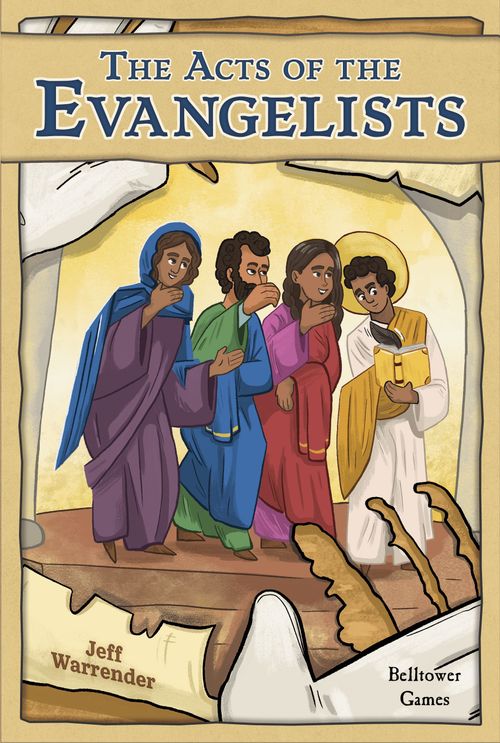
The Acts of the Evangelists
The Acts of the Evangelists Rulebook
Table of Contents
Table of Contents
Game Equipment
- 1 game board
- 6* player pawns
- 24* player cubes
- 3 boats
- 72 tradition cards (2 decks)
- 36 interview cards
- 25 codex leaf cards
- 6 theme cards
- 15 status cubes
- 3 action octagons
- 9 eyewitness discs
- 5 follow tokens
- 1 pad of score sheets
- 1 bag
- 1 time track marker
*Note: The game is only playable for 5 players, however the player colors match the themes, so there is an additional color to choose from.
Game Setup
- Place the game board on the table.
- Place one boat piece each in Rome, Ephesus, and Caesarea.
- Randomize the nine eyewitness discs, and place one in each city.
- Place all six white ("alive") status cubes and two black ("dead") status cubes into the bag. Place the other black status cubes in a supply near the board.
- Place the time track marker (black octagon) on the time track on the space corresponding to the number of players ("2-4", or "5").
- Separate the interview cards into nine piles (4 cards each) by witness, and place near the board.
- There are two tradition card decks. The primary deck has colored boxes on its back-printing. Shuffle this deck and deal four cards from this deck, face-down, next to the tradition box of each city. Splay the cards so that the color on the back of all four cards in each tradition box can be readily seen by all players.
- The secondary deck has white backs. Arrange the cards in this deck in numerical order from 1 to 36, and place it near the game board. The secondary deck is never shuffled.
- Shuffle the theme cards and deal one to each player, face-up; place unused theme cards back in the game box.
- Each player takes three codex leaves. Lay these in front of you, adjacent to each other with short edges touching. These form your gospel (currently blank!).
- Assign one player to be the game's stenographer. Hand that player the notepad, pencil, and the three action octagons.
- In clockwise order beginning with the stenographer, each player: select a pawn and place it in any city of your choice, but not one containing another player's pawn. Take the four cubes in the same color as your pawn.
- Suggestion: If all players agree, each player may use the pawn color that corresponds to the theme card they were dealt.
- Give each player other than the stenographer one follow token; give the player to the stenographer's right a second follow token.
Game Play
The game lasts 6 rounds with 2-4 players or 5 rounds with 5 players. Players take turns in clockwise order, with the stenographer taking the first turn each round.
On your turn you will spend action octagons to take actions, which let you travel to different cities, collect tradition cards, interview witnesses to gain tally marks on the score sheet, and, when necessary, adjust the order of the pages of your gospel.
You have three action octagons each turn. When you take an action, pay the appropriate number of octagons by placing them into the corresponding action circle on the board.
When you have used all of your action octagons (or do not wish to use any more), your turn ends. Clear the action octagons off the board and pass them to the player on your left.
Taking Actions
Each action has a weak version (costing one action octagon) and a strong version (costing two action octagons).
Other players may follow your action. If another player wishes to follow a weak action, they must give you a follow token. However, if you take a strong action, other players may take the associated follow action for free.
Note: For each action that you take, each opponent may follow at most one time. They may not give you another follow token to follow the same action twice.
End of Round
After each player has taken a turn, advance the time track marker one space down. Remove all white status cubes from eyewitness discs on the board and return them to the bag. Take one white cube from the bag and remove it from the game. When the marker reaches a space with a codex leaf symbol, each player: add one codex leaf to your Gospel, either to the left or right end.
If the track is not on the "Game End" space, a new round begins.
Actions Explained
Travel (once per turn)
To acquire tradition cards and interview witnesses, you will have to travel between the cities of the Roman empire and interact with the Jesus communities in those cities.
Weak: Move your pawn up to two spaces, following the black lines. Each city (red circle) or waypoint (black circle) counts as one space.
Strong: Move your pawn to any city on the board.
Follow: You may move one space.
Free Action: Use a Boat (once per turn)
Once per turn, if your pawn is in a city with a boat, you may move up to two spaces, moving the boat with you. This does not require spending an action octagon, and does not have to be connected with a travel action.
If the destination city already has a boat in it, move that boat to the closest city that lacks one. If more than one such city is the same distance away from you, you choose which city to move the boat into.
Tradition (once per city per turn)
Your gospel consists of the tradition cards that you acquire and place onto your codex leaves using this action.
Anatomy of a Tradition Card
- Witnesses to this tradition (colored circles)
- Where in the chronological sequence does this card fit? (the card number; for "chronology" literary device)
- Theme (some tradition cards have two themes)
- Motif symbols (for literary device scoring)
Weak: Pick up and privately examine the tradition cards next to the tradition box for the city you are in. You may select one to keep, or may elect not to keep any.
Strong: After taking the weak action, you may escalate to a strong action to keep a second tradition card. (Pay an additional action octagon if you escalate to a strong action).
Place each tradition card you kept onto an empty slot on one of your codex leaves.
Return any tradition cards you did not keep to the city's information box; leave one of the cards you return face-up.
Follow: For one of the tradition cards the active player kept, take the matching card from the secondary deck and add it to an open slot on one of your codex leaves. If more than one of you wants the same card, the player closest to the active player on the board gets it, or, if tied, the next player in turn order.
When you claim a tradition card, you may need to update your markers on the literary device tracks (see Literary Device Tracks).
Interview (once per city per witness)
Use this action to interview witnesses to the traditions you've written about in your gospel.
Take an interview card for the witness in your city. If none are available, or if you already have a card for this witness, you may not take this action.
If the eyewitness in your city lacks a status cube, draw a cube from the bag and place it on the eyewitness disc.
If you drew a black cube, take a black cube from the supply and add it to the bag, so the bag always has two black cubes in it.
Count the number of tradition cards in your gospel that have a circle in this witness's color.
Weak: If the witness is alive (white cube), receive 3 tally marks for each of your tradition cards that match the witness. If the witness is dead (black cube), receive 2 tally marks for each of your tradition cards that matches the witness.
The stenographer marks these in your column of the score sheet in the "witness interview tally" box.
Strong: You may wait to decide whether to take a strong action until after you draw the status cube. If the witness is alive, receive 5 tally marks for each of your tradition cards that matches the witness. If the witness is dead, receive 3 tally marks for each of your tradition cards that matches the witness.
Follow: If you hold an interview card for this witness, receive 2 tally marks. Whether you hold an interview card or not, receive 1 tally mark for each tradition card in your gospel that matches the witness.
Hint: The purple, light brown, yellow, and green eyewitnesses appear on 11 tradition cards each. The other five eyewitnesses appear on 8 tradition cards each.
Rearrange (once per turn)
This action allows you to move or flip the codex leaves of your gospel, which may help you to form literary devices.
Weak: Move a single codex leaf in your gospel, or switch the two tradition cards on a single codex leaf. (Swap two cards on the same codex leaf; never swap cards from different codex leaves.)
Strong: Take the "weak" action described above as many times as you wish.
Follow: Take a single "weak" action as described above. After rearranging cards, you may need to update your marker(s) on the literary device tracks (see Literary Device Tracks).
Thematic note: Writing materials are expensive! You can rearrange pages or flip pages over, but you can't remove what has been written on a page. (Writing on papyrus is permanent, as opposed to parchment palimpsests which can be erased and rewritten).
Literary Device Tracks
Taking the above actions will often lead to the creation (and sometimes removal) of a literary device. When this happens, add or adjust one of your cubes on the affected literary device track(s) accordingly, as described below.
Inclusio
When you form a contiguous set of at least three tradition cards, all sharing the same eyewitness (colored circle), and you hold the corresponding eyewitness's interview card, place (or advance) a cube on the inclusio track. You may only claim one inclusio per eyewitness.
Thematic note: An inclusio (in-KLOO-see-oh) is a section of text that is bracketed by an overt mention of a named individual; that individual is understood to have provided the eyewitness testimony for that section.
Chronology
When you have three tradition cards that increase in number going from left to right, place your cube at "3" on the chronology track. When you add tradition cards, adjust your cube on the chronology track according to the size of the largest contiguous cluster of tradition cards that increase in number order moving from left to right.
Thematic note: The gospel writers took some creative license with the chronological arrangement of their material.
Notes:
- Tradition cards separated by empty slots are considered contiguous for the purposes of literary devices.
- A tradition card may be part of more than one literary device, including more than one instance of the same literary device.
Emphasis
When you have four tradition cards that all share a motif symbol, place (or advance) a cube on the emphasis track. The cards do not have to be contiguous.
Chiasm
When your gospel contains a contiguous set of four tradition cards for which the first and fourth card share a motif symbol and the second and third share a different motif symbol, place (or advance) a cube on the chiasm track.
A card may be part of more than one chiasm, but the same four cards may only ever count as one chiasm.
Thematic note: A chiasm (KEE-az-um) is an ABBA structure, useful for ease of memorization in a society in which literacy was rare.
Knowledge Check
Miriam just added card 29 to her gospel. She has interviewed Mary Magdalene (pink), Matthew (yellow), and Mary&Clopas (grey). Where should her cubes be on the inclusio, emphasis, chiasm, and chronology tracks?
(Answer: inclusio: 1, emphasis: 1, chiasm: 2, chronology: 5)
Game End
The game ends when the time track marker moves onto the "Game End" space, after the 6th round (2-4 players) or 5th round (5 players). Proceed to final scoring.
Final Scoring
Players score points for the following contributions. The stenographer records each player's score on the appropriate row of the score sheet.
Tally Marks
Write the number of tally marks each player has in the witness interview tally box into the total tally marks box below it, as a number. (e.g. 37 tally marks = "37")
Literary Devices
Evaluate each literary device track separately. For each track, only players with cubes on the track may score points.
Each track has six scoring levels: 15/11/8/6/4/2/0 points.
The player in the highest position on a literary device track achieves the highest scoring level. Each space behind that player's cube is one scoring level lower.
Write each player's score for each device in the corresponding row on the score sheet.
Example: Grey/Pink/Blue/Red have achieved 8/8/7/5 on the Chronology literary device track. Grey and Pink are the highest (15 points), on "8". That means that 7/6/5/4/3 are worth 11/8/6/4/2 respectively. Blue is on 7, and receives 11 points. Red is on 5 and receives 6 points.
Tie Penalty
Count the number of cubes of other players on spaces that your cubes occupy on the literary device tracks. Write this number in the "tie penalty" box at the bottom of the score sheet.
In the previous example, Grey and Pink would receive (at least) 1 in their tie penalty box because they share a space on the Chronology track.
Theme Cards
Count the tradition cards that match your theme card. The player with the most such tradition cards achieves the highest scoring level, 15 points. For each card less that another player has, the player moves down one scoring level. The scoring levels are the same for theme cards as for literary devices: 15/11/8/6/4/2/0
Theme Bonus
If at least half of your tradition cards match your theme, receive 5 additional points.
Example: Miriam/Sarah/Joanna/Stephen have accumulated 6/4/4/1 tradition cards matching their themes, respectively. Miriam receives 15 points, Sarah and Joanna 8 points each, Stephen 2 points. Additionally, Miriam is entitled to the 5 point theme bonus because more than half of her tradition cards match her theme.
Identifying the Winner
The stenographer adds up all of the points in each player's column (subtract the number in the tie penalty box) to determine each player's final score. The player with the highest score is the winner!
In the event of a tie, the player with the most tally marks is the winner.
Motifs
The meanings of the five motifs on the tradition cards have no gameplay significance, but for those interested, they are as follows:
- Palm of blessing: Compassion/mercy
- Crown: The coming kingdom of God
- Footprints: Biographical details of Jesus' life
- Coin: The cost of discipleship
- Explosion symbol: Conflict with the Jewish religious elites
Actions Summary
Travel (once/turn)
- Weak: Move 2 spaces
- Strong: Move to any city
- Follow: Move 1 space
Tradition (once/city/turn)
- Weak: Claim 1 card
- Strong: Claim 2 cards
- Follow: Take one of the claimed cards from the secondary deck
Interview (once/witness)
If you pull a black cube, add a black cube from the supply to the bag.
- Weak: Receive 3 (alive) / 2 (dead) tally marks per circle
- Strong: Receive 5 (alive) / 3 (dead) tally marks per circle
- Follow: Receive 2 tally marks if you hold the witness's card. Receive 1 tally mark per circle
Rearrange (once/turn)
- Weak: Move or "flip" one codex leaf
- Strong: Move and/or "flip" any number of codex leaves
- Follow: Move or "flip" one codex leaf
Boat (free action)
- Move 2 spaces with boat
Literary Devices Summary
- Inclusio: 3+ cards in a cluster, all with same witness, and you hold the interview card
- Emphasis: 4 cards with the same motif, anywhere in your gospel
- Chiasm: 4 card cluster, 1st and 4th share a motif, 2nd and 3rd share a different motif
- Chronology: A cluster of cards whose numbers increase from left to right
Scoring Summary
Scoring levels for literary devices, theme: 15/11/8/6/4/2/0 points