The 7th Continent
The 7th Continent Rulebook
Table of Contents
Table of Contents
- Contents
- Object of the game
- In short
- Card types
- Overview
- Setup
- Turn sequence
- Action resolution
- Consequences of actions and events
- Life force – Action Deck and Discard Pile
- Exploring the continent
- Items
- Saving the game
- Resuming the game
- Win or die!
- Leaving or joining a game in progress
- 7 easily forgotten rules
- Definitions
- Icons
Contents
- This rulebook
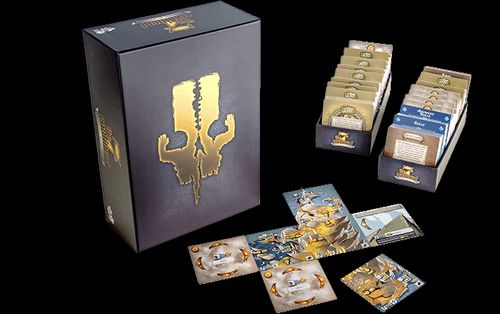
- 962 cards divided in different "decks":
- 683 numbered Adventure cards (with a green or gold back)
- 135 Exploration cards (with a foggy back)
- 118 Action cards (with a blue back)
- 11 Character cards
- 1 "Satchel & Journal" card
- 4 Clue cards
- 10 Save cards
- 7 explorer figures
- 4 fire figures (1 per player)
- 8 6-sided dice serving as durability counters for items within inventories
- 4 player aids
- 3 storing trays and 30 dividers to make it easier to find any card you need
- 1 magnifying glass to help you scrutinize all cards in play
- 1 double-sided holder for the Action cards' Discard Pile
Object of the game
YOU HAVE BEEN CURSED!
To win the game, players must lift each and every curse that they chose at the beginning of the game.
Do not worry – the game will clearly let you know when this happens!
Note: this box contains the following curses: "The Voracious Goddess", "The Bloody Hunt", "The Offering to the Guardians" and "The Dark Chest of the Damned". Expansions contain more curses that will add several hours of adventure and fun. You may add the cards of an expansion to the game even if you initially choose not to play with the curse that it comes with.
In short
The 7th Continent is a cooperative adventure, exploration and survival board game, in which you play against the game and try to lift the curses that have been placed on you. You may take up the challenge on your own or in a team of 2, 3 or 4 explorers.
Once you have selected your character, you will explore the seventh continent by resolving Exploration cards and putting numbered Adventure cards (Terrains and Permanent events) into play, which will gradually form the Board.
During the game, players decide collectively and freely which character will perform an action among those that can be seen on the Terrain card their figure is standing on, the Permanent event cards attached to that Terrain card, and the cards he/she has in hand and in his/her inventory.
To take these actions, you will use an Action Deck that represents the collective life force of your characters. All actions work the same way: you must pay their cost (the amount of energy needed to perform the action) by drawing a minimum required number of cards from the Action Deck, and obtain a minimum required number of successes (depending on the action's difficulty) to perform them successfully. These successes appear in variable amounts on the cards you have just drawn.
Then, you will apply the consequence of the action, which depends on the success or failure of the action.
Failing at performing an action may have nasty consequences, such as causing you to take negative State cards, which may force you to discard cards from the Action Deck, thereby reducing your life force.
Want to stack all the odds in your favor? You may choose to draw more cards from the Action Deck to get more successes. However, every card in the Action Deck is a bit of your life force and when the Action Deck is exhausted, so are you – then, every action might well be your last.
Thankfully, the Skill and Bonus cards you have in hand, the Item cards in your inventory and the help from your companions in misery will make things easier for you, particularly by decreasing the cost of your actions or by increasing your chances of success.
Unlike most board games, The 7th Continent will make you experience one extended, non-stop adventure. It will take several hours of exploration and adventure to lift each curse… or die trying. This is where the easy saving system comes in so handy: you can stop playing at any time and resume your adventure later on.
We recommend that your sessions run between one and two hours, since some events – game/prey returning to be hunted, for example – cannot happen unless you save the game (as if you had camped for the night).
Note: as you play, you will discover that if you want to beat the 7th Continent and lift your curses, you will need to use your very best survival skills – gather food (by hunting or fishing, for instance) in order to regain some life force, craft items to help you survive dangerous situations, boost the Action Deck with Advanced Skill cards you can gain by spending the precious experience points you have earned, and so on.
Example: Fight action
- Draw 2 or more cards from the Action Deck to perform the action.
- Get 1 or more successes to succeed.
- Apply this consequence(s) if you succeed.
- Apply this consequence(s) if you fail.
Card types
1. Adventure cards
Green or gold numbered cards include the terrains you will discover as you explore the continent, the predefined events (places, encounters, etc.) you can trigger, items you can find, as well as many more surprises to be discovered! Each Adventure card shows: a unique ID number, a card number, and flavor text.
TERRAIN — Terrain cards are portions of the continent that remain in play on the Board. A player may move their figure to a Terrain card, take the actions shown on it, and use the resources shown on it to craft items at cheaper cost. They show: available action(s), available resource(s), and Exploration card(s) to be put into play in the space indicated by the arrow.
PERMANENT EVENT — Permanent event cards remain in play on the Board after they have been revealed (see "A permanent event"). They are attached to the Terrain card in the direction their placement arrow points. They show: placement arrow(s) (pointing towards the Terrain card the event is attached to), the performed action that has caused the event to be put into play, flavor text, and effect(s) and/or available action(s).
TEMPORARY EVENT — Temporary event cards are discarded (unless stated otherwise) into the Past – the play area into which players discard Adventure and Exploration cards – immediately after they have been resolved. They show: card type (Temporary event), title, flavor text, effect(s) and/or available action(s), and keywords.
Important! Card text overrides this rulebook.
ITEM — Item cards are placed in the players' inventories and help them perform certain actions more easily or enable them to take new actions. They feature a die icon showing the number of times the item can be used before it is destroyed. They show: card type (Item) and initial durability, title, flavor text, effect(s) and/or available action(s), and keywords.
QUEST ITEM — Quest item cards provide the players with helpful information and, in some cases, enable them to use positive effects or take new actions. They are stored under the "Satchel & Journal" card and the players may look at and read them at any time. They show: card type (Quest item), title, flavor text, effect(s) and/or available action(s), and keywords.
STATE — State cards are harmful cards that players add to their hands after obtaining them along the adventure, generally when they fail at performing an action. In most cases, how you can get rid of a State card is explained on the card. They show: card type (State/Character), title, an indication if taking this state causes a loss of vital force, and effect(s) and/or available action(s).
BONUS — Bonus cards are positive cards that players add to their hands after obtaining them along the adventure, such as companions, positive states and side quests that players can complete. They show: card type (Bonus), title, flavor text, effect(s) and/or available action(s), and keywords.
2. Exploration cards
Exploration cards are events that occur randomly as you explore the continent. They can be permanent events, temporary events, found items, etc. Each Exploration card belongs to the area of the continent represented by the Roman numeral (I, II, III, IV, etc.) shown on the back of the card and on the Terrain card it is attached to.
Note: the unique ID number of an Exploration card can be seen on its front, in the top-right corner.
They show: area, placement arrows (pointing towards the Terrain card that caused the Exploration card to be put into play), and available action.
3. Action cards
Action cards include Skill cards and Curse cards. Together, they form the Action Deck, that enables you to perform actions (see "Action resolution") and represents the players' life force (see "Life force – Action Deck and Discard Pile").
SKILL — Skill cards enable you to craft helpful items or benefit from positive effects. They show: card type (Skill), title, purchasing cost (Advanced Skills only), successes the card generates when revealed during the Result step of an action, effect(s) of the skill, effect(s) of the item (once it has been crafted), keywords, and unique ID number.
CURSE — Curse cards decrease the odds that players perform an action successfully (since they are worth zero success). They also cause all players to lose when they get drawn from the Discard Pile during the Cost step of an action while the Action Deck is empty. They show: card type (Curse) and title.
4. Character cards
Character cards present the portraits and background stories of the explorers that players personify. They also display the character's abilities. They show: card type (Character/State), title, effect(s), flavor text, and the corresponding figure.
5. "Satchel & Journal" card
Players start the game with this card, under which they will store any Quest item cards acquired along the adventure. It shows: hand size and inventory size limit (depending on player count), title, and flavor text.
6. Clue cards
Before the game begins, players select the Clue card(s) that correspond to the curse(s) they wish to try and lift. Each clue provides a piece of information that helps solve the curse it is associated with. A clue is a Quest item card, so once selected, it is stored under the "Satchel & Journal" card and the players may look at and read it at any time. They show: card type (Quest item), title, flavor text, and clue and/or effect and/or available action(s).
7. Save cards
When you wish to save the game, use Save cards to store the cards that are in the Action Deck and the Discard Pile and to keep track of the durability of the items in all players' inventories.
Overview
ADVENTURE DECK — The Adventure Deck contains all numbered cards with a green or gold back. These cards may be terrains, events, items, etc.
EXPLORATION DECK — Exploration cards are random events and may have a variety of effects. Players must reveal and resolve an Exploration card before they can put the Terrain card it "hides" into play and therefore continue exploring the continent.
BOARD — Players build the Board as they explore the continent by putting face-up Terrain and Permanent event cards and face-down (foggy side up) Exploration cards into play.
PAST — The Past is the area where all Adventure and Exploration cards discarded during the game go to. Players may freely look through the cards in the Past, which must be returned to their respective original decks between two game sessions. All players use the same Past.
ACTION DECK — The Action Deck contains Skill and Curse cards. Players pay for the cost of the actions they take by drawing cards from this deck. All players use the same Action Deck.
DISCARD PILE — The Discard Pile is where all Action cards discarded during the game go to. Players may freely look through the cards in the Discard Pile as long as there are cards left in the Action Deck. All players use the same Discard Pile.
SATCHEL & JOURNAL — All Quest item cards gained along the adventure must be stored under this card, which is shared by all players.
HAND — Each player has a hand that is empty at the beginning of the game, except for their Character card. A player's hand may contain a limited number of Skill and Bonus cards (this number depends on player count – see "Satchel & Journal" card) and an unlimited number of State cards (however, no more than 1 of each state type).
INVENTORY — Each player has their own inventory. It is empty at the beginning of the game and will contain the Item cards they found or crafted. Each player also has dice that serve as durability counters for the items they have in their inventory.
CHARACTER FIGURES — The figures of the explorers taking part in the adventure.
Setup
Important! During setup, do not look at the front of any Adventure cards and Exploration cards. You may look at all the other cards freely.
- Each player chooses a Character card and adds it to their hand (remember to read the background story on the back).
- Each player takes their character's figure and one fire figure.
- Place the "Satchel & Journal" card face up in front of one player.
- Optional – take a 777 card if you wish to play in "easy" mode, or a 650 card if you wish to play in "hardcore" mode (see "Win or die!").
- Each player takes a number of dice based on player count, as shown on the "Satchel & Journal" card: 4 in solo / 3 with 2 players / 2 with 3-4 players.
- Choose one or more Clue cards and store them under the "Satchel & Journal" card. Return any unselected Clue cards. You may choose several Clue cards if you wish to fight multiple curses at once. However, this makes the game significantly harder, since you will need to lift all the curses corresponding to these Clue cards to win the game. Therefore, we do not recommend you to do so in your initial games.
We recommend you to play against "The Voracious Goddess" curse on your first game (starting on the 010 card, as indicated on the curse's Clue card).
- Shuffle the following cards together to form the Action Deck:
- The 35 Skill cards that are common to all characters;
- The 5 Skill cards that are specific to each of the characters taking part in the adventure (the character's portrait can be seen on these);
- The Curse card(s) associated with the Clue(s) you have selected (Curse and Clue cards have the same title);
- The 4 Curse cards titled "Death is lurking!".
- If you have it, assemble the Discard Pile holder and place it next to the Action Deck.
- Sort Exploration cards by area (I, II, III, IV, etc.) and then shuffle each pile and store it behind the corresponding divider (I, II, III, IV, etc.) in the game box, with the foggy side towards you.
- Sort the green and gold Adventure cards by ascending order (000 card on top), then place them in the storing trays with their numbered backs towards you, using the dividers [050, 100…]. Important! Green cards will always be placed before any gold cards bearing the same number.
- Take the Adventure card indicated on the Clue card you have chosen (take the lowest numbered one if you have chosen multiple Clue cards), read the flavor text at the back of the card and then put it into play to form the Board. This Adventure card is the starting Terrain card of your adventure. Place the figure of each character taking part in the adventure on that card.
- Place an Exploration card, foggy side up, next to each arrow visible on the starting Terrain card, making sure that their text is oriented the same way as on the other cards on the Board. These Exploration cards must bear the same Roman numeral as the Terrain card they are attached to.
- Read out the introduction text "Read this before you set off for a new adventure" as well as the Clue card you have selected (front AND back).
Turn sequence
Choose the active player
On each turn, one player is collectively chosen to be the "active player" (it may be the same player as on the last turn if all players agree). If players cannot reach an agreement, the player to the left of the last active player becomes the new active player.
Check for other involved characters
Any player whose figure is on the same Terrain card as the active player's may get involved in the action (if the active player agrees) and thus use cards in their hand and/or inventory to help the active player.
Take an action
The active player resolves the action of their choice among those visible (as an icon in a white square) on:
- the Terrain card their figure is standing on;
- an Exploration card attached to the Terrain card their figure is standing on;
- a Permanent event card attached to the Terrain card their figure is standing on;
- a Temporary event card they have just revealed (this action is mandatory);
- a Skill, Bonus or State card they have in hand;
- an Item card in their inventory;
- a Quest item card that is under the "Satchel & Journal" card.
Once the action has been entirely resolved, a new turn begins.
Important! An action cannot be taken if:
- another action is in progress;
- it has a prerequisite that players cannot meet;
- it has the "all characters get involved" icon and one or more players are not involved in it;
- this action is visible in the placement arrow of a Permanent event card attached to the Terrain card the player's figure is standing on – this means that the action has already been performed and cannot be performed again on this Terrain card.
When the active player reveals a mandatory action, the involved players must first finish resolving the current action, and then immediately resolve that mandatory action.
Action resolution
An action is characterized by: an icon in a white square, its default cost, its difficulty (minimum number of successes you need to succeed), its consequences if you succeed and, in general, its consequences if you fail.
Important! If the "all characters get involved" icon is associated with an action, it cannot be performed unless ALL characters get involved in it.
Example — Dig action: Draw 6 or more cards from the Action Deck to perform the action. Get 1 or more successes to succeed. Success – the active player takes a 063 card. Failure – each involved character takes a 101 card.
AN ACTION IS RESOLVED BY THE FOLLOWING SEQUENCE:
1. Item
Each player involved in the action may use one or more items from their inventory, by removing 1 pip from the value of the die resting on each used item (no matter how many Item cards the item consists of). If that value reaches zero, the die is removed. For each item used this way, the player will be able to apply – at most once during the action – some or all of the effects of one or more Item cards it consists of, provided an icon associated with the effect matches the current action.
Note: as a reminder of which items you are currently using, you may move their die onto their artwork.
2. Cost
a. The active player determines the cost of the action:
- The default number of cards to draw from the Action Deck (shown in the blue diamond to the right of the action icon);
- If more than one player is involved in the action, they may decide to lower the cost of the action by any number (-X cards to draw) and, on the other hand, increase the difficulty of the action by the same amount (+X required successes). This option is not available if the "locked" icon is associated with the action;
- Each player involved in the action may apply the effects of one or more cards from their hand, of one or more Item cards from their inventory used during step 1 (Item), of one or more Permanent event cards attached to the Terrain card their figure is standing on, and/or of one or more Quest item cards, in order to decrease the number of cards to be drawn.
b. The active player draws a number of Action cards equal to the final cost of the action and places them face down in front of him/her.
- The active player may draw additional Action cards if they wish to boost their chances of succeeding, unless the action has a "locked" icon. Any such additional cards are placed face down next to those previously drawn.
Note: the cost of an action may be zero, but never less than zero. In cases where the cost is lowered below zero, consider it to be zero.
Important! Usually, the active player must draw cards from the top of the Action Deck. If the Action Deck is empty, the active player must shuffle the Discard Pile, place it face down and draw from it randomly instead. In this case, if they reveal a Curse card drawn from the Discard Pile, the game ends immediately and players lose (see "Life force – Action Deck and Discard Pile").
3. Result
Now, the active player reveals all the cards drawn during step 2.b:
- If a Curse card is revealed and it has been drawn from the Discard Pile while the Action Deck is empty, the game ends immediately and players lose.
- Otherwise, total the successes you have obtained:
- Count the successes represented as full gold stars. You may freely combine any half-stars visible on the revealed cards as long as both their cards are facing the same way, in order to construct full gold stars.
- Each player involved in the action may apply the effects of one or more cards from their hand, of one or more Item cards from their inventory used during step 1 (Item), of one or more Permanent event cards attached to the Terrain card their figure is standing on, and/or of one or more Quest item cards, in order to obtain additional successes.
If the active player obtains at least as many successes as required by the action, the action is a success. Otherwise, it is a failure.
Important! Each "lucky 7" icon shown on certain Item and Skill cards is worth 1 success per icon obtained during this step.
Any success and "lucky 7" icons in the left strip of Skill cards are only taken into account when these cards are revealed during this step, not when they are in a player's hand or inventory.
4. Skill
The active player may choose one Skill card among those revealed during step 3 (Result). They may add that card to their hand or to the hand of another player involved in the action, even if the card exceeds the hand size limit.
Important! A Skill card that is specific to a character may only be added to that character's hand. A player may never add a Curse card to their hand.
5. Discard
Discard all other cards drawn during step 2 (Cost) into the Discard Pile. Discard any Item cards that no longer have a die associated with them into the Discard Pile (Action cards) or the Past (Adventure or Exploration cards).
6. Consequence
The active player applies the consequence of the action, depending on its result.
If the action is:
- a success – they apply the effects shown in the white section;
- a failure – they apply the effects shown in the black section.
If there is no such section, failing this action has no consequence.
Unless stated otherwise (e.g. "each involved character…"), the consequence of an action only applies to the active player.
Important! If a collective action (one with several involved characters) is a failure, the active player must take a 100 card – they become paranoid – right after applying the consequence of the action.
7. Hand size limit
Any involved player who has more Skill and/or Bonus cards in hand than the authorized limit must discard any excess cards of their choice.
Action resolution example
Bruno wants to take a Dig action: draw 6 or more cards, get 1 or more successes, and on success take a 063 card, on failure each involved character takes a 101 card. Ludovic offers his help and Bruno agrees. Ludovic will then be able to use cards from his hand and/or inventory in order to help Bruno.
- Step 1: Bruno decides to use the shovel in his inventory, which will help him dig more easily. He removes 1 pip from the value of the die resting on the "Shovel" card.
- Step 2: Bruno decides to apply the effect of his shovel to draw 2 fewer cards, bringing the action's cost from 6 (with difficulty 1) down to 4 (with difficulty 1). Since they are performing the action collectively, Bruno and Ludovic decide to lower the number of cards they must draw by -1. As a result of this choice, they must increase the required number of successes by +1. The action they are performing together is now cost 3, difficulty 2. Bruno draws 3 cards from the Action Deck and places them face down in front of him.
- Step 3: Bruno reveals the 3 cards drawn during the Cost step. The first card shows 1 right half of a gold star and the "lucky 7" icon. The second one is a Curse, which is worth zero success but has no other consequences, since it was drawn from the Action Deck. The third card shows 1 left half of a gold star. Bruno manages to couple both half-stars and obtains his first success. His shovel brings him 1 success for each "lucky 7" icon obtained during the Result step. Bruno therefore obtains a second success.
- Step 4: Bruno already has 3 Skill cards in hand, which is the character limit with 2 players, so he decides to let Ludovic add one of the two revealed Skill cards to his hand instead. In the end, Ludovic has obtained a new skill by helping Bruno to dig!
- Step 5: Bruno discards the Curse card and the Skill card that was not kept during the Skill step.
- Step 6: since the number of successes obtained (2) is greater than or equal to the required number of successes (2), the action is a success. Bruno therefore applies the consequence shown in the white section by taking a 063 card.
Odds of success
Here are your chances of succeeding at performing an action, depending on its difficulty and the number of cards you draw during the Cost step:
| Required successes | 1 card | 2 cards | 3 cards | 4 cards | 5 cards | 6 cards |
|---|---|---|---|---|---|---|
| 1+ | 55% | 88% | 97% | 99% | 99% | 99% |
| 2+ | 6% | 45% | 75% | 90% | 97% | 99% |
| 3+ | 2% | 14% | 39% | 65% | 82% | 91% |
| 4+ | – | 2% |
These figures – which are constant throughout all player counts – are based on the number of successes (not the "lucky 7" icons) shown on the 35 initial Skill cards, that are common to all characters, and on each character's 5 specific Skill cards. They do not take Advanced Skill cards into account.
Consequences of actions and events
Take a card summoned by a numbox
When taking a numbered card as a consequence of an action or an event, the active player must take it from the Adventure Deck.
If one or several cards match the number: the active player randomly takes one of the green cards and then reveals it. If there are none, they must take a gold card instead.
Important! A player may only take a gold card if there are no available green cards bearing the same number in the Adventure Deck. If the only available card(s) has a gold back, make sure that a green card bearing the same number can be found behind the "The Past" or the "Banished cards" divider. If not, you might have put it in the wrong place.
If no card with that number is available: the active player must immediately return ALL the Adventure cards in the Past to their place in the Adventure Deck and shuffle all the Exploration cards in the Past back into the Exploration Deck. They then take the newly available card as explained above.
If several involved players are to take a numbered card: the active player takes his/her card first and resolves it before the next involved player in clockwise order does the same.
Note: the flavor text on the back of the Adventure cards often contains helpful details. Likewise, the consequence texts of actions and events are important. Be sure to read them carefully!
If the numbox is associated with a banner
When a numbox comes with a banner (blue or purple), the active player may either take a card matching the number in the numbox, or take a card whose number is equal to the number in the numbox + the number associated with the pictograph in the banner, provided one involved character is using an Item (by lowering its durability) or a Quest item card showing this pictograph and the associated number.
Example: Bruno takes a swim/sail action, the consequence of which is to take a 159 card. Since Bruno has a raft in his inventory and it shows a +5 banner, he may either take a 159 card, or take a 164 card (159+5), if he used his raft during the Item step.
Note: most Clue cards have a purple banner on the front, which is crucial at certain moments in the game to resolve the corresponding quest.
Once this card has been revealed, if it is...
A TERRAIN — The active player must put this card into play by placing it on the Board where instructed by the card that enabled them to take it, making sure that it is oriented the same way as the other cards on the Board. Once that Terrain card is in play, the active player must place new Exploration cards, foggy side up, in each free adjacent space an arrow points towards. These new Exploration cards must bear the same Roman numeral as the Terrain card they are attached to.
Note: Terrain cards are generally put into play when an Exploration card is replaced or as a consequence of an event. Putting a Terrain card into play does not cause any figures to be moved automatically onto it.
A PERMANENT EVENT — The active player must put this card into play by placing it on the Board, making sure that its placement arrow points towards the Terrain card their figure is standing on and that the card is oriented the same way as the other cards on the Board. This Permanent event is now attached to the Terrain card its placement arrow points towards, meaning that any actions, resources, and/or effects shown on the Event are now available to any player whose figure is on the Terrain card it is attached to.
Note: the action icon in the placement arrow reminds you which action caused you to take the card. As long as this card is in play, that action may not be taken again from the Terrain card to which the Event is attached.
A TEMPORARY EVENT — The active player must resolve this event and then discard the card into the Past – or banish it if the card states so.
Important! If a temporary event shows a mandatory action, all players involved in the current action MUST take it right after the current action has been resolved and no other player may get involved in it (the active player remains unchanged).
AN ITEM — The active player may:
- add this card to their inventory, placing a die on it or combining it with an existing item in their inventory (see "Combining an item");
- or give this card to another player who was involved in the action, so that this player adds it to their own inventory;
- or discard this card into the Past if they do not wish to keep it.
The number of dice each player owns and the number of Item cards they may combine under a single die depends on the number of players:
- 1 player: 4 items (dice), consisting of up to 4 Item cards each.
- 2 players: 3 items/player, consisting of up to 3 Item cards each.
- 3 players: 2 items/player, consisting of up to 3 Item cards each.
- 4 players: 2 items/player, consisting of up to 2 Item cards each.
A QUEST ITEM — The active player must slip this card under the "Satchel & Journal" card.
A SKILL or A BONUS — The active player may:
- add this card to their hand;
- or give this card to another player who was involved in the action, so that this player adds it to their own hand;
- or discard this card into the Past if they do not wish to keep it.
A STATE — When a player reveals a State card, if the vital force loss icon can be seen on it, then they must immediately discard as many cards from the top of the Action Deck as they have Character/State cards in hand – unless an effect prevents them from getting that state. If there are no cards left in the Action Deck, the player randomly reveals cards from the Discard Pile instead. In this case, if one of the cards revealed from the Discard Pile is a Curse, the game ends immediately and players lose. Otherwise, all the revealed cards are shuffled back into the Discard Pile (see "Life force – Action Deck and Discard Pile").
The player must then add this card to their hand, unless an effect prevents them from getting that state. If they already have a State card with the same title in hand, they must return it to the Adventure Deck and replace it with the State card they have just taken.
Note: if a player takes several State cards at once, they must resolve them one by one in the order – left to right – they are referred to in the piece of text that instructed them to take these State cards.
If several players must take a state at the same time, the active player does first (they return any state bearing the same name from their hand, if applicable), then the next concerned player in clockwise order and so on, until all the concerned players have taken this state.
Note: there is no limit to the number of differently titled State cards a player may have in hand. How one gets rid of a State card is usually explained on the card.
Example: Bruno has the following State cards in hand: paranoid and freezing. He takes an action and Ludovic decides to get involved in it. The action is a failure and the consequence is "Each involved character takes a 104 card". Bruno takes a 104 card and gets injured. Since the vital force loss icon can be seen on the revealed card, Bruno immediately discards 3 cards from the top of the Action Deck (1 for his Character card, 1 for his paranoid state, and 1 for his freezing state), then he adds the injured State card to his hand. Ludovic too takes a 104 card. Since the icon cannot be seen on this card, he does not have to discard any cards from the Action Deck. Ludovic adds the injured State card to his hand. Since several players were involved in the action and it was a failure, Bruno, as the active player, must take a 100 card and gets paranoid. The vital force loss icon can be seen on the revealed card, so Bruno immediately discards 4 cards from the top of the Action Deck (1 for each Character/State card he has in hand). Since he is already paranoid, he returns the paranoid card he had in hand and replaces it with the paranoid card he has just taken.
Take a card not directly summoned by a numbox
The players may have to take a card in the Adventure Deck without the card being summoned by a straightforward numbox – for instance when they find a hidden number (see "Spotting a hidden number"), or add up the number in a numbox with the number in a blue or purple banner, or solve a riddle, etc.
When this is the case, a "???" icon must be visible at the back of the card you take, "???" being the number of the card that enabled you to take it. If that icon is not visible, then you must have taken the wrong card and must return it.
Discard a card
When the consequence of an action or event instructs you to discard a card, the active player must immediately put that card into the Discard Pile if it is an Action card (blue back), or into the Past if it is either an Adventure card (green or gold back) or an Exploration card (foggy back).
Banish a card
When the consequence of an action or event instructs you to banish a card, the active player must immediately remove that card from play once and for all by storing it behind the "Banished cards" divider in the box. All banished cards will be returned at the end of the game (when players lose or win).
Important! If the consequence of an action instructs you to "banish a XXX card", you must banish a green card from the Adventure Deck if possible, without looking at it.
When the "banish and replace" icon appears in the consequence of the action, the active player must banish the green card where the icon can be seen and then immediately replace it with a gold card bearing the same number.
Return a card
When the consequence of an action or event instructs you to return a card, the active player immediately places that card back in its original deck.
Lower item durability
The affected players (generally, the involved players) must lower the value(s) of one or more dice resting on Item cards in their inventories by the indicated amount, distributing that loss of durability in any way they like across several items in several inventories. When an item has a durability of zero, it can no longer lose any and all the cards forming the item must be discarded.
Example: Bruno has a shovel in his inventory and Ludovic has a bow in his. They take an action together and fail. The consequence of this failure is -2 durability. They decide to lower Bruno's shovel's durability by -1 and Ludovic's bow's durability by -1. Bruno's shovel is destroyed (the die is removed and the card is discarded to the Discard Pile) and the bow now has its durability reduced.
Move (a) character figure(s)
See "Exploring the continent".
Life force – Action Deck and Discard Pile
The Action Deck represents how much life force the whole group of players has.
As long as there are cards in the Action Deck:
- Players draw Action cards from the top of the Action Deck. If they draw a Curse card, this has no consequence.
- Players discard Action cards into the Discard Pile, which is face up and may be examined freely.
- When an effect enables players to put cards back into the Action Deck (either random or chosen cards, depending on the effect), these cards are shuffled back into it.
When the last card in the Action Deck is removed (discarded or drawn):
- Players must shuffle the Discard Pile and place it face down.
As long as there are no cards left in the Action Deck:
- During the Cost step of an action, the active player shuffles the face-down Discard Pile and then randomly draws Action cards from it. If they draw a Curse card, the game ends immediately and players lose.
- During the Discard step of an action, the active player shuffles the Action cards back into the face-down Discard Pile.
- When players must discard cards from the Action Deck (because of a vital force loss icon on a newly taken state, for example), they reveal cards from the Discard Pile instead, before shuffling them back into it. If one of these cards is a Curse, the game ends immediately and players lose.
- When an effect allows players to shuffle cards back into the Action Deck from the Discard Pile, they re-form the Action Deck with the corresponding cards. Players will then resume drawing from the Action Deck as usual, since it now contains cards again, and flip the Discard Pile face up.
Note: if a player has to draw or discard more Action cards than there are in the Action Deck, they carry out the steps described above, drawing cards from the Action Deck until it is empty, then shuffling the Discard Pile and drawing the remaining cards from the Discard Pile. In this case, if they reveal a Curse card that was drawn from the Discard Pile, the game ends immediately and players lose.
Example: there are 3 cards left in the Action Deck. Bruno decides to take a cost 5, difficulty 0 action. He draws the first 3 cards from the Action Deck, which becomes empty. He therefore sets these 3 cards aside, shuffles the Discard Pile, flips it over face down and randomly draws the remaining 2 cards from it. He reveals a Curse card, but luckily, it was drawn from the Action Deck – not from the Discard Pile – so it has no effect. Afterwards, he shuffles the cards that were not kept back into the face-down Discard Pile. Next, Ludovic takes a cost 0, difficulty 0 action, the consequence of which is to randomly take 6 cards from the Discard Pile and shuffle them back into the Action Deck. Thereby, he forms the Action Deck anew with these 6 cards.
Exploring the continent
Opening the space occupied by an Exploration card
An Exploration card is a random event that hides a portion of the continent. You need to resolve an Exploration card in order to remove it and put the Adventure card (generally a Terrain card) that belongs there into play. This is how you explore the continent.
Once the Exploration card has been resolved and discarded, the active player must put a numbered Adventure card into play, replacing the Exploration card. The number of this Adventure card is shown in the numbox associated with the arrow on the Terrain card that points towards the newly opened space.
If that Adventure card is a Terrain card, the active player must make sure that it fits with each adjacent Terrain card like in a puzzle, and then put new Exploration cards into play (foggy side up) in each free adjacent space to which an arrow on the Terrain card is pointing. These new Exploration cards must bear the same Roman numeral as the Terrain card to which they are attached.
Note: an Exploration card may be a permanent or temporary event, an item, a bonus, etc. If it is a permanent event, it remains in play (making it impossible to discover the terrain it hides) until it is resolved and discarded.
Example: Bruno performs the pathfind action and applies its consequence by flipping the Exploration card over. It is an Item card, which he chooses to add to his inventory. The space the Exploration card used to occupy is now open, so Bruno takes the 009 Adventure card, associated with the arrow visible on his Terrain card, and puts it into play in the newly opened space. From now, he will be able to move to this new Terrain card by performing the move action.
Moving to another Terrain card
The active player may take a move action visible on the Terrain card their figure is standing on, in order to apply the following consequence: "All involved characters move their figure to the same reachable Terrain card."
A reachable Terrain card is one that is connected to the active player's Terrain card by an uninterrupted series of Terrain cards (no matter how many there are).
It may happen that some permanent events (cliff, raging river, bottomless pit, etc.) showing several placement arrows separate two Terrain cards. In this case, these events feature an action whose consequence is to move the figures to the Terrain card on the other side of the obstacle.
Note: some cards refer to the cardinal points; North, South, East and West. In this regard assume card text and icons are orientated to be read from west to east.
Important! If a mandatory action can be seen on a Terrain card, players whose figures arrive onto that card must immediately take it (collectively if applicable), unless it can no longer be taken.
Spotting a hidden number
Some Terrain and Permanent event cards contain hidden numbers. When players find one, they may discard the card on which they spotted it and replace it with the card bearing that number.
Note: a hidden number is always made of 3 digits. On the back of the card matching the hidden number, you should see the number of the card on which you spotted it.
Example: on the 054 Terrain card, Ludovic has spotted the hidden number 316. He discards the 054 card and replaces it with the 316 card, on the back of which he can see the icon 054.
Not enough room to put a card into play
When there is not enough room on the table to put a card into play, all characters must meet on the same Terrain card and then players must return the Terrain cards of their choice, along with the Permanent event cards attached to them, making sure that all remaining Terrain cards are reachable. The remaining cards are repositioned to the center of the table. If applicable, players must put new Exploration cards into play in every empty adjacent space an arrow on a Terrain card points towards.
Items
Finding an item
When a player reveals an Adventure or Exploration card with the die icon, they may add it to their inventory or give it to another involved player, so that this player adds it to their inventory instead (see "Consequences of actions and events – An item").
Crafting an item
Resources include: wood, stone, foliage, vine, bamboo, bone, poison, and fire.
The craft action available on certain Skill cards enables you to turn that Skill card from your hand into an Item card that goes into your inventory or another involved player's inventory.
The items you can craft are made of resources. When these resources are available on your Terrain card or on a Permanent event attached to it, you may reduce the number of cards to be drawn during the Cost step of the craft action by -X as shown on the Skill card under each relevant resource icon.
Note: you may craft an item even if the resources it is made of are not available. When there is a fire figure on your Terrain card, you have the fire resource.
Example: the wood resource is available on this Terrain card. The number of cards to be drawn to craft a raft is therefore 5 (default cost of the action) −3 (wood resource) = 2. Had the vine resource been available on this terrain too, the cost of the craft action would have been 0.
Once the craft action has been successfully performed, the active player may:
- create a new item by adding the Item card to their inventory and placing a die on it, that show the face matching the initial durability of the item;
- or combine the Item card with an existing item in their inventory (see "Combining an item");
- or give this card to another player who was involved in the action, so that this player takes one of the two options above.
Combining an item
When an Item card is found or crafted, the player may combine it with an existing item in their inventory in order to form one single item, without exceeding the allowed "stacking" limit, which depends on player count (as shown on the "Satchel & Journal" card). In this case, the newly combined Item card is placed at the bottom of the column it is added to, in last position, making sure that the lower part of the card remains visible (effects and keywords). If the newly combined Item card shares at least one keyword with the Item card the die is resting on (at the top of the column), its durability value is added to the value of that die (to a maximum of 6).
Note: the interest of combining Item cards is threefold: having more cards in your inventory, making the initial item more efficient/versatile and increasing its durability.
Example: Bruno has a walking stick in his inventory. He decides to craft a bow. He may either put a die on the "Bow" card to create a new item, or combine the walking stick and the bow by sliding the "Bow" card underneath the "Walking stick" card. In this case, since both the "Bow" card and the "Walking stick" card have the keyword "will", the value of the die resting on the "Walking stick" card increases by as many pips as the durability of the bow. This gives a total of 8, brought down to 6, which is the maximum possible durability for an item.
Relinquishing an item
A player may relinquish an item from their inventory at any time. In this case, the die is removed from it and all the cards it was consisting of are discarded.
It is not allowed to deconstruct an item voluntarily by just discarding one card from an item that is made up of multiple cards, unless it is part of the effect of the Item card (e.g.: the "Bolas" are discarded after use).
Using an item
A player may use an item in their inventory – by lowering its durability by 1 – either to apply some or all of the item's effects when they are involved in an action to which the item's effect applies, or to take an action featured on this item. Using an item enables the player to freely choose to apply some or all of the effects of one or more Item cards it consists of.
Example: the empty can is a found item that helps you when you craft or dig. The rudimentary flint is a Skill card that enables you to craft the "Rudimentary flint" item. Once crafted, this item enables you to take the make fire action.
Giving or swapping an item
Characters that are on the same Terrain card may freely give or swap one or more full items (i.e. all the Item cards the item consists of) to/with one another. However, they must discard 2 cards from the Action Deck every time an item is given or two items are swapped. A player may not combine an item they receive from another player with another item in their inventory.
Saving the game
Players may suspend and save the game at any time, as long as all character figures are on the same Terrain card and no player is performing an action or forced to take a mandatory action.
-
Discard all the cards on the Board into the Past, except for the Terrain card all characters' figures are standing on.
-
Stack the remaining cards in the following order (from the bottom up) and put them behind the "Save" divider in the game box: a. for each character, his/her Character card, with the following cards underneath:
- i. all Skill, Bonus and State cards he/she has in hand;
- ii. for each item in their inventory, one Save card (oriented in such a way that the durability of the item appears in the upper part of the card) with the cards that the item consists of underneath it;
b. the "Discard Pile" Save card, with all the cards in the Discard Pile underneath it;
c. the "Action Deck" Save card, with all the cards in the Action Deck underneath it;
d. the "Satchel & Journal" card, with all the Quest item cards stored under it;
e. the Terrain card where figures were standing.
Resuming the game
When you resume a game after suspending it:
- Return all the cards in the Past to their place in their respective original deck (Adventure or Exploration);
- Put the saved Terrain card back into play. Place the figures of all characters taking part in the adventure onto it and one Exploration card in front of each arrow;
- Put the "Satchel & Journal" card back into play, with the cards it contains underneath it;
- Put the Action Deck back into play;
- Put the Discard Pile back into play;
- Each player takes all their Skill, Bonus and State cards back in hand;
- Each player puts the items from their inventory back into play, setting each item's die to the value shown in the upper part of the item's Save card;
- Return all Save cards to the game box.
You're now ready to go again!
Win or die!
You win!
The game ends and players win collectively if they manage to lift all the curses they had chosen to fight at the beginning of the game. The game will clearly let you know when this happens.
Easy mode
If you are more into exploring than surviving, you may choose to play in "easy" mode. In that case, take a 777 card before you begin the game.
Hardcore mode
Even if you manage to lift a curse, you can still try and play with it again later in "hardcore" mode. If you feel up to it, take a 650 card before you begin the game.
Eliminated character
A character is eliminated if the applicable consequence of an action they are involved in states "Your adventure is over". In this case, the player must:
- discard all the Skill and Bonus cards they have in hand;
- discard all the Item cards in their inventory (they may not swap and/or give them with/to another player);
- return all the State cards they have in hand and banish all Skill cards showing their character's face (whether they are in the Action Deck or in the Discard Pile).
The player may continue the adventure with a new character (see "Joining a game in progress").
You lose…
The game ends immediately and players lose collectively if one of the following occurs:
- a player reveals a Curse card drawn or revealed from the Discard Pile while the Action Deck is empty;
- the applicable consequence of an action all characters are involved in states "Your adventure is over".
Leaving or joining a game in progress
Leaving a game in progress
If the player leaves for good, apply the "eliminated character" rule. Otherwise, the player must save their cards, after swapping items with the other players if they wish to, and must then return all those of their character-specific Skill cards that are in the Action Deck and/or the Discard Pile (those in their hand and/or inventory are saved, not returned). Any of this character's character-specific Skill cards that are in another player's inventory will not be returned until they are discarded, unless the character has joined the game again by then.
Joining a game in progress
A player can easily join a game in progress or continue the adventure with their group if their character was eliminated. To do so, they choose any character they want to be, take the corresponding Character card and shuffle the 5 Skill cards specific to this character into the Action Deck. Immediately apply the new hand and inventory size limits, by discarding any excess cards and/or items in each player's hand and/or inventory. The new character's figure is placed onto the same Terrain card as the other figures.
7 easily forgotten rules
- Every time you put a Terrain card into play, place an Exploration card (foggy side up) in each free adjacent space an arrow points towards.
- A player may craft an item even if the resources it is primarily made of are not available. The resources being present simply makes it easier to craft the item.
- When a player applies the move consequence, the Terrain card they want to move their figure to must be connected to their current Terrain card by an uninterrupted series of Terrain cards.
- Players may always draw more cards than required by the action, unless the action is locked.
- "Success" and "Lucky 7" icons in the left strip of Skill cards are only ever taken into account when these cards are revealed during the Result step of an action.
- During each action, at most one involved player may take in hand at most one Skill card, regardless of the number of cards drawn and the number of players involved.
- If more than one player is involved in an action that is a failure, the active player must take a 100 card – therefore becoming paranoid – right after applying the consequence of the action.
Definitions
- Action Deck: contains the blue Action cards that players draw to perform actions.
- Active player: the player whose turn it is (the one who takes an action).
- Advanced Skill cards: new Skill cards that players can purchase at certain moments in the adventure (the game will let you know when you can) by spending the experience points they have earned.
- Adventure Deck: contains the green and gold numbered Adventure cards.
- Banish: remove a card from play once and for all. The card goes into the game box, behind the "Banished cards" divider and will be returned at the end of the game, after the players have won or lost.
- Board: the area formed by the Terrain and Permanent event cards that are in play.
- Bonus cards: positive cards that players obtain along the adventure and hold in hand.
- Character: a character played by a player. "Character" is very often synonymous for "player".
- Clue cards: cards that players choose before they begin the adventure and that provide a hint as to how to lift the corresponding curse.
- Cost: the minimum number of Action cards that must be drawn to perform the action.
- Curse cards: cards from the Action Deck that can cause players to lose (see "Life force – Action Deck and Discard Pile").
Icons
Decks: Action cards; Adventure cards; Exploration cards.
Card types: A Curse card; A Skill card; A State or Character card; A Bonus card (companion, positive state, side quest); An Item card whose durability is equal to the value of the die; A Quest item card (to be stored underneath the "Satchel & Journal" card); A Temporary event that must be resolved immediately and then discarded; A Permanent event that must be put into play, oriented in the same way as the other cards on the Board, with its placement arrow pointing to the Terrain card your figure is standing on. It is then considered to be attached to that Terrain card; The purchasing cost (in experience points) of an Advanced Skill card.
Actions:
- An action players may take (see "Action resolution").
- This action has already been performed and cannot be performed again from the Terrain card this Permanent event card is attached to.
- All players involved in the current action must take this action collectively. Other players may not get involved in it.
- The related effect may only be applied during an action of this type (if the character is involved in it).
- Players may not alter the default cost of the action (the number of cards to be drawn imposed by the action), unless they use the effects of cards from their hands and/or inventories.
- An action all players must get involved in (the consequence of this action might force them to discard all the cards forming the current Board and reset somewhere different).
- When players are on a Terrain card showing this icon, they are not allowed to take the following actions: make fire, craft and rest.
- X+ (default cost): the minimum number of cards to be drawn to take the action.
- -X: the number of cards that players may subtract (i.e. they need not draw them) from the action cost during the Cost step of an action they are involved in.
- X (difficulty): the minimum number of successes (full gold stars) you must obtain to perform it successfully.
- One success that must be added to your total during the Result step of an action the player is involved in.
- For each "lucky 7" obtained during the Result step of an action the player is involved in, the icon is worth 1 success.
Action consequences and card effects:
- Numbox (XXX): Take a card bearing this number from the Adventure Deck (green by default; gold only if no green card is available). Once it has been resolved, discard this Exploration card and replace it with an Adventure card that belongs there.
- Banish this green card and replace it with a gold card bearing the same number.
- All involved characters move their figure to the same reachable Terrain card.
- You may add together the number associated with the pictograph in this banner and the number of the card you are to take.
- -X (durability): Unless otherwise stated, the involved characters must remove a total of X pips, as chosen by themselves, across the values of the dice resting on their items. When an item's durability goes down to zero, it is discarded.
- The player must discard 1 card from the top of the Action Deck for each Character/State card they have in hand.