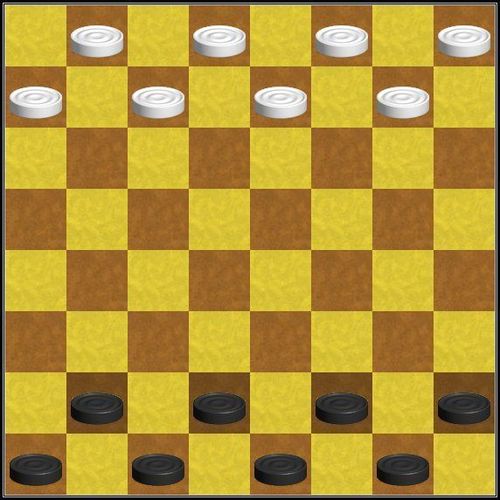
Thai Checkers
Thai Checkers Rulebook
Table of Contents
Table of Contents
- Part A: Basic Play
- Chapter A.1: General
- Chapter A.2: Setup
- Chapter A.3: How Pieces Move
- Chapter A.4: Win, Loss and Draw
- Chapter A.5: Counting for a Draw
- Part B: Competition Rules
- Chapter B.1: Thai Checkers Clock
- Chapter B.2: Irregularities
- Chapter B.3: Recording Moves
- Chapter B.4: Draw
- Chapter B.5: Conduct of Players
- Chapter B.6: Role of the Referee
- Chapter B.7: Appeals Against Rulings
- Part C: Appendices
- Chapter C.1: How to Record Moves
- Chapter C.2: Time System
- Chapter C.3: Contest System
- Chapter C.4: Tiebreaks
- Chapter C.5: Managing Team Contests
- Chapter C.6: Organising Contest Rounds
- Chapter C.7: Special Rules for Disabled Players
Part A: Basic Play
Chapter A.1: General
Article A1.1. Thai checkers is a game played between two players. Each player moves pieces on the square board in turn, moving diagonally. Both sides move alternately, one move each, and the dark-coloured side moves first. A side that runs out of pieces to move, runs out of moves on its turn, or resigns is considered to have lost, and the game ends.
Article A1.2. The Thai checkers board is a square of 8 squares per side, 64 squares in total, of which 32 are dark squares and 32 are light squares.
Article A1.3. Thai checkers is a game of alternating moves. There are 16 pieces on the board in total, divided into 8 dark pieces and 8 light pieces.
Chapter A.2: Setup
Article A2.1. Before play begins, the two players sit facing each other with the board placed between them. Each side has 8 pieces, placed on the dark squares of the back row and the row in front of it, 4 pieces per row. The dark pieces move first and are placed on the side with the higher numbers. The diagrams in the printed rulebook number the 32 playable squares 1 to 32 from each player's seat, with the light pieces on squares 1 to 8 and the dark pieces on squares 25 to 32 (the second diagram shows the same numbering from the opposite seat).
Chapter A.3: How Pieces Move
Article A3.1. A piece that is a man (เบี้ย) moves diagonally forward one square per turn. A man may not move backward.
Pieces that are kings (ฮอส) may move forward or backward diagonally in all four directions, without limit on the number of squares moved, and a king may capture several times in several ways, choosing whichever capture it wishes.
A piece counts as a king (ฮอส) when it moves onto a square on the back row of the opposing side. The opposing player then places another piece of the same colour on top of it as the sign that it has become a king.
Diagram: a dark man on square 31 with its two legal diagonal moves to squares 26 and 27.
Diagram: a king on square 15 shown with the full diagonal lines it may move along, outlined in red (squares 1, 4, 6, 8, 10, 11, 18, 19, 22, 24, 25, 28 and 29).
Article A3.2. If a piece is moved so that it stands in the path of an opposing piece, the blocking piece is captured. The side whose path is blocked captures it by moving its own piece, which is blocked, to the empty square lying immediately beyond the blocking piece, and then removes the captured piece from the board.
Diagram: a dark man on 31 captures a light man on 26 by landing on 22 (capture of 1 with a man).
Diagram: a dark man on 32 captures two light pieces in succession, landing first on 23 and then on 14 (capture of 2 with a man).
Captures may be made several times in succession. However, if a man's capture lands it on the back row so that it becomes a king, the man's turn ends there: it may not continue capturing until the opponent has had a turn.
Diagram: a dark man on 28 captures in succession, landing on 19, then 10, then on 3 on the back row, where it becomes a king (multiple capture by a man).
Capturing with a king (ฮอส). When an opposing piece stands in the path of a king that can move, the king must capture. It captures by landing on any empty square beyond the blocked piece. If, after landing, another opposing piece stands in the king's path, the king may continue capturing in the same way. This is called a "two-piece capture", as shown in the diagram.
The printed rulebook points to the two-piece diagram above for this example. Its caption there reads "capture 2 with a man", and the transcriber has kept the printed caption as it stands.
Where a capture can be made by more than one route, the player must show the capture clearly. A move is considered complete only when the piece has been released and the clock has been pressed.
Diagrams: two multiple-capture routes by dark pieces. On the left, a dark man on 3 captures along a route ending on 27 (outlined in red), with an alternative landing on 14 shown dashed. On the right, a dark piece on 15 captures along a route through 11, 18 and 22.
Chapter A.4: Win, Loss and Draw
Article A4.1. A loss arises from four cases:
- A player has no pieces left to move.
- A player has no legal move on their turn.
- A player asks to concede (resigns).
- A player is penalised and loses (โดนปรับแพ้).
Article A4.2. If both players agree to a draw, the game is drawn.
Article A4.3. If both players move back and forth so that the same position occurs three times, the game is drawn.
Article A4.4. If both players keep moving back and forth, for example moving kings back and forth with no capture, and 16 moves are completed without a man moving, the game is drawn. If the moves are not recorded, the players must call a referee.
Translator's note: the printed wording of Article A4.4 ("เดินเบี้ยเกิดขึ้น ครบ ๑๖ ก้าว") is compressed, and the translation above is a best reading of it. The phrase "no man has moved" is an interpretation, not a literal rendering; check it against the Thai page image if precision matters.
Chapter A.5: Counting for a Draw
Article A5.1. The count begins when the side that wants a draw stops its clock and asks the referee to count. The referee counts 16 moves, counting only the turns of the side that asked for the draw. If a man moves or a capture occurs during the count, the count must start again.
Part B: Competition Rules
Chapter B.1: Thai Checkers Clock
Article B1.1. Each competitor must press the clock personally. Officials and outside persons may not remind a player about pressing the clock. This must conform to the rules the Sports Association for the disabled has set (see Chapter C7, Special Rules for Disabled Players).
Article B1.2. A flag fall (ธงตก) is recorded when a player informs the referee that the opponent's time has run out, or when the referee decides it. A flag fall ends the game.
Article B1.3. A competitor on one side must wait until the other side has made its move and pressed the clock before that competitor may move and press the clock.
Article B1.4. A competitor may stop the clock only when protesting or consulting the referee about a ruling.
Article B1.5. Unless the organiser has specified otherwise: if one competitor is not present when the contest begins on the first board, that competitor is penalised and loses on that board. If the competitor is still absent on the next consecutive board, the competitor is considered to have lost in that round. In the case of a bye, the printed rule reads "count as win 1, draw 3" (ชนะ 1 เสมอ 3) and enter the result as 1F:0F.
Translator's note: the bye figures "win 1, draw 3" are transcribed as printed. They may be a typographical error in the source, and the transcriber has not corrected them. Check the Thai page image before relying on them.
Chapter B.2: Irregularities
Article B2.1. A warning consists of an irregularity under this chapter. Only the opposing competitor may protest to the referee; other persons or a deputy referee may not. The referee gives the first warning. If the referee has already given three warnings in the same round, the competitor is penalised in that round (ปรับแพ้).
The grounds for a warning are as follows:
- Moving a piece illegally (a breach of Part A, Basic Play).
Article B2.2. The following are grounds on which the referee may give a warning, or a warning-type penalty, while the contest continues as before. The referee informs the competitors of these before the contest begins:
- Not pressing the clock with the hand that moved the piece in that turn.
- Making a loud noise or disturbing a competitor in any way.
- Failing to record moves for more than 5 turns, not necessarily consecutive. A dark move and a light move together count as one turn. This applies whether a protest is made, or whether the referee finds the failure and can issue the warning directly without waiting for a protest. The competitor must complete the record during their own time. This also covers deliberately failing to record moves truthfully for more than 5 turns.
Article B2.3. Penalties without a prior warning are as follows:
- Using any electronic device during the contest, or a mobile telephone or other object that rings or vibrates and makes a sound. The competitor is penalised on that board (ปรับแพ้ในกระดานนั้น) but may continue in the next round. The referee may impose this penalty directly, without waiting for a protest.
- Witnessing or committing any cheating in the contest. Apart from the penalty of losing, the matter must also be referred to the association for consideration of punishment.
Article B2.4. A competitor has the right to protest to the referee, asking the referee to warn the opponent, once the opponent has moved and pressed the clock. If the protest is made before the opponent presses the clock, or if a competitor has made an illegal move but realises it before pressing the clock, the competitor must make a new move, legal, with the piece already touched. The competitor may move a different piece only if the touched piece has no legal move.
Chapter B.3: Recording Moves
Article B3.1. Competitors must record the game using Arabic numerals only, and must record their own moves correctly and systematically, following Appendix C1, How to Record Moves. Moves must be recorded up to date before the competitor makes the next move. The winner must take the record sheets of both sides and hand them to the referee.
In a draw, the White side must hand the record sheets to the referee. A competitor who cannot record loses the right to compete. This conforms to the rules the association has set for disabled players (Chapter C7).
If a move has not been recorded, the referee shall require the competitor to record it, using that competitor's own time, until the record is complete up to the current move. Play then continues.
Article B3.2. Competitors must show their record to the referee at all times during the contest.
Article B3.3. In a contest with a time increment of 10 seconds or more per move, moves must be recorded until the game ends. The exemption from recording while one's own time is under 5 minutes does not apply.
In a contest with no time increment per move, when one competitor's time is under 5 minutes, only that competitor need not record moves. If the opponent still has more than 5 minutes, the opponent must continue to record.
Chapter B.4: Draw
Article B4.1. A competitor may begin counting only after notifying the referee. The competitor may stop the clock so that the referee can come and count.
Article B4.2. A side may ask for a draw count only by calling the referee to count. If a man moves or a capture occurs, counting must restart immediately.
While counting, the side that asked for the count has the right to win at any time. If that side sees that it can win, it must immediately ask to stop the count. If it continues counting, the other side may then claim a draw. Once the count has stopped and the side finds it cannot win, it may resume counting later, but must start again from 1.
Chapter B.5: Conduct of Players
Article B5.1. Players must not do anything that disturbs the order of the contest.
Article B5.2. A player who is in the middle of a contest must stay within the contest area. This means the contest table area, the toilets, the smoking area or the eating area for competitors, or any other area the organiser has prepared. The player may leave the contest area only after the game in that round has ended.
Article B5.3. A player must not leave their playing chair during their own turn, except with the permission of the opponent or the referee.
Article B5.4. Once a competitor has touched or been touched by a piece, the competitor must move that piece. The exception is where that piece cannot move under the rules; the referee then allows another piece to be moved. Once the hand has released the piece on the board, the move cannot be changed. If a piece needs to be adjusted, the competitor must first ask the opponent for permission.
Chapter B.6: Role of the Referee
Article B6.1. The referee must check the competition rules and act as guardian of the rules, so that the contest proceeds in good order.
Article B6.2. The referee watches boards where time is running short, to prevent emergencies, and helps competitors who need assistance, such as with a protest or a request for an additional record sheet.
Article B6.3. The referee may press a competitor's clock when a necessary incident occurs, for example when a protest is made.
Article B6.4. The referee has authority to impose appropriate penalties on competitors or spectators, as follows:
-
A warning (โทษเตือน).
-
Adding time to the opponent of the penalised competitor.
-
A penalty of loss (ปรับแพ้) and a win for the opponent.
-
A penalty of loss for both sides.
-
A fine (ปรับเงิน). This must be announced in advance and displayed as a notice, for example a smoking penalty in the contest room.
-
Removal from the contest.
Chapter B.7: Appeals Against Rulings
Article B7.1. When a competitor has protested to the referee but disputes the ruling, the competitor may appeal to the appeals committee.
Article B7.2. An appeal is made by depositing money of no more than 2,000 baht with the committee that organised the contest, before the next round begins.
Article B7.3. The appeals committee consists of three qualified persons (ผู้ทรงคุณวุฒิ), who act as judges. They must not be referees in that contest. They may be competitors, but must have the following qualities:
- They are generally recognised as having knowledge and expertise in the Thai checkers rules.
- They appear at the contest.
- They have no connection with the parties in dispute, for example being a teacher of one side, being the referee whose ruling is disputed, or being a guardian of a party, and so on.
Article B7.4. If, after the appeal, the appeals committee reverses the referee's ruling, the deposit is returned to the appellant, and the committee's ruling is enforced. If, after the appeal, the appeals committee upholds the referee's ruling, the deposit is forfeited (ถูกริบ) to the organising body.
Part C: Appendices
Chapter C.1: How to Record Moves
Article C1.1. Moves are recorded using the square numbers on the board. For example:
- "32-28" means a move from square 32 to square 28.
- "25x18" means a capture from square 25 to square 18.
Where there are multiple captures, write the final landing square. For example, "25x11" means a capture from square 25 to square 11. The exception is where captures are made in several directions, or land on the same square; for example, "25x18x9x2" means a capture from square 25, to 18, to 9, ending on 2.
Chapter C.2: Time System
Article C2.1. A standard game is a contest in which the starting time for each competitor is 15 minutes or more. If there is a time addition in any form, or the starting time is 20 minutes or more, recording moves is compulsory.
Article C2.2. A short game is a contest in which the starting time for each competitor is under 15 minutes. Competitors are not required to record moves.
Chapter C.3: Contest System
Article C3.1. If the regulations do not specify otherwise, an individual contest uses this scoring: a win gives 1 point, a draw gives 0.5 points, and a loss gives no points. It is customary to draw lots for the colours of the top-ranked players before the contest begins, or a random programme may be used.
Translator's note: Article C3.1 gives a draw as 0.5 points. Article B1.5 prints the bye figure as "draw 3" (เสมอ 3), which may be a typographical error for 0.5; the transcriber has left B1.5 as printed.
Article C3.2. The Swiss System Pairing is a contest system that pairs competitors with equal scores to play one another, repeating round after round until all rounds are complete. All competitors play in every round, and no competitor is eliminated.
The Swiss system can rank the highest-scoring competitors down the list by net score (คะแนนสุทธิ). In general, 5, 7 or 9 rounds are played, depending on the number of entrants in the division; more rounds are better where there is enough time, but 6 or 8 rounds may also be used if the schedule requires it. The Swiss system is not suitable for very small fields, such as 5 to 8 competitors or 5 to 8 teams, because the final rounds then cannot be paired or are hard to pair.
Article C3.3. The knockout system (Knockout) pairs competitors, and a loser is eliminated. A pairing may be played on one board or on several boards in series, alternating black and white, in one or more rounds. The winner is paired with a new opponent in the next round, and so on, until the last winner, who has won every round, remains. The knockout system may also hold a third-and-fourth place round for the losers of the semi-final round.
Article C3.4. The round-robin system (Round-Robin) pairs competitors so that each competitor meets every other competitor. Ranking is then decided by accumulated scores. It suits contests with a small number of competitors, and it can solve the problem of the Swiss system where the final rounds cannot be paired. A draw is used to order the competitors before the contest begins.
Article C3.5. The group system (ระบบการแบ่งสาย) divides competitors into groups and ranks the competitors within each group, so that the top competitors advance to the next round. Accumulated rating, seeding, or another method must be used to spread skill among the groups, so that no group has strong players concentrated in it, for a fair contest. If this cannot be done, another system must be used for the contest.
Article C3.6. The mixed system (ระบบการแข่งขันแบบผสม) is a contest system that combines several contest systems together.
Examples:
- The first round is a Swiss system. The top four competitors then enter a knockout, played as a semi-final round and a final round (รอบรองชนะเลิศและรอบชิงชนะเลิศ).
- Eight rounds of the Swiss system are played, and the results are then used to rank competitors, for single players, teams, pairs and others.
Chapter C.4: Tiebreaks
Article C4.1. A tiebreak (ไทเบรก) is a second-level ranking. When competitors have equal contest scores, the tiebreak is used to decide the next ranking. If the first tiebreak is still equal, the second, third and fourth tiebreaks are considered in that order, and so on.
The recommended tiebreaks are as follows.
Individual contests, Swiss system:
- Head to head (ผลแพ้ชนะระหว่างคู่กรณี).
- Buchholz.
- Sonneborn-Berger.
- Minor score.
Individual contests, Round-Robin:
- Head to head.
- Sonneborn-Berger.
- Minor score.
- Play another round. If the players are still drawn, reduce the time.
Team contests, Swiss system: the main score is the team score (คะแนนรายทีม, Match point).
- Head to head.
- Individual score (คะแนนรายบุคคล, Game point).
- Sonneborn-Berger.
- Minor score.
- Play another round. If the teams are still drawn, reduce the time.
Translator's note: the printed list for team contests in the Swiss system numbers both the "Minor score" item and the "play another round" item as 4. The translation keeps this numbering as printed.
Team contests, Round-Robin: the main score is the team score (Match point).
- Head to head.
- Individual score (Game point).
- Sonneborn-Berger.
- Minor score.
- Play another round. If the teams are still drawn, reduce the time.
Translator's note: as for the Swiss team list above, the printed numbering shows 4 twice. It is kept as printed.
Article C4.2. Head to Head (ผลแพ้ชนะระหว่างคู่กรณี) is the result of the contest between two competitors who have equal scores. It is suitable as the first tiebreak in every contest system that uses tiebreaks.
Article C4.3. Sonneborn-Berger (ซอนเนอบอนเบอเกอร์) is the total, over all rounds, of (the score gained in that round) multiplied by (the net score of that round's opponent) (คะแนนที่ได้จากการแข่งขันรอบนั้น คูณกับ คะแนนสุทธิของคู่แข่งคนนั้น). In team contests, use the Sonneborn-Berger of the team score (Match point).
Article C4.4. Buchholz (บูโช) is the total net score of all the opponents a competitor has played in the contest. A net score is the score at the end of the contest. Buchholz applies to the Swiss system and not to the Round-Robin system. In a Round-Robin, competitors with equal scores would all have the same Buchholz, so it cannot measure the results of the contest.
Article C4.5. Progress (โพเกรส) is the running total of the score, adding up the score from each round. For example:
- If three rounds are played, progress = (score in round 1) + (score in round 2) + (score in round 3).
- A win, win, loss, win, draw gives 1 + 2 + 2 + 3 + 3.5 = 11.5 points.
Translator's note: the printed example says "three rounds" but then lists five results (win, win, loss, win, draw). The translation keeps the printed example as it stands.
Progress is used only together with Rating, and only to rank the list of entrants for the starting order (Starting Rank). It is not used where the starting order is set by a draw or by randomly selected letters, because that would bring chance into the contest order. It applies to the Swiss system and not to the Round-Robin system, because in a Round-Robin the starting order must be drawn by lot before the contest, even if Rating is used.
Article C4.6. Number of games won (จำนวนเกมชนะ) is the number of times a competitor has won in that contest.
Article C4.7. Minor score is the total number of sub-boards (กระดานย่อย) in the contest. A win scores 3, a draw scores 1, and a loss scores 0.
Article C4.8. Match point (คะแนนรายทีม) is the score of the team in each round. It is customarily used as the main score, but it may be used as a tiebreak if Game point is used as the main score. The method is to add up the individual scores of all the team members in that round:
- If a team's total is greater than the opponent's, the team wins that round and gets 2 points.
- If the totals are equal, the teams draw that round and each gets 1 point.
- If a team's total is less than the opponent's, the team gets no points.
Examples:
- A team of three in which one competitor wins, one draws and one loses: the team draws that round and gets 1 point.
- A team of two in which one competitor loses and one draws: the team loses that round and gets no points.
- A team of three in which all three win: the team wins that round and gets 2 points.
Article C4.9. Game point (คะแนนรายบุคคล) is the score of each individual competitor in the team. A win scores 1, a draw scores 0.5, and a loss scores 0. For example, a team plays three boards with one win and one draw: that team gets 1.5 game points from that round. Game point can be used as the main score. However, Thai checkers team contests more commonly use Match point as the main score, so Game point is used as the tiebreak after the head-to-head result.
Chapter C.5: Managing Team Contests
Article C5.1. If the regulations do not specify otherwise, a team contest scores as follows: a win gives 2 points, a draw gives 1 point, and a loss gives no points.
Article C5.2. In a team contest, a team has several players. The team must submit the list of names before the contest begins. This includes the starting board order list (รายชื่อลำดับมือวางตั้งต้น) and the reserve list (มือสำรอง).
Article C5.3. There are two kinds of board order: the Fixed Board Order (มือวางตั้งต้น) and the Round Board Order (มือวางรอบ).
- The Fixed Board Order is the seating order of the team's players. The team must submit the names to the referee before the round begins, and the names or order may not be changed until the contest ends. The organiser of the contest may allow the order to be changed in a knockout round (รอบตัดเชือก), and the change applies to all teams contesting at the same time.
- The Round Board Order is the seating order for that round. The contest organiser pairs the teams according to the seating order that each team submits for that round, before that round's contest begins. After the team pairings are released (Pairing Team), the players submit the Round Board Order, with a stated deadline by which it must be submitted, so that the organiser can pair the teams in seating order before that round's contest. This does not apply to the first round. If the organiser does not have enough time, the organiser may allow the Fixed Board Order to be used for pairing in the first round. If any team does not submit a Round Board Order for that round, the Fixed Board Order is used for pairing the teams in that round.
Article C5.4. There are several systems for changing the board order:
- The push-up system (ระบบดันขึ้น): if a player does not take part in that round, the player's name is withdrawn, and the remaining players are arranged in the order of the Fixed Board Order.
- The free-swap system (ระบบสลับอิสระ): players following the Fixed Board Order may freely change their seating order on the Round Board Order.
- The mixed system (ระบบผสม): several systems are combined, for example not allowing the first-ranked player's board to change while other boards may change. It is commonly used in contests that run one event and then derive several kinds of ranking from it, such as individual, team and other rankings.
Chapter C.6: Organising Contest Rounds
Article C6.1. A general contest, run as a Swiss system over two days, plays 5 to 7 rounds. Where there are many entrants, the pairings can normally follow the number of rounds required. But if the number of entrants is small, restrictions arise in the contest. If a division has 8 or fewer entrants, the pairings in the final rounds may repeat the same players, so another contest system must be brought in to help.
Article C6.2. In a youth-level contest that is divided by age group or by gender, it is recommended that the groups compete together (mixed men and women), or that they compete together with another group. The competitors are then ranked and the prizes are separated.
Article C6.3. Where the round-robin system is used to solve the problem:
- With 3 to 4 competitors, play a round-robin twice, alternating black and white, giving 6 rounds.
- With 5 to 6 competitors, play 5 rounds.
- With 7 to 8 competitors, play 7 rounds.
The number of rounds in a division may be reduced or increased to suit the number of rounds that is feasible.
Article C6.4. Round-robin tables. The pairings below are numbered as printed, with each pair written as "X:Y".
Three to four competitors:
- Round 1: 1:4, 2:3
- Round 2: 4:3, 1:2
- Round 3: 2:4, 3:1
Five to six competitors:
- Round 1: 1:6, 2:5, 3:4
- Round 2: 6:4, 5:3, 1:2
- Round 3: 2:6, 3:1, 4:5
- Round 4: 6:5, 1:4, 2:3
- Round 5: 3:6, 4:2, 5:1
Seven to eight competitors:
- Round 1: 1:8, 2:7, 3:6, 4:5
- Round 2: 8:5, 6:4, 7:3, 1:2
- Round 3: 2:8, 3:1, 4:7, 5:6
- Round 4: 8:6, 7:5, 1:4, 2:3
- Round 5: 3:8, 4:2, 5:1, 6:7
- Round 6: 8:7, 1:6, 2:5, 3:4
- Round 7: 4:8, 5:3, 6:2, 7:1
Form: the printed book closes Chapter C.6 with a blank round-robin score grid for eight competitors. It has columns for the competitor's name, boards 1 to 8, score and rank, with a shaded diagonal. It is a form, not a rule, and is not transcribed further.
Chapter C.7: Special Rules for Disabled Players
Article C7.1. A visually impaired competitor may touch the pieces to establish which piece is where on the board. Such a competitor is exempt from being required to move the piece that was touched. A helper may keep the record, or may call out the moves and move the pieces on the competitor's behalf, as the case requires. This conforms to the rules that the association has set for disabled players.
Translator's note: the printed label for this article reads "ข้อ ค๖.๑" (C6.1), which duplicates the label of Article C6.1 above. It sits under the Chapter C.7 heading, so the transcriber has numbered it C7.1. This is an assumption about a probable typographical error in the source; check the Thai page image if the numbering matters.