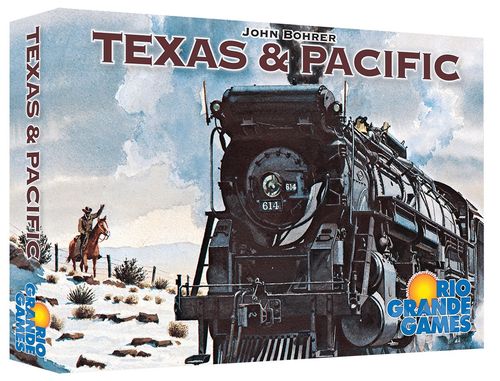
Texas & Pacific
Texas & Pacific Rulebook
Table of Contents
Table of Contents
Goal of the Game
In Texas & Pacific, 2 to 6 players represent wealthy investors and ranchers in the 19th-century Midwest and Texas. Players buy Stock Certificates from the major railroads of the era. They compete to earn the most money during the game by carefully timing Dividend payments and expanding the railroads across the plains to increase the value of their holdings. At the end of the game, the player with the most money is the winner.
Game Components
- 1 gameboard
- 20 Stock Certificates (3 Texas & Pacific RR, 2 Galveston, Houston & Henderson RR, 4 Missouri-Kansas-Texas (KATY) RR, 5 Missouri Pacific RR, 6 Southern Pacific RR)
- 90 Track cubes (16 black T&P, 14 red GH&H, 18 blue KATY, 20 light green MP, 22 yellow SP)
- 22 hexagonal Ranch markers
- 4 light brown (natural wood) cubes for the Decision and Round Tracks
- Paper money (45 x $1, 35 x $5, 20 x $25)
- This rulebook
Game Setup
- Place the gameboard in the middle of the table.
- Each player takes their starting money based on the number of players in the game. The remaining money is set aside as a Bank. The amount that each player receives is shown on the chart below:
| Number of Players | Starting Cash |
|---|---|
| 2 | $60 |
| 3 | $40 |
| 4 | $30 |
| 5 | $24 |
| 6 | $20 |
- Place a blue KATY cube in Wichita, and place another blue KATY cube on the $4 space on the Railroad Income Track. The remaining blue KATY Track cubes and the blue KATY Stock Certificates are placed next to the KATY Treasury, Stock & Track banner in the upper right section of the gameboard.
- Place a green MP (Missouri Pacific) cube in Little Rock, and place another green MP cube on the $5 space on the Railroad Income Track. The remaining green MP Track cubes and the green MP Stock Certificates are placed next to the MP Treasury, Stock & Track banner in the upper right section of the gameboard.
- Place a yellow SP (Southern Pacific) cube in New Orleans, and place another yellow SP cube on the $6 space on the Railroad Income Track. The remaining yellow SP Track cubes and the yellow SP Stock Certificates are placed next to the SP Treasury, Stock & Track banner in the lower right section of the gameboard.
- Place a red GHH (Galveston, Houston & Henderson) cube in Galveston, and place another red GHH cube on the $3 space on the Railroad Income Track. The remaining red GHH Track cubes and the red GHH Stock Certificates are placed next to the GHH Treasury, Stock & Track banner in the lower right section of the gameboard.
- Place the black TP (Texas & Pacific) cubes and the black TP Stock Certificates next to the TP Treasury, Stock & Track banner in the right section of the gameboard. This railroad will start later in the game.
- Place a Ranch marker in each of the 22 hexes that show a Ranch icon on the gameboard.
- Place the small natural-color cube in the "1" space of the Round Track on the gameboard.
- Place a large natural-color cube in each of the three "Start" boxes of the Decision Tracks on the gameboard.
Initial Auctions
Before the game begins, a Stock Certificate of each active railroad in the game will be auctioned.
First, one Stock Certificate of the red GHH Railroad is put up for auction. The first bidder for this auction should be chosen at random. The minimum bid is $3, which is the GHH Railroad's current income, as shown on the Income Track. Bidding continues clockwise until all but one player has passed. If a player passes, they may not reenter the bidding. If all players pass, the first bidder receives the Stock Certificate for free. The money paid for the Stock Certificate is put in the GHH Railroad's Treasury next to the gameboard.
Next, one at a time and in the same manner, repeat the initial auction process for a Stock Certificate of the KATY, MP, and SP railroads (in that order). The first bidder for each auction is the player who won the previous auction, and the minimum bid is the railroad's position on the Income Track. The money paid for each Stock Certificate is placed in that railroad's Treasury, next to the gameboard.
The game now begins with the player who purchased the GHH Stock Certificate and continues clockwise.
Sequence of Play
During their turn, a player must pick a Decision from the available options and slide the cube on that Decision Track one space to the right. The three Decision Tracks are:
- Stock
- Ranch
- Track
After the actions related to the selected Decision are completed, events may occur:
- Go West
- The Texas & Pacific Railroad Opens
- General Dividends
- End of Game
If the game does not end, play continues with the player on the current player's left.
Available Decisions
During their turn, a player must make an available Decision on the Decision Track and slide the corresponding cube to the next box to the right. If the cube for that Decision is already in the "End" box, that Decision is not available.
For example, if a player chose "Track," the player would move the cube on the corresponding Decision Track one box to the right. However, if the cube were already in the rightmost "End" box for the Track Decision, that Decision would be unavailable.
After a Decision is made and associated actions are completed, the Decision Tracks are checked. If two of the three Decisions are unavailable (i.e., two of the three cubes are in the "End" box), General Dividends are paid. (See "General Dividends" below.)
A player is not obligated to take the actions associated with the Decision. They may pass and take no action. They must, however, select a Decision and move the cube one space to the right along the corresponding track.
1. Track Decision
The Track Decision allows a player to build Track for a railroad company. Each railroad has a limited number of Track cubes of its color. Placing a cube in a hex indicates that a railroad has built Track in that hex. The Track built must connect back to that railroad's starting city using only that railroad's Track. Branches are allowed.
The player making the Track Decision must own at least one Stock Certificate of the chosen railroad to build Track for that railroad. The player making the Decision decides what Track is built. The railroad must pay for the Track built with money from its Treasury. A railroad may build up to 3 Track during a Track Decision. All money used to build Track is returned to the Bank.
Exception: The Texas & Pacific Railroad may build any number of its available Track during a Track Decision.
Building Costs: Each hex has a $2 base cost. If another railroad is already in the hex, building Track there costs more. The first railroad to build Track on that hex must pay the $2 base cost to build the Track. The second railroad to build Track on the hex pays double the cost: $4. The third railroad pays triple the base cost: $6. The fourth railroad pays 4 times the base cost: $8. The fifth railroad pays 5 times the base cost: $10.
Galveston, Wichita, Little Rock & New Orleans are Start Cities. Each starting railroad begins the game with Track in its Start City and may not build track into another Start City.
If a railroad has built Track into Albuquerque, El Paso, or any of the 3 gray westernmost hexes, it may immediately Go West. (See "Go West" below.)
Increase Railroad Income: Building Track into certain hexes will increase the income for that railroad. City hexes have either a 1 or a 2 printed, showing the income gained from the city. Any additional income received must be added to the railroad's income on the Railroad Income Track. For example, if the KATY Railroad built Track in Oklahoma City, the KATY Railroad's income would be increased on the Income Track by 2.
A Ranch hex adds $1 to the railroad's income.
2. Ranch Decision
The Ranch Decision allows a player to build a Ranch. A Ranch may only be built if at least one railroad has built Track into the Ranch hex.
When a player builds a Ranch, they take the Ranch marker from the Ranch hex on the gameboard and add it to their money. A player's Ranch markers are worth $1 each when General Dividends are paid. (See "General Dividends" below.)
3. Stock Decision
The player making this Decision selects an unsold Stock Certificate in a railroad's Treasury and puts it up for auction. They must make the first bid.
The minimum bid is the railroad's current Dividend as if the Stock Certificate had already been sold. (See "General Dividends" below.) In other words, the minimum bid is the railroad's current income divided by the total number of owned stocks plus 1, rounded up to the nearest $1.
For example, if two KATY Stock Certificates are already owned, and the current KATY income is 14, the minimum bid for a KATY Stock Certificate would be $5 ($14/(2+1) = 4.667, which rounds up to $5).
The player who made the Stock Decision must bid at least the minimum. If they are unable or unwilling to make the minimum bid, they must choose another Decision.
Bidding continues clockwise until all but one player has passed. If a player passes, they may not reenter the bidding.
The money paid for the Stock Certificate is put in the railroad's Treasury.
Note: The T&P Stock may not be auctioned until after the T&P Railroad is opened.
Events
During the game, certain events can be triggered. These are described in detail here:
1. Go West
If a railroad has built Track into Albuquerque, El Paso, or any of the other 3 gray westernmost hexes, it may immediately Go West. However, if the railroad does not immediately decide to Go West, it may only Go West when it has a future Track Decision. The Go West event may be triggered by any Track Decision, not just another Track action that meets the Go West criteria.
If a railroad decides to Go West, Go West Dividends are immediately paid to the players who own Stock Certificates of that railroad from the Bank.
The Dividend paid for each Stock Certificate is the income level of that railroad, as shown on the Railroad Income Track, divided by the number of Stock Certificates sold, rounded up.
When a railroad decides to Go West, its unused Track cubes are removed from the game. Any remaining money in its Treasury is returned to the Bank.
However, any unused Stock Certificates for that railroad remain in the game and may be auctioned, and the railroad still pays General Dividends (see "General Dividends" below).
2. The Texas & Pacific Railroad Opens
Immediately after the 6th Ranch is built, play is momentarily suspended while the Texas & Pacific Railroad opens for business.
First, place a black cube in Dallas. It is the starting city for T&P. Place another black cube on the "2" spot on the Income Track to indicate the starting income for the T&P Railroad.
Next, the first Stock Certificate of T&P is auctioned. The current player has the first opportunity to bid or pass on the T&P Stock Certificate. As with the other auctions, bidding continues clockwise. If a player passes, they may not reenter the bidding. If all players pass, the current player receives the Stock Certificate for free.
After the Stock Certificate is sold, play continues normally with the next clockwise player.
3. General Dividends
After a Decision has been made and implemented, if two of the three Decisions are unavailable (i.e., two of the three marker cubes are in the "End" box), General Dividends are paid from the Bank to all the players for each of the Stock Certificates they hold.
The General Dividend paid for each Stock Certificate is the income level of that railroad, as shown on the Railroad Income Track, divided by the number of Stock Certificates sold, rounded up.
For example, the KATY Railroad is paying dividends based on a current income of $16. There are three Stock Certificates in the hands of the players. Any player who holds a KATY Stock Certificate would be paid $6 ($16/3 = $5.33, rounded up) for each one they own.
After General Dividends are paid, players receive money for their Ranches. They receive $1 per Ranch from the Bank.
After Ranch income is paid, reset the cubes on all 3 Decision Tracks to the "Start" boxes. Increase the Round marker by one. If the Round marker is moved to the box marked "End," the game is over. (See "End of Game," below.)
4. End of Game
The game ends immediately after a General Dividend is paid if any one of four conditions is met:
- 3 or more railroads have built all their Track.
- 4 or more railroads have sold all their Stock Certificates.
- 7 or fewer Ranch markers are on the map.
- 8 rounds have been played.
The player with the most money wins the game. In case of a tie, the player who owns the fewest Stock Certificates wins. If there is still a tie, the player who owns the most ranches is declared the winner. If there is still a tie, the players grudgingly accept a shared victory.