Tetrarchia: Dux
Tetrarchia: Dux Rulebook
Table of Contents
Table of Contents
Modules
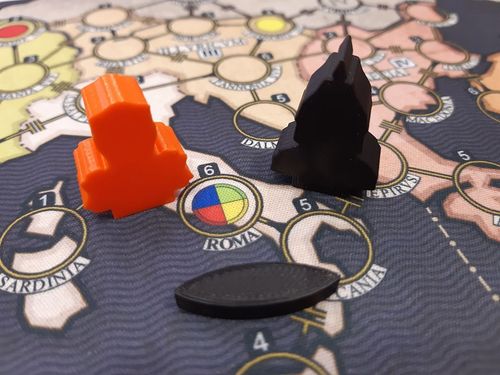
This expansion is made of three independent modules, Dux, Pirates and Goths, and includes:
- 1 orange 'Emperor' (the Dux).
- 1 black fleet (the Pirates).
- 1 black Barbarian (the Goths).
The modules can be added to the base game to make it easier (Dux) or harder (Pirates and Goths). When you calculate your score on the 10 point scale, the Pirates or Goths on the board count an additional –1 each.
1. Dux
Diocletian avoided concentration of power in the hands of possible usurpers. The Dux could command armies if needed, but lacked the civil power of ancient governors.
Once in the game, any player can spend 2 IP and deploy the Dux in a Roman province linked to his Emperor that is free of Revolt/Unrest tokens. From now on, any player can spend any of his IP on his Emperor and/or the Dux.
The Dux behaves as an Emperor, with two exceptions:
- He cannot Secure, since he has no tokens.
- If he must be removed from the board, he dies and leaves the game permanently.
2. Pirates
Losing control of a coastal area often lead to the increase of pirate raids, that required the submission of the coastal provinces and the construction of new fleets.
This module can only be used when playing with less than 3 Roman fleets*. During setup, before you place your fleet(s), roll the normal die until you get 1-3 and place the Pirates in that sea zone. While they are on the board, they block the entry of fleets to that zone. Any Emperor on that coast (a coastal province of that zone) can attack the Pirates for 2 IP.
Combat is similar to land combat, if one considers that all the provinces on that coast are linked. Roll the Roman die and normal die: the Pirates add to the normal die the Revolt tokens on that coast; the Emperor adds to the Roman die his tokens on that coast; and Emperors and Barbarian armies on that coast multiply x2 the corresponding combat values.
In case of victory, remove the Pirates from the board, the sea zone becomes available to Roman fleets. In case of defeat, remove the Emperor and any Emperor token on that coast. In case of a draw, nothing happens. Defeated Pirates can come back to the game: if there is an Uprising on the coast of a sea zone without Roman fleet, they come back to the board in that zone.
* Footnote from the rulebook: Since the original edition of TETRARCHIA had brown Roman fleets, we offer 3 orange fleets for a better contrast with the Pirates.
3. Goths
During the III century the Goths became the most serious threat to the Roman Empire, crossing the Danube several times and ravaging entire provinces. Two centuries later they would be pushed into the Empire by the arrival of Attila's Huns.
Use the same reserve of 3 Barbarian armies: place the Goths figure laying down on the TETRARCHIA logo. Every time a Barbarian army must be placed on the northeastern borders (III or IV), and the Goths are available, place them instead. The maximum number of armies is still 3, so place provisionally on the logo the army you should have used.
The Goths behave as a Barbarian army, but two exceptions make them more dreadful:
- They arrive even if the border is protected or occupied! In that case, remove the token or figure.
- In combats involving them, add +1 to the normal die.
Once eliminated they go back to the TETRARCHIA logo, 'pushing' the Barbarian army there back to the reserve.