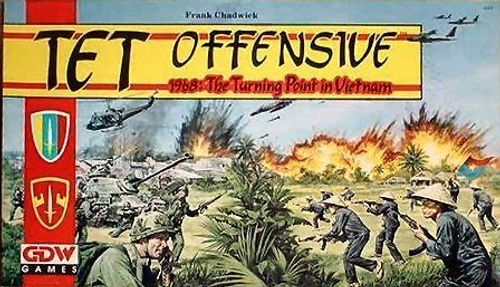
Tet Offensive
Tet Offensive Rulebook
Table of Contents
Table of Contents
- Basic Rules
- VC/NVA Movement
- VC/NVA Combat Phase
- Replacement Phase
- Allied Aero-Mech Movement Phase
- Allied Search Phase
- Allied Combat Phase
- Allied Movement Phase
- Morale Phase
- Winning the Game
- Destruction of Air Units
- Corps Boundaries
- Sappers
- VC/NVA Sanctuaries
- Preparing for Play
- Optional Rules
- Commonly Asked Questions
- Bibliography
- Armies of Tet
- Politics of Tet
- Combat Results Table
- Morale Phase Summary
Basic Rules
The Map
The map for Tet is divided into a number of areas to regulate movement and placement of the game pieces.
Areas
The map is divided into three types of areas: cities, sanctuaries, and provinces. There are, in addition, two types of provinces: highland, lowland, and delta.
Cities are represented by large squares, and each city is named. Each city also has a political point value printed in a yellow circle, and some cities contain an airbase symbol. Airbases are important for basing aircraft, as explained on pages 12 and 14.
Sanctuaries are represented by red circles, each of which is named. The portion of North Vietnam shown on the map is also a sanctuary area, even though it is irregularly shaped like a province.
Provinces are irregularly shaped. Their type is determined by their color: brown for highland, green for lowland, and green with a pattern for delta.
Provinces in South Vietnam are identified by a two-digit number. The first digit of the number is always the same as the corps tactical zone (1st through 4th) in which the province is located.
Provinces in Laos and Cambodia are represented by letter-number combinations, with "L" for provinces in Laos and "C" for provinces in Cambodia.
Other Features
Other features important to game play shown on the map are corps zone boundaries (in yellow), national boundaries (in red), highways (black with white dotted lines), the Ho Chi Minh Trail (brown), and the Mekong River (blue).
Playing Pieces
Three sheets of die-cut counters are included in the game. Before punching them out, compare them with the reproductions printed on pages 18 to 23 to make sure that you have the correct counter sheets. These reproduction sheets are also handy for inventorying your playing pieces after they have been punched out to make sure you have not lost any.
In addition to the cardboard counters, 15 plastic stands are included to be used with the NLF flag counters. Insert the flag, black border down, into the plastic stand as shown in the illustration at the top of the next column.
Flag Counter
[Illustration: an NLF flag counter inserted into a plastic stand.]
Unit Size
Notice that counters are provided in four distinct sizes: ½", ⅝", 1", and 1¾". Each different size of counter has a distinct function in the game.
- The ½" counters are never combat units. Instead, they are markers for the demoralization scales provided on the map.
- The ⅝" counters are all ground combat units, and provide the majority of game playing pieces.
- The 1" counters are ground combat units with special movement restrictions or abilities. These include all Allied aero-mech units and all South Vietnamese Regional Forces and Popular Forces (RF/PF, or "Ruff-Puff") units. Notice that these Ruff-Puff units are grey on their reverse side and are the same size as the grey city boxes on the map.
- The 1¾" counters are NLF flag markers, used to mark cities held by the VC and NVA.
| Symbol | Unit Size |
|---|---|
| II | Battalion |
| III | Regiment |
| X | Brigade |
| XX | Division |
Unit Types
Most ground combat units have a unit symbol which indicates the type of unit, and a unit size symbol above the type symbol. These are read according to the charts on this and the previous page. A unit is also usually identified with its own ID number to the right of the box and its parent ID number (usually a division, but sometimes a corps) to the left.
[Unit type chart: Infantry (crossed box); Marine (anchor); Sapper (upward arrow); Engineer (bridge symbol); Ranger and Special Forces (crossed arrows); Airborne (parachute/wing symbol); Air Mobile (helicopter-rotor symbol); Mechanized Infantry (box with diagonal lines and wheel symbol); Armored Cavalry (oval with horizontal bar); Military Police ("MP").]
Ruff-Puff counters have the silhouette of an infantryman instead of a unit type symbol, and have neither a unit size nor a unit ID, as they represent various ad-hoc groupings of local forces. The single US riverine unit has the silhouette of a riverine amphibious vessel. Printed below the unit symbol on each counter are the game values of the unit. VC and NVA units, the US naval gunfire support unit, and all South Vietnamese Ruff Puffs, have only a combat value. All other Allied ground combat units have both a combat value (listed to the left) and a search value (listed to the right).
VC and NVA sappers and the US riverine unit have a defense value distinct from their combat value. To differentiate this from the combat and search values, it is shown in parentheses.
Unit Identification
| Unit ID | Abbreviation |
|---|---|
| PG | Palace Guard |
| WH | White Horse |
| Cav | Cavalry |
| LB | Long Binh |
| MF | Mike Force |
| Am | American |
| ATF | Australian Task Force |
Nationality Color Coding
Nationality is determined by the color of the playing piece. The chart below lists the various color combinations and their corresponding nationality. In addition, the color of the unit box for Allied units indicates whether they are theater reserve units (yellow boxes) or corps-assigned units and, if corps assigned, which corps.
| Nationality | Color |
|---|---|
| North Vietnam | White on red |
| Viet Cong | White on black |
| United States | Black on olive |
| South Vietnam | Black on blue |
| Special Case South Vietnamese | White on blue |
| Korean | Black on light olive |
| Australian | Black on light blue |
Corps Color Coding
| Corps | Unit Box / Stripe Color |
|---|---|
| I | Lt. blue |
| II | Red |
| III | Lt. olive |
| IV | Grey |
| Theater reserve | Yellow |
Finally, there are several air units included in the game, all of them in United States colors. These consist of six aviation groups (shown with the silhouette of a UH-1 "Huey" helicopter), five Tac Air groups (with the silhouette of an F-4 Phantom), and one Arc Light bombing mission group (with the silhouette of a B-52 heavy bomber). The silhouettes are color-coded in the same way as the unit boxes, except that the colored unit box is replaced by a colored stripe through the middle of the counter.
Counter Examples
[Diagram 1, Mechanized Infantry counter: Type = Mechanized Infantry; Parent Unit = 4th Division; Size = Brigade; Unit = 2nd Brigade; Combat Value = 14; Search Value = 2.]
[Diagram 2, Sapper counter: Type = Sapper; Parent Unit = 1 Corps; Size = Battalion; Unit = Hue City Sapper Battalion; Combat Value = 4; Defense Value = 2 (shown in parentheses).]
Sequence of Play
Play in Tet is divided into game turns. The first turn represents one day, but subsequent turns represent progressively longer periods of time. This enables the game to accurately deal with both the initial frantic period of the prepared offensive as well as the later, somewhat more sluggish, operations conducted by increasingly exhausted forces on both sides.
The game lasts for a total of five game turns.
All activity in a game turn is conducted in eight distinct phases. These phases are always conducted in the exact order detailed here. At the conclusion of the morale phase, a new game turn is begun.
- VC/NVA Movement Phase: The VC/NVA player may move any or all of his units.
- VC/NVA Combat Phase: Combat takes place between VC/NVA and Allied units in the same area.
- Replacement Phase: Both players place any replacement units on the board.
- Allied Aero-Mech Movement Phase: The Allied player moves any or all of his aero-mechanized units, which include all air strike units, helicopters, riverine, and ground mechanized units.
- Allied Search Phase: The Allied player conducts searches in provinces and sanctuaries containing both Allied and VC/NVA ground units.
- Allied Combat Phase: Combat takes place between VC/NVA and Allied units in the same area.
- Allied Movement Phase: The Allied player moves any or all of his units. Units which moved in the Allied aero-mechanized movement phase may move again. All air strike and helicopter units return to airbases.
- Morale Phase: Both players total the demoralization points gained and lost in the turn and adjust the demoralization track accordingly.
Allied Slow Reaction: Due to confusion based on the timing and strength of the attack, the Allies were slow to react to the Tet Offensive. At the start of each Allied movement phase for the first two turns of the game, the Allied player rolls the die once per corps tactical zone. This is the number of conventional ground units he may move from that corps tactical zone. Conventional ground units are nonmechanized, non-riverine ground units permanently assigned to that corps tactical zone. Note that this rule does not restrict the movement of air units, mechanized units, riverine units, aviation units or theater units. From Turn Three onward this rule is no longer in effect.
VC/NVA Movement
Each VC and NVA unit can move in each friendly movement phase.
Movement Procedure
Units begin each phase either in cities, provinces, or sanctuaries. Troops in a city can move into the surrounding provinces or sanctuaries. Troops in a province can move either into a city which is within that province, or into an adjacent province or sanctuary. Troops in a sanctuary can move to any adjacent province.
Limitations: VC/NVA units may never move from a province in Vietnam to an adjacent province in Laos or Cambodia, or vice versa. They may only move from one country to the other by way of sanctuaries.
VC/NVA units may never move from one province to another by crossing a corps zone boundary. Units may move from one corps zone to another by way of Laos and Cambodia.
Movement Example
[Diagram showing the Ia Drang Valley sanctuary, Province 23, Cheo Reo, Pleiku and Province 21, with several VC/NVA units.]
The VC/NVA player has two units each in the Ia Drang Valley (a sanctuary), Province 23, and Cheo Reo. He moves one of the units in the Ia Drang Valley into Province 23 and the other into Province C-1, since both areas are adjacent to the Ia Drang Valley. He moves one of the units in Province 23 to Cheo Reo (which is in Province 23) and the other to Province 21 (which is adjacent to Province 23). He moves both units in Cheo Reo to Province 23.
Note that he cannot move a unit directly from Province 23 to Pleiku, although he can move one to the surrounding province. Furthermore, he cannot move a unit from Cheo Reo to Province 21, but must instead first move into Province 23.
Trail Movement
Instead of moving from one area to an adjacent area, the VC/NVA player may move along the Ho Chi Minh Trail. Only units which start in a sanctuary area with a trail connection may do so. The unit may move from the sanctuary it is in to any sanctuary area directly linked to it by the Ho Chi Minh Trail.
For example, a unit in Tchepone could move to North Vietnam, the A Shau Valley, or Saravane, as each of them is directly linked to Tchepone by trail. The unit could not move directly to the Ia Drang Valley, as there is no direct trail link between it and Tchepone. Instead, the unit could move to Saravane in one turn and then move to the Ia Drang Valley the next turn.
A VC or NVA unit may use trail movement to move into a sanctuary containing Allied units, but may never use trail movement to move out of a sanctuary containing Allied units.
VC and NVA units may not use South Vietnamese highways for trail movement.
Detection
At the end of VC/NVA movement, all VC/NVA units in city boxes are turned face up, while all VC/NVA units in sanctuaries and provinces are turned face down.
VC/NVA Combat Phase
Combat takes place between VC/NVA units and Allied units which are in the same area.
Combat Procedure
First, the VC/NVA player decides which, if any, of his units in provinces and sanctuaries will be flipped face up. Only units flipped face up may attack or be attacked in the combat phase.
Next, the Allied player decides the order in which the individual battles will be resolved in the phase. A battle is the exchange of fire between hostile units in the same area. In each battle, the players remove their pieces from the area and spread them out in the Battle Box. Each enemy unit can only be attacked once per combat phase.
Each enemy unit is attacked separately by one or more friendly units. All friendly units firing at an enemy unit combine their combat values, compare the total to the enemy's combat values, and reduce it to one of the simple odds ratios found on the Combat Results Table on page 32. If the ratio falls between the odds shown, round down in favor of the defender.
For example, a combined attack value of 17 firing at a defense value of 6 fires at 2-1 odds.
Terrain
Allied mechanized units (mechanized infantry and armored cavalry) have their combat value halved for purposes of firing at enemy units when in delta or highland provinces. Their combat value for defense is unaffected. This reduction in attack value does not apply when the unit is in a city in a delta or highland province.
Combat Results
Once the odds column is determined, roll a die and read off the result from the Combat Results Table. One of three results are possible: overrun, hit, or miss.
- Overrun: The unit is removed from play and placed in the Current Casualties Box.
- Hit: The unit is forced to retreat from the battle. If no retreat route is available (see below) the unit is instead removed from play and placed in the Current Casualties Box.
- Miss: There is no effect on the target unit.
Order of Fire
While the Allied player decides the order in which battles are resolved, fire during each individual battle is normally considered to be simultaneous. That is, one player may resolve his fire first, but units hit or overrun by that fire are still allowed to fire back before being removed from the battle or eliminated. There are three exceptions to this, however:
- City Defenders: Allied units in a city always fire first unless the city is in insurrection. That is, any units eliminated or caused to retreat by the city defenders' fire are not allowed to fire back. How a city comes to be in insurrection is explained later. So long as a city is in insurrection, all fire in the city box is simultaneous.
- Sanctuaries: VC and NVA units in a sanctuary always fire first.
- Sapper Surprise Assault: All VC and NVA sappers fire first (before city defenders) in the VC/NVA combat phase of the first game turn (only).
Retreat From Combat
Any unit which suffers a hit result must retreat from combat. If unable to do so, the unit is eliminated instead. The following retreat options are open to units:
- Allied Units: Allied units which suffer a hit must retreat to a nearby friendly city. A friendly city is one which does not have, at the instant of the retreat, any VC or NVA units in it and which is not in insurrection. A nearby city is one which is in the same province as the Allied unit or, if the Allied unit is already in a city on a road, one city box away by road.
For example, an Allied unit in An Loc could retreat to either Song Be (because it is in the same province) or Saigon (since it is one box away by road). An Allied unit in Province 31 could retreat to either Song Be or An Loc, but could not retreat to Saigon, since it is not on a road.
Ruff-Puffs may never retreat.
- VC/NVA Units: VC and NVA units which suffer a hit must retreat to a nearby secure sanctuary. A secure sanctuary is one which is free of Allied units, or one which contains at least one VC or NVA unit. A nearby sanctuary is one adjoining the province in which the battle took place. If the battle took place in a city, the unit may retreat to any sanctuary adjacent to the province in which the city is located.
For example, a VC unit attacking Saigon which suffers a hit may retreat to the Iron Triangle.
VC and NVA units which retreat to a secure sanctuary are flipped over to their concealed side.
Combat Example
[Diagram, "Before" and "After" panels, showing Saravane, Phuoc Long Valley, Dak To, Kontum, Pleiku and La Drang (Ia Drang) with the units described below.]
In the example shown the Allied player has units in Pleiku and Kontum, both of which are under attack. Dak To, Cheo Reo, and An Khe are all under either strong attack or are in insurrection, and so are not available as retreat routes for Allied units. Saravane is unoccupied and so is available as a retreat route for VC and NVA units.
The Allied player feels that he has a good chance of winning the battle at Kontum, while the battle at Pleiku will be more difficult. He therefore decides to fight the battle of Kontum first.
The VC/NVA player is attacking Kontum with two 2-factor battalions. The Allied player has a 4-factor Ruff-Puff and a 6-factor airborne brigade in the city. Since he is defending the city, he fires first.
The Ruff-Puff unit fires at one battalion at 2-1 odds and rolls a 3, which is a hit. The VC battalion retreats to Saravane. The South Vietnamese airborne brigade fires at the other battalion at 3-1 odds and rolls a 1, which is an overrun result. The VC battalion is removed from play. Since both VC battalions were hit by the defenders' first fire, they do not get to fire back.
The VC/NVA player is attacking Pleiku with a 10-factor VC infantry regiment, a 2-factor VC battalion, and an 18-factor NVA division. The Allied player is defending Pleiku with a 10-factor Mike Force brigade, a 2-factor infantry regiment, and a 1-factor Ruff-Puff unit. Since he is defending the city, he fires first again.
The Mike Force fires at the VC regiment at 1-1 odds and rolls a 3, which is a miss. The infantry regiment and the Ruff-Puff unit combine to fire at the VC battalion at 3-2 odds. They roll a 1, which is a hit, and force the battalion to retreat to Saravane.
Now it is the VC/NVA's turn to fire. The VC regiment fires at the infantry regiment at 5-1. The VC player rolls a 1, which is an overrun result. The infantry regiment is removed from play. The NVA division fires at the Mike Force at 3-2 odds and rolls a 3, which is a hit result. Since Kontum is now clear of enemy units, however, the Mike Force can retreat down the road to Kontum. The VC battalion cannot fire since it was hit by first fire.
Notice that if the Allied player had fought the battle at Pleiku first the Mike Force unit would not have been able to retreat to Kontum as there would still have been VC units present.
Insurrection
If at the end of the combat phase there are no Allied ground combat units in a city, and there is at least one VC (not NVA) unit in the city, the city is in insurrection. To indicate that the city is in insurrection, place one of the NLF flag markers on it. The VC player immediately reduces his demoralization point total by an amount equal to the political value of the city. (See the morale phase rule on page 13 for an explanation of demoralization points.)
So long as a city is in insurrection, the following results are in effect:
- All fire in combat phases in that city is simultaneous; the Allied player does not get to fire first.
- The VC/NVA player recruits local sympathizers as combat units. To represent this, the VC/NVA player has available a bonus combat value equal to twice the city's political point value each combat phase. This value may be used to attack an enemy unit separately or may be added to any one attack by another VC or NVA unit in the city. This bonus combat value may not be attacked by the Allied player and is present so long as the city remains in insurrection, even if there are no other VC or NVA units in the city.
A city is no longer in insurrection if, at the end of the combat phase, there is at least one Allied unit present in the city and there are no VC or NVA units present. Remove the stand-up NLF flag marker and replace it with a grey "Secured" marker. Reduce the South Vietnamese demoralization level by the political point value of the city.
Once a city has been in insurrection and then has been secured, it may go into insurrection again later. However, the VC player does not receive a demoralization point drop for creating the insurrection, no local sympathizers are recruited, and the South Vietnamese do not receive a demoralization point drop for resecuring the city.
To enable players to remember which cities have been secured and which have not, leave the secured marker in place even if the city later goes back into insurrection. Place the flag marker on top of the secured marker. When, and if, the city is resecured, remove the flag and leave the secured marker in place.
Replacement Phase
Both players may return eliminated units to play in the replacement phase. The units are placed on the map at that time and may function normally in all subsequent phases of the turn.
Allied Replacements: Each turn one US ground unit, one South Vietnamese ground unit, and one US air unit (either Tac Air or aviation) may be returned to play. These units may be taken from any units in the Eliminated Units Box; they may not be taken from the Current Casualties Box. (This means that no replacements are received on the first turn of the game, as all losses suffered so far will still be in the Current Casualties Box.)
The Allied player may not accumulate replacements. Any replacements not taken in a turn are lost. US and South Vietnamese ground units may be placed in any secure city in their corps setup area. (Theater units may be placed in any secure city on the map.) Tac Air and Aviation units may be placed on any secure or contested airbase in their corps area. (Theater air units may be placed on any secure or contested airbase on the map.)
The Allied player may not replace South Vietnamese rangers, Mike Force or Ruff-Puff units.
NVA Replacements: The NVA receives one replacement point per turn. These replacements may be used immediately or accumulated for use in later turns. A scale is provided on the map to record accumulated NVA replacements.
Each replacement point expended allows the NVA player to return one regiment to play. Two replacement points allow the return to play of one 18-factor NVA division. Three replacement points allow the return to play of any NVA division. All units returned to play are taken from the Eliminated Units Box, not the Current Casualties Box.
VC Replacements: The VC may return one 2-factor battalion to play each turn in each corps area. The battalion must be placed in a sanctuary area in or adjacent to the corps area. (The only sanctuary adjacent to IV Corps, for example, is the Parrot's Beak.) The battalion may not be placed in a sanctuary area which contains one or more Allied units. The battalion returned to play must be from the VC forces assigned to that corps, and must be taken from the Eliminated Units Box.
VC replacements may not be accumulated. If a battalion cannot be returned to play in a corps area, either because no battalions from that corps area are in the Eliminated Units Box or because there is no sanctuary free of Allied units, the replacement is lost.
Allied Aero-Mech Movement Phase
The Allied player may move any or all of his mechanized units, his aviation units, his air units, his naval gunfire support unit, and his riverine unit in the aero-mech movement phase. In order to make it easy to remember which units move in this phase, all of them are printed on large 1" counters.
Mechanized Units: There are four US mechanized units in the game: three mechanized infantry brigades and one armored cavalry regiment. These units move in the same manner as VC and NVA ground units except that instead of trail movement, Allied units may conduct road movement.
Only units which start the phase in a city which is on a highway and which is free of enemy units may make road moves. A unit making a road move may move from city box to city box along the highway for as far as the Allied player wishes. Units making a road move may enter a city box containing enemy units, but they may not leave such a box.
Allied units may not use the Ho Chi Minh trail to conduct road movement.
Riverine Unit: The riverine unit may move anywhere in the two riverine regions, including directly to and/or from any city, in a single phase. The riverine unit may carry one nonmechanized, non-Ruff-Puff ground unit with it, provided the unit begins the phase in the same area as the riverine unit.
Naval Gunfire Unit: This unit represents offshore naval vessels which were used to provide fire support to ground units, particularly marine units in the I Corps area. This unit is placed anywhere along the coast of South Vietnam in the I Corps area in the Aero-Mech Movement Phase. It must be placed adjacent to one of the three coastal provinces in the corps.
Aviation Units: Six US aviation groups exist in the game: one for each corps area and one for each of the two airmobile divisions (the 101st Airborne and the 1st Air Cavalry). Aviation units have the capability of transporting one ground unit from one location on the map to another. Aviation units may only transport nonmechanized, non-Ruff-Puff units.
Each aviation unit flies to any location in its corps area, picks up one ground unit, and carries it to any other location in the corps area.
The two theater aviation groups have the capability of flying to other corps areas, and may carry a unit with them provided it also is a theater unit. However, if they fly to another corps area, they must fly to a secure airbase. They may not fly to a non-airbase city, province, or contested airbase.
If an aviation unit begins the aero-mech movement phase on a contested airbase, it may only fly to an uncontested airbase in the same corps area, regardless of whether it is a corps or theater aviation group. It may carry one ground unit with it from the contested airbase. It may not fly to any location that phase other than the uncontested airbase.
Air Units: There are six air units in the game. There is one Tac Air unit for each corps area as well as one Tac Air and one Arc Light (B-52) theater unit. Tac Air and Arc Light units are moved identically, and differ only in their attack abilities (covered on page 12).
Air units are placed in any area on the map desired during the aero-mech movement phase. Corps units may only be placed in areas within their own corps; theater units may be placed anywhere.
An air unit which begins the phase on a contested airfield may only fly directly to another uncontested airfield in the same corps area.
Air units may conduct strike missions. Corps Tac Air units may only conduct strikes in their own corps areas. Strategic theater air assets may conduct strikes anywhere.
Allied Search Phase
VC and NVA units in a province or sanctuary are usually turned face down, and the Allied player is not allowed to examine them. This gives the VC/NVA player considerable ability to bluff and mislead his opponent, provided this capability is used carefully.
Search Procedure: Allied units in a province or sanctuary may search for VC/NVA units in the same area. Roll one die per region. If the roll is equal to or less than the search value of the Allied unit in the area with the highest search value, the Allied player detects as many VC and/or NVA units in the area as he has Allied units in the area. The VC/NVA player always decides which specific units are detected.
For example, there are four VC and NVA units in an area and two Allied units. The Allied player makes a successful search die roll, and so detects two of the units.
To show that a unit is detected, turn it face up. All detected units usually remain detected until the end of the next VC/NVA movement phase. (A unit which retreats to a sanctuary during combat, however, is flipped back over at once.)
Detection and Terrain: All VC/NVA units in cities are always detected and are always placed face up, even if there are no Allied units in the city. They are flipped back over to their undetected side at the end of the VC/NVA movement phase in which they move out of the city and into a province.
Allied mechanized units (mechanized infantry and armored cavalry) have their search values reduced by one in highland and delta terrain.
All Allied units have their search values reduced by one in sanctuary areas.
Allied Combat Phase
Combat takes place in the Allied combat phase following exactly the same procedure as in the VC/NVA combat phase, with the following additions.
Air Attacks
Air units will already have been placed in areas containing enemy troops during the aero-mech movement phase. They may now attack any detected enemy unit in that area. Air attacks take place before ground attacks. Although a unit may only be attacked once per phase by ground fire, it may be attacked as many times as desired by air units (up to the number of air units present).
Air units may attack enemy units in the same area as friendly units (and this will almost always be the case). The one restriction on their use, however, is that the Arc Light unit may never be used to attack enemy units which are in a city also occupied by friendly units.
To attack, the Allied player indicates which unit is being attacked by which air unit, locates the correct column on the Combat Results Table (CRT), rolls a die, and implements the result. If more than one air unit is present, they may be used to gang up on one target with multiple attacks or they may be spread out to hit different units, but the target of each air unit must be declared before any attacks are made.
In the case of Arc Light attacks, the Allied player rolls two dice. These may be two attacks on the same unit or may be one attack each on two separate units, at the Allied player's option. However, he must declare which option he is using before the dice are rolled.
Note that Tac Air units and Arc Light units have separate rows on the CRT, and that the type of terrain occupied by the target unit affects the column of the CRT used. For example, a Tac Air unit attacking an enemy unit in delta terrain does so on the 3-2 column of the table, while an Arc Light unit attacking an enemy unit in a city does so on the 4-1 column.
Order of Attacks: Air attacks are resolved after the VC/NVA player has flipped over any units with which he intends to attack during the phase, but before any ground attacks are resolved. VC/NVA units flipped over at the start of the phase for the purpose of attacking Allied units may be attacked by air units which are in the same area.
Air attacks may be conducted in any order desired by the Allied player. All air attacks are resolved before any ground battles are resolved. This means that the Allied player can wait to see the results of his air attacks before deciding which units will attack which during ground combat. (Likewise, the VC/NVA player will know which units survived air attacks when allocating his own attacks.)
Bombing Cities: There is a political cost associated with bombing cities, and this is reflected in the game by the accumulation of demoralization points. The effects of demoralization points are covered in detail in the morale phase rules (on page 13). Each time the Allied player bombs a city, both the US and South Vietnamese demoralization point totals are increased by the political point value of the city.
Naval Gunfire Support: The naval gunfire support unit cannot attack separately, but instead supports the attack of a ground unit. It does so by adding its printed combat value to that of any one Allied unit in the province to which the gunfire support unit is adjacent. The gunfire support unit may add its combat value to an Allied unit in a city, provided the city is located in the province to which the gunfire support unit is adjacent.
The gunfire support unit can never be attacked by VC or NVA units.
Allied Movement Phase
All Allied ground units may move during the Allied movement phase with the exception of Ruff-Puff units (which may never move). Units which have already moved during the aero-mech movement phase may move again.
Ground units move during the Allied movement phase using the same movement as do mechanized units in the aero-mech movement phase. That is, each unit may either move from one area to another adjacent area or may make a road move of any length (subject to the limitations of corps boundaries and the presence of enemy units).
Riverine Unit: The riverine unit may move again exactly as it did in the aero-mech movement phase. That is, it may move to any area in one of the two riverine provinces, pick up a unit, and then move to any other area in the two riverine provinces.
Aviation Units: Aviation groups must return to an airbase in the corps area they currently occupy. This applies to both corps units and theater units. Aviation groups may carry a ground unit back with them, but may only pick it up from the area in which they begin the phase. Aviation units which begin the phase already in an airbase may not fly to a different one.
Air Units: The two theater air units are returned to the Theater Air Box on the map. The other four Tac Air units must return to a secure or contested airbase in their corps area.
Morale Phase
Tet is won by demoralizing the opposing forces, either by crippling the morale of the opposing ground troops or breaking the morale of their national leadership. Both of these are taken into account by demoralization points (DPs). In the morale phase each player totals the DPs suffered during the turn and records the change on the demoralization track.
The demoralization track has three scales (for 1's, 10's, and 100's of demoralization points suffered). There are four armies in the game for which morale is important: the United States, South Vietnam, North Vietnam, and the Viet Cong. Each of these armies has three markers, one for each scale. At the start of the game all markers are placed in the 0 boxes at the bottom of each scale.
As DPs are gained, move the army's marker up the 1's scale. Once it reaches 9, record an additional point by moving the 1 marker back to 0 and the 10 marker up to 1.
DPs are gained by the different armies for different effects. In addition, some events cause an army to lose demoralization points. All armies, however, lose points for casualties, which is why there is a separate Current Casualties Box on the map. During the morale phase the casualties are added up, DPs recorded, and the units are then moved to the Eliminated Units Box.
When DPs are awarded for casualties, they are based on the combat value of the unit. If the unit has separate attack and defense values, the defense value is used. Air and aviation units, since they have no combat value, do not count against morale.
South Vietnam: Each combat factor of South Vietnamese troops lost gains one DP, with three exceptions: DPs are never gained for the loss of Ruff-Puffs, rangers, or Mike Force units.
Each city bombed during the turn gains DPs equal to its political point value. This will have already been recorded during the course of the turn.
Each city in insurrection during the morale phase gains DPs equal to its political point value.
Each city in insurrection which was secured during the turn (the insurrection was put down), lowers the South Vietnamese DP total by the political value of the city. This will already have been recorded during the course of a turn. This DP reduction for securing a city from insurrection is received only once per city, as explained in the VC/NVA combat phase rules on page 10.
North Vietnam: Each combat factor of NVA troops lost gains one DP.
United States: Each combat factor of US troops lost gains one DP. Each factor of Australian troops lost gains two DPs. Every two factors of Korean troops lost gains one DP.
Each city bombed during the turn gains DPs equal to its political point value. This will have already been recorded during the course of the turn.
Each city in insurrection during the morale phase gains DPs equal to its political point value.
The US demoralization track is reduced by one DP for every six VC and/or NVA factors eliminated during the turn (round fractions down).
Viet Cong: Each combat factor of VC troops lost gains one DP.
Each city which goes into insurrection lowers the VC DP total by the point value of the city. This will have been recorded during the course of the turn. Note that, especially on the first turn, this may push the VC demoralization level into negative numbers. Special markers have been included to allow recording of negative DP levels.
Winning the Game
The object of Tet is to demoralize both opposing armies before both of your own armies become demoralized. Each army has a demoralization level, which is printed on the map next to the demoralization scales. When an army's DP total is equal to or in excess of its demoralization level, it is demoralized.
It is possible for an army to become demoralized and then later reduce its DP total back below its demoralization level. If it does so, it is no longer demoralized.
If, at the end of any morale phase, both armies of one side are demoralized, the game ends and the opposing player wins. If this condition does not occur before the end of the fifth turn, or if both sides become demoralized in the same morale phase, the Allied player wins.
Destruction of Air Units
The only way that a Tac Air unit or aviation group can be destroyed is by capturing its airbase. If, at the end of any combat phase, there are VC and/or NVA units in an airbase city and there are no Allied ground units in the city, any air units on the airbase are removed from play and placed in the Current Casualties Box.
Corps Boundaries
There are four corps areas in the game, numbered from I (northernmost) to IV (southernmost). These boundaries limit the deployment of units.
Allied Units: Allied units may not cross corps boundaries unless they are theater units. Theater units are marked with a yellow unit type box or stripe.
VC and NVA Units: NVA units may not cross corps boundaries, but may enter Laos and Cambodia and move from one corps to another by that means. VC units may enter Laos or Cambodia, but may only move back into their own corps area in South Vietnam.
Sappers
Sappers have a special surprise attack ability on the first turn of the game. Sapper units fire before any other unit during the VC/NVA combat phase of the first turn. This fire comes before city defenders' first fire, and any defenders eliminated by sapper fires are immediately removed from play and may not fire back.
VC/NVA Sanctuaries
Allied units may enter VC/NVA sanctuary areas, but several special rules apply. Most of these are covered above, but are recapitulated here.
- All Allied search ratings are decreased by one in sanctuary areas.
- All VC/NVA units in a sanctuary fire first in a battle.
- All attacks against VC/NVA units in a sanctuary are reduced one odds column. Attacks already at the lowest odds column and reduced one more column are not allowed.
- No unit in a sanctuary may retreat. If hit, such a unit is eliminated.
Preparing for Play
Carefully punch out all of the counters. The VC/NVA flag counters are placed upright in the plastic bases provided.
The Allied player sets up his units first. Each Allied unit has its starting location printed on its back (either the name of a city or the number of a province). The two strategic reserve air units have the notation "Theater" printed on them. Place them in the Theater Air Units Box on the game map.
The VC/NVA player sets up second. All VC/NVA units begin the game face down.
VC units may be placed in any sanctuary or in any province of South Vietnam in their designated corps zone.
NVA regiments and battalions may be placed in any sanctuary, any province of Laos or Cambodia, or any province in the I Corps area.
NVA divisions may be placed in any sanctuary or any province of Laos or Cambodia.
Optional Rules
The following rules are optional. They are not part of the basic game, and are not necessary to simulating the Tet battles. Instead, they are included to provide additional depth to the game. After you have played the basic game a number of times, try using one or more of these rules for variety.
The Four-Player Game
The game can easily be played with four players. The four players are the US, South Vietnam, North Vietnam, and the Viet Cong.
Player Forces
The US player controls all US theater units (including theater air units) as well as all corps units of all Allied nationalities in I and II Corps areas.
The South Vietnamese player controls all South Vietnamese theater units as well as all Allied corps units in III and IV Corps areas.
The North Vietnamese player controls all VC and NVA units in I and II Corps areas, and determines the initial deployment of all NVA units.
The Viet Cong player controls all VC and NVA units in III and IV Corps areas and determines the initial deployment of all VC units.
Player Victory
The game ends when the same conditions are met as in the basic game. A player, however, only wins if his own army remains undemoralized.
For example, if at the conclusion of a turn the US, South Vietnamese, and Viet Cong armies are all demoralized, while the NVA is not, the NVA player wins. If, on the other hand, only the US and South Vietnamese armies were demoralized, both the VC and NVA players would win.
Note that it is possible for one player, two players, or no players to win the game when using this option.
Advanced Four-Player Game
The advanced four-player game divides the commands differently between players. Each player controls all of the units of his own army, regardless of their location. The US player also controls the Australian and South Korean units.
Although this is, in many respects, a more interesting four-player option, players should be warned that the game will take approximately twice as long (or more) to play, due to the extensive consultation required between players for every move and combat.
Victory is determined in the advanced four-player game the same as in the regular four-player game.
Invading Cambodia and Laos
The Allied forces did not invade Cambodia or Laos during the period of the game, due in part to a reluctance to suffer the political consequences associated with doing so. Players may decide to invade either or both countries if they are willing to pay the price.
The US player rolls one die during each morale phase in which there are South Vietnamese units in either Laos or Cambodia, and adds that many DPs to his demoralization track. If US units are present in either Laos or Cambodia, either alone or in company with South Vietnamese units, two dice are rolled instead.
Separate die rolls are made for Laos and Cambodia if both are invaded.
Australian and South Korean troops may never enter Laos or Cambodia.
Allied Free Setup
If the Allied free setup option is used, the normal locations printed on the counter backs are ignored. Instead, corps units may be set up in any city or province of the corps, while theater units may be set up in any city or province in South Vietnam.
Stepped Up Bombing of the North
If this optional rule is used, theater aircraft (only) may be used for strategic bombing missions against North Vietnam instead of tactical support missions in the South. Each turn in which the Tac Air unit is used in this mission, the NVA player rolls one die, subtracts two from the number rolled, and adds the result to his DP total. Each turn in which the Arc Light unit is used, the NVA player rolls two dice and subtracts four from the result. Die rolls reduced to a negative number by the subtraction are ignored (treated as 0 DPs).
Blind Bombing
The Allied player may attempt to bomb undetected units. The undetected units in the area are placed in a stack in any order desired by the VC/NVA player. The Allied player then rolls a die. The number rolled indicates the unit in the stack hit by the strike. A 1 means the top unit is hit, a 2 means the second unit, and so forth. Roll the die twice for an Arc Light mission.
If the number rolled is greater than the number of units in the stack, the air strike hits a civilian target instead, and the US player loses one DP.
After the die roll determines which unit is hit, the Allied player resolves the attack normally. The Allied player should only see the target unit if it is removed from play and placed in the Current Casualties Box.
Strategic Recon
The Allied player has four US Special Forces strategic recon units available. Each unit can be placed in a province or sanctuary during the Allied aero-mech movement phase and is withdrawn from the map during the Allied movement phase.
Each strategic recon unit may only be used every other turn. When the unit is withdrawn from the map, place it on the Turn Record Chart two turns later to remind the Allied player when it can next be used again. For example, if the Project Delta unit is used on Turn One, it is unavailable for use again until Turn Three.
Each strategic recon unit has its own area of operations, which is printed to the left of the unit type box. The MAC-V SOG (Special Operations Group) and Project 404 units may only be used in Laos. The Project Gamma unit may only be used in Cambodia. The Project Delta unit may only be used in South Vietnam. Note that the first three named units are the only Allied units which can enter Laos or Cambodia unless the optional rule covering their invasion is used.
The strategic recon units cannot attack or be attacked. Their only function is to detect one enemy unit, which they do automatically (without a die roll). The unit detected, if more than one is present in the province or sanctuary, is chosen by the VC/NVA player.
Commonly Asked Questions
Q: A city is in insurrection but there are no VC or NVA units in it. In the Allied movement phase an Allied ground unit moves in. Is the insurrection marker removed?
A: No. An insurrection is only put down if there is an Allied unit present and no VC or NVA present at the end of a combat phase.
Q: Can the Allied player bomb Laos or Cambodia?
A: Since the corps Tac Air units may not move outside of their corps areas, they are never allowed into Laos or Cambodia.
Theater air units could bomb there. But since an air unit may normally only bomb a detected unit, and since there is no means of detecting a unit in Laos or Cambodia in the basic game, this is meaningless. Theater air units could bomb Laos or Cambodia, however, if either the blind bombing, strategic recon, or invasion of Laos and Cambodia optional rules are used.
Q: The two US theater aviation units can move to any corps zone and can transport any non-aero-mech, non-Ruff-Puff unit. Can they transport a nontheater infantry unit to a different corps zone?
A: No. They can transport nontheater units within their corps zones, but they may only transport theater units between corps zones.
Q: The setup rule says that "VC units may be placed in any sanctuary or in any province of South Vietnam in their designated corps zone." Does this mean that, if placed in a sanctuary, they need not be in their corps zone?
A: No. If placed in a sanctuary, they must be in or adjacent to their corps zone. IV Corps VC units, for example, can only be initially placed in the four provinces of IV Corps or in the Parrot's Beak.
Q: Can the riverine unit move to all four delta provinces, or only the two that have a river printed in them?
A: Only the two that have a river.
Q: I know that several attacking units may combine their values to attack a single enemy unit. Can one large unit divide its combat value to attack several enemies?
A: No. It can only attack one enemy unit.
Q: The rule on VC/NVA sanctuaries says that all attacks on VC/NVA units are reduced one odds column. Does that include air attacks?
A: No. Air attacks always use the designated "Sanctuary" column of the Combat Results Table; they do not reduce the odds one column below this.
Q: As I understand the setup rule, I can place an NVA regiment or battalion in a province of I Corps, but I cannot place it in a province of South Vietnam in any other corps zone. Is that correct?
A: Yes.
Bibliography
- Arnold, James R., Tet Offensive 1968. Osprey, 1990; ISBN 0-85045-960-5.
- Corson, William (Colonel USMC, ret.), The Betrayal. Norton, 1968.
- Davidson, Phillip B. (Lt. General, USA, ret), Secrets of the Vietnam War. Presidio Press, 1990; ISBN 0-89141-382-0.
- Karnow, Stanley, Vietnam: A History. Penguin Books, 1983; ISBN 0-14-00-7324-8.
- Maclear, Michael, The Ten Thousand Day War: Vietnam 1945-1975. St. Martin's Press, 1981; ISBN 0-312-79094-5.
- Sheehan, Neil, A Bright Shining Lie: John Paul Vann and America in Vietnam. Random House, 1988; ISBN 0-394-48447-9.
- Stanton, Shelby L. (Captain, US Army, ret.), Vietnam Order of Battle. Galahad Books, 1981; ISBN 0-88365-709-0.
- Stanton, Shelby L. (Captain, US Army, ret.), The Rise and Fall of an American Army: U.S. Ground Forces in Vietnam, 1965-1973. Presidio Press, 1985; ISBN 0-89141-232-8.
- Starry, Donn A. (General, US Army, ret.), Armored Combat in Vietnam. Arno Press, 1980; ISBN 0-672-52673-5.
- Wolf, Duquesne (Colonel, US Army, ret.), The Infantry Brigade in Combat. Sunflower University Press, 1984; ISBN 0-89745-053-1.
The Counter Sheet Inventory (pages 18 to 23) reproduces the die-cut counter sheets as artwork only; it has no rules text and is not transcribed.
Armies of Tet
The scope of the 1968 Tet Offensive provided Allied intelligence with an embarrassment of riches, and allowed the compilation of a fairly reliable opposing force order of battle. Although unit identifications were cloudy in many cases, overall force levels were determined with a high degree of reliability. The table below lists the numbers of maneuver battalions available to each of the combatants in the four corps zones of the Republic of Vietnam on January 25, 1968.
The North Vietnamese Army had approximately 50,000 men in South Vietnam, with perhaps 20,000 more in Laos. Viet Cong main force combat strength was about 60,000, with an estimated 400,000 more in the local forces, of which well fewer than 200,000 could be considered actual combat soldiers. On the other hand, those who were not combatants carried out logistical, intelligence, medical, and other vital support functions, as did many of the troops listed for the Allied forces below.
By contrast, the Armed Forces of the Republic of Vietnam totaled 342,951 regulars and even more auxiliary combatants. There were 151,376 men in the Regional Forces, 148,789 in the Popular Forces, 42,000 in the Green Beret-trained and led Civilian Irregular Defense Groups, and nearly 70,000 Vietnamese National Police. These last would be heavily involved in the Tet-68 fighting in defense of the cities.
Total non-Vietnamese Allied forces were nearly as strong. On the eve of Tet there were 331,098 US Army troops, 78,013 Marines, 6000 Australians, 2400 Thais, and nearly 50,000 Koreans in South Vietnam.
Even including all of the VC local force personnel, the balance of military manpower was intimidating, especially considering that the VC and NVA carried the burden of the offensive. 510,000 VC and NVA faced a total of 1,221,427 Allied soldiers.
Available Maneuver Battalions in 1968
| Region | NVA | VC | US | AFRVN | FW |
|---|---|---|---|---|---|
| I Corps | 46 | 19 | 38 | 35 | 4 |
| II Corps | 33 | 16 | 17 | 31 | 18 |
| III Corps | 20 | 36 | 39 | 4 | 5 |
| IV Corps | — | 27 | 3 | 42 | — |
| Total |
The Armed Forces of the Republic of Vietnam
The bulk of the South Vietnamese regulars was concentrated in the Army of the Republic of Vietnam (ARVN). Its 10 regular divisions ranged from reasonably good (the 1st Division, for example), to nearly worthless (the 9th).
The best regular troops were concentrated in the elite airborne brigades, a countrywide fire brigade which was in the process of shifting north to I Corps when the Tet Offensive broke. Although there were some notable exceptions, the separate ranger battalions were generally good, as well. The ranger battalions were notable for having a very high proportion of former VC ralliers in them, and the Saigon government generally considered them to be politically unreliable. (It is for this reason that ranger casualties do not count toward South Vietnamese demoralization.)
It is interesting to note that 87% of the battalion commanders of the ranger and airborne battalions, the best units in the army, were former Viet Minh officers. None of these former Viet Minh officers ever made general officer rank, almost all of them served one or more grades lower than they had when fighting the French, and most held ranks lower than that generally held by battalion commanders. By contrast, all of the South Vietnamese generals had either fought with the French in the First Indochina War or had stayed out of the Army altogether.
The only force of regular ground combat troops not part of the ARVN were the Vietnamese Marine Corps (VNMC). At this time there were two solid brigades of marines who, like the airborne troops, were used as a countrywide reserve. The 1st Marine Brigade, for example, began the Tet-68 Offensive in IV Corps, recaptured Moc Hoa from VC assault units, shifted north to Saigon and helped secure the capital, and was then shifted further north to I Corps to support the recapture of Hue.
A large number of part-time soldiers filled the ranks of the Regional Forces and Popular Forces—the so-called Ruff-Puffs. Equipped with obsolete weapons and receiving only sketchy training and support, the Ruff-Puffs were considerably less effective than their numbers would indicate. In many cases there was a callous disregard for RFPF losses by Saigon, and so their loss does not
count toward South Vietnamese demoralization.
The Green Beret-trained Civilian Irregular Defense Forces were made up of indigenous troops trained and led by US Special Forces teams. Most of the CIDF were spread across the country as garrisons of Special Forces camps, and the area garrison effects of these troops are subsumed in the game's RFPF units.
The best of the CIDF troops were concentrated in five Mobile Strike Force Commands (better known as Mike Forces). Each had a headquarters company and recon company and from two to five battalions. Each corps zone had its own MSFC, while the 5th MSFC Force was a countrywide strategic reserve. 5th Mike Force, serving under the personal direction of the commander, 5th Special Forces Group, became particularly famous and saw action in all four corps tactical zones. Because CIDF units were largely made up of nonethnic Vietnamese and were mostly US-led, their losses do not count toward South Vietnamese demoralization.
The 70,000-strong Vietnamese National Police played an important role in Tet-68 as they found themselves on the front line once the cities were under attack. The police were already armed as a paramilitary force and so were better equipped for the mission than the term police might imply. The police, like the local CIDF, are subsumed in the RFPF units in the game.
United States Armed Forces
The United States entered the Vietnam War with what was probably the finest army it had ever fielded in peacetime. However, the army then, as now, was designed to rely on its reserve component for logistical support units.
Early in the war, however, it was decided that the reserves would not be mobilized, and so the army went to Vietnam with a largely extemporized support structure. This was to hamper it throughout the war; its rear area support infrastructure was extremely inefficient. Most items, with the exception of ammunition, were in short supply in front-line units. The rear services became bloated with personnel, while the leakage of supplies fueled a thriving black market. Certainly the decision to dispense with the reserves had an adverse effect on US performance in Vietnam.
A policy which was equally destructive of combat efficiency was the rotation system. Soldiers served one term in Vietnam instead of serving for "the duration," as Americans had served in previous wars and as the VC and NVA served. As a result, combat units suffered from constant personnel turbulence. Between stateside rotation and routine transfers, a unit would suffer a 10% turnover each month, before any allowance was made for casualties. By the time a soldier became proficient at his job, his rotation time was approaching, and soldiers who were "short" displayed an understandable reluctance to expose themselves to unnecessary risks.
The situation was even worse with officers. As officers were expected to gain both command and staff experience, their one-year tour was usually broken up into a six-month command position and a six-month staff assignment. Since the staff assignment was usually in a relatively secure area, resentment grew among enlisted men required to spend their entire 12 months in combat. Also, the turnover in combat leaders made it difficult for a unit to develop a sense of teamwork.
But even more important than the above considerations was the fact that every soldier who went to Vietnam knew that the war would not be over during his tour of duty. He knew that, no matter what he did, in 12 months he would be going home, provided he survived. From a morale point of view this was crippling. It meant that the average soldier had little or no personal stake in the winning of the war.
As a result of the above, US units exhibited an unusual development pattern in Vietnam. Most units performed very well when initially dispatched to the theater of war, as they arrived as a cohesive, well-trained unit. As time went by and the rotation system took its toll, the unit's combat effectiveness declined rather than improved.
All of the above notwithstanding, US units overall remained effective and powerful combat units, with a number of units consistently providing standout performance. The 1st Air Cavalry Division, along with the 173rd Airborne Brigade and the 1st Brigade of the 101st Airborne Division, served as elite countrywide strategic reserve forces, which would always be found at the cutting edge of major offensive operations. The balance of the 101st was also a good unit, but the 2nd and 3rd brigades had, prior to being shipped to Vietnam, been stripped of many experienced NCOs and soldiers to replace casualties in the 1st Brigade, which was deployed early. This inevitably hurt combat efficiency in the other two brigades when they were deployed overseas.
The marines retained a high level of combat proficiency as well in all of their units, and in their local pacification program may have developed a potentially war-winning tactic. In late 1967, however, Gen. William Westmoreland ordered the marine pacification program shut down to free maneuver battalions for his upcoming battle of Khe Sanh. Those who put a great deal of stock in military stereotypes will have difficulty explaining a situation in which the USMC is forced, by an army commanding general, to give up a program of local security and development to return to a policy of attritional warfare.
Some mention should also be made of the 23rd "Americal" Division. This was a lashed-together division, hastily assembled from odds and ends, and its makeshift formation was indicative of the extent to which manpower demands were beginning to strain the US Army's ability to respond. The most recent arrival was the poorly trained and equipped 11th Infantry Brigade (Light), which had arrived in December of 1967, less than two months before the onset of Tet-68. Noted Vietnam historian Shelby Stanton would later describe some elements of this brigade as "little better than organized bands of thugs, with the officers eager participants in the body-count game." In March of 1968, elements of this brigade committed a string of atrocities in Quang Ngai Province, of which the best known is the My Lai Massacre.
National Liberation Front (Viet Cong)
The original cadre of the armed units of the National Liberation Front was drawn from the Viet Minh, who had defeated the French in the First Indochina War. The term Viet Minh was highly respected throughout Vietnam, and so the government in Saigon decided very early in the war that an alternative term was required. The term they invented was Viet Cong, an abbreviated version of the Vietnamese language term for Vietnamese Communist. For much of the war the NLF soldiers continued to think of themselves as Viet Minh.
The Viet Cong had taken a severe beating during 1967. The frequent US offensive operations against vital base regions, such as the Iron Triangle, War Zone C, and the Ia Drang Valley, had led to a number of bloody confrontations. More importantly, the massive relocation of the Vietnamese population from the countryside to the cities was dramatically eroding the Viet Cong's recruiting base.
That notwithstanding, a large number of VC local force battalions during the last half of 1967 had made the march to Cambodia where they traded in their obsolete weapons for new AK-47s, light machineguns, and B-10 rocket launchers. As Tet approached, the VC was stronger in well-equipped combat battalions than it had been a year earlier. The difficulty was that these battalions represented the VC's last major reserves outside the cities.
Morale among VC units was high going into Tet, however. Although the long, grinding defensive battles of the previous year had hurt morale, the prospect of a countrywide offensive to liberate the cities was heady stuff. And a violent offensive, despite the high casualties expected, was preferable to the protracted war of attrition they had been fighting.
The following listing shows identified Viet Cong battalions and regiments in each of the Corps zones and lists which cities they attacked during Tet-68.
Viet Cong Order of Battle
I Corps (19 maneuver battalions)
- 1st VC Regiment: Chu Lai area
- 2nd VC Regiment: Quang Ngai province
- 52nd VC Regiment
- 416 VC Regiment: Hue
- 814th VC Regiment
- 10 VC Sapper Battalion: Quang Tri
- 12 VC Sapper Battalion: Hue
- Hue City VC Sapper Battalion: Hue
II Corps (16 maneuver battalions)
- 52nd VC Regiment
- 70th VC Regiment
- 165A VC Regiment: Tuy Hoa area, 1967
- 40 VC Sapper Battalion: Pleiku
- 15H VC Local Force Battalion: Pleiku
- 145 VC Battalion: Dalat
- 186 VC Battalion: Dalat
- 301E VC Local Force Battalion: Ban Me Thuot
- 482 VC Local Force Battalion: Phan Thiet
- 840 VC Main Force Battalion: Phan Thiet
III Corps (36 maneuver battalions)
- 101 VC Regiment: War Zone C, 1967
- 271 VC Regiment (5th VC Division): Saigon
- 272 VC Regiment (5th VC Division): War Zone C
- 273 VC Regiment (5th VC Division): Saigon
- 274th VC Regiment (9th VC Division): Long Binh
- 275th VC Regiment (9th VC Division): Long Binh
- C-10 VC Sapper Battalion: Saigon
- U-1 VC Local Force Battalion: Long Binh
- 1 VC Local Force Battalion: Saigon
- 2 "Go Mon" VC Local Force Battalion: Saigon
- 3 "Di An" VC Local Force Battalion: Saigon
- 4 "Thu Dac" VC Local Force Battalion: Saigon
- 5 "Nha Be" VC Local Force Battalion: Saigon
- 6 VC Local Force Battalion: Saigon
- D16 VC Battalion: Tan Son Nhut Airbase (Saigon)
- 56 VC Battalion: Saigon
- 101 VC Battalion: Saigon
- 211 VC Battalion: Song Be
- 212 VC Battalion: Song Be
- 238 VC Local Force Battalion: Long Binh
- 267 VC Battalion: Tan Son Nhut Airbase (Saigon)
- 268 VC Battalion: Saigon
- 506 VC Battalion: Long An Province, 1967
- 508 VC Battalion: Saigon
- 857 VC Battalion: Vinh Long
IV Corps (27 maneuver battalions)
- D1 VC Regiment
- D2 VC Regiment
- D3 VC Regiment
- DT1 VC Regiment
- DT2? VC Regiment
- DT3? VC Regiment
- 261 VC Battalion: My Tho
- 263 VC Battalion: My Tho
- 306 VC Battalion: Vinh Long
- 308 VC Battalion: Vinh Long
- 514 VC Battalion: My Tho
- 516 VC Battalion: Truc Giang (near My Tho)
- 518 VC Battalion: Truc Giang (near My Tho)
North Vietnamese Army (NVA)
Most of the NVA was not committed to the south at this time. About 50,000 men were in South Vietnam and another 20,000 were in Laos, while nearly 400,000 remained under arms in the north. A number of the NVA divisions committed to the south were badly understrength, as well, having been severely mauled during the "big battles" of 1967. As a result, many NVA divisions would take no active part in the battles of Tet-68, but would remain in reserve in sanctuary areas, ready to exploit sudden or unexpected successes or deal with major reverses.
The following NVA order of battle has been assembled from a number of different sources, and parts of it are at best tentative. It should indicate to players, however, the basis for many of the ratings provided in the game.
NVA Order of Battle
I Corps (46 maneuver battalions)
- 2 NVA Division (3, 21 Regiments). The 2nd NVA Division had been active in the I Corps area since 1966. It was based in the Phuoc Ha Valley area west of Chu Lai and clashed repeatedly with marines and elements of Task Force Oregon (later the 23rd "Americal" Division) throughout 1967. Although depleted by combat in late 1967, the division attacked Da Nang during the Tet-68 Offensive, spearheaded by the 402nd NVA Sapper Battalion.
- 5 NVA Division (4, 5, 6 Regiments). All three regiments of the 5th NVA Division were committed against Hue during the Tet-68 Offensive. The 4th and 6th Regiments were committed early and the 5th was later slipped in through Allied lines to reinforce the city defenders.
- 304 NVA Division (66, 101D Regiments). The 304th NVA Division had a long and proud history, having been one of the divisions which fought and defeated the French at Dien Bien Phu. Its appearance near Khe Sanh shortly before the onset of Tet-68 attracted considerable attention to the area.
- 320 NVA Division (48, 64 Regiments). The 320th NVA Division remained in reserve in the DMZ area throughout Tet-68, but was committed to combat by midyear, and was available throughout the period of the game.
- 324B NVA Division (90, 812, 716 Regiments). This division was first committed to combat in 1966 when it infiltrated across the DMZ and launched a series of attacks against Quang Tri province. USMC units experienced intense combat against the division throughout 1967, and the division's 810th Regiment spearhead the attack on Quang Tri City in Tet-68. Other elements of the division were used to reinforce the Hue defenders.
- 325C NVA Division (29, 95, 101 Regiments). This division was another crack NVA formation committed to the siege of Khe Sanh. Unlike the 304th, the 325C had been present in the area since 1967.
- 402 NVA Sapper Battalion. This battalion was involved in the attack on Da Nang in Tet-68, where it was attached to the 2nd NVA Division.
II Corps (33 maneuver battalions)
- 1 "Yellow Star" NVA Division (32, 52, 174 Regiments). This division was active in the western part of the central highlands from 1965 with the 32, 33, and 66 NVA regiments. By 1967 the 33rd Regiment had been sent south, replaced by the 174th. The division was badly mauled in 1967 during the fighting in the Ia Drang Valley campaign and the battles near Kontum and Dak To, and was forced back into Laos and Cambodia. At that time the 66th Regiment was sent north to join the 304th NVA division, and was replaced by the 52nd Regiment. The division remained near the border throughout the Tet-68 Offensive and in 1969 was shifted south to War Zone C in the III Corps Region.
- 3 "Yellow Star" NVA Division (12, 18, 22 Regiments). The division was active south of Chu Lai in Binh Dinh province from 1966. It was badly mauled in Operation Pershing in 1967 and did not play a significant role in Tet-68.
- 10 NVA Division (24, 95B Regiments). The regiments of the division were active in the central highlands from 1966, but as independent units. The division itself was not formed until early 1967, and was then badly mauled in the fighting in the Ia Drang Valley. The division was split up for the Tet-68 fighting, with the 24th Regiment hitting Kontum and the 95B Regiment hitting Tuy Hoa.
- 28 NVA Regiment. A separate regiment active in the central highlands area after the Tet-68 Offensive. Its location in 1968 is uncertain.
- 33 NVA Regiment. Originally a component of the 1st NVA division, 33 NVA Regiment saw action against US forces in the central highlands as early as 1965. The regiment became independent in 1967 and supported the attack on Ban Me Thuot during the Tet-68 Offensive. By August of 1968 the regiment had shifted south and was used to reinforce the battered 9th VC Division.
- 44 NVA Sapper Regiment. A separate regiment active in the central highlands area after the Tet-68 Offensive. Its location in 1968 is uncertain.
- 406 NVA Sapper Battalion. This battalion assisted VC units in the attacks on Kontum during Tet-68.
III Corps (20 maneuver battalions)
- 7 NVA Division (88, 141, 320 Regiments). This division's regiments were active along the Cambodian border at least from 1967, and perhaps earlier. The 88th Regiment was involved in the fighting near Song Be in October of 1967, but the division remained in reserve throughout Tet-68.
- 2 NVA Regiment. A separate regiment active in the central highlands area after the Tet-68 Offensive. Its location in 1968 is uncertain.
- 18B NVA Regiment. A separate regiment active after the Tet-68 Offensive. Its location in 1968 is uncertain.
- 86 NVA Regiment. A separate regiment active after the Tet-68 Offensive. Its location in 1968 is uncertain.
- 165 NVA Regiment. A separate regiment active after the Tet-68 Offensive. Its location in 1968 is uncertain.
Politics of Tet
All wars are political in their causes and goals, and Vietnam was no exception. Because of some of the unusual aspects of the war and its reporting, however, Vietnam was a more obviously political war than most, and many accounts of it are as influenced by the politics of the war as was the war itself.
The Politics of Attrition
The fundamentally political nature of the war was, if anything, reinforced by the decision of the United States Army, in the person of Gen. William Westmoreland, to fight the war as a battle of attrition.
Attrition can provide a clear-cut military victory only when it can seriously reduce the actual capacity of the enemy to resist. Failing that, it can only succeed by sapping his will to resist, an essentially political objective. Could attrition in Vietnam have achieved a physical, as opposed to political, victory in Vietnam? Probably not, as was recognized as early at late 1965.
The base analysis was provided by Lt. Gen. Victor Krulak, USMC, then commanding general Fleet Marine Force Pacific. He calculated that the North Vietnamese and the Viet Cong had a combined available manpower pool of roughly 2.5 million men. Although he considered the current published "kill ratio" of 2.6-1 to be optimistic, for purposes of argument he accepted it and concluded that it would cost 10,000 American dead and 165,000 South Vietnamese dead "to reduce the enemy [manpower] pool by only a modest 20 percent." His conclusion was that attrition was, ultimately, Hanoi's best strategy, not the United States', because the tremendous casualties the United States would suffer would "erode our national will and cause us to cease our support of the government of Vietnam." His argument proved to be amazingly prophetic.
If anything, the numbers were even more unfavorable to the US for a strategy of attrition. By the eve of the Tet-68 Offensive, the North Vietnamese Army had a total of 450,000 men under arms of whom only 70,000 were active in the south. An estimated 200,000 men came of military age annually. Although the army had administered heavy casualties in 1967, clearly the North could continue the war, from a purely material point of view, for years, perhaps decades. The question was rather its willingness to do so, not its ability. And there was never any genuine sign of a faltering in the NVA's resolve to continue the war.
Nevertheless, Gen. Westmoreland insisted on pursuing an attritional strategy. Soon after American troops were introduced to combat, the war became essentially a killing game, the outcome of which would be determined when one or the other of the belligerents' will to fight gave out. Viewed in these terms, Tet-68 was clearly the decisive battle of the war in that it broke the will to fight of the United States leadership.
There had already been considerable erosion in the willingness of the civilian leadership of the United States to continue to pursue the war along the current lines. Robert McNamara, the secretary of defense who had originally urged commitment of ground troops and who had presided over the creation of several different operational plans for pursuing the war had, by 1967, become convinced that the war was unwinnable and had urged both a cessation of bombing of the north and the opening of negotiations for a termination of hostilities. At that time President Lyndon Johnson was convinced that a genuine victory was still attainable, a view supported not only by the military high command, but also by his secretary of state, Dean Rusk, a tough and experienced Cold Warrior. In Johnson's own words, "The one man in this war I never need to worry about is Dean Rusk. He's as tough as a Georgia pine knot." As a result, McNamara was shunted aside to head the World Bank and was replaced by Clark Clifford, an enthusiastic hawk.
By early March, the Tet-68 Offensive had changed all of that. Rusk himself was then advocating a bombing halt and a negotiated withdrawal. Clark Clifford, just taking office as secretary of defense, had also almost completely changed direction. His orientation to the office had included a thoroughgoing review of the record of the US conduct of the war, all conducted with the thunder of Tet-68 as an ominous backdrop. By the end of March the administration was nearly unanimous in its belief that a military solution was beyond the capability of the United States.
On March 22, 1968 President Johnson announced Westmoreland's appointment as army chief of staff. The strategy of attrition was dead, and its architect was being kicked upstairs. On the 31st of March Johnson announced a unilateral bombing halt, his desire to negotiate with Hanoi, and his intention not to seek reelection. In a very real sense, that date marked the beginning of the end of the Vietnam War.
The Politics of the Cities
Prior to Tet-68, very little fighting had taken place in the cities. The VC had expended most of its effort in organizing the rural peasantry, and this had been its principal base of strength. As the South Vietnamese population was increasingly relocated to urban areas, however, traditional VC recruiting sources began to dry up. At the same time, the Saigon government was able to point to the security of the urban areas as added incentive for the remaining rural population to relocate.
Thus, the first reason for assaulting the cities in Tet-68 was to dispel the illusion of urban security. If fighting broke out in cities the length and breadth of the country, it would prove that no part of the country was safe from the NLF.
The second reason was also related to the relocation of the population from the countryside to the cities. Many Viet Cong sympathizers had been resettled in cities, and both Hanoi and the NLF leadership calculated that a countrywide offensive would cause these sympathizers to join in a national insurrection. That this insurrection failed to materialize shows that neither side had a monopoly on political miscalculation.
It is further evidence of Hanoi's ability to badly misread the political opportunities offered by the offensive that there was apparently little thought given to the impact on US public opinion of such an attack. As NVA Gen. Tran Do would later observe, "We didn't achieve our main objective, which was to spur uprisings throughout the south.... As for making an impact in the United States, it had not been our intention—but it turned out to be a fortunate result."
In fact, the political impact on the United States of the city battles was profound. Although there had been tremendous damage inflicted on the Vietnamese countryside by the war, the American people had witnessed very little of it prior to Tet-68. During the month of the offensive, particularly during the fighting in Saigon and latter the stubborn battle for Hue, the American public saw the country it thought it was protecting being systematically destroyed. For many, the irony of the war was brought home with unintentional eloquence by an American major's description of the battle of Ben Tre in the Mekong River Delta: "It became necessary to destroy the town to save it."
The Press and Politics
Few discussions of the politics of Tet-68 are complete without comment on the role of the American press. Certainly the prevailing view among many is that the seeds of American defeat lay in biased reporting of the war by an antiwar, liberal press establishment, which led to widespread public dissatisfaction with the war, which in turn finally forced the political leadership to concede defeat. The facts, however, do not bear this view out.
It is true that the reporting of the war eventually provoked a tremendous public reaction. However, it is also true that reporting of the war was almost universally supportive of the military and its role in Southeast Asia up to the opening of Tet-68 itself. While reporting changed after that date, and American public support for the war eroded rapidly, the collapse of support by the political leadership of the country took place at the same time, not afterward. The very timing of the change in view of the administration almost certainly shows it to have been caused by the events of Tet-68 itself, not by the reporting of those events, or even public reaction to them.
If anything, the tendency of the press to accept the pronouncements of the military without serious challenge before Tet-68 may have contributed more to the collapse of public support for the war than did the more challenging reporting which took place later. 1967 had been a year of big battles: Cedar Falls, Junction City, the Ia Drang Valley, and many more. Many of these had been costly battles, but they had, almost without exception, been reported as successes. Certainly the US Army ended in possession of the battlefield, and with a clear edge in "kill ratio," two classic measures of military success.
As a result, by the end of the year Westmoreland was announcing a "light at the end of the tunnel." On November 21, 1967, he said, "We have reached an important point when the end begins to come into view." 1967 had dealt a crushing blow to the Viet Cong and NVA. Although they remained in the field, their capacity for offensive action had been destroyed, he argued. The US Army was nearly ready to begin a mopping-up phase of the war which would soon lead to a phased withdrawal of US forces, their mission complete.
Had these remarks and supporting analysis not been as widely and as credibly reported, it is likely that the countrywide Tet-68 Offensive would not have come as such a psychological body blow. As it was, Walter Cronkite spoke for many Americans when, at the height of Tet-68, he exclaimed, "What the hell's going on here? I thought we were winning this war!"
Rather than dispelling this view of defeat, Westmoreland did much, unintentionally, to add to it. On January 31, shortly after the US embassy compound had been cleared, Westmoreland gave a press conference, standing among the bodies of the VC sappers and US MPs who had died in the brief battle there. In it he offered the amazing observation that the attacks going on throughout the country were not a major offensive at all, but rather a diversion to draw US troops away from Khe Sanh, where the real main effort would come.
The senior military leadership had been unable to forecast a major offensive, had even denied that the enemy had the capability to launch one. Now, Westmoreland demonstrated his inability to recognize it while it was in progress.
Once the offensive was over, Westmoreland was quick to point out the massive scope of the Allied military victory. In March of 1968, however, after declaring Tet to have been an American victory of unprecedented scope, he called for the immediate mobilization of the reserves and shipment of an additional 206,756 men to Vietnam. These blunders during and after the offensive filled in the details of a picture, then becoming increasingly clear, of appallingly incompetent military leadership, capable of astonishing self-delusion. This was not a picture invented by the press; it was the logical result of any objective and dispassionate examination of the facts.
American servicemen were often disturbed by the reporting of the Tet-68 battles as an American defeat, when they were surrounded by the evidence of a stunning battlefield victory. At a cost of 4000 American and perhaps 8000 South Vietnamese dead, between 40,000 and 50,000 VC and NVA soldiers had been killed. The Viet Cong had been all but destroyed as a combat force and would never be rebuilt except by massive infusions of North Vietnamese recruits.
Nevertheless, it had been a defeat. The shocking violence of the offensive, its demonstration that neither the Viet Cong nor the NVA had lost their will to fight or their offensive capacity, the clear proof that even the largest cities of Vietnam were not immune to the ravages of the war, all underscored the bankruptcy of US military strategy and policy in Vietnam. American servicemen successfully carried out every task assigned to them by their superiors; it was never their fault that their superiors were unable to devise war-winning tasks for them to perform.
The Politics of Reconciliation
Americans are, by nature, a generous and good-hearted people. But they are also a very proud people. Our generosity and good-heartedness have always led us to quickly forgive the enemies we have defeated. Perhaps no nation is history has been as open-handed and farsighted with its former foes as we have been, and it has historically proven to be both to our credit as a people and our long-term advantage as a nation.
However, our pride makes it harder to forgive a foe whom we have not beaten, and that has hindered our reconciliation with the people of Vietnam, perhaps to a greater degree than any supposed ideological barriers to normalization of relations. As of this writing it is 23 years since the opening of the Tet Offensive. Consider for a moment what our relations were with Germany and Japan 20 years after the end of World War II. By then, 1965, both were valued allies.
Although there has been less of a tendency to accept and admire the courage of the adversary following the Vietnam War than in other conflicts, that tendency has not been absent altogether. Not surprisingly, it is often the warriors who set the example for civilians in healing the wounds of a war. In mid-1968, in the aftermath of Tet, the First Brigade of the 5th Infantry Division (Mechanized) was deployed to Vietnam and fought a tough campaign against elements of the 5th and 9th VC divisions (which by then contained sizable numbers of NVA replacements). The commander of the brigade, Col. Duquesne Wolf, described the campaign in his book The Infantry Brigade in Combat. His dedication of the book is worth quoting here in full.
To all the members of the 1st Infantry Brigade ("Lancers")
And
Their teammates of the 25th Infantry Division ("Tropic Lightning") whose teamwork, fighting spirit and heroic gallantries triumphed in all the battles during the third VC/NVA offensive, August of 1968
And
To the honored foe, 5th VC/NVA and 9th VC/NVA Divisions, who fought with fierce determination and great valor
And
To each, friend and foe alike, a common soldier's glory in the eyes of his country and in God's blessings of peace evermore.
Combat Results Table
Column headings are the odds ratios; the Tac Air and Arc Light row uses the same die roll. The terrain heading names the column of the table used for the target unit's location.
| Die Roll | Sanctuary 1-2 | Highland Sanctuary 1-1 | Delta Highland 3-2 | Lowland Delta 2-1 | City Lowland 3-1 | City 4-1 | City 5-1+ |
|---|---|---|---|---|---|---|---|
| 1 | H | H | H | OR | OR | OR | OR |
| 2 | M | H | H | H | OR | OR | OR |
| 3 | M | M | H | H | H | OR |
OR: Overrun. H: Hit. M: Miss.
Morale Phase Summary
The following table records the demoralization point (DP) awards made in the morale phase, as printed on the Combat Results Table page of the rulebook.
| Event | DP Award |
|---|---|
| South Vietnam | |
| Combat factor lost* | +1 |
| City bombed | +DP = Political Value |
| City in insurrection | +DP = Political Value |
| City secured** | −DP = Political Value |
| United States | |
| US combat factor lost | +1 |
| Australian combat factor lost | +2 |
| Korean combat factor lost | +½ |
| City bombed | +DP = Political Value |
| City in insurrection | +DP = Political Value |
*Ruff-Puffs, rangers and Mike Force units do not count.
**These awards are made only at the time the city goes into insurrection or is secured, not each turn in which it remains in that state.