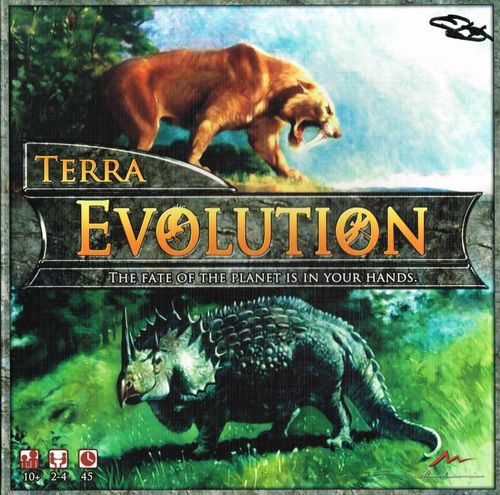
Terra Evolution
Terra Evolution Rulebook
Table of Contents
Table of Contents
Components
- Name of the card. Population cards have no name.
- Population count on biological species cards.
- Defence value on biological species cards and continent cards. Disaster strength on disaster cards. Victory points on biological species cards (the number with an asterisk).
- Purchase cost of the card. On disaster cards, also the activation cost.
- Icons at the bottom centre of the card: evolution possibilities on biological species cards; the type of region affected by a disaster on disaster cards.
- Region type on continent cards: sea or land.
- Population card.
The game contains 208 cards in total:
- Continent cards (32 cards). Continent cards form the regions on which players will place biological species. A biological species card can only be played onto a continent card that is already on the table. In the rules, the term "continent card" refers to the seven land regions and to the ocean, which is already on the table at the start of the game. Over the course of the game, each player creates their own planet from continent cards.
- Biological species cards (76 cards). Biological species cards depict representatives of the animal kingdom living on the player's planet. The game has 6 different types of these cards: bilaterians, insects, fish, reptiles, birds and mammals. Biological species cards allow a player to play cards of other, more advanced species.
- Population cards (60 cards). Population cards serve as the game's resource, allowing players to buy new cards from the common pool, and to play disaster cards against opponents' planets. They also protect biological species from the effects of disasters.
- Disaster cards (28 cards). Disaster cards allow players to affect the continents, biological species and population of other players. The cost of a disaster card determines the strength of the disaster. Each disaster card also shows the region it affects: a sea region, a land region, or both.
- Reference cards (12 cards). Each player is dealt 3 reference cards: one summarising the structure of a turn, one for biological species, and one for disasters.
Playing Area
Each player sets aside an area of the table as their playing space, in which the following elements will be placed during the game:
- The player's planet. The planet consists of a row of continent cards and the biological species cards played onto them. At the very start of the game every player has only the ocean; continents will be built up around it over time.
- The player's deck. The deck is placed face down below the continent cards, on the left side of the playing space.
- The reserve. To the right of the deck is a place where the player's population cards are placed face up as their reserve.
- The fossil pile. Each player's fossil pile (biological species cards set aside as victory points) is placed on the right side of the playing space.
- The common pool. In the centre of the table is a place for the common pool of cards that can be bought during the game (biological species cards and disaster cards), and for the population cards. These cards belong to no one.
Setup
Each player forms their starting deck from:
- 5 population cards
- 5 "bilaterian" biological species cards
- 7 different continent cards (land regions)
Each player prepares their playing space:
- shuffles the starting deck and places it in the corresponding area of the playing space
- places the Ocean as the first card in the row of continent cards. The other places in the player's personal playing space remain empty at this stage.
The cards that can be bought during the game (biological species cards and disaster cards), together with the population cards, are placed in the centre of the table as the common pool. The number of cards in the common pool depends on the number of players:
- "bilaterian" biological species cards = 2 × number of players (4, 6 or 8)
- "fish" biological species cards = 3 × number of players (6, 9 or 12)
- "reptile" biological species cards = 3 × number of players (6, 9 or 12)
- "insect" biological species cards = 2 × number of players (4, 6 or 8)
- "bird" biological species cards = 2 × number of players (4, 6 or 8)
- "mammal" biological species cards = 2 × number of players (4, 6 or 8)
- each of the 7 disaster cards = number of players (2, 3 or 4)
- population cards = 10 × number of players (20, 30 or 40)
When playing with two or three players, all surplus cards are returned to the box.
Each player receives one reference card of each type.
Players draw 5 cards from their own deck into their hand.
During the game, cards in a player's hand may not be shown to other players.
Game Turn
Determine which player will begin the game.
Play proceeds clockwise until one of the players meets the following victory condition:
- 2 players: at least 15 victory points in their fossil pile
- 3 players: at least 13 victory points in their fossil pile
- 4 players: at least 10 victory points in their fossil pile
In addition to the required number of victory points, the player's planet must hold at least 1 "bird" biological species card and at least 1 "mammal" biological species card.
A player's turn:
On their turn, a player performs various actions. Actions are not mandatory, and a player may decline to perform any one of them, or all of them.
Actions are always performed strictly in the following order:
- play any number of population cards
- play 1 biological species card
- play 1 continent card
- play 1 disaster card
- buy 1 card from the common pool, or take 1 card from their fossil pile
- closing actions (shuffle the cards in hand and place them at the bottom of the deck; draw 5 cards into hand)
Actions
1. Play Population Cards
A player may play any number of population cards from their hand into their reserve.
Information about population cards held in players' reserves is open, and any player may ask an opponent to state how many cards they have in their reserve.
The number of population cards in the common pool may also be counted at any time.
2. Play a Biological Species Card
A player may play 1 biological species card from their hand, placing it on their planet.
Playing a "bilaterian" biological species card does not require the player to have any biological species cards on their planet. To play cards of other biological species, the player must already have a card of a specific species on their planet.
On one of the player's continents there must already be either:
- a card of the same biological species (that is, exactly the same species as the one the player intends to play), or
- a card that shows, at the bottom centre, the icon of the biological species the player wants to play.
In the first case, the newly played biological species card is placed on an empty continent card. In the second case, the newly played biological species card replaces the previously played card (the one with the icon). The previously played card is sent to the fossil pile (it counts towards victory points).
After playing a biological species card, the player takes from the common pool into their hand a number of population cards matching the number shown in the centre of the card they played.
When the supply of population cards in the common pool runs out, players may no longer draw these cards.
Notes on biological species cards (the source prints these as three numbered notes after this action, without a heading):
- The defence value on "bilaterian", "fish" and "reptile" biological species cards determines the number of victory points these cards provide in a fossil pile.
- To win the game, in addition to victory points, a player must have "bird" and "mammal" biological species cards on their planet.
- The "insect" biological species card does not provide victory points, and its presence on the planet is not required as a victory condition; however, it can quickly increase the player's population.
3. Play a Continent Card
A player may play 1 continent card from their hand, placing it on their planet.
A player's planet may contain only one continent card of each kind (1 Ocean, 1 Australia, and so on).
4. Play a Disaster Card
A player may play 1 disaster card from their hand.
To play a disaster card, the player must pay its activation cost using population cards from their reserve. The activation cost equals the purchase cost of the card. Population cards spent to pay for the activation of a disaster are taken by the player into their hand.
- A player may play a disaster on any other player's continent card that holds a biological species card.
- The region type of the disaster card and of the chosen target continent card must match: a disaster that affects only a sea region may be played only onto an Ocean card and cannot be played onto land continents. A disaster that affects both regions may be played onto any continent card.
- The strength of the disaster is shown in the bottom left corner of the card.
- The player against whom a disaster card is played first moves from their reserve (not from their hand!) into the common pool a number of population cards equal to the strength of the disaster.
- If there are not enough population cards in the reserve, the remaining strength of the disaster affects the biological species card on the targeted continent, and then the continent card itself.
- If the remaining strength of the disaster is equal to the defence value of the biological species card, the attacking player takes that biological species card into their hand.
- If the remaining strength of the disaster exceeds the defence value of the biological species card, then, in addition to that biological species card, the attacking player takes into their hand the continent card lying beneath it.
The played disaster card is removed from the game.
5. Buy a Card from the Common Pool (or Take a Card from Your Fossil Pile)
During this phase, the player may buy 1 biological species card or 1 disaster card from the common pool. The player must pay the purchase cost shown in the bottom right corner of the card, using population cards from their reserve.
The population cards spent on payment, together with the card acquired, are taken by the player into their hand. If the player does not wish to buy a card from the common pool, they may instead take 1 card from their fossil pile into their hand. A biological species card that returns to play in this way no longer counts towards victory points from that moment on.
6. Closing Actions
The player shuffles the cards in their hand and places them at the bottom of their deck.
To finish the phase, the player draws 5 cards from the top of their deck into their hand.
If fewer than 5 cards remain in the deck, the player takes all remaining cards.
Likewise, if the player's deck is empty at the moment the shuffled cards must be placed at the bottom of the deck, these cards form the new deck.
When the player begins shuffling the cards in their hand, the next player may begin their turn.
N.B. Under the established order of game actions, a player can never play the cards they have taken into their hand in the same turn. These cards return to the deck and may only be played in later turns.
Victory Conditions
If the sum of victory points in a player's fossil pile meets the minimum victory requirement (depending on the number of players: 15, 13 or 10 points), the player has collected enough points to claim victory.
The defence value (1–3) on biological species cards in the fossil pile determines the number of victory points those cards provide.
In addition to the required number of victory points, to win the game the player's planet must hold at least 1 "bird" biological species card and at least 1 "mammal" biological species card.
The player who first meets the victory conditions wins the game IMMEDIATELY.