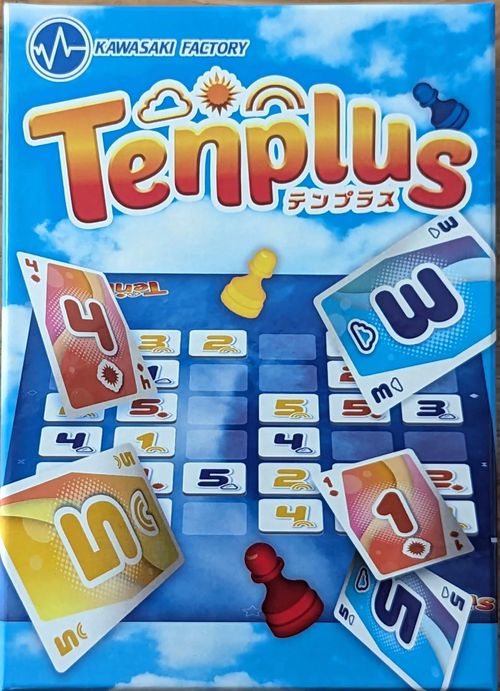
Tenplus
Tenplus Rulebook
Table of Contents
Table of Contents
Components
Included in the box (入っているもの):
- Tiles: 36 (12 in each of three colours: red, yellow and blue). Each colour has the numbers 1, 1, 1, 2, 2, 2, 3, 3, 4, 4, 5, 5.
- Cards: 48 (16 in each of the three colours: red, yellow and blue), numbered 1 to 5.
- Board: 1 (assembly required).
- Pawns (コマ): 3 (blue, yellow and red).
- Rulebook.
Sums Ten (サムズテン)
Sums Ten is explained here for 2 players. The rules for 3 players are the same.
What You Need (使うもの)
- Board.
- 36 tiles.
- Pawns (one per player).
Setup (準備)
- Shuffle the 36 tiles well and place them face up at random on the board.
- Each player chooses one pawn and calls it "my pawn" (自分のコマ).
- Decide the first player (先手) with rock-paper-scissors (じゃんけん). The second player is the 後手. With 3 players, play proceeds clockwise.
How to Play (ゲームの進め方)
- The first player places their pawn on any tile in the 6×6 grid, then takes that tile. The player takes the tile into their own play area and sorts it by colour ("色別にして" – arranged by colour in front of them). The second player does the same on their first turn.
- From then on, each turn the player moves their pawn according to the movement rules below, and takes the tile it lands on.
Movement Rules (コマの移動ルール)
- From your pawn's current position, you may move your pawn in a straight line, vertically or horizontally, to a tile on the yellow-green squares (黄緑色のマスにあるタイル).
- You may not jump over another player's pawn.
- You cannot move to a square that has no tile.
- If there is no tile you can move to, you pass (パス). Your pawn does not move on that turn.
Exception Rule (例外ルール)
- If another player's pawn is directly next to yours, you may jump over that pawn and move your pawn to the tile one space beyond it, on a light-blue square (水色のマスにあるタイル).
- If there is no tile on the light-blue square, you cannot jump.
[Diagrams omitted.]
Scoring (得点の取り方)
- When you have taken tiles of one colour that add up to exactly 10, say "Ten" (テン) and turn all of the tiles that make up the 10 face down. Sums are counted by colour. You cannot make a 10 from tiles of different colours.
- You score 1 point for each tile you turned face down.
- Note (注意): If you take a tile that makes the total of one colour go over 10, you lose. See the next page for details.
Example: In the lower-right diagram, the first player took red 4. Red now totals 1+2+3+4 = exactly 10, so all the red tiles are turned face down and scored. Four tiles made 10, so that is 4 points. In other words, the more tiles you use to make 10, the more points you score.
A colour that has once made 10 and been turned face down must be made into 10 again.
Target Score (目標得点):
- 2 players: 10 points.
- 3 players: 8 points.
Defensive Play (相手の得点を防ぐ作戦)
Example: In the diagram, if the first player takes blue 2 next, the blue total becomes 10 and they score 4 points. In that case, the second player, on their turn, can move to yellow 1 and block the first player's route, preventing the score.
[Diagrams omitted.]
End of the Game (ゲームの勝敗)
- As soon as either player has reached the target score of 10 points or more, the game ends and that player wins. (With 3 players the target is 8 points.) Figure 1: the first player takes red 5, which makes the red total 10. 3 points are added, the first player reaches 11 points, and the first player wins.
- If neither player can make the target score of 10 points and neither player can move any more, the game ends. The player with more points wins. If the scores are tied, the player whose remaining tiles (the tiles not yet turned face down) add up to the higher total wins. Figure 2: neither player can move, so the game ends. Both players have 8 points, but the second player's remaining tiles total more, so the second player wins.
- If a player takes tiles that make one colour go over 10, that player bursts (バースト), the game ends immediately, and the bursting player loses. (With 3 players, the player with more points of the remaining two players wins.) Figure 3: the red numbers total 1+2+3+5 = 11, so the second player loses.
Example: In the diagram, it is the second player's turn and the only tile they can move to is red 5. If a move is possible, it must be made. Because the second player takes red 5, their red bursts, and they lose.
[Diagrams omitted.]
One-Shot Burst Tactic (一発逆転のバースト作戦)
Near the end of the game, when the opponent looks likely to reach the target score first, instead of increasing your own score you can switch to a one-shot reversal: make the opponent burst.
Example: In the diagram, the first player could score now by taking either the red 5 or the yellow 4 next to them. But if the second player then takes red 4, the first player loses. So the first player moves to yellow 2. The second player can then move only to red 5, which makes them burst.
[Diagrams omitted.]
Sums Ten: One-Player Point Game (ポイントゲーム(1人プレー))
This one-player game is useful for practising how to take tiles.
Setup (準備)
- Shuffle the 36 tiles and lay them out at random. Place two pawns on the board as shown in the layout diagram, and remove 2 tiles from the board. The 2 removed tiles are not used. The two pawns on the board are not moved for the rest of the game.
[Diagram omitted: the two fixed pawns, the tiles set aside as "unused tiles", and the one pawn that can move.]
How to Play (ゲームのやり方)
- Use the one remaining pawn as the movable pawn. Take a tile on any square you like to start, then take tiles in order following the Sums Ten movement rules.
- The game ends when you can no longer move, or when you burst. The target score is 21 points.
[Diagram omitted: example end-of-game layout, showing 23 points.]
Tips for Reaching the Target Score (目標得点をクリアするためのコツ)
- Early in the game, jump over an adjacent pawn to move, so that the fixed pawns do not block your route.
- Plan your combinations before you take tiles, so that no tiles are wasted in making 10.
Count Up Ten (カウントアップテン)
Count Up Ten is explained here for 3 players. The rules for 2 and 4 players are the same.
What You Need (使うもの)
- 48 cards.
Setup (準備)
- Shuffle the 48 cards well and place them face down in the centre of the table. This is the draw pile (山札).
- Deal 3 cards face down to each player from the draw pile. Each player holds their cards so that only they can see them. These are their hand (手札). Cards drawn from the draw pile during the game are also kept in hand this way.
- Decide the player who plays first with rock-paper-scissors (じゃんけん). Play then proceeds clockwise, starting with the winner.
How to Play (ゲームの進め方)
-
On your turn, choose 1 card from your hand and play it face up to the table (場). If the cards are the same colour, you may play 2 or 3 of them at once. Cards played to the table are called the table cards (場札). When you play a card, declare the total of the numbers of the table cards.
- You cannot pass. You must play a card.
Example: In the diagram, the first player plays yellow 3 and declares "3". The second player then plays blue 1 and blue 3 (2 cards) and declares "7".
-
After playing, draw from the draw pile as many new cards as you played, so that you again hold 3 cards. If the draw pile is empty, do not draw; continue playing.
[Diagrams omitted.]
Scoring (得点の取り方)
- Play cards so that the total of the table cards becomes exactly 10. This is Up (上がり). You then take the cards you played and score points. Keep the card you played (or the played card with the highest number, if you played several) in front of you, face up and upright (タテ). The number printed on an upright card is a plus point.
- The table cards other than the scoring card are turned face down and placed in the discard pile (捨て札).
Example: In the diagram, the table total is 3+1+3 = 7. Player A plays yellow 3, so the total is 3+1+3+3 = 10. Player A places the yellow 3 card in front of them to score +3 points. The remaining 3 table cards are turned face down and placed in the discard pile.
Burst (バースト): If the total of the table cards goes over 10, the player has burst. The player takes the card they just played and makes it a minus point: they place it in front of them, face up and sideways (ヨコ). The number printed on it is a minus point. The other table cards are turned face down and placed in the discard pile.
Example: In the diagram, the table total is 9 (2+1+4+2). Player B, who did not have a 1, plays blue 2. The total becomes 2+1+4+2+2 = 11, which goes over 10. Player B places the blue 2 sideways in front of them as -2 points. The remaining 4 table cards are turned face down and placed in the discard pile.
Scoring with 2 or 3 Cards (2枚・3枚出して上がりになったときの得点)
Example: In the diagram, the table total is 4. Player B plays the three red cards 1, 2 and 3 at once. The total becomes 4+1+2+3 = 10, which is Up. Of the cards played, the one with the highest number, the 3, is kept in front of Player B, so Player B scores +3 points.
[Diagrams omitted.]
Continuing After an Up or Burst (上がり・バースト後の続け方)
If someone makes the table total exactly 10 (Up), or goes over 10 (Burst), that same player starts the next play, continuing the turn sequence.
Example: In the diagram, the table total is 6 (3+1+2). Player A plays red 1 and red 3 (2 cards of the same colour), making the table total 3+1+2+1+3 = 10. That is Up.
- Player A places the red 3 card in front of them to score +3 points. The remaining 4 table cards are turned face down and placed in the discard pile.
- Player A draws 2 cards from the draw pile to return their hand to 3 cards. If the draw pile does not have enough cards, draw as many as possible.
- From the cards in hand, Player A plays one card (blue 2) to the table.
- Player A draws 1 card from the draw pile to return their hand to 3 cards.
Only at this point does the turn pass to the next player.
Game End (ゲームの勝敗)
- When the draw pile runs out, continue the game using only the cards in hand. A player who has no cards left in hand is temporarily out of the game, but this is not a loss. When every player has no cards left in hand, the game ends. Table cards left on the table become discards as they are.
- Calculate each player's score from the scoring cards in front of them. Upright cards add their number as plus points. Sideways cards subtract their number as minus points. The player with the highest score wins.
- Tie: If the scores are tied, the player who has taken more cards (plus or minus, whichever) wins. If still tied, the player with more plus cards wins.
Example scores:
- Player A: 1+1+4+2-2 = 6 points.
- Player B: 5+1+3-2 = 7 points (4 cards).
- Player C: 1+2+2+1+1 = 7 points (5 cards).
Players B and C both have 7 points, but Player C has more cards, so Player C wins.
[Diagrams omitted.]
Winning Tactics (勝つための作戦)
- Keep cards of the same colour in hand. Same-colour cards can be played together as 2 or 3 cards, so keeping them in hand is useful. For example, if you hold the same colour 1, 2 and 4, then when your turn comes round you can go Up whatever the table total is, as long as it is from 3 to 9.
- Do not let opponents score high. If your turn comes round and you cannot go Up, choose the card to play so the next player cannot score high. Example: In the diagram, you do not have a 5. If you play a 1 or a 2, the next player may go Up for 4 or 3 points. So play a 4 to make the table total 9. Then even if the next player goes Up, they can score only 1 point.
- A double 5 is a scoring chance. If you have two 5s of the same colour in hand, it is a chance to score. Example: In the diagram, the table total is 8 when it comes round to you. Play blue 2 to go Up (+2 points). Your turn then continues, so you can play the two yellow 5s for 5 points. Also, if the table total is 9, a burst with blue 2 (-2 points) still lets you continue and play the two 5s for 5 points, a net of +3 points.
[Diagrams omitted.]
Hand Ten (ハンドテン)
Hand Ten is explained here for 3 players. The rules for 2 and 4 players are the same.
What You Need (使うもの)
- Cards: from the 48 cards, remove one each of the "4" and the "5" in each colour (blue, red and yellow), 6 cards in total, and put them back in the box. This game uses the remaining 42 cards.
- 36 tiles (for showing points).
Setup (準備)
- Shuffle the 42 cards well and place them face down in the centre of the table. This is the draw pile (山札). The 5 cards at the very bottom of the draw pile are placed sideways in a cross shape, as shown in the diagram, so the number of cards left in the draw pile is easy to see.
- Deal 1 card face down from the draw pile to each player. This is their hand (手札).
- Give every player one tile "1" and two tiles "2". The colour does not matter. Each player starts the game with 5 points. Place the remaining tiles beside the table as the bank (銀行).
- Decide the first player with rock-paper-scissors (じゃんけん). Play then proceeds clockwise, starting with the winner.
How to Play (ゲームの進め方)
- On your turn, draw 1 card from the draw pile and look at it only yourself. Then decide whether to keep it (自分でもらう) or pass it to another player (人におしつける).
- Keeping a card: Say "Stay" (ステイ) and add the card to your hand. However, if the total of the numbers in your hand would go over 10, you cannot stay. The colour of the card does not matter.
- Passing a card: Say "Pass" (パス) and choose a player to pass the card to. Hand the card to that player so that the other players cannot see it. Only the card you just drew can be passed. A player who has been passed a card cannot refuse it.
- When one player has finished by staying or passing, the turn passes to the next player.
Scoring (得点の取り方)
Up (上がり): When the numbers in your hand total exactly 10, declare "Up" (上がり). You then receive scoring tiles from the bank, worth points according to the number of cards in your hand at that time (see the table below).
Burst (バースト): If the numbers in your hand total more than 10, you have burst (バースト) and lose points. In this case, reveal all of your hand cards and discard them. You must then give 2 points to the player who passed you the card. If you do not have 2 points, pay the shortfall from the bank.
Note (注意): You cannot deliberately burst with a card you drew yourself.
Furikomi (フリコミ): If passing a card to an opponent makes that opponent's hand total exactly 10, this is Furikomi (フリコミ). The opponent takes the score for going Up from the bank. In addition, the player who passed the card must give 4 points to the player who went Up. If you do not have 4 points, pay the shortfall from the bank.
After you go Up or burst, your hand is all discarded. You then aim to make 10 again with newly drawn or passed cards.
Scoring tiles are grouped in 5-point stacks and placed in front of you, so that the other players can see them.
Points by number of cards in hand (手札枚数 / 得点 / 例):
| Cards in hand | Points | Example |
|---|---|---|
| 3 or fewer | 1 point | 2+3+5 |
| 4 | 3 points | 1+2+3+4 |
| 5 | 6 points | 1+1+2+3+3 |
| 6 | 10 points | 1+1+1+2+2+3 |
| 7 or more | 15 points | 1+1+1+1+2+2+2 |
Up example: The hand is 1, 1, 2 and 3, and the player takes a 3 from their hand to make 1+1+2+3+3 = 10. With 5 cards in hand, the player scores 6 points and takes tiles from the bank totalling 6 points (any colours).
Burst example: The hand is 1, 2 and 4, and a 4 is passed in. The total is 1+2+4+4 = 11. Because the total is over 10, the player gives 2 points to the opponent who passed the 4 card.
Furikomi example: An opponent holds 1, 2 and 3. The player passes them a 4 card, making 1+2+3+4 = 10. This is Furikomi. The opponent goes Up with 4 cards and so receives 3 points from the bank, and the player who passed the card gives the opponent 4 points.
Scoring tile arrangement example: Tiles 1, 1, 1 and 2 make one stack worth 5 points. Tiles 2, 2 and 1 make another stack worth 5 points. A single 1 is worth 1 point. The total is 11 points.
[Diagrams omitted.]
Ending the Game (ゲームの勝敗)
- When the last card of the draw pile has been drawn and the player has stayed or passed, the game ends. Calculate the points for any Up, burst or Furikomi, and finish.
- At this time, the player with the greatest total of numbers left in hand receives a bonus of 8 points from the bank. If several players are tied for the greatest total, each of them receives 8 points. However, if anyone went Up with the last card of the draw pile, no player receives the bonus.
- The player with the highest score wins.
- Tie: If the scores are tied, the player whose remaining hand contains the largest number wins. If still tied, the game is a draw.
Example: Player A has scoring tiles 1, 1, 2, 2, 3 and 4 (13 points), with 1 and 4 in hand (total 5). Player B has scoring tiles 1, 2, 2, 3 and 4 (12 points), with a 5 in hand (total 5). Player C has scoring tiles 1, 2, 2, 5 and 5 (15 points), with 1 and 2 in hand (total 3). Players A and B each receive the bonus of 8 points from the bank (shown as tiles 3 and 5). Player A then has 21 points, Player B has 20 points and Player C has 15 points. Player A wins.
[Diagrams omitted.]
Winning Tactics (勝つための作戦)
- Aim for a burst by the leader. When the card drawn from the draw pile is a 4 or a 5, you have a chance to make an opponent burst by passing it to them. In particular, if you can make a leading opponent burst, that opponent loses 2 points and you gain 2 points, so you can close a 4-point gap.
- Aim for the bonus points with a late reversal. The draw pile is laid out so you can see when its last 5 cards remain (the cards are turned sideways). A player who is behind on points at that stage, as the draw pile runs low, should accept the risk of a burst, say "Stay" to raise the numbers in hand, and aim for the 8 bonus points.
Variation Rule (バリエーションルール)
If all of the cards in hand are the same colour when a player goes Up, that player receives twice the usual points. The points lost for Furikomi and for burst do not change.
[Diagrams omitted.]
Hand Ten: Pair Play (4 players) (ペアプレー(4人プレー))
With 4 players, you can play Hand Ten in pairs. The 4 players sit around the board, and the two players sitting opposite each other form a pair. In pair play, the pairs compete on the combined points of each pair's members, so the key to winning is for two players to work together to increase points.
Tactics for Pairs (ペアが協力する作戦)
In this section, pair A (A1 and A2) and pair B (B1 and B2) are used as examples.
- Concentrated passes to burst an opponent (「パス」の集中攻撃でバーストさせる). Player A1 passes a card to B2, who is in front of them in the turn order. Then A2 also passes a card to B2. From B2's point of view, they are passed two cards in a row before their turn comes round, so the chance of a burst goes up.
- Rescue a teammate in trouble (味方のピンチを救う). Suppose A2 has been passed a card by B2, so that A2's hand has grown to 4 cards. In that case, A1 passes a card to their teammate A2. If A2 bursts, the points only move between teammates. If it becomes Furikomi, A2 receives points from the bank, so the pair gains points overall.
- Cooperate to aim for the bonus points (協力してボーナス点をねらう). When the draw pile runs low, one player of the pair should be able to receive the bonus of 8 points. For example, if player A1 has no cards in hand and it is A1's turn, A1 passes to A2 to raise the numbers. Also, if the card A2 draws last takes A2 over 10 and A2 does not want to pass that card to an opponent, A2 can escape by passing it to A1.
[Diagrams omitted.]
Scoring Quick Reference (得点早見表)
The quick-reference sheet printed on the back cover of the rulebook. It summarises the scoring rules above.
Sums Ten (サムズテン)
- Points: The number of tiles of the same colour that add up to exactly 10. Turn those tiles face down.
- Example: Red 1, 2, 3 and 4 add to 10, so the tiles are turned face down for +4 points.
- Target score: 2 players: 10 points. 3 players: 8 points.
Count Up Ten (カウントアップテン)
- Up (上がり) points: When the table total is made exactly 10, the number on the last card played is the points. The card is placed upright (タテ) as a plus.
- Example: 2+1+3+4 = 10, so the last card, the 4, is placed upright for +4 points.
- Burst (バースト) penalty: When the table total goes over 10, the number on the last card played is the penalty. The card is placed sideways (ヨコ) as a minus.
- Example: 2+1+4+2+2 = 11, so the last card, the blue 2, is placed sideways for -2 points.
Hand Ten (ハンドテン)
- Up (上がり) points: When the total of the hand is made exactly 10, the points depend on the number of cards in the hand:
| Cards in hand | Points |
|---|---|
| 3 or fewer | 1 point |
| 4 | 3 points |
| 5 | 6 points |
| 6 | 10 points |
| 7 or more | 15 points |
- Example: 2+1+4+3 = 10 with 4 cards, so 3 points are taken from the bank.
- Burst (バースト) penalty: When the total of the hand goes over 10, the player gives 2 points to the opponent who passed them the card.
- Furikomi (フリコミ) penalty: When passing a card makes the opponent go Up, the player who passed the card gives 4 points to the player who went Up.
- Bonus points: When the draw pile is empty, the player with the highest total of numbers in hand receives 8 points from the bank.