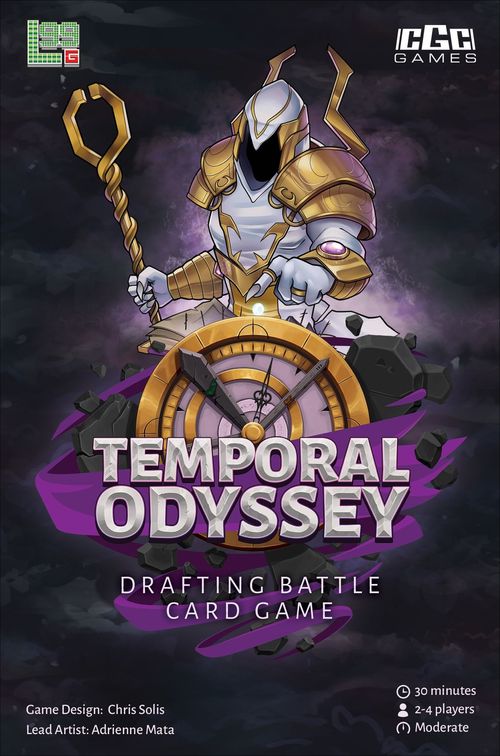
Temporal Odyssey
Temporal Odyssey Rulebook
Table of Contents
Table of Contents
Components
- 6 Traveler decks (8 cards each): 1 Traveler, 1 Tower, 1 Scout, 1 Mercenary, 1 Artifact, 3 Spells
- 38 Past Cards
- 38 Present Cards
- 38 Future Cards
- 18 Instability Cards
- 5 Token Cards
- 16 AP Tokens
- 24 Damage Tokens
- 18 Class Reminder Cards
- 4 Player Reference Cards
Card Layout
There are five types of cards in Temporal Odyssey: Characters, Structures, Spells, Artifacts, and Instability.
Characters & Structures
Characters make up the main body of cards in the game. Use them to attack and defend. Characters and Structures are organized in Groups.
- Name: The name of the card.
- Cost: How many AP ("Action Points") it costs to play this card.
- Card Type / Class: The type and class of the card. These have no inherent effects, but many effects cannot target structures.
- HP: "Hit Points". The amount of damage the card can take before being defeated.
- ATK: "Attack Power". The amount of battle damage dealt when declaring an attack.
- Active Ability: These abilities can be used on your turn, either automatically or by spending AP to activate them.
- Defensive Ability: These abilities are only active during opponents' turns.
- Share: If this icon is present, the defensive ability is shared with the group. This shared ability is granted to the grouped card.
- Elemental Sigils: The card's element or elements. These elements vary from card to card, though one is usually determined by the card's class. Some cards have no elements.
The elements are Fire, Earth, Dark, Water, Wind and Light.
Traveler
Travelers have a reverse side "Under Judgment", to remind you how they return to life. They are also immune to Banish effects and anything else that would remove them from the play area.
In all other aspects, they act just like characters.
Travelers are special characters that represent you during a showdown. Travelers return to life rather than being defeated like other characters. They are also immune to effects which Banish characters (but not ones that defeat characters). In other respects they behave like normal characters.
If a traveler is defeated when they have 3 instability cards, they are banished to the end of time. The remaining traveler is the victor!
Spells
Example: Mr. F's Malice spell lets him improve one character's attack for the turn. If he has the proper elemental sigils, the spell may target ALL his characters instead. If he has a second set of these sigils, he may make it impossible to reduce or prevent their damage!
Spells are played directly from your hand for immediate effects.
Pay the AP cost and place the card into play, then follow the directions on the card. It will remain in play until it is exhausted (placed under your traveler) at the start of your next turn. Some spells will banish themselves after use, instead of being exhausted.
Spells can power up if you control certain elemental sigils. If you control one copy of each elemental sigil pictured on the spell, you may gain its Level 2 Boost effect. If you control two copies of each elemental sigil pictured on the spell, you may gain both the Level 2 and Level 3 boosts. Not all spells have a Level 3 boost.
Artifacts
Most artifacts cause your opponent to gain instability when they enter the battlefield. Artifacts in play always provide their elements and often grant access to a powerful AP or Traveler Ability.
Artifacts destabilize your opponent and provide powerful long-term effects. Once in play, artifacts are separate from your characters and are never part of a group or combat.
Instability
If you have 3 of these and your traveler is defeated, you lose the game! They provide a sigil and a small ability. A gift from Lovox, the god of time.
As you suffer losses, you will gain instability cards. This represents the decay of your timeline and the judgment of the god of time.
Every instability card provides an elemental sigil and an AP Ability which can be activated by flipping the card face-down (depriving you of access to its element).
Tokens
Tokens remain outside of the game, and are brought into play by specific effects.
Token cards are cards which are summoned from the Token deck by special effects. They may be any kind of card.
Setup
-
Take all six cards associated with three different classes, plus the two bonus spells for each time period. Shuffle these separately to form the three time period decks and place them face-down to the side of the play area. For your first game, we recommend:
- Past - Ancients, Elementals, Beasts
- Present - Warriors, Paladins, Assassins
- Future - Soldiers, Machines, Engineers
Set aside the class reminder cards under each relevant time period deck for reference purposes.
-
Place the token deck face-up near the play area.
-
Each player should choose a traveler, and take that traveler's cards.
-
Place your tower and traveler into play.
-
Give each player 4 AP Tokens.
-
Place the instability deck face-up near the play area.
-
Choose the first player at random. Take the Haste spell out of the token deck and add it to the hand of the player who is going last.
Now begin the game with the first player taking their first turn.
The play area includes a Banish Pile (face up) and a Discard Pile (face up) for each player.
Main Objective
Deal 3 instability to your opponent, then defeat their traveler!
Start of Turn
- Resolve all Start of Turn effects on your characters and artifacts in any order of your choice.
- Discard any AP Tokens that are on top of cards in your play area. Gain AP Tokens until you have 4.
- Exhaust all spells in your play area (place them underneath your traveler).
Play
Spend your AP to perform actions. AP is only used on your turn, so try to spend every AP you have every turn for maximum efficiency.
You can only place AP onto a card once per turn: if there is already AP on a card, the card cannot act again this turn.
Enlist a Card
Place the card into your play area with the required number of AP Tokens on it, bolt-side up. Enlisted abilities activate at this time. Positioning of cards is not important at this time. There is no limit to the number of cards which can be in your play area at a time.
Whether a card is a character or an artifact, it is enlisted the same way. The AP placed on the card show how those AP were used, and also prevent you from using the card to attack or activate an ability during this turn.
Cast a Spell
Place the card in your play area with the required number of AP Tokens on it, bolt-side up, and perform its effects. If you have the proper sigils in your play area, you may boost it to Level 2 or Level 3 to gain all effects at and below that boost level.
Spells perform their effects immediately. Once cast, the spell will stay in play, until it is exhausted.
Example: If Jin has Josefina in play, her sigils allow his Meteor to strike for 30 damage. With an additional copy of each sigil, it strikes for 40 damage.
Attack
Place one AP Token onto the card, sword-side up, then inflict damage equal to the card's attack on the leader of any group. Make note of passive abilities on that leader and its support, as they may deal damage back to you or reduce the amount of damage you deal. A card with an ATK of - cannot attack. The first player cannot attack on their first turn.
Example: An AP token is placed sword-side up on Zane, and he places damage onto R. Ridley equal to his ATK. Carole's shared Armored: 10 reduces the incoming damage from 30 down to 20. Zane couldn't attack Carole directly, because she is not the group's leader. R. Ridley's Retaliate: 10 deals 10 damage back to Zane. Zane's own Retaliate does not trigger, since defensive abilities only work during an opponent's turn.
Use an AP Ability
To use an AP Ability, pay the ability's cost (place AP Tokens bolt-side up on the card) and activate the effect.
Example: Placing an AP Token on Emberstadt Hall activates its Blast ability, which deals 10 damage to a target. This is not an attack, so it can even hit a support.
Traveler's Rest Ability
The traveler's Rest ability is an AP Ability that returns your exhausted spells to your hand. Using an AP Ability places AP on the card with the ability, so your traveler cannot attack during the same turn they use it. Time your use of this ability carefully to recover spells when you need them most.
Damage and Defeat
As a result of your actions, you may damage or defeat opponents' cards.
When a card has damage equal to or greater than its HP, it is defeated immediately; ungroup it and discard it to its controller's discard pile. (If it was a leader, its support is now a leader.)
Whenever you have 2 cards in your discard pile, immediately banish them and gain 1 instability. If a card is not defeated, damage remains on it across multiple turns.
Example (Defeating Characters): After accumulating 60 damage, Wanderer Charlie is defeated. He ungroups from Carole and is discarded. Jin's discard pile also contains a previously defeated character, Blades Up Above. Since there are two cards in his discard pile, Jin banishes both of them and gains an instability card.
Traveler Defeat
When a traveler is defeated, ungroup them and remove all damage, but flip them over instead of discarding them. If that traveler has 3 instability, they lose the game! Otherwise, they gain 1 instability and will revive automatically at the start of their next turn. Players cannot interact with defeated travelers by any means.
Example: Travelers are defeated like other characters, but instead of going to the discard, they ungroup and flip over. Defeating Jin causes him to gain 1 instability. If he already had 3 instability, his opponent wins!
Gain Instability
Actions your opponent takes will cause you to gain instability cards. Once you have 3 instability, your Traveler is vulnerable.
When you gain instability, draw a card from the instability deck and place it face-up in your play area. That card now provides an elemental sigil and an AP Ability. You can never gain more than 3 instability; if you already have 3 instability, ignore effects that would cause you to gain instability.
Regroup
After spending all AP you wish, regroup into a defensive formation.
When you're finished playing cards and using abilities, rearrange your characters and structures into groups. Cards that attacked during the turn must be at the front of their groups. Stunned characters also recover now.
A group can have 1 or 2 members. The card in front (or the only card) is the Leader. The card behind the leader is the Support. Special effects (such as AP Abilities and spells) can target either card, but only the Leader can be attacked.
Most characters have a defensive ability, and many of these can be shared with the group. This ability is only active during your opponent's turn.
Groups are formations which are only active during opponents' turns.
Example: Grouping SKG with Varsha will cause each character to gain the other's shared defensive ability, resulting in an effective Armored: 20 for each. Of course, as the group's leader, only SKG can actually be attacked. Since SKG attacked this turn, it must be the leader of any group it is in.
Example: DeMattei's powerful Barrier ability prevents himself and Inu from being targeted by effects. This means opponents will have to fight through Inu's deadly Retaliate ability rather than using spells or abilities to take out the group.
Stun
Some effects stun cards; turn a card sideways to indicate that it is stunned. AP cannot be placed onto stunned cards, but their defensive abilities still function normally.
Your stunned cards recover when you regroup your cards.
Example: Nefarious's Paralyze ability can stun Inu, protecting his team from Inu's powerful attack.
Draft
The final step in your turn is drafting a card from a time period deck!
- Choose a time period and pick up 3 cards from the top of that deck.
- Place one of these cards face-up on top of that deck.
- Place another into the banish pile.
- Place the last one into your hand (without showing your opponent), then pick up your hand again.
It is now the next player's turn!
Victory and Defeat
A player achieves victory by defeating his opponent's traveler when they have 3 instability cards.
When one player is defeated, the remaining player wins!
2v2 Teams
To play a 4-player game, two teams of two players should sit side by side, and each set up their own play area as usual. There are a few changes and special rules:
- Each team can suffer 4 instability, instead of the usual 3. Both players on a team share these cards.
- Revealed instability cards are controlled by both members of the team; all other cards are controlled by their owners, as normal.
- Your teammate's cards are considered 'allied' cards, and can be targeted by effects which target ally cards.
- The cards in your teammate's play area are separate and cannot form groups with yours.
- Your spells are only boosted by elemental sigils on cards that you control.
- If a traveler is defeated when their team has 4 instability, their entire team is defeated, and the opposing team wins.
- A player cannot attack until each other player has had at least one turn. This means the last turn player will have the first opportunity to attack.
- Allies can show each other their cards and can otherwise communicate freely to decide their strategy.
An example turn order for a 4-player game: Jin and Mr. F showdown against Zowie and Drake. Turn order passes back and forth between the teams as shown. Jin, Mr. F, and Zowie can't attack on their first turns. As the last turn player, Drake gains the Haste spell.
FAQ
Q: What happens if I am instructed to gain the top-most character of a deck (such as with Reckless Portal, Living Portal, etc) and the top card is not a character or is hidden? A: Reveal cards one by one until a character is revealed, then gain that one. Put the revealed cards face-down the bottom of the deck in the order they were revealed. Gained cards always go to your hand. If you reveal the entire deck without finding a character, the effect fails and you gain nothing.
Q: How do Infest and Endure interact? A: Endure has no effect on the damage moved by Infest.
Q: What happens if I need to gain an instability card, but the instability deck is empty? A: Return all banished instability cards to the instability deck, then shuffle it and gain an instability.
Q: If I enlist an Alternate Self token with the Alternate Timeline spell, what happens? A: You now have a second Traveler! It provides a powerful benefit and counts as your traveler for the purpose of artifact abilities, but if it is defeated, it can cause you to gain instability or lose the game!
More FAQ
Q: Is there a maximum hand size? A: No. You can have any number of cards in hand.
Q: How do Shield and Bullet Storm interact? A: Each instance of Bullet Storm is targeted separately, so you have to pay 1 additional AP for each shielded card you target. This extra cost is for targeting the ability, not activating it, so it does not increase the damage dealt by Bullet Storm.
Q: If I target a group with Shield, rather than individual cards, do I have to pay extra AP? A: Yes. You must pay 1 extra AP per shielded card in the group to target the group.
Q: If I defeat a card with Retaliate with an attack, do I still take damage from Retaliate? A: Yes. Cards are not defeated until the attack has resolved, so Retaliate will activate regardless of how much damage is on the card.
Q: Can I choose to play a spell at a lower level? A: Yes. Using the level boosts on spells is always optional.
Q: What if two opposing travelers are defeated at the same time and they each have 3 instability? A: The active player is declared the winner.
Q: Do effects like Retaliate, Shield, and Armored stack? A: Yes. These effects combine together and become one. So an Armored:10 card that gains Armored: 10 again would have Armored: 20.
Q: Can I choose to resolve only part of my effects? A: No. Effects must resolve as completely as possible (you cannot choose to resolve only part of an effect). An effect may be more than one sentence long.
Q: If I cannot resolve part of an effect, what happens? A: Once you choose to use an effect, it must resolve as completely as possible.