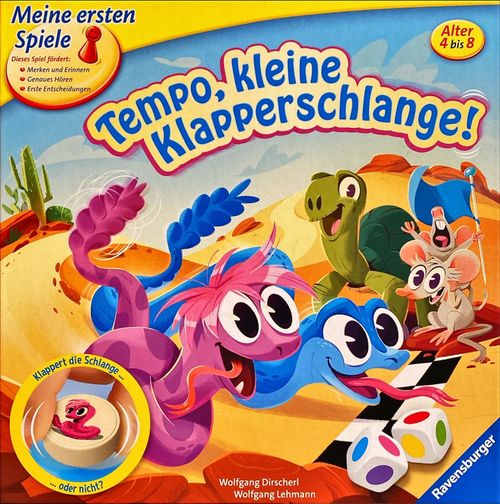
Tempo, kleine Klapperschlange!
Tempo, kleine Klapperschlange! Rulebook
Table of Contents
Table of Contents
Contents and Setup
- 60 cards
- 6 rattlesnakes (rattle cans)
- 2 colour dice
- 1 game board
Set up the game as shown in the illustration on the game board.
Further preparation:
- Shuffle the card deck.
- Each player receives one card from the deck, looks at it, and places it face down in front of themselves.
- Place the remaining cards face down as a draw pile.
- Mix up the rattlesnakes thoroughly by turning them over several times. Then, without testing them, place them on the starting line.
Object of the Game
As soon as the first rattlesnake reaches the last space of the race track, the game ends. The player who has collected the most cards of the winning rattlesnake wins the game.
Sequence of Play
The youngest player begins. The turn of the current player proceeds as follows:
- Roll the dice. Roll both dice and decide which of the two dice you want to use.
- Make a prediction. Using the die you chose, make a prediction for the rattlesnake of the matching colour: will it rattle or stay silent?
- Check the prediction. Only then pick up the rattlesnake and check whether you were right. To do so, gently shake it horizontally from side to side.
- Correct prediction: The player takes a card from the draw pile and adds it to their other cards. All of a player's own cards may be looked at by that player at any time.
- Incorrect prediction: The player unfortunately receives no reward.
- In both cases, the player turns the rattlesnake over to its other side and moves it one space forward.
Then the next player is up. They roll both dice and continue the game as described above.
Note: A rattlesnake that rattles now will do the opposite of what it just did the next time it is moved. A rattlesnake that now rattles will therefore not rattle next time, and vice versa.
Ending the Game
The game ends as soon as the first rattlesnake reaches the target space at Willy, the desert mouse. All players now reveal their collected cards. The player with the most cards of the winning rattlesnake wins the game. In the event of a tie, there are several winners.
Scoring Variant for Older Players
The game is played as described above, but the scoring works differently. As soon as the first rattlesnake reaches the target space, all cards are revealed. Each rattlesnake now scores as many points as there are cacti (1-3) shown on the space on which it stands. The player with the highest score wins!
Example from the rulebook:
- Nick: 0 + 1 + 1 + 9 + 0 = 11
- Lea: 0 + 2 + 2 + 1 + 3 + 0 = 8
- Simon: 6 + 2 + 1 + 3 + 0 = 12
How the Rattlesnakes Work
Take one rattle can in each hand, as shown in the illustration on page 2 of the rulebook. Hold it horizontally and shake it gently from side to side.
Listen carefully: on one side the snake rattles, and on the other side it does not. This is because of what it looks like on the inside. The rulebook illustrates this with two balls inside the can for the side marked "Klappert!" (rattles), and a single ball for the side marked "Psst ..." (silent).
Tip: Rattling correctly takes some skill. It is best to practise before the first game. You can also simply leave the can lying on the board and shake it gently from there. Give it a try!