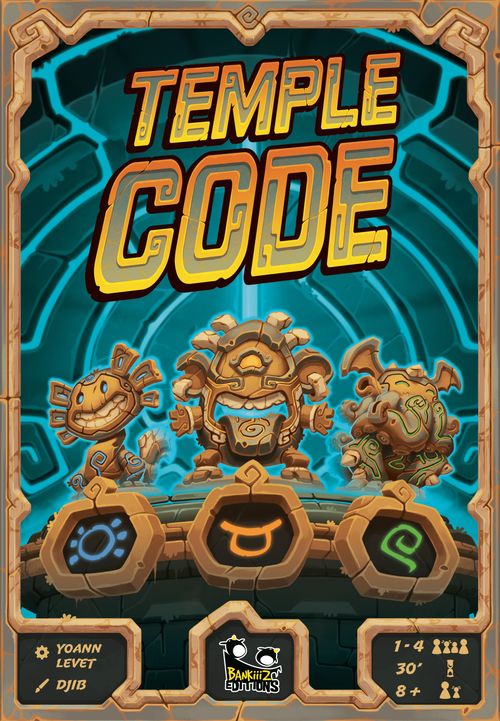
Temple Code
Temple Code Rulebook
Table of Contents
Table of Contents
Goal of the Game
Each player receives a Combination card they must guess.
The first player to guess their second Combination card wins the game.
Components
- 35 Combination cards (Cipher side and Statues side), showing statues: Great Wave, Tiki, Cthulhu, Axolotl, Narwhal, Emperor Penguin, Kraken
- Note sheets
- 1 First player tile
- 5 half-medallion tokens
- 4 card holders
Setup
Each player takes:
- a card holder
- a note sheet
- a pencil or pen (not supplied in the game box)
Shuffle all 35 Combination cards into a deck, Cipher side up.
Each player receives a Combination card and places it on the holder in front of them, so as to see only the Cipher side. Players must not look at the Statues side of their own card, as it is the combination they must guess.
Choose a first player who takes the First player tile.
Put the half-medallion tokens on the table, within reach of all players.
Game Flow
The game plays in multiple rounds. In each round every player takes their turn, starting with the first player. Whenever the round is over — when all players have taken their turn —, pass the First player tile to the next player in clockwise order. Then start a new round.
Anytime, even during other players' turns, a player may attempt to find their own combination by making a proposition. If they find the right combination, they take a half-medallion token and a new Combination card.
The player who gets their second half medallion first immediately wins the game!
Game Round
At the start of a round, the first player deals 2 cards to each player. Put them in front of your card holder, statues side up.
If the draw pile is ever empty, shuffle the discard pile and create a new deck with it.
Then, starting with the first player, each player takes their turn in clockwise fashion.
On their turn, the active player must choose another player who still has cards in front of them.
The active player chooses and takes one of the chosen player's statues side-up cards.
The chosen player takes the other card for themselves.
The active player and chosen player will obtain information from the card they have taken.
When they choose their card, the active player must ensure the chosen player will not get a card that gives them too much information.
Sometimes the active player will be forced to do so because it allows them to get a card they are very interested in.
Obtain Information from a Card
Whenever a player takes or receives a card, they flip it so as to see the cipher side and they align it just above their Combination card.
Once the card is aligned perfectly, the player looks at the information below the arrow.
Each blue dot indicates that a statue from the card they just retrieved is present in the combination they need to guess and is in the right position.
Each red triangle indicates a statue from the card they just retrieved is present in the combination they need to guess but is not in the right position.
If there is nothing under the arrow, none of the statues in the card they retrieved are in the combination.
After deciphering a card, you may keep it aside for future reference, if needed. You will find advice on how to take notes and gather information at the end of these rules.
In this example, the player learns two of the statues on this card are in their combination. One of them is even in the right position!
Special case: if, on their turn, the last player of the round is the only one with cards in front of them, they must decipher both of their cards.
Announcing Your Combination
At any point in the game, a player may announce they have found the statues of their card (their combination).
Then they must announce what they are in order.
If the order they announced is the right one, they take a half-medallion token.
If they just took their second half-medallion, they win the game.
If the game didn't end, whether the player has found their combination or not, they discard their Combination card as well as all Combination cards they had put aside. The player then draws a new Combination card and places it on its holder.
Solo Mode
Goal of the Game
In the solo mode, you must find as many combinations as possible before the end of the game.
Setup
Shuffle all 35 cards.
Place the first combination on your holder.
Game Flow
Draw the next card to obtain information from it.
Then, on each game turn, you reveal two Combination cards from the deck. You must discard one and will get information from the other.
At any point, you may attempt to guess a combination. If you find it, you score a point.
Whether you have succeeded or not, you then replace your card with a fresh one, then draw the next card to obtain information from it, much like at the beginning of the game.
End of the Game
The goal of the game is to find the most combinations before the 35-cards deck runs out.
Your Score
| Combinations found | Rank |
|---|---|
| 1 or 2 | Wannabe Archaeologist |
| 3 | Seasoned Archaeologist |
| 4 | Expert Archaeologist |
| 5 | Master Archaeologist |
| 6 | Jedi Archaeologist |
| 7 | Oh... wow. |
| 8 | Is it even possible?! |
Note-Taking and Guessing Hints
Case 1: You See Only Blue Dots
The card you just took only shows blue dot symbols.
You know that if one of the statues is in your combination, it is in the position shown on the card. You may then eliminate all other positions for statues on the retrieved card.
Case 2: You Only See Red Triangles
The card you just took only shows red triangle symbols.
You know that if one of the statues is in your combination, it must be in another place. You may then eliminate the current position of the statues on the retrieved card.