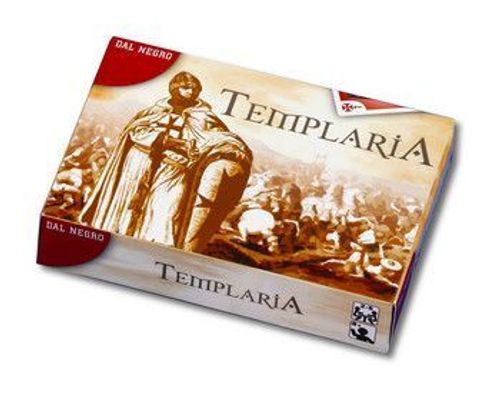
Templaria
Templaria Rulebook
Table of Contents
Table of Contents
Components
The game contains 55 playing cards, divided into:
- 48 numbered cards (12 for each of the 4 Guilds: Cup (Coppa), Cross (Croce), Fortune (Fortuna) and Moon (Luna))
- 5 "historical note" cards
- 2 "seal" cards
- 1 score pad
Number of Players
Templaria is mainly a game for two, four or six players. A special variant given at the end of this rulebook also allows play with five.
With two players, the players simply play against each other.
With four players, the players divide into two teams (teammates sit facing each other).
With six players, three teams of two players each are formed, or two teams of three players each.
Object of the Game
The players compete in a series of games ("Battles") to accumulate points.
The player (or team) that reaches or exceeds 13 BATTLE POINTS wins.
In a two-player game the individual player wins; in a four- or six-player game the entire team wins.
Setup
Prepare the draw deck by removing the four "historical note" cards, the two "seal" cards and the summary card. Randomly choose a dealer for the first Battle. The dealer changes at each Battle, passing the role counterclockwise.
The dealer shuffles the deck and deals a certain number of cards to the players:
- two-player game: 12 cards
- four-player game: 12 cards
- six-player game: 8 cards
In this way, in the four- and six-player games the deck is completely dealt out. In the two-player game, 24 cards remain instead, forming a separate pile from which the players draw one card at the start of their turn (starting from the second turn), until it runs out.
The Templaria deck is made up of four series of numbered cards from 1 to 12. Each series is marked by a symbol called a "Guild" (the suit).
Play
Play begins with the player to the right of the dealer; play then proceeds counterclockwise.
On their turn, each player must play one card from their hand.
The Battle always ends with the dealer playing their last card.
N.B.: in the two-player game, starting from the second turn, before playing a card the player first draws one from the pile of cards left over after the initial deal.
The card played from the hand is left face up on the table, or is used for a conquest or a capture.
The cards used for a conquest or capture, together with the cards taken, form the Loot (the pile of cards that will be used to determine the points scored by the player or team at the end of the Battle).
More precisely:
- If among the face-up cards on the table there is a card of the same value as the card played, a conquest is mandatory: the two cards are added to the Loot, face down. For example: on the table there are an 11 Cup, a 6 Cross and a 2 Fortune; the player plays a 6 Moon from their hand. They make a conquest: the cards 6 Moon and 6 Cross are added face down to the Loot.
- Otherwise, if there are several face-up cards on the table, and some of them, added together, equal the value of the card played by a player, a conquest is mandatory: all the cards used for the sum are added to the Loot together with the card used for the conquest. If more than one combination is possible, the player chooses which to use. For example: on the table there are an 11 Cup, a 6 Cross and a 2 Fortune; the player plays an 8 Moon from their hand. They make a conquest: the cards 8 Moon, 6 Cross and 2 Fortune are added face down to the Loot.
- If a conquest removes from the table all the cards that were present (even if there was only one), it becomes a capture of prisoners: the cards are added to the Loot as usual, but the captured cards (that is, those that were face up on the table) must be kept face up, to distinguish them from the other cards in the Loot. They may be worth extra points at the end of the Battle. For example: on the table there are a 6 Cross and a 2 Fortune; the player plays an 8 Moon from their hand. They make a capture: the 8 Moon is added face down to the Loot, while the 6 Cross and 2 Fortune are added to the Loot face up.
- If there are no face-up cards on the table, or none of them shows the same value as the card played by the player (neither individually nor by adding them together in any way), the card played is left face up on the table and no conquests or captures are made. For example: on the table there are a 6 Cross and a 2 Fortune; the player plays a 7 Moon from their hand. They make no conquest or capture and leave the 7 Moon face up on the table together with the other two.
End of Battle
When the dealer plays their last card from their hand, the Battle ends.
The cards left face up on the table are added to the Loot of the player who made the last conquest or capture (including the dealer themselves).
At this point the points are counted.
Card Composition and Scoring
As we have seen, the cards are divided into 4 suits with values from 1 to 12. Cards with value 5, 6 and 7 are SOLDIER cards; cards with value 1 are WEAPON cards.
The deck also contains 3 very powerful special cards: Baphomet, Jacques De Molay and The Holy Grail.
- BAPHOMET (12 Cross): when a player plays this card from their hand to make a capture or a conquest, they may assign it any value from 1 to 12. When the card remains on the table or is in the Loot, it returns to its value of 12.
- JACQUES DE MOLAY (10 Cross): this card is worth 10 additional points for the calculation of the Crusade score (see below); however, it is not considered a Soldier card for the purpose of matching it with Weapon cards.
- THE HOLY GRAAL (12 Cup): is worth 1 BATTLE POINT, regardless of any other factor.
There are four ways to score points: Fortune, the Crusade, the Prisoners and the Holy Grail.
Points scored at the end of the Battle are recorded on the score pad. As stated, the player (or team) that first reaches or exceeds 13 BATTLE POINTS wins the game.
- FORTUNE: the players (or teams) add together the numerical values of all the Fortune Guild cards in the Loot (including those face up from captures). The player with the highest total gains 1 BATTLE POINT. In case of a tie, nobody gains the point.
- CRUSADE: for the calculation, all the Soldier cards in the Loot are considered, that is, all the cards of value 5, 6 or 7 (including those face up from captures). Their numerical values are added together. To the total are added the bonuses due to the Weapons (the cards with value 1): these, only for the calculation of the Crusade, take the value of a Soldier card of the same Guild (therefore 5, 6 or 7 points). Warning: if a Weapon card has no corresponding Soldier card, the Weapon card is worth zero points. If the card JACQUES DE MOLAY is also in the Loot, 10 additional points are added. The player with the highest overall total gains 1 BATTLE POINT and frees the Prisoners: in practice, the opponent or opponents must turn face down all the cards that were face up in their Loots, and may no longer count them for the purpose of the PRISONERS score. In case of a tie, nobody gains the point and none of the players must turn cards in their Loot face down.
- PRISONERS: the player who obtained the highest score in the Crusade (or, in case of a tie, all the players) gains 1 BATTLE POINT for each card face up in their Loot (regardless of its numerical value). For example: the player with the highest Crusade score, in addition to gaining that point, also gains 3 additional points because they had three face-up cards in their Loot, derived from captures.
- HOLY GRAAL: the player/pair of players who has this card in their Loot gains 1 additional BATTLE POINT.
Five-Player Variant
At the start of each Battle, before shuffling the deck, the dealer places one of the two "seal" cards in front of them, which identifies them as the "Grand Master". The dealer then shuffles the 48-card deck, taking care not to include the second "seal" for the moment, and takes 9 cards, their hand.
Then, they shuffle the cards again, this time adding the second "seal" card to the regular cards (for a total of 40 cards).
The dealer then deals 10 cards to each of the other participants.
Play begins and proceeds according to the normal rules, but with each player keeping their own individual Loot.
Furthermore, the player who received the second "seal" card among their cards is secretly allied with the Grand Master.
When it is the turn of the player holding the second "seal", that player may reveal their role by playing the "seal" card on the table in place of a normal card. The "seal" card has no effect on the course of the game, and from that moment it is kept face up as a reminder.
At the end of the Battle, the scores of the Grand Master and their ally are computed by combining the Loots of the two players, and the total is attributed to both of them. The three remaining opponents calculate their points individually in the normal way.
Since the role of the dealer, and therefore that of the Grand Master, passes from player to player at the end of each Battle, the scores will accumulate in different ways as the game goes on.
In the end, only the player who first accumulates or exceeds 13 points will win.
Score Pad
Players record their points at the end of each Battle (the boxes on the pad may be filled in several times, until the total is reached).