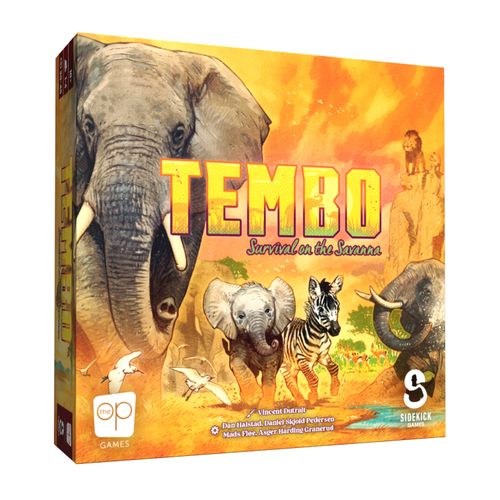
Tembo: Survival on the Savanna
Tembo: Survival on the Savanna Rulebook
Table of Contents
Table of Contents
Components
Cards — There are 3 card types in TEMBO, divided into 5 decks based on their card backs: 50 Savanna cards, 9 Matriarch cards, 10 Lion cards.
Decks — Starting, Support, and decks I, II, III.
Meeples — 52 Elephants (13 each in the 4 player colors), 1 Matriarch, 1 Energy token, 2 Lions.
Boards — 6 Savanna boards, 4 Player boards, 1 Start board, 1 Destination board.
Tiles, Tokens & Standees — 4 Tree standees, 5 Support tokens, 13 Journey tiles, 20 Event tiles, 6 Landmark standees.
Game Setup
The pictured setup is for a 3-player game. For the easy game or event, solo and campaign modules, please refer to pages 9-11.
- Each player takes a Player board and 11 Elephants (in a 3 or 4 player game) in the matching color (13 Elephants in a 2-player game). Place 3 Elephants on your Player board (rested Elephants) and the remaining in a reserve next to your player board (tired Elephants).
- Choose a Journey tile and recreate the map by placing the 6 Savanna boards as shown. Randomise the position and orientation of each board. Then place the Start and Destination boards as shown. We recommend using Journey 1 for your first few games.
- Place the 6 Landmark standees on or near the Destination board. Place the Matriarch meeple standing on its spot on the Start board. Beside it, place the Energy token on the space matching your player count.
- Optional: you may decrease energy by 2 in order to orientate a single Savanna board as you see fit.
- Place the Lioness and Lion meeples on the Savanna boards as shown on the Journey tile. Both Lions start by laying down on their side.
- Place the 4 Tree standees standing near the Start board.
- Sort the Savanna, Matriarch and Lion cards into 5 decks based on their card backs. Shuffle each deck separately.
- All players draw 3 cards from the Starting deck into their hand. Return the leftovers to the box.
- Stack decks I, II and III in order with the lowest on the top. This is the draw deck.
- Choose your team's difficulty level by adding 0–5 cards from the Support deck to the top of the draw deck, along with an equal number of Support tokens near the Start board. The more you add, the easier the game. For your first few plays, we recommend adding all 5.
- Randomly choose a starting player.
Event tiles are only used for advanced play. If you are using events see pg. 10 for set-up, otherwise, return the Event tiles to the box.
Taking a Turn
Players take turns in clockwise order. On your turn, choose one of 2 actions:
- A. BUILD SAVANNA – Play a card from your hand into an open area anywhere on the Savanna boards.
- B. PLACE ELEPHANTS – Spend a card from your hand to place Elephants in the Savanna, matching the footprint pattern shown on that card. The card is then placed in the discard pile.
After resolving your action, draw until you have 3 cards in hand. The next player then takes their turn.
Communication
You are encouraged to communicate about anything on your cards, but you may never show your cards to other players.
Direction of Play
Your seating position determines your direction of play for the entire game. Once chosen, it cannot change. Place cards with the arrow in the top-left corner, pointing directly away from you. You may not rotate cards when playing them unless indicated by this symbol: rotate icon. Players can sit anywhere, and multiple players may share the same direction.
Example — Direction of Play: You play cards based on your seating position around the table. Purple plays following their direction of play (A) while Grey plays cards following theirs (B).
Example — Rested/Tired Elephants: Actions make you gain (+) or lose (-) rested Elephants. Elephants on your Player board are considered rested and available for placement. Elephants to the side of your Player board are tired and must be rested before they can be used. When gaining Elephants, take Elephants from your tired Elephants and move them to your rested Elephants. When losing Elephants, you do the reverse.
Note: In the rulebook examples, colored rectangles represent Elephants.
A. Build the Savanna
Play a card from your hand onto any open area on the Savanna boards. After playing the card, perform the action in the area covered by your card:
- All players gain +2 rested Elephants.
- Another player of your choice gains +4 rested Elephants.
- You gain +5 rested Elephants. Another player of your choice loses -2 rested Elephants (you may choose a player with 0 or 1 rested Elephants).
- You gain +3 rested Elephants. Then you place a single Elephant ignoring rough terrain (see page 6).
Cards can be played anywhere on the Savanna boards, and do not need to be played adjacent to other cards or Elephants. However, you cannot place a card on top of another card or on a Landmark area. You may play a card underneath a Lion.
When you Build Savanna, Savanna cards with the rotate symbol may be rotated in any direction. Once placed, Savanna cards can never be rotated.
B. Place Elephants
Spend a card from your hand to place rested Elephants onto the Savanna, matching the exact footprint pattern in the card's top left corner. You cannot rotate the pattern as it must adhere to your direction of play. Rested Elephants must be taken from your Player board. The card is then placed in the discard pile.
- Each Elephant must be placed inside an empty space.
- The first Elephant you place in any turn must be adjacent to another Elephant and/or the Matriarch (diagonally adjacent is allowed).
- You must place the full pattern of footprints shown on a card. If you do not have enough rested Elephants or you cannot fit the full pattern inside empty spaces, you cannot use the pattern to place Elephants at all. No partial patterns are allowed.
Place a single Elephant: Instead of placing the full pattern of footprints, you may spend any Savanna card to place a single rested Elephant, following normal placement rules. The card is then placed in the discard pile.
When you Place Elephants, you may rotate the pattern shown on Savanna cards with the rotate symbol as much as you like.
Example — Building Savanna: You may Build Savanna on all areas marked with a green checkmark. You cannot build on areas marked with a red X, as they already have a Savanna card or are a Landmark.
Example — Direction of Play: You play cards based on your seating position around the table. If Purple (A) and Grey (B) play the same card, they would create two different patterns on the Savanna.
Example — Placing a Single Elephant: Orange may discard any Savanna card to place a single rested Elephant on a space adjacent to the herd (marked with a green checkmark). They cannot place an Elephant on a space that already has one.
The Savanna
The Savannah cards and boards feature a variety of spaces with different rules, including open spaces, Trees, Water and Rough Terrain.
Open Spaces
Open spaces can each hold up to 1 Elephant and have no additional rules.
Trees
Trees come in four different colors, each consisting of two connected spaces.
When both connected spaces of a Tree have Elephants on them, find the matching color Tree standee and lay it on its side. Then gain +1 Energy (+2 for the green Tree as shown on its standee) by adjusting the Energy token on the Start Board. If the Tree standee was already on its side, you gain nothing.
Example — Eating Trees (A): Grey plays 3 Elephants in the pattern shown. Two are placed on the green Tree (A), completing it. The third Elephant is placed on the blue Tree (B), which is also completed, as Purple had previously placed an Elephant on its other space.
Example — Eating Trees (B): Since the green Tree was completed, Grey places the matching Tree standee on its side (A) and gains +2 Energy (B) as indicated on the standee. The blue Tree (C) does not provide any Energy because it was already laying on its side.
Water
When Placing Elephants on a water space, the active player gains +3 rested Elephants. These Elephants cannot be placed on the same turn you gain them.
Rough Terrain
Placing Elephants in rough terrain requires an extra rested Elephant, for a total of 2 Elephants placed in each rough terrain space.
When Placing Elephants using a Savanna card with the paw print symbol, ignore the rough terrain rule. You never place more than one Elephant per space when using this card. This applies even if you are placing only a single Elephant.
Example — Rough Terrain Placement: Purple plays 3 Elephants in the pattern shown. Since one is placed on a rough terrain space, they must place an extra Elephant on this space, using a total of 4 Elephants this turn. Purple can only take this action if they have at least 4 rested Elephants at the start of their turn.
Example — Ignoring Rough Terrain: Purple plays 2 Elephants in the pattern shown. Because the card has the paw print symbol, they may ignore the rough terrain penalty, placing only one Elephant on each rough terrain space.
The Matriarch
Unless otherwise mentioned, the Matriarch meeple counts as a normal Elephant for all gameplay purposes.
The card decks I, II, and III have a total of 9 Matriarch cards shuffled into them. When you draw a Matriarch card, you may play it on a subsequent turn instead of Build Savanna or Place Elephants.
If a player is ever holding 2 Matriarch cards in their hand, they will be forced to play both cards immediately. (See the rules for Double Matriarch at the bottom of this page.)
If one or more Matriarch cards are played, follow these 4 steps in order:
- Move the Matriarch — Pick up the Matriarch meeple and place her adjacent to an Elephant already on the Savanna. She may also be placed adjacent to her current position or simply not move at all. When moving, she ignores the rough terrain penalty. Immediately gain any benefits from placing her on Water, Trees, or Landmarks (see page 9), if applicable.
- Gather the Herd — All players pick up their Elephants placed on the Savanna and return them to their tired Elephants.
- Lose Energy — Move the Energy token down -2 steps on the Start board. If a Double Matriarch happens, move the Energy token -5 instead.
- Refresh Trees — All Tree standees are stood back upright.
Double Matriarch
If any player draws a second Matriarch card while they are already holding one, immediately play both cards and perform steps 1–4. Lose 5 energy in the "Lose Energy" step. Then draw back up to three cards. In rare cases, this could trigger another Double Matriarch if you draw two more Matriarch cards.
Example — Matriarch Movement: The Matriarch can be moved to any space adjacent to the herd, as indicated by a green checkmark. She may also remain in her current space.
Example — Move Then Gather: Players choose to move the Matriarch to her new location (A). They then take all Elephants from the Savanna and add them to their tired Elephants. Only the Matriarch remains on the Savanna and players will continue from her location.
Example — Energy & Tree Upkeep: Move the Energy token -2 steps on the Start board (A). Any Tree standees that are currently laying on their side are stood back up and made available again (B).
Lions
The Lion meeples do not affect gameplay except when activated by a card. When activated, the Lioness always completes her full activation before the Lion completes his.
The card decks I, II, and III have a total of 10 Lion cards shuffled into them. When you draw a Lion card, immediately play it and perform the following steps in order. Then draw back up to three cards.
-
Lion Moves — Lions move from area to area on the Savanna. They can move onto Savanna cards, Landmarks, and even empty areas. Lions do not occupy individual spaces but rather the entire area they are in. They do not move diagonally.
If a Lion is already standing, it moves towards the closest Elephant(s) along the shortest path. If there are Elephants in the area it is standing in, it does not move. Often there are several groups of Elephants that are equally far away or several paths that are equally short. When there are several equal options, refer to the Lion Compass (found on the Start board) and choose the option with the lowest number.
If a Lion is laying down it does not move, simply stand it up.
-
Chasing Elephants — All Elephants in an area with a standing Lion are removed from the game and put back in the box. This does not apply to the Matriarch.
In addition, if a Lion is in the same area as the Matriarch, all players remove 1 rested Elephant from the game. If you do not have any rested Elephants, remove a tired Elephant instead. If there are no tired Elephants, nothing happens.
If any Elephants were removed from the game by one of the Lions, place that Lion meeple laying down on its side.
Note: You may Build The Savanna and Place Elephants in areas with Lion meeples, regardless of whether they are standing up or laying down.
Note: Remember the Lioness completes her full activation, before the Lion begins his.
Example — Lion Movement: Purple draws a Lion card and immediately plays it. The Lioness (A) moves first using the Lion Compass to decide among the equally short paths towards the nearest Elephants (3 for south, 4 for west). The Lion (B) was laying on its side and therefore stands up as its move.
Example — Lioness Moves First: Orange draws another Lion card. The Lioness moves toward the nearest Elephants. Arriving at an area with Elephants, she removes all of those Elephants from the game. The Lioness is then placed laying down on its side.
Example — Lion Moves Last: After the Lioness, the Lion moves. As the Elephants to its north were removed by the Lioness, the Lion moves west. First remove all Elephants (A) from that area. Since the Matriarch (B) is present, each player also removes one rested Elephant from the game. The Lion is then placed laying down on its side.
Winning and Losing
In order to win a game of TEMBO, you must first visit all 6 Landmarks, before placing Elephants on both purple spaces on the Destination board.
Landmarks
There are 6 Landmarks, one on each Savanna board. They come in 6 different shapes, each consisting of 1 to 4 purple spaces.
When all spaces of a Landmark have Elephants on them (player Elephants and/or the Matriarch), find the matching Landmark standee and place it near the area to mark that you have visited it.
Once all 6 Landmarks have been visited, you unlock the Destination board. You cannot Place Elephants on the Destination board until it has been unlocked.
How to Lose
You immediately lose the game if any of the following happens:
- The Energy token reaches space zero.
- Any player needs to draw a card at the end of their turn, but there are no cards left in the draw deck.
- Both Lion meeples are in the same area as the Matriarch meeple.
- Any player has zero Elephants left (0 rested, 0 tired and 0 on the Savanna).
Example — Completing a Landmark: Grey plays the 3 Elephants shown (A) and completes the Landmark that already had the Matriarch on one of its purple spaces. Then move the matching Landmark standee nearby (B). Since this was the final Landmark, the Destination board is now unlocked.
Example — Winning the Game: Orange plays the 2 Elephants shown on the Destination board, covering both purple spaces and winning the game!
Support Tokens
Support tokens are a shared team resource gained during Setup (step 7). Before taking any action, a player may spend as many Support tokens as they like. Once spent, return the Support token to the box. Each Support token spent allows you to gain one of the following benefits:
- A. Gain +1 Energy.
- B. Gain +2 rested Elephants.
- C. Rotate your next card.
- D. Place 1 rested Elephant (ignore rough terrain).
Intro Game
If you want to try an easier Journey to learn the game or introduce it to other players, you may consider playing Journey A and B. These Journeys have less of a threat from Lions, and Journey A is also shorter than the standard.
Events
For a more challenging experience, the Event tile module can be added to your game.
Setup: Shuffle all 20 Event tiles and place them face down in a stack next to the Destination board. Reveal two Event tiles that start the game as active, placing them in a line to the right of the Event stack. There will always be exactly 2 Event tiles active at any time.
New Events: A single new Event tile is revealed if one or more Matriarch cards are played. After resolving the normal Matriarch steps, do the following:
- Discard the rightmost Event tile without triggering it.
- Slide the leftmost tile to the right.
- Reveal a new tile from the stack and place it in the now empty leftmost position.
There are two types of Event effects:
- Immediate effects trigger when revealed, and again when the tile slides right. If two immediate effects clash, resolve the rightmost first.
- Persistent effects modify gameplay as long as the tile is active. If two persistent effects clash, the leftmost is considered active.
Example — Active Events: Two Event tiles are revealed at game's start (A & B), triggering any immediate effects. When the next Matriarch card is played, discard Event A, slide Event B over and reveal a new tile from the stack, triggering any immediate effects from the 2 Events currently in play.
Event Tile Reference
- Lioness or Lion activates.
- Lay both Lions down on their side.
- Gain +1 Energy.
- Remove 1 Support token from the game.
- When you Place Elephants on a water space, gain +5 or +0 rested Elephants instead of the standard +3.
- When you Place Elephants or Build Savanna: cards with the no-rotate symbol may not be rotated.
- All players remove 1 rested Elephant from the game (if no rested Elephants available, remove a tired Elephant instead).
- When you Place Elephants on a rough terrain space, place 1 or 3 rested Elephants instead of the standard 2.
- When you Place Elephants: cards with the paw print symbol no longer ignore rough terrain.
- All players lose -2 rested Elephants.
- Lay the brown, blue, green or red Tree standee on its side.
- Gain +2 Energy for the brown, blue or red Tree instead of the standard +1.
Campaign
A TEMBO campaign links several games together. Every decision matters as your performance in one game directly affects your chances in the next. A typical campaign lasts 2 to 3 hours, spanning 2 to 4 games.
Before Starting the Campaign
Setup the game as normal with the following changes:
- Select a difficulty level. This difficulty will be used for all games in the campaign.
- Randomly select a green 1-star Journey to play (Journeys 1 to 4).
- Lose 3 Energy.
- Remove 3 tired Elephants from each player.
Before Each Game
- Shuffle the 11 Journey tiles not in use and draw 2 at random. Flip them to their Scenario side (opposite the Journey side).
- Choose one of the 2 available scenarios and apply its effects for this game:
- A. Gain Energy.
- B. Recover Elephants from those previously removed from the game. Place them in your tired Elephants.
- C. Trees with the red X are removed and not available this game. Trees with the laying-down symbol start the game laying down. All other Trees start the game standing up as normal.
- D. Determines whether events are used in this game (green checkmark) or not (red X).
After Each Game
It is important that you do not recover any Energy or Elephants. You must begin the next game with the same amount of Energy and Elephants you had at the end of the previous game. Then check the steps below:
You lost the game
- If this is your second loss of the campaign, you lost. Try again.
- If this is your first loss, replay the same Journey with Energy and Elephants fully reset to the settings used Before Starting the Campaign.
You won the game
- Progress to a harder journey and complete the steps in Before Each Game: If you just won a green 1-star journey, randomly select a yellow 2-star journey. If you won a yellow 2-star journey, randomly select a red 3-star journey.
- If this was your third win, thus beating a red 3-star journey, the campaign is over and you won.
Solo Rules
To play TEMBO at 1 player, follow the standard rules except:
- Setup: Take 26 Elephants, player colors do not matter. Draw 4 cards to form your starting hand. At the end of your turn, always draw back up to 4 cards.
- Build Savanna: Whenever you Build Savanna, gain +4 rested Elephants, ignoring any printed effects on the Savanna boards.
- Lifeline: Once per game, if you draw a second Matriarch card, you may immediately discard it to avoid triggering a Double Matriarch (you still keep the first Matriarch card).
Reference
Actions
- A. BUILD SAVANNA – Play a card from your hand into an open area anywhere on the Savanna boards.
- B. PLACE ELEPHANTS – Spend a card from your hand to place Elephants in the Savanna, matching the footprint pattern shown on that card. The card is then placed in the discard pile.
- Place a single Elephant: You can always choose to disregard the pattern of footprints on a card when placing Elephants, to instead place a single rested Elephant, following normal placement rules.
Draw Deck — decks I, II, and III are stacked lowest on top: deck I (10 Savanna + 4 Matriarch + 3 Lion), deck II (11 Savanna + 3 Matriarch + 3 Lion), deck III (12 Savanna + 2 Matriarch + 4 Lion).
Matriarch Sequence — 1. Move the Matriarch, 2. Gather the Herd, 3. Lose Energy, 4. Refresh Trees.
Lion Sequence — 1. Lion Moves, 2. Chasing Elephants.
Strategy Tips
Across hundreds of plays we have seen that it is possible to consistently beat the game, even at the hardest difficulty levels on the toughest journeys. Through careful foresight and clever tactics, you can overcome TEMBO's superficial randomness.
Communicate — Talk to each other. Everyone holds part of the puzzle, even a simple coordination of your tools makes solving it much easier.
Matriarch Plays — Do not rush to the next Landmark. Sometimes it is better to move slowly and access grouped food. Risking a Double Matriarch now to maybe reach a Landmark and not backtrack, could save many turns.
Support Tokens — Support tokens can at the right time allow moves that would otherwise be impossible. Use +1 Energy preemptively to survive Double Matriarch losses. You may use several at once.
Manage Energy — Coordinate Tree colour placements. Grouping diverse Trees lets you eat with maximum efficiency. Eat before it becomes urgent. It can be worth risking the hit of a Double Matriarch, especially when others still hold Matriarch cards.
Engage Lions — Avoiding Lions entirely can backfire. One Elephant can sometimes redirect a Lion, for several actions. They move faster than you expect, so calculate their full threat range.
Conserve Elephants — It is often better to simply place a single Elephant, rather than using the full pattern. Placing 2 Elephants to rest 3 is not efficient, so focus on overall progress.