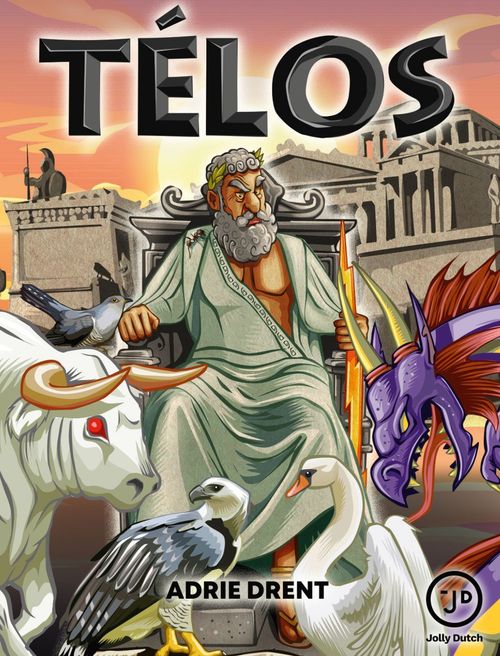
Télos
Télos Rulebook
Table of Contents
Table of Contents
Components
- Zeus cards (6x)
- God cards (104x)
The game contains 8 sets of 13 God cards, ranging from 1 to 13. Each set has its own color, allowing you to easily sort out the different sets. The number of sets used in the game depends on the amount of players:
- 3 players – 5 sets
- 4 players – 6 sets
- 5 players – 7 sets
- 6 players – 8 sets
Note that there is a special rule for a 5 and 6 player game.
In addition to these God cards, a number of Zeus cards is used. This number is equal to the amount of players in the game. Return any remaining Zeus and God cards to the box. Shuffle the required number of Zeus cards and God cards to form one deck. You may choose which Zeus cards you want to use or pick them at random.
Game play
Select one player to be the dealer; in subsequent rounds the player that won the last trick becomes the new dealer. The dealer gives each player 7 cards for the first round. Note that a trick is one card played by all players.
Playing a trick
The player left of the dealer will start playing the first card of the trick. All other players, one at a time in clockwise motion, will have to play a card with the same or higher value as the highest card on the table. The 13 is the highest value and 1 is the lowest value. Once all players have played a card, the player with the highest value card wins the trick. If there are multiple cards with the highest value, the player that played the last one wins the trick. The winner of the trick starts the next trick. Whenever a player cannot play a card that is equal or higher than the highest card, the player must play their lowest card.
Example: Sietse starts the trick with a 9. Vicky needs to play a 9 or higher, she plays an 11. Irene now needs to play an 11 or higher, but she does not have such a high card. She therefore must play her lowest card, in this case a 1. Arnold needs to play an 11 or higher, he plays a 12. Arnold wins the trick because he played the highest card and starts the next trick with a new card.
Playing multiple cards
Except for the first and last trick of a round, the player starting a new trick can decide to play multiple cards at once instead of just one. However, all cards must be of the same number. All other players must follow the lead, meaning that they must play the same number of cards as the first player. All these cards need to be individually higher than what is on the table already. Whenever a player cannot play equal or higher cards, they must play their lowest cards. Note that only the first player in a trick can decide to play multiple cards.
Example: Sietse starts the trick with three 6's. Vicky needs to play three cards as well, all equal or higher than a 6. She plays a 6, an 8 and a 9. Irene needs to play cards equal or higher than the 6, 8 and 9. Irene plays a 7, an 8 and a 12. Arnold does not have a card equal or higher than a 12, he therefore is unable to play three cards equal or higher than what is on the table. Arnold has to play his lowest three cards, in this case two 1's and a 2. Irene wins the trick and starts the next trick.
Playing the last trick
When every player only has one card left in their hand, the last trick will start. The player that wins this trick earns negative points, which is why players will aim to have a low card in their hand. Whenever two or more players have played the same card and this is the highest card, the player that was last in the playing order wins the trick.
Scoring
The player that won the last trick of the round, puts aside the card that gave them the win. The number on this card is the number of points they receive. This card will not be shuffled back into the deck but will function as the score of that player. All players should be able to see how many points each player has.
Example: Vicky wins the last trick of a round with an 8. She already won the last trick in an earlier round with a 9. Vicky now places the 8 next to the 9 to keep track of her points, her total is now 17.
Next round
The player that won the last trick becomes the new dealer. This player takes all cards, except those functioning as points, and shuffles them into a single deck again. The dealer now deals as many cards to all players as the number of the card that won the last trick of the round, with a minimum of 7 cards. So, in the previous example Vicky won with an 8, meaning the next round starts with 8 cards.
End of the game
When a player has a total of 32 or more points, that player loses the game. The rest of the players are winners and may feast like Gods.
Zeus cards
Basic rules
The Zeus card is a special card and will, most of the times, be beneficial to the player using it.
- It will always count as equal to the highest card played so far in the trick.
- It never counts as a player's lowest card, so they cannot use them when they cannot follow.
- It can never be used to start a new trick, with exception of the last trick.
- In the final trick, Zeus cards change in value, considering them at value 20, the highest of the game.
- When winning the last trick with a Zeus card, the player will gain 20 points.
Advanced rules
All basic rules for the Zeus cards still apply, but the six different Zeus cards all have a specific extra power.
The six Zeus card powers are shown by the following icons, each explained below:
- Dragon: Starting with the next trick, the direction of play is swapped. Going from clockwise to counterclockwise. This continues for the rest of the game.
- White Bull: When a player starts a new multiple card trick, they may add the White Bull. This now counts as an additional card with the relevant number. Example: Sietse starts the trick with two 9's and a White Bull, Vicky now has to follow with three cards equal to or higher than 9's.
- Dark bird (lowest card): The player that played the lowest card in this trick will start the next trick.
- Eagle: The player that played the Eagle must start the next trick, regardless of who won this trick.
- Swan: From now on, until the end of the round, all players are banned from playing multiple cards.
- Ant: When a player uses the Ant card in a multiple card trick, the player does not have to match the highest cards on the table anymore. The next players still must play as normal. Example: Sietse plays three 10's. Vicky is now allowed to play an Ant with, for instance, a 3 and an 8.
5 and 6 player games
There is one additional rule when playing with 5 or 6 people. Players are not allowed to play more than two cards at the same time. Even if you have more than two cards of a certain number.
Variation: Divine Trick
If you want an extra challenge, you can play with the 'Divine Trick'. When dealing the cards to the players, give each player one additional card face down. This will be their blind card. In each round the players may choose one moment too swap one of their handcards with the blind card. This could result in a far better card or one that is even worse. Once this Divine Trick has taken place, you must keep the card that you have swapped.