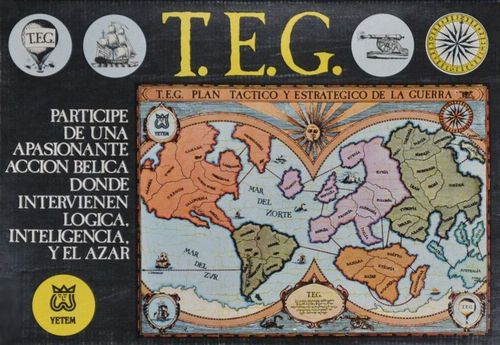
T.E.G.: Plan Táctico y Estratégico de la Guerra
T.E.G.: Plan Táctico y Estratégico de la Guerra Rulebook
Table of Contents
Table of Contents
1. General Idea
The game is a military conflict played on a map-board divided into 50 countries. At the start the 50 countries are divided among the players, who occupy their territories with pieces (armies).
Each player has a SECRET OBJECTIVE to fulfil, assigned at random and unknown to the other players. To achieve the objective (occupying a certain number of countries or destroying other colours) the player must expand his territories and reorganise his forces. This requires launching attacks and defending against enemy attacks; grouping and moving armies; and concluding pacts with other contenders.
Conquering new territories allows a player to increase the number of armies at his disposal, giving him greater chances of winning combats.
The mechanics of combat are based on rolling dice, but they take into account the number of attacking and defending armies. This mechanism means that it is not only chance that decides battles, but also, and fundamentally, the tactical and strategic intelligence of the player in deploying his forces.
2. Game Components
- MAP A world map divided into 50 countries grouped into 6 continents: North America, South America, Europe, Asia, Africa and Oceania. The dimensions and political divisions do not respect reality: they were modified to make the mechanics of the game easier.
- PIECES Each piece represents 1 army. Each of the six colours has 100 armies.
- 6 DICE
- COUNTRY CARDS A deck of 50 cards, one for each country. Each card also bears a picture of a galleon, a balloon or a cannon.
- 15 SECRET OBJECTIVE CARDS
- ONE RULEBOOK
3. Distribution of Countries and Objectives
- Each participant chooses a colour of pieces, which he will use throughout the game.
- The 50 COUNTRY CARDS are shuffled and dealt among the players. (If 3, 4 or 6 people play, two cards will be left over; in this case, each player rolls one die, and the two leftover cards are given to the players who obtained the two highest numbers.)
- Now each participant places one army of his colour on each of the countries he received in the country-card deal. The 50 countries on the map are thus occupied, each by one army.
- The country cards are gathered, shuffled again, and the deck is set aside next to the map for later use.
- The 15 SECRET OBJECTIVE CARDS are shuffled and placed face down. Each player takes one of these cards at random and keeps it without showing it to the others. The leftover cards are removed from the game and are not used again during the rest of the game.
Secret Objectives
There are two types of secret objectives:
A. OCCUPATION OBJECTIVES: a player with this type of objective fulfils it at the moment he occupies all the countries required by it. There is no problem in holding a surplus; that is, more countries and continents than those stated in the objective.
B. DESTRUCTION OBJECTIVES: a player with an objective that states to destroy a given colour fulfils it at the moment he eliminates the last army of that colour remaining on the map (it does not matter who destroyed the previous ones). If, by accident, another participant brings this about, the objective becomes impossible to fulfil. The player who had that objective is left with only one recourse: aim for the common objective, occupying 30 countries (this must not be announced to the other players).
A destruction objective for a colour may be impossible from the start, either because the player who holds it is himself the player with that colour, or because nobody plays with that colour (which can happen when fewer than 6 people take part). In that case, the objective becomes destroying the colour of the player seated to his right.
Note: The list of objectives is available to all players, and can be useful for frustrating an opponent's secret objective. It is recommended not to head directly for your own objective unless it is very easy. Try to reach your objective by the safest route (which is not always the fastest), avoiding letting the others notice it or fulfil their objectives before you do.
Common Objective
There is one objective common to all participants: occupy 30 countries. This objective is independent of the secret objective, and the player who comes to occupy 30 countries automatically wins the game, even if his SECRET OBJECTIVE card states something totally different.
4. Two Rounds to Add 8 Armies
A. Each player rolls a die; the one who obtains the highest number is the first to play, and the round continues clockwise.
B. The player adds 5 armies of his colour to the map, placing them in one or several of his countries. Following the round, each player does the same.
C. The first player begins a second round, adding 3 more armies to the map; in turn, the other players do the same.
At the end of this second round, each participant will have added 8 armies of his colour, distributed among one or more of his own countries.
At all times in the game, the 50 countries on the map must be occupied. At no time may armies of different colours be in the same country.
5. Beginning of Hostilities
Again it is the turn of the first player. He may:
- ATTACK foreign countries.
- REGROUP his forces.
- If with his attacks he conquered at least one country, request a COUNTRY CARD.
His turn then ends, and the player to his left continues in the same way. The player may choose whether or not to carry out any of these three steps, but he may not alter their order. That is, if he begins to regroup his forces he may no longer, in that turn, make new attacks.
The details for carrying out each of these steps are given below.
Attacking Foreign Countries
A. Attacking armies: The number of attacking armies a country has is the total number of armies in the country at that moment, minus one. If a country has only one army, that country cannot attack another (that army is considered an occupation army).
B. Defending army: For the defence of a country, all the armies in the country count.
C. Two countries are neighbours if they share a common border, or if they are joined by bridges over water (such as Chile – Australia).
D. A country may attack another (belonging to another colour) if: the attacking country has attacking armies, and the attacked country is a neighbour of the attacking country.
DEVELOPMENT OF AN ATTACK
Suppose it is the turn of "Green". This player has armies (more than one) in France, and wishes to attack Spain, which is "Red".
- He announces his attack, saying: "From France to Spain".
- "Green" takes as many dice as he has attacking armies in France, up to a maximum of 3 dice (even if he had more than 3 attacking armies he may not use more than three dice).
- "Red" takes as many dice as the total number of armies he has in Spain, up to a maximum of 3 dice.
- The contenders roll their dice.
- Each player's dice are placed in decreasing order. The highest die of "Green" is compared with the highest die of "Red", the middle die of "Green" with the middle die of "Red", and the lowest die of "Green" with the lowest die of "Red". If one of the contenders has one or two more dice than the other, the lowest of his dice, or the two lowest, do not enter the comparison. In case of a tie when comparing dice, the defender's die wins.
- Each player removes from his country one army for each losing die, placing it in his supply of pieces.
EXAMPLE 1 Suppose "Green" and "Red" each play with three dice, and the results are:
| GREEN | RED | |
|---|---|---|
| 5 | 4 | "Green" die wins. |
| 3 | 3 | Tie: "Red" die wins (defender). |
| 1 | 2 | "Red" die wins. |
Consequently, "Green" removes 2 armies from France and "Red" removes 1 army from Spain.
EXAMPLE 2 Suppose "Green" plays with 3 dice and "Red" with 2.
| GREEN | RED | |
|---|---|---|
| 6 | 4 | "Green" die wins. |
| 3 | 3 | Tie: "Red" wins (the defender). |
| 1 | - | The third die of "Green" is not taken into account. |
Consequently, each player removes one of his armies.
After this attack is finished, one of two things may happen:
A. If no red army remains in Spain: this country has been conquered by "Green", who must move one army from France to Spain. If he wishes, he may move one or two more armies to Spain, at most.
B. If at least one red army remains in Spain: this country remains "Red".
In either case, "Green" may choose to end his attacking stage for this turn, or to begin a new attack. For his new attack, "Green" has no restrictions other than those already explained (the attacking country must have more than one army; the attacked country must be a neighbour of the attacker). That is, he may attack any colour from any place on the map. "Green" is not obliged to follow any order in his successive attacks: he may attack "Red", then "Blue", then attack "Red" again, and so on.
In particular, some possibilities are detailed:
- If "Green" conquers Spain, and chose to move more than one army from France to Spain (remember that the maximum to move is 3), he may attack from Spain to Sahara.
- If Spain remains "Red", and in France more than one army of "Green" is still left, he may attack from France to Spain again. Take into account that the number of dice that decide this new combat will be governed by the number of armies that "Green" and "Red" now have in those countries.
- If Spain remains "Red", and "Green" has other countries neighbouring Spain (for example, Great Britain) that have attacking armies, "Green" may, if he wishes, attack Spain from Great Britain.
A player may, in his turn, attack as many times as he wishes; he may even choose not to make any attack. When he ends his attacking stage for that turn, he moves on to the next stage: regrouping.
Regrouping His Forces
When a player concludes his attacks, he may begin to regroup his armies. But if he begins to regroup, he may no longer start new attacks anywhere on the map during that turn.
Regrouping means moving armies from one country to a neighbouring country, also one's own.
Any number of armies may be moved, on condition that at least one army is left in the country from which they are withdrawn. (Remember that there must always be at least one occupation army in each country.) Armies may not be moved from one country to another that is not a neighbour, even if this is done in several steps. For example: if a player has armies in France, Spain and Sahara, he may move armies from Spain to Sahara, and from France to Spain, but he may not move to Sahara armies that have just been moved from France to Spain. One or more areas may be regrouped, at any point on the map, regardless of whether or not attacks took place in that region. Regrouping is not compulsory: the player may prefer not to regroup his armies. Once the regrouping stage is finished, the player may be in one of the following conditions:
A. During the turn he conquered no country: in this case, his turn ends here.
B. During this turn he conquered at least one country: in this case, he requests a country card.
Requesting a Country Card
A player who conquered at least one country has the right to receive a COUNTRY CARD from the deck lying face down beside the board. The request for the card must be made aloud: if he forgets to request it, and the next player begins his turn, he loses the right to it. Only one card is obtained at a time, even if the player conquered more than one country in that turn. The player keeps the card until he uses it for a TRADE-IN (as will be explained under "Adding armies by trade-in").
What the card is for
A. When the player simultaneously holds a country and the corresponding card, he has the right to place, once only, two additional armies in that country as a bonus.
- If the player had already occupied that country when he received the card, he adds the two armies at that moment.
- If the country is conquered in a later turn, and the card is still held, the two armies are added at the end of that turn, in the stage of requesting a card.
- If he forgets, the player may add the two armies at the end of any of his later turns, provided he still holds the country and the card.
- After placing his two bonus armies, the player continues to hold the card; it must only be handed in when a TRADE-IN is carried out.
B. For the TRADE-IN. This procedure may be carried out after several rounds have passed, as explained below under "Adding armies by trade-in."
The three stages just explained (attack, regroup, request a card) make up the turn of each player in the first round of hostilities.
6. Continuation of the Game
Once the first round of hostilities is concluded, a new element is added to the players' turn: adding armies. From here on, the order of the turn is:
- ADD ARMIES
- ATTACK AND REGROUP
- REQUEST A COUNTRY CARD
Adding Armies
At the start of his turn the player adds armies for three reasons:
A. For countries occupied. The player begins his turn by counting the number of countries he occupies at that moment, and adds to the map a number of armies equal to 50% of that number. (If the number is odd, it is rounded down: for example, 7 armies for 15 countries.) With fewer than 6 countries a minimum of 3 armies is always added (even if the player has only one country). These armies are distributed freely across the whole map, always in the player's own countries.
B. For continents occupied. If at the start of his turn the player occupies one or more continents in their entirety, he has the right to add, in addition to the armies that correspond to him for countries, an additional number of armies for each continent, according to the following table:
- ASIA ..................... 7 armies
- EUROPE ................... 5 armies
- NORTH AMERICA ............ 5 armies
- SOUTH AMERICA ............ 3 armies
- AFRICA ................... 3 armies
- OCEANIA .................. 2 armies
These armies must go to countries of that continent (they may be moved afterwards, at the moment of regrouping).
C. By trade-in. The player now looks at the country cards he holds. (Remember that he receives one in each turn in which he conquered countries.)
Each card bears a printed symbol: galleon, balloon or cannon. If the player holds three with the same symbol (for example: balloon – balloon – balloon), or three with different symbols (galleon – balloon – cannon), he has the right to trade these three cards for additional armies: he shows them to the other participants, places them face down beside the board (when the initial deck runs out, all of them are shuffled and used again), and adds and distributes freely among his countries the armies that correspond to him according to the following table:
- 1st trade-in ..................... 4 armies
- 2nd trade-in ..................... 7 armies
- 3rd trade-in ..................... 10 armies
From here on, 5 more armies are added each time:
- 4th trade-in ..................... 15 armies
- 5th trade-in ..................... 20 armies
And so on.
Cards bearing the three symbols together act as "jokers" or wild cards. Note that when he has 5 cards, there are inevitably 3 that are in one of the two situations necessary for a trade-in. While he holds 5 or fewer cards there is no obligation to carry out a trade-in; but it is obligatory to do so before receiving the 6th card. An optional variant is the "Defensive trade-in" (see below). This allows armies to be added at a later moment, after attacking and before requesting a card.
When the player finishes the stage of adding armies, he may attack, regroup, request a card if it corresponds to him; or he may pass the turn to the next player at whatever moment he considers convenient.
Attack and Regroup
These are carried out under the same rules explained for the beginning of hostilities. As before, neither of the two actions is compulsory. (Remember also that if a player begins to regroup, he may no longer make further attacks in that turn.)
Requesting a Country Card
To be entitled to receive a country card at the end of his turn, the player must have conquered in that turn:
A. At least one country, while he has carried out fewer than 3 trade-ins. B. At least two countries, if he has already carried out 3 or more trade-ins.
DEFENSIVE TRADE-IN
If the player holds cards that make a trade-in possible, he may choose not to carry it out in the initial stage of his turn: he adds the armies that correspond to him for countries or continents, begins his attacks, regroups if he wishes, and now, if he conquered any country, carries out the trade-in. At that moment he hands in the 3 cards and places the armies that correspond to him in exchange; but not in just any place. These armies must be placed obligatorily in the last country that was conquered. Afterwards, if it corresponds to him, he requests a card.
7. Pacts
The rules allow players to propose pacts between players, which must be public, stated aloud, and without secret clauses. Any player has the right to ask the table about the pacts existing at that moment, and the table is obliged to answer him.
Pact Between Countries
A player may propose a non-aggression pact between one of his countries and a neighbouring country; the owner of the latter may accept or not. If he accepts, neither of the two colours will attack the other across that border.
World Non-Aggression Pacts
Non-aggression pacts across the entire map are permitted, but they are not advisable. If such a pact were made between two colours, its immediate consequence would be that the other players concentrate their attacks on those two, to prevent them from consolidating.
International Zone Pact
From the third trade-in onwards, the player is obliged to conquer 2 countries per turn in order to receive a card. As the game advances this may become difficult, so he has the recourse, if need be, of proposing an International Zone pact over a neighbouring country that is adjacent to both and undefended. For example: "Green" occupies California (with many forces), and "Red" is in Canada (also strong); Oregon has only one army. "Green" occupies Oregon and proposes to Canada: "Oregon, international zone". This means that, if the pact is accepted, when it is "Red's" turn he will conquer Oregon and leave there a single occupation army, without regrouping onto that country. When it is "Green's" turn, he will do the same: he will occupy Oregon without reinforcing it. This allows both countries to have an easily conquerable country available.
Aggressive-defensive alliances or pacts are not valid. For example, a pact by which "Green" and "Red" undertake to attack only "Black" and not the other players is not permitted.
A Pact Is Broken When:
A. One of the parties announces its rupture. In this case the player who decided to break the pact must continue to respect it until the next turn of the other party has ended.
B. Any of the countries involved in the pact is occupied by another colour. Example: suppose a pact Brazil – Sahara ("Green") is in force, and Brazil is occupied by a third colour. The pact is broken, and even if "Magenta" later recovers Brazil, "Green" may attack it (unless a new pact is established).
8. General Considerations
Accidental Destruction of a Colour
If a player, during the course of the game, eliminates another colour (that is, dislodges it from the last country it occupies on the map) without this being his objective, the game continues. That player "inherits" the country cards that the destroyed colour may hold. If another player had as his SECRET OBJECTIVE the destruction of that colour, he must pass automatically, and without announcing it, to the COMMON OBJECTIVE (occupy 30 countries).
Communication During the Game
There are two ways of approaching the game: (a) "Anything goes" and (b) "Fair Play". Under (a) a player may give indications to another about which countries to attack or not, give opinions about pacts proposed between third parties, propose pacts out of turn, remind another participant that he must request his card, etc. Under (b) only impartial or neutral comments on the development of the game are accepted; "advice" is not permitted. The participants will decide, when beginning the game, which style will be adopted.
Games of 2 or 3 Players
When the number of participants is 2 or 3, there is a possibility that, given the number of countries occupied initially (25 per player between two; and 17-17-16 between three), the objective is already fulfilled before play begins. To avoid this, proceed as follows:
- Each player chooses a colour.
- Instead of dealing the COUNTRY CARDS, each player places one army at a time on any country, until the whole map is occupied.
- Each colour adds to the map a number of armies equal to 50% of the countries occupied initially (12 armies if two people play; 8 armies if three play).
The sole and common objective is the conquest of the 50 countries. The rest of the game mechanics are the same as explained above.
9. List of Secret Objectives
- Occupy Africa, 5 countries of North America and 4 countries of Europe.
- Occupy South America, 7 countries of Europe and 3 countries that border each other anywhere on the map.
- Occupy Asia and 2 countries of South America.
- Occupy Europe, 4 countries of Asia and 2 countries of South America.
- Occupy North America, 2 countries of Oceania and 4 of Asia.
- Occupy 2 countries of Oceania, 2 countries of Africa, 2 countries of South America, 3 countries of Europe, 4 of North America and 3 of Asia.
- Occupy Oceania, North America and 2 countries of Europe.
- Occupy South America, Africa and 4 countries of Asia.
- Occupy Oceania, Africa and 5 countries of North America.
- Destroy the blue army; if impossible, the player to the right's army.
- Destroy the red army; if impossible, the player to the right's army.
- Destroy the black army; if impossible, the player to the right's army.
- Destroy the yellow army; if impossible, the player to the right's army.
- Destroy the green army; if impossible, the player to the right's army.
- Destroy the magenta army; if impossible, the player to the right's army.
Common objective: occupy 30 countries.