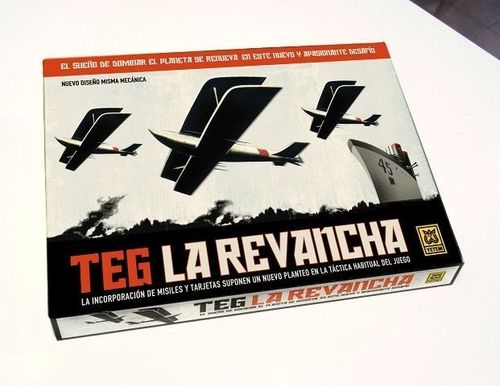
TEG: La Revancha
TEG: La Revancha Rulebook
Table of Contents
Table of Contents
Introduction
Idea of the Game
T.E.G. La Revancha is a game that stages a war in which 2 to 6 players can take part by occupying and moving their armies across a world map made up of 72 countries.
Each player has a SECRET OBJECTIVE to complete, which is assigned by chance and which the other players do not know.
To win the game there are two ways: complete the SECRET OBJECTIVE, or forget about it and OCCUPY 45 COUNTRIES. The first player to complete one of these two alternatives is the winner.
To complete its objective (occupying a certain number of countries or destroying other colors) a player must expand its territories and reorganize its forces. This requires launching attacks and blockades, defending against enemy attacks, regrouping and moving armies and missiles, agreeing pacts, and even sharing countries with other rivals. Conquering new countries lets a player increase the number of armies at its disposal and gives it greater chances of winning each battle.
The mechanics of battles are based on rolling dice, but they take into account the number of armies attacking a country and the number of armies defending it.
This new version of TEG also includes the fearsome missiles, so that it is not only chance that decides battles, but mainly the tactical and strategic intelligence of the player in deploying its forces.
Game Components
Materials
- 1 board: a world map divided into 72 countries, grouped into 7 continents: North America, Central America, South America, Europe, Asia, Africa and Oceania. (The dimensions and borders are not representative of the physical-political division of the world: they were modified in order to make the game more dynamic.)
- Pieces (tokens): the smaller tokens represent 1 army; the larger (square) ones represent 10 armies.
- Each participant owns a box of tokens and has 100 armies of its color.
- Country cards: a deck of 72 cards which, besides bearing the name of a country, show different combinations of symbols: soldiers, airplane, tank, grenade and ship.
- 8 dice, 7 continent cards, 20 secret objective cards, 50 situation cards, 1 hand card, missiles, instruction manual, pact and exchange sheet.
Initial Instructions
Dealing Countries
- Each participant chooses a color of tokens, which it will use throughout the game.
- The 72 country cards are shuffled and dealt among the players. (If 5 people play, 2 cards will be left over; in this case, each player rolls a die, and the two remaining cards are given to the players who obtained the highest numbers.)
- Each participant now places one army of its color on each of the countries it received in the dealing of the country cards. The 72 countries on the map are thus occupied, each by one army.
- The country cards are gathered, shuffled again, and left face down as a deck for later use.
- The 20 secret objective cards are shuffled and placed face down. Each player takes one of these cards at random and keeps it without showing it to the others. The secret objective cards left over are removed from the game and are not used again during the rest of the match.
Objectives
Secret Objectives
Frequently consulting the list of objectives is recommended, in order to try to discover the secret objectives of opponents and to anticipate them. It is advisable to take some detours before moving your armies and launching attacks, so that your objective is not quickly discovered by the others.
There are two types of secret objectives:
- Occupation objectives: these consist of occupying at least all the countries indicated on the player's SECRET OBJECTIVE CARD. If the participant has won and kept more territories than those indicated on the card, these are considered a surplus.
- Destruction objectives: these consist of eliminating and removing from the map all the armies of the color indicated on the card. If, by chance, this goal is affected by the interests and movements of another participant, the objective becomes impossible to complete.
A destruction objective against a color may be impossible from the start, either because the player who holds the objective is precisely the player who has that color, or because nobody plays that color (which can happen if fewer than 6 people participate). In that case, the objective becomes that of eliminating the armies of the player seated to its right.
Common Objective
There is an objective common to all participants: occupy 45 countries. This objective is independent of the secret objective, and the player who comes to occupy 45 countries automatically wins the game, even if its secret objective card states something totally different.
Start of the Game
First Round
Placing Armies
Once the colors of tokens, the OBJECTIVES and the COUNTRY CARDS have been dealt, and after all players have occupied with 1 army the countries indicated by the cards received, the round of placing new armies on the map begins.
- Each player rolls a die; the one who obtains the highest number is the first to place armies, and the next one is the player to its right, continuing the round in the clockwise direction.
- The first player places 8 armies of its color on the map, positioning them on one or several of its countries. Following the round, each player does the same.
- The first player starts a second round, placing another 4 armies on the map; in turn, the other players do the same.
At the end of this second round, each participant will have added 12 armies of its color, distributed over one or more of its own countries.
- Each missile is equivalent to 6 armies and may be placed as part of the new forces, or may replace armies already on the map.
At all times the 72 countries on the map must be occupied. At no time may a country be occupied by armies of different colors.
Hostilities - Situation Cards
Before each round begins, the player who starts will turn over a SITUATION CARD which indicates the mechanics to follow throughout the round, until the next one is turned over. There are 50 situation cards, of which 20 bear the inscription "combate clásico" (classic combat) and indicate that warlike actions continue to take place without any modification. The remaining 30 cards are: 4 snow, 4 tailwind, 4 crisis, 4 extra reinforcements, 4 open borders, 4 closed borders, and 6 rest cards, one for each color. When they appear, these situation cards set the following guidelines:
- SNOW: attacked players defend with one die more than they would be entitled to according to the number of armies they have. Example: if the player has one token, it defends with two dice; if it has two armies, it defends with three dice; if it has three or more armies, it defends with four dice.
- TAILWIND (VIENTO A FAVOR): attacking players roll with one die more than they would be entitled to according to the number of armies they have. Example: if the player has two armies, it attacks with two dice; if it has three armies, it attacks with three dice; if it has four armies or more, it attacks with four dice. As always, a minimum of two armies is needed to attack another country.
- OPEN BORDERS: attacks may only be made from one continent toward the outside. For example: Chile to Australia or Alaska to Chukchi.
- CLOSED BORDERS: attacks may only be made within the borders of each continent. For example, Argentina to Brazil or Spain to Portugal.
- CRISIS: each player must roll a die. The player who rolls the lowest number may not draw a country card during that round, although it keeps its right to place armies, attack enemy countries and regroup. In case of a tie, none of the players who tied may draw a card during the round.
- EXTRA REINFORCEMENTS: all players have the right to place an extra sum of armies, equal to half of the countries they occupy. Extra reinforcements are placed one player at a time, following the round of the game and before attacks begin. Once all players have placed their extra reinforcements, the first player in the round resumes the normal routine of the game.
- REST: the color mentioned on the rest card may only place armies during its turn, but may not attack or regroup. If the color mentioned does not take part in the game, a new card is turned over.
If the situation card allows it, each player on its turn may: attack, regroup, request a COUNTRY CARD, request a CONTINENT CARD.
Phases of the Turn
- A. Attack enemy countries.
- B. Regroup its forces.
- C. Request a COUNTRY CARD, if with its attacks it conquered at least 1 country.
- D. Request a CONTINENT CARD, if with its attacks it conquered at least 1 continent.
With this its turn ends, and play continues with the player to its left. The player may choose whether or not to carry out any of these four steps, but it may not alter their order. That is to say, if it begins to regroup forces it may no longer, in that turn, carry out new attacks.
The details for carrying out each of these steps are given below.
A) Attacking Enemy Countries
Attack Conditions
- Attacking armies: the number of attacking armies available to a country is the total number of armies in that country at that moment, minus one. If a country has only one army, that country may not attack another (that army is considered an occupation army).
- Defending armies: for the defense of a country, all the armies in the country count.
- Missiles: each missile is equivalent to 6 armies and serves only for attacking (not for defending). They are placed at the same time as the armies, respecting the maximum number of forces each player must place. Example: suppose the red color must place 10 armies. It may instead place one missile and four armies.
Two countries are neighbors (limítrofes) if they share a common border or if they are joined by bridges over water (Mauritania – Uruguay).
A country may attack another (belonging to another color) if:
- the country has attacking armies and/or missiles, and
- the attacked country is a neighbor of the attacking country.
Missiles CAN attack countries that are not neighbors.
Development of the Attack
Suppose it is the turn of "White." This player has armies (more than one) in New Zealand, and wishes to attack Tasmania, which belongs to "Black."
-
It announces its attack, saying "New Zealand attacks Tasmania."
-
"White" takes as many dice as attacking armies it has in New Zealand, up to a maximum of 3 dice. Even if "White" has more than 3 attacking armies, it may not use more than 3 dice, with one exception: if "Black" has a minimum of three armies and "White" at least doubles it in armies (missiles are not counted), "White" may roll with 4 dice.
-
"White" may also roll with one extra die if the Tailwind (Viento a favor) situation card is in effect in the round, but even in that case it may never use more than four dice.
-
"Black" takes as many dice as the total number of armies Tasmania has, up to a maximum of three dice.
-
"Black" may use one die more than it is entitled to if the Snow (Nieve) situation card is in effect during the round, up to a maximum of four dice.
-
The contenders roll their dice.
-
Each player's dice are arranged in decreasing order. The highest die of "White" is compared with the highest die of "Black," the middle of "White" with the middle of "Black," and the lowest of "White" with the lowest of "Black." If one of the contenders has one or two dice more than the other, its lower die or its two lower dice do not enter the comparison. In case of a tie when comparing dice, the defender's die wins.
-
For each losing die, the player removes one army from its country and places it in its box of tokens.
Examples
Suppose "White" and "Black" each play with three dice, and that the results are:
| White | Black | Result |
|---|---|---|
| 6 | 6 | "Black" die wins. |
| 5 | 4 | "White" die wins. |
| 1 | 2 | "Black" die wins. |
Consequently, "White" removes two armies from New Zealand and "Black" removes one army from Tasmania.
Suppose "White" plays with four dice and "Black" with three:
| White | Black | Result |
|---|---|---|
| 5 | 4 | "White" die wins. |
| 5 | 5 | "Black" die wins. |
| 4 | 2 | "White" die wins. |
| 2 | - | The 4th die of "White" is not taken into account. |
Consequently, "Black" removes two of its armies from Tasmania and "White" removes one of its armies from New Zealand.
Once the attack is concluded in this way, two things may happen:
- If no Black army remains in Tasmania: this country has been conquered by "White," which must move one army from New Zealand to Tasmania. If it wishes, it may move one or two more armies to Tasmania, at most.
- If at least one Black army remains in Tasmania: this country remains "Black."
In either case, "White" may choose to conclude its attack stage for this turn, or to begin a new attack.
For its new attack, "White" has no restrictions beyond those already explained. (The attacking country must have more than one army; the attacking country must be a neighbor of the attacked one, except in the case of missiles.) That is to say, it may attack any color in any place on the map.
"White" is not obliged to respect any order in its successive attacks: it may attack "Black," then "Green," then "Yellow," and so on.
Some possibilities are detailed here:
- If "White" conquered Tasmania and chose to move more than one army from New Zealand (remember that the maximum to move is 3), it may attack from Tasmania to Australia.
- If Tasmania is still "Black" and more than one "White" army remains in New Zealand, it may attack Tasmania again from New Zealand. Note that the number of dice that decide this combat will be governed by the number of armies that "White" and "Black" now have in those countries.
- If Tasmania is still "Black" and "White" holds other countries neighboring Tasmania (for example, Australia) that have attacking armies, "White" may, if it wishes, attack Tasmania from Australia.
Attacks with Missiles
Missiles are placed, if desired, during the army placement phase of the turn.
Each missile is equivalent to 6 armies and may be placed as part of the new forces, or may replace armies already on the map.
Example
"White" has 20 armies in New Zealand. Before beginning its army placement, it may replace them with 1, 2 or 3 missiles, depending on the case:
- If it replaces 1 missile for 6 armies, the country will remain with 14 armies and 1 missile.
- If it replaces 2 missiles for 12 armies, the country will remain with 8 armies and two missiles.
- If it replaces 3 missiles for 18 armies, the country will remain with 2 armies and 3 missiles.
In all cases, at least one occupation army must always remain in the corresponding country.
Suppose "White" has 6 armies in New Zealand. It need only place one more army for it to be able to replace its armies with one missile. The country will thus remain with one missile and one army.
The detonation of a missile means the automatic destruction of enemy armies, without the need to roll dice. Missiles have a range of up to three borders in relation to the country in which they are located, but their firepower decreases the further away the attacked countries are.
- If the attacked country is a neighbor, the detonation of a missile automatically destroys 3 enemy armies;
- if there is one country between the attacking country and the attacked one, the missile destroys two armies;
- if there are two countries in between, the missile destroys only one army.
Example
Suppose "White" has one missile in New Zealand: if it is launched at Tasmania, it destroys three armies; if it is launched at Australia, it destroys two armies; if it is launched at Sumatra, the Philippines or Tonga, it destroys one army.
- Each missile may be detonated only once and leaves the board together with the armies it destroyed. Missiles do not serve to conquer countries, but to destroy enemy armies. To complete a conquest, occupation armies are needed. If a country has fewer armies than the missile can destroy, it may not be attacked by a missile. For example, "White" has a missile in New Zealand and wants to detonate it in Tasmania ("Black"). But Tasmania has only three armies. The missile may not be detonated.
- A missile may not be used to defend against an attack with dice. For example, suppose New Zealand ("White") conquers Tasmania ("Black") and captures the missile that was in Tasmania. As usual, during its attack turn "White" may move up to three armies to Tasmania, but now it may use the captured missile to carry out a new attack.
- A missile may not be moved from one country to another in order to carry out an attack. For example, suppose New Zealand ("White") attacks Tasmania ("Black") and that New Zealand has a missile, but does not use it in its attack. New Zealand may not move that missile to Tasmania in order to attack Australia. It may, however, regroup it during its regrouping stage.
Missiles serve to prevent missile attacks.
Examples
"White" wants to launch a missile from Argentina at Australia ("Green"). Australia has another missile among its forces. The attack cannot be carried out. Suppose, on the other hand, that Argentina ("White") has two missiles and Australia ("Green") only one. One of the Argentine missiles may be detonated and, consequently, destroys two armies of Australia.
A player may, on its turn, attack as many times as it wishes, with or without missiles; it may even choose not to make any attack. When it concludes its attack stage in that turn, it may move on to the next stage: regroup.
Blockades
All countries that have at least three neighboring countries become blockaded when they are surrounded on all their borders by enemy armies of a single color. For the blockade to be carried out, each of the "blockading" countries must have a minimum of 2 armies.
When a country is blockaded, it may not receive new armies, not even those which might correspond to it for holding its country card. It may, however, attack any of the blockading countries with the tokens it has available.
The blockade is cancelled when:
- The player who carries it out leaves at least one of the blockading countries with one token.
- One of the blockading countries is conquered, either by the blockaded player or by a third party.
- The blockaded country is the only one left to the player when its turn comes.
When the blockade is broken, the player regains its right to place armies in that country.
Only during the two initial army placement rounds (8 and 4) may players place armies in countries that were blockaded.
B) Regrouping Forces
Regrouping means moving armies from one country to another neighboring one, also one's own.
When a player concludes its attacks, it may begin to regroup its armies. But if it begins to regroup, it may no longer begin new attacks anywhere on the map during that turn.
Any number of armies may be moved, on the condition that at least one army is left in the country from which they are withdrawn.
Armies may not be moved from one country to a country that is not a neighbor, even if the move is carried out in several steps. For example: if a player has armies in Argentina, Brazil and Sahara, it may move armies from Argentina to Brazil, and from Brazil to Sahara, but it may not move to Sahara armies that have just been moved from Argentina to Brazil.
Regrouping may be done in one or more places, at any point on the map, regardless of whether or not attacks occurred in that region. Regrouping is not mandatory.
Once the regrouping stage is finished, the player may be in one of the following conditions:
- During the turn it conquered no country: in this case its turn ends here.
- During the turn it conquered at least one country: in this case, it requests a country card.
C) Requesting a Country Card
The player who conquered at least one country has the right to receive a COUNTRY CARD from the deck lying face down beside the board.
The request for cards must be made aloud; if it forgets to request it, and the next player begins its turn, it loses the right to it.
Only one country card is obtained at a time, even if the player has conquered more than one country in the turn. The player keeps the card until using it for an EXCHANGE (as will be explained under "Placing armies, by exchange").
Uses and Benefits of COUNTRY CARDS
- When the player simultaneously holds a country and the corresponding card, it has the right to place, only once, three additional armies as a bonus on that country.
- If, on receiving the card, the player already occupies that country, it adds the three armies at that moment.
- If the country is conquered in a later turn, and the card is still kept, the three armies are added at the end of its turn, in the request-card stage.
- In case of forgetting, the player may add the three armies at the end of any of its later turns, provided it still holds the country and the card.
- After placing its three bonus armies, the player continues to keep the card; it must be handed in only when an exchange is made (the exchange is explained under "Placing armies, by exchange").
- The number of country cards each player holds is public information. On any request from its rivals, the player must report how many cards it has.
D) Requesting a CONTINENT CARD
When a player conquers a continent (when it occupies all the countries that make it up), it acquires a card corresponding to the continent it conquered. This card may be used in future exchanges (the EXCHANGE is explained under "Placing armies, by exchange").
- While it keeps the continent, the player may keep the continent card indefinitely, but once it has used it, it may not use it again during the rest of the match.
- If the player loses absolute control of the continent and has not yet used the corresponding card, its continent card returns to the deck. If it later occupies the continent again, it recovers its continent card.
- If another player later conquers the same continent, it acquires the continent card. Each continent card may be used once during the whole match by each player that has conquered a continent.
The three stages just explained (attack, regroup, draw a card) make up each player's turn in the first round of hostilities.
Continuation of the Game
Second Round and Following
Once the first round of hostilities is concluded, the order of turns changes: the player who started the hostilities will now be the last to play, and the one who was second to play during the initial round will now be the first. This mechanism will be repeated from then on for the rest of the match.
It is important to keep this in mind when planning your strategy: when attacking, if your tokens are not enough to attack an enemy country and you play before your opponent in the next round, you will have the possibility of reinforcing your attack; when defending, if you are concerned about defending certain positions, consider whether the rival that threatens them will play before or after you in the next round.
From this second round on, the order of the turn will be:
- A. Turn over a situation card (only the player who starts the round).
- B. Place armies.
- C. Attack, regroup, request cards.
A) Turn Over a Situation Card
Situation cards are turned over by the player who starts the round, before the placement of armies on the map. In this way the card's legend determines the tactics and strategies during the round of play.
B) Placing Armies on the Map
At the start of its turn the player places armies for three reasons:
1) For occupied countries
The player begins its turn by counting the number of countries it occupies at that moment and places on the map a number of armies equal to 50% of that number. (If the number is odd, it is rounded down: for example, 9 armies for 19 countries.) With fewer than 6 countries it always places a minimum of 4 armies (even if it has only one country).
These armies are distributed freely across the whole map, always in its own countries or in condominium (see "Aggression pacts and countries in condominium").
2) For occupied continents
If, at the start of its turn, the player occupies one or more continents in their entirety, it is entitled to place, in addition to the armies corresponding to it for countries, an additional number of armies per continent according to the following table:
- ASIA: 8 armies
- EUROPE: 8 armies
- NORTH AMERICA: 6 armies
- SOUTH AMERICA: 4 armies
- AFRICA: 4 armies
- CENTRAL AMERICA: 3 armies
- OCEANIA: 3 armies
These armies must go to the player's own countries of the same continent (they may later be moved, at the time of regrouping).
3) By exchange
The player now keeps the country cards it has in its possession. Each country card bears one of the following symbols: soldiers, airplane, tank, grenade and ship. If the player holds three with the same symbol (for example soldier/soldier/soldier), or three with different symbols (for example airplane/soldier/ship), it is entitled to exchange these three cards for additional armies: it shows them to the other participants, places them face down on the deck beside the board (when the initial deck runs out, all of them are shuffled and used again), and places freely among its countries the armies corresponding to it according to the following table:
- 1st exchange: 6 armies
- 2nd exchange: 10 armies
From then on, five more armies are added each time:
- 3rd exchange: 15 armies
- 4th exchange: 20 armies
And so on.
Note that when a player holds five country cards, there are inevitably three that are in a situation enabling an exchange. While a player holds 5 or fewer country cards, there is no obligation to make an exchange, but it is obligatory to do so before receiving the sixth country card.
Equivalence of COUNTRY and CONTINENT CARDS
- Cards with the soldiers symbol act as wildcards.
- Cards with the three symbols (airplane, ship and tank) act as super cards. By themselves they are equivalent to one exchange.
- CONTINENT CARDS may be used alone or combined with COUNTRY CARDS for possible exchanges:
- Those corresponding to North America, Europe and Asia (the three largest continents) are equivalent to one exchange by themselves.
- Those corresponding to South America and Africa are equivalent to two of the three variables for an exchange. South America is equal to an airplane and a tank. Africa is equal to an airplane and a ship.
- Those corresponding to Central America and Oceania are equivalent to one extra card. Central America is equal to a tank. Oceania is equal to a ship.
No player may make more than one exchange per round, even if, combining country and continent cards, it had the possibility of making two.
C) Attacking, Regrouping and Requesting Cards
These are carried out according to the same rules explained for the start of hostilities. As before, none of the actions is mandatory.
Requesting a COUNTRY CARD
To be entitled to receive a country card at the end of its turn, the player must have conquered in its turn:
- At least 1 country, while it has made fewer than 3 exchanges.
- At least 2 countries, if it has already made 3 or more exchanges.
Special Considerations
1. Pacts
The rules allow pacts to be proposed between players, which must be public, expressed aloud and without secret clauses. Any player has the right to ask the table about the pacts existing at that moment, and the table is obliged to answer it.
Pacts between countries: a player may propose a non-aggression pact between one of its countries and a neighboring or non-neighboring country that could be bombarded with a missile; the owner of the latter may accept or not. If so, neither color will attack the other on that border.
Pacts within a continent: a player may also propose a non-aggression pact on a continent. For example, "White" offers "Black" a pact in South America. If "Black" accepts, neither color may attack the other within that continent. Suppose Argentina and Chile belong to "White" and Brazil belongs to "Black." They sign a non-aggression pact in South America. It is the turn of "White," which conquers Uruguay ("Green") from Argentina. Uruguay is thus incorporated into the pact.
Pacts between borders: two players may also sign a pact between borders of continents. For example, "White" has Turkey and Israel, and "Black" has Egypt. They sign an Asia – Africa pact.
Worldwide non-aggression pacts: non-aggression pacts across the whole map are permitted.
Pacts and missiles: two non-neighboring countries may sign a pact, provided there are no more than three borders between the two. This variable is included because of the possibility of long-distance attacks that missiles represent. When two countries sign a non-aggression pact, they may not fly missiles over the borders of the pact. For example: suppose Colombia ("White") and Nicaragua ("Black") sign a non-aggression pact. Colombia may not bombard El Salvador, because it would be flying over the airspace of the pact. Nor can it do so, for example, Chile, if it belonged to the same owner as Colombia. Of course, the owner of Colombia could bombard El Salvador or Nicaragua if it possessed any of the countries north of El Salvador or Nicaragua, because in that case it would not fly over the airspace of its pact (Colombia).
[Printed source reads "Los pactos y los misiles: Los pactos y los misiles:" with the heading repeated; transcribed here once.]
A pact is broken when:
- One of the parties announces its breaking. In this case the player who decided to break the pact must continue to respect it until the next turn of the other player ends.
- One of the countries involved in the pact is occupied by another color. Example: suppose a pact is in force between Argentina ("White") and Brazil ("Black"), and Brazil is occupied by a third color. The pact is broken, and even if "Black" later recovers Brazil, "White" may attack it (unless a new pact is established).
2. Special Pacts
International Zone Pacts
From the third exchange on, the player is obliged to conquer two countries per turn in order to receive a card. As the game advances this may become difficult, so it has the resource, if applicable, of proposing an international zone pact over an undefended country that borders both participants of the agreement.
For example, "White" occupies New Zealand (with many forces) and "Black" is in Australia (with many forces); Tasmania has only one army. "White" occupies Tasmania and proposes to "Black" an International Zone in Tasmania. This means that, if the pact is accepted, when it is "Black"'s turn it will conquer Oregon and leave there only one occupation army, without regrouping onto that country. When it is "White"'s turn it will do the same: it will occupy Tasmania without reinforcing it. This allows both countries to have an easily conquerable country.
[Printed source example names "Oregon" in the Tasmania example; no such country appears in the printed map list. Transcribed as printed.]
-
From the third exchange on, each player has the right to have one International Zone in the world, but may not have two or more International Zones at the same time.
The International Zone is insisted upon as a pact and therefore must be honored. If a player "forgets," voluntarily or involuntarily, to attack an International Zone or to leave the corresponding country with a token, it will be penalized. One country card is taken from it at random, which returns to the deck. And if the player has no cards, it may not pick up a new one when it again conquers the two necessary countries. The player harmed by the "forgetting" of the International Zone decides whether it remains in force or not. In any case, the signatories of the International Zone are recommended to notify each other when it must be honored.
-
When a player who has an International Zone receives the country card corresponding to the country where the zone operates, it may not place the three armies while this zone remains in force.
-
Aggressive-defensive alliances or pacts are not valid. For example, a pact by which "White" and "Black" commit to attack only "Red" and not the other players is not permitted.
Aggression Pacts and Condominiums
A player may join an opponent to conquer a country of a third party, provided both retain a border with that third party.
Example: Iran (Red) and Russia (Black) join to attack Ukraine (Blue).
When the pact is noted, it is established during which turn (that of Red or that of Black) the attack will be carried out. The allied players are obliged to attack the "attacked" country until they conquer it or until only one token remains in each "attacking" country.
Attacks must be carried out in the following order:
- The player whose turn it is attacks the attacked country with its armies.
- If the attacked country still retains tokens, the second player who takes part in the pact is obliged to attack it with its armies; this is the only occasion on which a player may attack outside its usual turn.
- The attack turn returns to the first player and the round continues until the country is conquered, or until the allied countries are left with a single army. If the country is conquered, it becomes a COUNTRY IN CONDOMINIUM. The two allied colors are obliged to move a minimum of one and a maximum of two armies each, if they wish to continue attacking from the country in condominium. If the player whose turn it is wishes to regroup, it may move all the armies it wishes into the country in condominium, from the attacking country and/or from any other neighboring country of the one conquered. Once the player who led the attacks has finished its regroupings – and before the next player begins its turn – its ally may also regroup armies (from its attacking country and/or from any other neighbor) toward the country in condominium, this being the only case in which a player may regroup armies outside its turn.
Aggression pacts automatically establish a non-aggression pact between the allied countries, which must be respected for one round. Example: Iran and Russia sign an aggression pact to attack Ukraine, during the turn of the player who holds Iran. During that round they may not attack each other. Only during the following round, when the turn of the player who joined the attacks (the holder of Russia) comes, may they attack each other again.
A country conquered by means of an aggression pact belongs equally to the two players who allied to conquer it. Both players have influence over that country, but neither has absolute control of it.
The conquest of a country by means of an aggression pact does not count for drawing a card, except that by this method at least two countries had been conquered.
Once a country is conquered by two allies, a non-aggression pact is automatically established within its territories between its two holders. This pact has no fixed duration and may be broken when one of the parties announces its breaking. In this case, the player who decided to break the pact must continue to respect it until the next turn of the other party ends.
Countries in condominium may only be conquered by their holders from inside, after the pact is broken.
Example: "Red" – which holds Iran – and "Black" – which holds Russia – share Ukraine. "Red" may not attack the Black armies in Ukraine from Iran, nor may "Black" attack the Red armies in Ukraine from Russia. After the pact is broken, they may attack each other within the borders of Ukraine.
When a player conquers for itself a country in condominium, it may count it among those necessary for drawing a card.
Holders of countries in condominium may not attack from there the neighboring countries of their allies. For example, the Red armies in Ukraine may not attack the Black armies in Russia, nor may the Black armies in Ukraine attack the Red armies in Iran.
Allies may join forces from the country in condominium to attack another country belonging to a third party. In that case, the attacks will have the same order as in aggression pacts, except that there is no obligation to attack the new target to the end. If one of the colors holding a country in condominium wishes to attack another country from there and does not have, or does not wish to have, the help of its ally, it must carry out the attack using only its armies in the country in condominium. Example: "Red" and "Black" share Ukraine. It is the turn of "Red," which wishes to attack Belarus without the help of "Black." It may use only the armies of Ukraine that belong to it, and if it conquers the country, that country will belong to it entirely.
To attack a country in condominium
A player who wishes to attack a country in condominium from a neighboring country may do so according to the following mechanics:
- It must announce, before each roll, which of the occupants it is attacking.
- If it manages to expel both occupants, the country will belong to it exclusively.
- If it manages to expel one of the two occupants, it has the right to move its armies into the country in question. In that case a new condominium will be established between the occupant that still remains in the country and the new one. Unlike aggression pacts, in this case the incursion into a country in condominium implies no new pact, and the occupants may attack their condominium rival from outside and from inside.
- The expulsion of one of the occupants of a country in condominium automatically implies the breaking of all pacts linked to that condominium. Example: "Red" and "Black" shared Ukraine, but "Black" was expelled by "Yellow." From now on, "Black" may attack the Red armies in Ukraine from outside, and the Red armies in Ukraine may attack the Black armies in the neighboring countries.
3. Accidental Destruction of a Color
If during the course of the match a player eliminates another color (that is, removes it from the last country it occupies on the map) without this being its objective, the game continues.
That player "inherits" the country cards that the eliminated player holds.
If another player had as its SECRET OBJECTIVE the destruction of that color, it must automatically and without announcing it switch to the COMMON OBJECTIVE (occupy 45 countries).
4. Communication During the Game
There are two ways of approaching the game: "Vale Todo" (anything goes) and "Fair Play."
- Vale Todo: a player may give indications to another about which countries to attack or not, give opinions on pacts proposed between third parties, propose pacts out of turn, remind another participant that it must request its card, etc.
- Fair Play: only impartial or neutral comments on the development of the game are allowed. That is to say, "advice" is not permitted.
The participants will decide, at the start of the game, which style will be adopted. If all players agree before starting the game, they may add or remove whatever rules they wish.
5. Playing with 2 or 3 People
When the number of participants is 2 or 3, there is a possibility that, given the number of countries initially occupied (36 per player, between two; and 24 per player, between three), the objective may already be fulfilled before play begins. To avoid this, proceed as follows:
- Each player chooses a color.
- If two people play, each places 18 armies in the initial round (the equivalent of half of the 36 occupied countries). If three people play, the two initial rounds of 8 and 4 armies are kept.
- In either case, remove from the deck the destruction objectives and the objective of occupying 35 countries.
- If two people play, each is dealt two secret objectives; the winner will be the one who first completes both together (it does not matter if some of the countries or continents overlap). A player who has completed one of the two objectives must keep it secret until completing the remaining one.
- If three people play, each is dealt one secret objective; the winner will be the one who has completed its objective plus a minimum of 10 extra countries.
The rest of the game mechanics are the same as explained above.
Appendix
1. List of Objectives
The printed list is reproduced in the order given by the manual. Entries are not numbered in the source.
- Occupy 4 countries of North America, 4 of Europe, 4 of Asia, 3 of South America, 3 of Central America, 3 of Africa and 3 of Oceania.
- Occupy Europe and South America.
- Occupy North America, Oceania and 5 countries of Africa.
- Occupy Asia and Central America.
- Occupy North America, 8 countries of Asia and 4 of Europe.
- Occupy Oceania, 6 countries of Asia, 6 of Africa and 6 of North America.
- Occupy Central America, 6 countries of South America, 6 of Europe and 6 of Asia.
- Occupy South America, Africa and 8 countries of Asia.
- Occupy Oceania, Africa, 4 countries of Central America and 4 of Asia.
- Occupy Europe, 4 countries of Asia and 4 countries of South America.
- Occupy Africa, 4 countries of Europe, 4 countries of Asia and 6 islands, spread over at least three continents.
- Occupy 35 countries anywhere on the map.
- Destroy the White army. If this is not possible, destroy the player on the right.
- Destroy the Black army. If this is not possible, destroy the player on the right.
- Destroy the Red army. If this is not possible, destroy the player on the right.
- Destroy the Blue army. If this is not possible, destroy the player on the right.
- Destroy the Yellow army. If this is not possible, destroy the player on the right.
- Destroy the Green army. If this is not possible, destroy the player on the right.
- Destroy the player on the left.
[Transcriber note: the printed list contains 19 entries, while section III states that there are 20 secret objective cards. The discrepancy is in the source and is reproduced as printed.]
[Transcriber note: the back-cover page of the source contains a note on the artistic style of this edition (Russian Constructivism) and the publisher's contact details; these are artwork and attribution text and are not transcribed.]