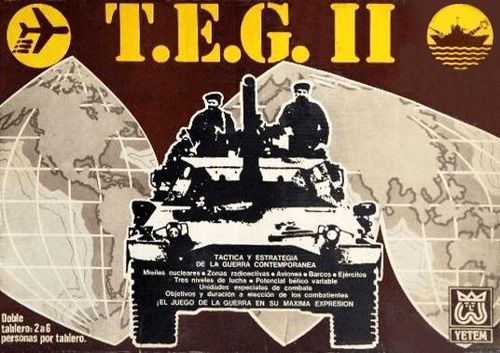
T.E.G. II
T.E.G. II Rulebook
Table of Contents
Table of Contents
Game Levels
TEG II is a game with many elements and can be played at three levels.
- At the BASIC LEVEL only armies are used.
- At the MEDIUM LEVEL armies and ships are used.
- At the ADVANCED LEVEL all forces are used: armies, ships and aircraft.
At any of the three levels, nuclear rockets and special units take part.
To master this game, it is advisable to start by playing the basic level.
The basic level rules are given below for 3, 4, 5 or 6 players. Variants for more or fewer players follow, because TEG II can be played by 2 to 12 players. After that, the rules for the medium and advanced levels are given.
Basic Level Rules
Board
The world map comes cut into 2 parts:
- One board with the American continent.
- Another board with Europe, Africa and Asia.
When up to 6 people play, a single board is used, which the players choose before starting. The board not in use is put away. Later, the VARIANTS section explains how to play on both boards at the same time.
The map is divided into land regions and sea regions. Each region has a name: it can be a country, a group of countries or an ocean. At the basic level, armies are on land and at sea alike.
Notes:
- Sea regions are not separated by border lines, but because they have different names, they are to be understood as different regions. Thus the Indian Ocean (on the Old World board) borders the Atlantic on one side and the Pacific on the other.
- The Middle East region borders North Africa.
- Regions without a name take no part in the game: no pieces may be placed there.
Powers
Players choose or draw lots for which power each one represents. Each takes the armies of the corresponding colour. On either board that is used, the same powers take part, even if they do not appear on the map.
In addition to the pieces representing 1 and 5 armies, each player takes their 5 rectangular cardboard tokens, which are their objectives (CONTROL, INTERVENTION and NON-INTERVENTION), 3 SPECIAL UNIT tokens, 1 nuclear rocket and one square token in their colour. The pieces showing the "atomic mushroom" are set aside, available to whoever needs them. There is a triangular token used to indicate who starts each round. The pieces representing ships and aircraft are not used at the basic level.
Choosing Objectives
Beside the board is the OBJECTIVES TABLE corresponding to the map being played. For the map of the American continent, the table that contains the ATLANTIC OCEAN, ARGENTINA, CHILE, etc. is used. This table has 9 regions. For the map of Europe, Africa and Asia, the table that contains NORTH AFRICA, CENTRAL AFRICA, HORN OF AFRICA, etc. is used. This table has 10 regions. The TABLE that is not used is put away.
The first step of the game is choosing objectives.
Each player has 5 objective tokens, reading: INTERVENTION 1, INTERVENTION 3, INTERVENTION 4, NON-INTERVENTION 2, CONTROL 5. These tokens are inserted one at a time, face down (that is, hiding the words on the squares of the OBJECTIVES TABLE). The first to place is the American player, followed by the Soviet player, then the Chinese player, and so on.
Example: if the American player intends CONTROL of South Africa (supposing we are playing on the Old World board), they place their token reading "CONTROL" in their column and facing the name "SOUTH AFRICA". The others will know that the USA has an objective in South Africa, but for now they do not know what that objective is, since the token was placed face down. Others may also place objectives in South Africa.
After everyone has placed an objective, it is the Soviet player's turn to start a new round to place a second objective, and so on. The same player may not have more than one objective per region.
Once everyone has placed their 5 objectives, they are turned face up and remain visible for the whole game.
Note that the regions where objectives are placed are never the territories of the great powers, because the war takes place in the underdeveloped world. No combat takes place in the territories of the USA, USSR, CHINA, JAPAN, WESTERN EUROPE and EASTERN EUROPE, and no pieces are placed there. That is why a power that does not appear on the map can still take part in the war.
With 6 people, objectives may be placed in any of the regions indicated on the OBJECTIVES TABLE.
If 5 people play, the last 2 regions are eliminated (CARIBBEAN and PACIFIC on the American map; INDOCHINA and PACIFIC on the other).
If 3 or 4 people play, the last 3 regions of the table are eliminated.
What Each Objective Means
Transcriber's note: the source text does not define the CONTROL, INTERVENTION or NON-INTERVENTION objectives, does not state the point value printed on each objective token beyond the labels above, and does not list the regions of the Objectives Table beyond the names given in the rules. Those definitions are not in the source and have not been supplied from memory. Consult the printed objective tokens and table.
Each player has 5 objective tokens, which they place as they choose, as explained above, in 5 regions on the OBJECTIVES TABLE. Each token states what it is about and how many points it is worth.
When the war ends, it is seen which objectives each player achieved, and the points indicated on the respective tokens are scored.
It is therefore essential to be quite clear about what each objective means.
Length of a Game
A game lasts a fixed number of rounds, depending on the number of participants. If 6 play, there are 6 rounds. If 5 play, there are 5 rounds. If 4 play, there are 4 or 8 rounds (the participants decide this before starting). If 3 play, there are 6 rounds.
Objective points are only counted at the end of the war, regardless of what happened during the game.
War Potential Level
The board shows a WAR POTENTIAL LEVEL track. Each player places a square cardboard token in their colour in their own column and facing the number 7. This means that in the first round each one adds 7 armies.
Each time a player wins a combat, their token moves up one place, and if they lose it moves down one place. At the start of the next round, each one adds as many armies as their war potential level indicates.
If a player is at level 10 or at level 4, they add one nuclear rocket in addition to the number of armies indicated. If they are at level 5, they add one special unit (SU) in addition to the number of armies indicated.
Course of Play
Each round consists of:
- ADDITION of armies, and after everyone has added them:
- MOVEMENTS AND COMBATS.
Adding Armies
At the basic level explained here, only armies are used, and they act the same at sea and on land. There are tokens worth 1 army and tokens worth 5 armies.
The first round is started by the American player. At the top of the OBJECTIVES TABLE, the triangular token is placed pointing to the USA. The American player adds 7 armies, because their WAR POTENTIAL LEVEL is at 7 (as for all players at the start of the game).
They may place the 7 armies wherever they like, in land or sea regions, whether or not they have objectives there. They may place several armies in the same region if they wish.
Next, the Soviet player adds their armies: they may place them in unoccupied regions or also where there are already opposing pieces. The Chinese player follows, and so on, until everyone has placed their armies.
When adding armies, the player must already take into account the objectives they chose, in order to try to achieve them.
Movements and Combats
When everyone has finished adding their armies, movements for combat begin. Since this is the first round, the American player also begins the combat stage.
They decide whether or not to attack. Attacks are not made from one region to another, but within the same region. Therefore, to attack, they must have at least one army in that region, where there are supposedly also armies of another power.
They announce in which region they attack and whom they attack, since it is possible that armies of 3 or more powers are in the region.
After the declaration of war, but before combat begins, the opponents may, if they wish, bring their own armies as reinforcements from neighbouring regions, both sea and land. From each neighbouring region the player may bring up to 2 armies. The attacker brings theirs first, then the defender.
Once both opponents have brought the armies they wished and were able to bring to the region in conflict, combat takes place.
How Combat Works
Each opponent uses a BATTLE COMMAND, which has 3 "clocks". Each clock indicates one battle.
The player must divide all their armies in the conflict region among the 3 battles. Each does so in secret, indicating it with the hands of their clocks.
Example:
Suppose the American player, with 8 armies, attacks the Chinese player, who has 5 armies. The American player sets 1 for the first battle, 2 for the second and 2 for the third.
Transcriber's note: the source sentence above reads "1 for the first battle, 2 for the second and 2 for the third", which adds to 5 and does not match the 8 armies in the example. The comparison printed below (American 3 / 0 / 5, Chinese 1 / 2 / 2) and the battle results that follow are consistent with each other, so the printed comparison figures are used here.
Both players now show their BATTLE COMMANDS and compare them:
- American: 3 / 0 / 5 (total 8)
- Chinese: 1 / 2 / 2 (total 5)
Result: the American wins the first battle 3 to 1, and both players lose 1 army in this battle (since the American had to "spend" one army on their fight with the Chinese). The Chinese wins the second battle 2 to 0, and here nobody loses armies, because the two Chinese armies did not have to fight any American. The American wins the third battle 5 to 2, and both players lose 2 armies in this battle. Note that in each battle, both players always lose the lower amount. The total losses in this example are 3 armies per side. Lost armies are removed from the board and returned to their respective boxes.
Note that each player must put in the combat ALL of their own armies gathered in the region of the fight.
Besides the armies that are lost, another important thing happens: the American won more battles than the Chinese, so the American wins the combat. Consequently, on the WAR POTENTIAL LEVEL track the American moves their token up one place and the Chinese moves theirs down one place. Even if they had won all three battles, the WAR POTENTIAL LEVEL moves only one place, because what counts is winning or losing the whole combat.
If in some battle both players put the same amount, both lose what they put in that battle, and it is considered that no one won it. If at the end of the combat neither player won more battles than the other, the war potential levels are not changed.
Example: the American player, with 8 armies, attacks the Japanese player who has 10. The BATTLE COMMANDS were set as follows:
- American: 1 / 4 / 3 (total 8)
- Japanese: 4 / 4 / 2 (total 10)
The Japanese won the first 4 to 1, and both lose 1 army. The second was a 4-4 tie, and both lose 4 armies. The American won the third 3 to 2, and both lose 2 armies. In summary: each won one battle; that is, nobody won the combat and, therefore, the war potential levels are not changed. Each lost 7 armies in total.
The clocks only go up to 11, but if a player has many armies in a region and wants to put more than 11 in one battle, they may do so: they simply point the hand of one clock to the "+" sign. This means that in that battle the player commits all the armies they did not put in the other two.
Example: the Soviet player, with 16 armies, attacks the Japanese player, who has 10.
- Soviet: 2 / + / 1
- Japanese: 5 / 5 / 0
The Japanese win the first 5 to 2 (both lose 2 armies here). In the second battle, the Soviet player risked 13 armies, because they have 16 and used 3 in the other two battles; therefore they win 13 to 5 (both lose 5 here). The Soviet player wins the third 1 to 0 (nobody loses armies here). Since the Soviet player won 2 of the 3 battles, they move up one level on the war potential track, and the Japanese player moves theirs down.
Once a combat has finished and, where applicable, the war potential levels have been adjusted, the active player may continue attacking in a similar way: in the same region or in another, against the same player or others.
When the American player, who started the round, decides not to attack any more, the Soviet player's attack turn begins. When they finish, the Chinese player begins, and so on.
A Special Case: Retreat
After the attacker has brought the reinforcements they wished to the region where they announced combat, the attacked player may choose not to fight and to retreat. To do so, they must move all their armies out of that region, to neighbouring regions. They may move up to a maximum of 2 armies to each neighbouring region, and only where they already have at least one army of their own. If they cannot get all their armies out, the retreat does not take place: they must leave all their armies there and fight, adding reinforcements or not.
If the retreat was carried out, the attacker moves their WAR POTENTIAL LEVEL up one place and the retreating player moves down one place.
The purpose of retreat is to avoid losing armies when a player has no chance of winning the combat.
Note that all army movements are made either to bring reinforcements or to retreat when combat has been announced. There are no other movements, nor regrouping of forces.
How the Game Continues
We have seen how the first round ends. The second is started by the Soviet player, and the triangular token is placed on the OBJECTIVES TABLE pointing to the USSR. The Soviet player then adds as many armies as their position on the WAR POTENTIAL LEVEL indicates. They may place the armies wherever they like. Then the Chinese player adds theirs, and so on. The last in this round will be the American player.
Once the additions are complete, the Soviet player begins their attack turn. When they finish, the Chinese player begins their attack turn, and so on.
All the rounds are played in a similar way.
Special Unit
If at the start of a round a player is at number 5 on the WAR POTENTIAL LEVEL track, in that round they add 5 armies and also one SPECIAL UNIT.
To be placed and to move, the SPECIAL UNIT (SU) behaves exactly like an army. But it has an exceptional combat capacity: it beats all the armies it faces in a battle.
Example: the Chinese player, with 6 armies and one SU, attacks the Japanese player, who has 10 armies. The Chinese player divides their 6 armies between two battles and marks the "SU" on the third clock. The Japanese player divides their 10 armies among the three battles.
- Chinese: 1 / SU / 5
- Japanese: 4 / 3 / 3
The Japanese win the first battle 4 to 1 (both players lose 1 army). The Chinese win the second, because the SU beats any number of armies (the Chinese lose their SU and the Japanese lose their 3 armies). The Chinese win the third 5 to 3 (both lose 3 armies).
Since the Chinese won 2 of the 3 battles, they move up one place on the war potential level and the Japanese moves down one place.
When a combatant has an SU in the place of combat, they must play it; they cannot leave it out of combat.
An SU that was used in a combat is put out of action. The player may have another one again only if, at the start of a new round, their war potential level is at 5.
Note that to have an SU it is not enough to pass through level 5 at some point; the player must be at that level at the start of the round.
Nuclear Rocket
If at the start of a round a player is at number 10 or at number 4 on the WAR POTENTIAL LEVEL track, they add a nuclear rocket in addition to the armies indicated by the level.
The rocket is placed in any region where the player has at least one army of their own. It must be launched in the same round in which it was added, when it is their attack turn. It may be launched at any region, regardless of distance. It may even be launched at the same region where it is located.
Launching consists of lifting the rocket and carrying it to the chosen target region. The result is also simple: all the pieces in that region are lost and removed from the board. The rocket is also lost and removed from the game. In the region where the rocket exploded, a token showing the atomic mushroom is placed. That region can no longer be occupied by any army until the end of the game. Launching a rocket does not raise or lower anyone's war potential level.
A region with the atomic mushroom gives no points to anyone. That is, if a player had NON-INTERVENTION as an objective in that region, they do not gain the two points, even if no one has intervention in that region. The most practical course is for everyone to remove from the OBJECTIVES TABLE the tokens that were in the destroyed region.
There are two ways to "defeat" an enemy rocket:
- Have another rocket. In this case, when the opponent, on their turn, launches their rocket, it is permitted to launch your own rocket immediately, even off turn. Consequence: both rockets explode in the air and nothing else happens.
- Eliminate all the armies that the rocket's owner has in the region where it is placed. The player who achieves this takes possession of the rocket and must launch it in this same round.
Once a player has had a rocket, they can no longer have another, even if at the start of another round they are at the war potential level that grants a rocket. There is only one rocket per player.
If at the start of a round a player is at level 10 or 4, they may prefer not to add the rocket. If at the start of another round they are again at level 10 or 4, they again have the option of adding it.
War Potential Level Limits
When a player is at level 11, they can no longer go up. If they win a combat, they remain at level 11 without "accumulating" any more level. Then, if they lose a combat, they move down one place.
Similarly, if they are at level 3, they can no longer go down.
End of the Game
When the last round ends, the points of the objectives achieved by each player are counted. The player with the highest total score wins.
Variants
For 2 Players
One player represents the USA and CHINA. The other represents the USSR and JAPAN. The game is played as if 4 people were playing. At the end, each player adds up the points of the objectives achieved by the two powers they represent, and the one with the highest total wins.
For More Than 6 Players
TEG II can also be played by up to 12 people. Since the number of players generally does not exceed 6, the price of the game was not raised by including the pieces needed for more than 6. But considering that there may be large groups wishing to play, a kit has been put on sale containing the extra elements needed for more than 6 people.
Game with 8 People
Both boards are used, best set up separately, though in the same room. Each board has its own OBJECTIVES TABLE, its own pieces and its own two BATTLE COMMANDS. The 8 people form 4 pairs: one represents the USA, another the USSR, another CHINA and the other JAPAN.
On each board one representative of each power plays. That is, 4 play on one board and 4 on the other. They use the usual rules of the 4-player game.
WITH ONE DIFFERENCE: if a power raises or lowers its war potential level on one board, it must announce it aloud so that the war potential level of that power is also raised or lowered on the other board. That is, at every moment the potential levels must be equal on both boards. In this way, what happens to our partner on the other board becomes very important. Since it will be normal for each board to be played at a different pace, the following rule is important: each player adds the number of armies indicated by their war potential level at the moment they have to add. It is not permitted to "stall", waiting for the partner to win a combat and raise the level.
Once the wars on both boards have ended, the usual point count is made, and the points of each pair are added together. The pair with the highest total wins.
Game with 10 and 12 People
It is similar to the 8-person game, except that with 10 there are 5 pairs and 5 powers take part, while with 12 there are 6 pairs and all 6 powers take part.
Playing on the Whole World Map
The explanations so far showed how to play on a single board, either the American continent or the Old World, which the participants choose before starting. We now show how to play on the whole world map.
- The two boards are placed one next to the other.
- The two OBJECTIVES TABLES are placed to one side.
- If there are 6 players, they may choose their objectives from 10 regions, which are the first 5 of each of the Objectives tables. The regions below are not taken into account.
- If there are 4 or 5 players, the regions in conflict are 8: the first 4 of each of the Objectives tables.
Once the stage of choosing objectives is complete, the game proceeds as already explained.
Playing with Secret Objectives
If you want to play with hidden objectives, simply leave face down the objective tokens that were inserted in the OBJECTIVES TABLE. They are turned over only when the game has ended and the points must be counted. As it often happens that one forgets one's own objectives, it is advisable to note them on a sheet of paper.
Medium Level Rules
Once the basic game has been tried, the medium level is not difficult to enter. Here ships appear (there are tokens worth 1 ship and tokens worth 5 ships), and a rule is added that gives more possibilities for bringing reinforcements from neighbouring regions: the attrition rule.
Ships
Now armies may only be on land. Ships are placed in the sea regions. At no time are armies and ships "mixed". That is, on land armies move and fight, while at sea ships move and fight.
Combats between ships are made in the same way as combats between armies. There are no "mixed" combats between ships and armies.
When forces are added to the board, the player adds as many units as their WAR POTENTIAL LEVEL indicates, choosing between ships and armies. For example: in the first round, which adds 7 units, a player may place 5 armies and 2 ships, or 6 ships and 1 army, etc.
For the purpose of achieving objectives, ships perform at sea the same role that armies perform on land.
As at the basic level, the nuclear rocket or the Special Unit may be placed in a sea or land region.
Note: the Caribbean is considered a sea region, neighbouring the Atlantic.
Attrition Rule
At the basic level, before combat began, the opponents could bring reinforcements from neighbouring regions. From each region the player could bring a maximum of 2 armies. Now more than 2 units may be brought, but attrition occurs, which is greater the more units cross a border.
Of all the units that are going to cross the border, only half plus one passes. The rest are lost and removed from the board.
Examples:
- If 6 armies or ships are going to cross a border, only 4 pass (half of 3 plus 1), and 2 are lost, removed from the board.
- Another example: if 9 armies or ships are going to cross a border, only 5 pass (half of the nearest lower number, 4, plus 1), and 4 are lost.
The following table shows what happens under the attrition rule for several cases:
| If crossing | Arrive | Lost |
|---|---|---|
| 1 | 1 | 0 |
| 2 | 2 | 0 |
| 3 | 2 | 1 |
| 4 | 3 | 1 |
| 5 | 3 | 2 |
| 6 | 4 | 2 |
| 7 | 4 | 3 |
| 8 | 5 | 3 |
| 9 | 5 | 4 |
With the attrition rule, the passage of large contingents is punished more severely. Therefore it is better to bring small reinforcements from several neighbouring regions than a large number from one side.
The player is free to cross as many units as they wish.
Note from the table that there is less attrition if an even number of units is brought than if an odd number is brought.
Advanced Level Rules
At this level, squadrons of aircraft appear. There are tokens worth 1 air unit and tokens worth 5 air units.
Aircraft may be on land or at sea, provided they accompany the player's own armies or ships. There may never be more aircraft than the player's own armies in a land region. Nor more aircraft than the player's own ships in a sea region.
Aircraft do not count toward INTERVENTION or toward CONTROL of a region. For example, if at the end of the war we have 3 ships and 2 aircraft in a sea region, we do not achieve INTERVENTION, for which 4 or more ships had to be totalled.
But aircraft stand out for their mobility and combat capacity.
How Aircraft Fight
Aircraft may move from one region to a neighbouring one without limit on number and without suffering any attrition. The only restriction is that in no region may we have more aircraft than our own armies or ships. Movements (as with the other forces) are made only to join a combat or to retreat. Each aircraft counts in combat as 2 armies or 2 ships.
When a player has armies (or ships) and aircraft for combat, they must divide the armies (or ships) among 2 battles and place all the aircraft in another battle.
Example:
The Chinese player has 8 armies and 2 aircraft in one region, and faces the Russian player, who has 12 armies and 4 aircraft there.
- Chinese: 3 in the first battle; aircraft in the second (indicated by pointing the second clock's hand to the aircraft mark); 5 armies in the third battle.
- Russian: 8 in the first battle, 4 in the second, and the aircraft in the third.
Both then show their BATTLE COMMANDS and compare.
- Chinese: 3 / Aircraft (2) / 5
- Russian: 8 / 4 / Aircraft (4)
The Russian wins the first 8 to 3 (both lose 3 armies). In the second there is a tie, because the 2 Chinese aircraft equal the 4 Russian armies (the Chinese lose their 2 aircraft and the Russian 4 armies). In the third the Russian wins, because 3 aircraft are enough to equal the Chinese 5 armies (the Russian loses 3 aircraft and the Chinese loses 5 armies). In conclusion, the Russian won 2 of the 3 battles, so they move up one place on the war potential level and the Chinese moves down one place. The Russian lost 7 armies and 3 aircraft. The Chinese lost 8 armies and 2 aircraft.
If in a battle there are, for example, 2 aircraft against 3 ships, the battle is a tie, because although the aircraft are worth more, the 2 aircraft must still be "spent" to equal the 3 ships. One player loses these 2 aircraft and the other loses the 3 ships.
It can happen that after a combat a player has more aircraft than armies (or ships) in a region; then the excess aircraft are lost and removed from the board.
Additions
IMPORTANT: when forces are added to the board, each player always adds 3 units more than their WAR POTENTIAL LEVEL indicates. For example, if they are at level 8, they add 11. And they may choose freely among armies, ships and aircraft. The purpose of increasing the amounts added is to give players more choice, since they have 3 types of force available.
In all other respects, the usual rules apply. For example, if a player is at level 10 at the start of a round, they add 13 units and the nuclear rocket.