Teddy's Colors & Shapes
Teddy's Colors & Shapes Rulebook
Table of Contents
Table of Contents
Contents
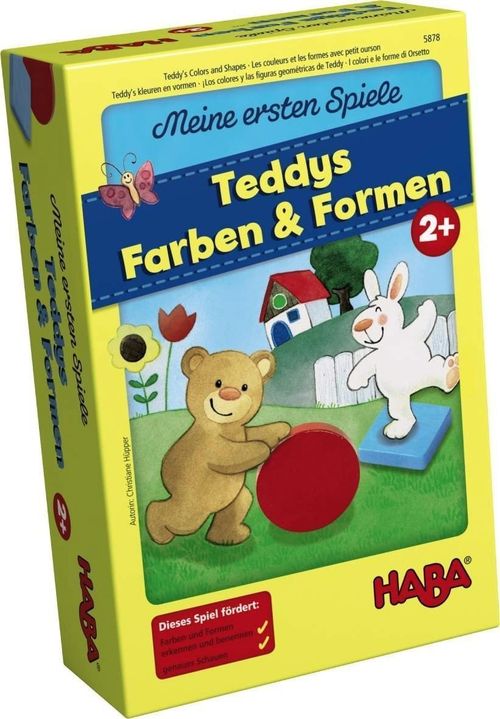
8 wooden pieces (2 of each: square, triangle, circles, and flowers), 5 game boards, 1 color die, 1 die with symbols, set of game instructions.
Before starting to play, please press the puzzle pieces carefully out of the game boards.
1. Free Play
In free play, your child handles the game material. Play with your child! Explore the illustrations and the puzzle pieces. Tell your child what is illustrated on the game boards. Show him the shapes and the colors of the pieces and what they are called.
Invite your child to fit the pieces into the game boards and talk about how to assign things. For example, when it comes to square shapes and your child fits the square with the picture of the window into the space for the big die (= children's room game board) then he gets the shape (square) right but not the picture. Correct your child in a positive way, for example, "Look! The letter A is now in the window! Do you think that is right?" In this way you foster the verbal and language skills, the motor skills, and attention of your child.
Give your child sufficient time and be patient if you feel he needs more time than necessary or if you have to help. Each child is different and skill only comes with practice. Once your child is familiar with the assignment of the game material you can start playing the two amusing games with rules.
When children are already acquainted with the game material you can also ask questions about details. For example: What is the teddy doing? Which animal can you see here? What color is that?
2. Everybody is Helping Teddy!
A co-operative game with shapes where the children always win.
Before Starting to Play
Place the game boards with the side of the teddy face up in front of the children. The boards should be within easy reach of all players. Place the wooden pieces, the puzzle pieces, and the die with symbols in the center of the table.
Of course you can also place the puzzle pieces next to their corresponding game boards. Playing will be easier.
And Off You Go
The children play one by one in a clockwise direction. Whoever can roar the most like a bear may start and rolls the die.
On the die appears: Ask your child what the shape is called.
- A circle, a triangle, a square, or a flower? The child says the name of the shape. If he is right, praise him nicely. Help him if he does not know the name of the shape. The child now takes a wooden piece of that shape from the center and places it in a matching hole on the game board. After that he may keep the corresponding puzzle piece. If a shape that has already been placed in appears on the die, the child unfortunately cannot puzzle anything in and does not receive a puzzle piece.
- A star? Great! Everybody is happy for the player who can now choose any shape. He chooses a shape that is still missing from the game boards and says the name of the shape. Then he keeps the shape. The corresponding puzzle piece stays in the center.
- The face of the teddy? It's Teddy's birthday and he is happy! All children raise their arms and together shout "Birthday party! Hooray!"
Then it's the turn of the next child to roll the die.
Celebrating together emotionally empowers and creates a good mood. It confirms children in their actions and fosters cohesion within the family or the playgroup.
End of the Game
The game ends as soon as all the game boards have been completed with the right shapes. Together you helped Teddy assign everything correctly.
3. Who Knows The Colors?
A co-operative color game in which children always win.
The game is played as "Everybody Helps Teddy!" with the following changes: Place the game boards with the picture of teddy face down in front of the children and use the color die. The children now don't name the shape but the color on the die. When the star symbol is rolled, the player may choose any color.
Play at being color detectives! This can be done in the house or outdoors, when on a walk or on the way back from nursery school. Indicate different objects, pieces of clothing, cars, flowers, or plants and talk to your child about the colors. Search together for something that is red/blue/... When children already know the colors you can also ask questions like: "What is your favorite color? Can you find this color somewhere in the room? Are you wearing something of this color?..."
4. Competition Variation of "Everybody Helps Teddy" and "Who Knows The Colors?"
In play situations where children want to establish a winner, just pile up the collected puzzle pieces and see who has the highest pile. This child wins the game.
Winning and losing are both part of playing! Whoever wins is as happy as a lark. Whoever loses is sad, disappointed, and sometimes even angry. Show interest in your child's emotions, be happy for him or comfort him. Children who just lost need to be reassured and to know that the next game will bring a new opportunity. In this way they become emotionally stronger for the highs and lows of life.