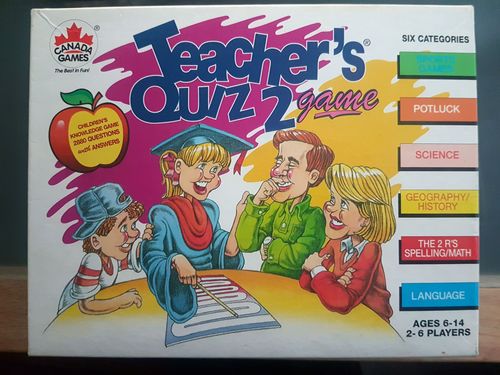
Teacher's Quiz 2
Teacher's Quiz 2 Rulebook
Table of Contents
Table of Contents
Object
To be the first player to reach 100; by answering questions correctly; by the luck of the dice; or by a combination of both.
Equipment
Playing board, Quiz Cards with 2,880 questions and answers in SIX categories, one numbered die, one coloured die, 6 play pieces.
Play
Place the tray containing the cards on the table so that they can easily be reached by all players. There are "A" and "B" sides to each card. During play, start with "A" side until they have all been used once. Then repeat the same procedure with the "B" side.
The player asking the question is always the one on the left of the player answering. The card is always taken from the back of the category card section being played and replaced in the front of the same section once the player's turn has been completed. Each player or team selects a coloured playing piece. Choose a player or team to go first (usually the youngest). Players take turns, moving to the left, clockwise.
The first player rolls both dice. The Coloured Die indicates the category of the question to be asked. The colour of the die matches the category colour of the card. The Numbered Die indicates the number of the question to be asked.
For example: Each coloured card represents a different category as follows;
RED CARDS - THE 2R'S...SPELLING/MATH
BLUE CARDS - LANGUAGE
GREEN CARDS - SPORTS/GAMES
YELLOW CARDS - GEOGRAPHY/HISTORY
PINK CARDS - SCIENCE
ORANGE CARDS - POTLUCK
When a player rolls the dice and the dice show: Red on the Colour Die and 2 on the Number Die, the player may choose:
Option 1) To answer a spelling question, No. 2 on the card. When a player chooses the first option (to be asked the question) and gives the CORRECT answer, he or she moves DOUBLE the number of spaces shown on the Number Die. If the answer is WRONG the player does not move.
Option 2) to move his or her playing piece the number shown on the Number Die. (ie. 2 spaces)
When a player chooses the second option the player does not get the opportunity to hear the question at all and simply moves his or her playing piece the number shown on the Number Die.
UP and DOWN Paths
A player landing on a space showing an arrow pointing up, must do two things:
-
Choose ANY category.
-
Roll the Number Die, and try to answer the question on the card corresponding to the number rolled. A CORRECT answer enables the player to move UP to the end of the path, improving his or her position on the board. A WRONG answer means "STAY WHERE YOU ARE".
A player landing on a space showing an arrow pointing down must do two things:
-
Choose a category.
-
Roll the Number Die and try to answer the question on the card corresponding to the number rolled. A CORRECT answer prevents the player from going down the path. A WRONG answer means "GO TO THE BOTTOM OF THE PATH".
Play continues following these rules until spaces 94 to 99 are reached through normal play. These SIX spaces are individually coloured and marked with Categories. When a player lands on one of these Category spaces, The Coloured Die is no longer used, and the player must try to answer a question in the Category shown by rolling only the Number Die to discover which question, (1, 2 or 3) he or she will be asked. A CORRECT answer moves the player to the next space where he or she awaits the next turn. A WRONG answer means "STAY WHERE YOU ARE and try again on the next turn".
When a player arrives at space #99 (LANGUAGE) and CORRECTLY answers the question shown by the Number Die, he or she moves to space #100 and WINS the Quiz.
Variations
- When children of varying age groups are playing the Quiz together, the following suggestions may be applicable.
6, 7 and 8 year olds move FOUR TIMES the number rolled when they answer questions CORRECTLY. 9 and 10 year olds move THREE TIMES the number rolled when they answer questions CORRECTLY. Older children play by the regular rules.
- If you are having a Party, forget the game board and organize a Quiz using the 2,880 questions, and keep score with pencil and paper using your own scoring system.