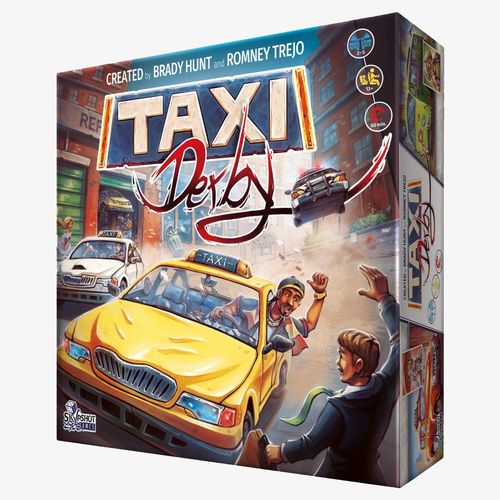
Taxi Derby
Taxi Derby Rulebook
Table of Contents
Table of Contents
Contents
- 5 Taxi player mats
- 5 Taxi miniatures (meeples)
- 1 Patrol car miniature (meeple)
- 4 City grid game boards
- 5 Color cubes (orange, green, yellow, blue and red)
- 56 Passenger tiles
- 44 Taxi upgrade tokens (11 each of Stereo, Turbo, Wi-Fi and Luxury)
- 1 Pursuit die (D4)
- 32 $1 coins
- 22 $5 coins
- 12 $10 bills
- 36 Traffic Ticket cards
Setting Up the Game
A: Game Board. The city grid is set up by taking the four city grid game board pieces (A), and arranging them randomly in a square pattern to form the game board (2x2 for the standard configuration). Spaces on the board are the rectangular road sections (a) and DO NOT include the intersections. The outer border of the game board is not a valid road and cannot be moved onto.
B: Player Mats. Each player takes a taxi player mat (B) and the corresponding colored taxi meeple and cube. Each player places their corresponding meeple on the board at one of the two available locations surrounding the locational icon (b) on the board that matches their taxi player mat color (bb).
C: Taxi Upgrade Token Placement. Place all taxi upgrade tokens into a bag and have each player randomly draw one taxi upgrade token from the bag and place it on their player mat over the matching icon (C). Each player starts the game with one random upgrade to their taxi.
Then randomly draw the required amount of taxi upgrade tokens (see the chart below) and randomly distribute them across all the stores spread throughout the city indicated by the wrench and screwdriver icon (cc). Return any unused tokens to the box. (Note: Store's upgrade tokens ARE NOT replenished when purchased by a player.)
The number of taxi upgrades available at stores within the city changes based on the number of players as follows:
| No. Players | Number of Tokens per Store |
|---|---|
| 2 | 1 |
| 3-4 | 2 |
| 5 | 3 |
D: Passenger Stack Formation. Separate the 56 passenger tiles (D) by the color on the back of each (green, yellow, red and purple). Shuffle each stack of passenger tiles separately and then form 5 passenger stacks facedown as follows (starting at the bottom of each stack): 1 purple tile, 2 red tiles, 3 yellow tiles and then 3 green tiles on top. This will form 5 stacks with 9 total passengers in each stack.
These five stacks are placed on passenger stack icons (d) located throughout the city. Two passengers are drawn from the top of each stack and placed on the board face up on the single passenger icons (dd) located next to the passenger stacks. Any remaining passengers are placed back into the box.
E: Traffic Tickets and End of Game Bonuses Board. Shuffle the deck of traffic ticket cards (E) and place them facedown next to the game board. Place the End of Game Bonuses board (see the End of Game Bonuses Explained section below) next to the game board and place one colored cube from each player on the speeding track located at the bottom of the End of Game Bonuses board.
F: Patrol Car Miniature. Place the patrol car (black meeple) on the police station icon.
Object of the Game
The objective of Taxi Derby is to be the player with the most money accumulated at the end of the game.
Playing the Game
First Player. The player who drives the oldest car in real life begins the game. Play continues clockwise.
Turn — Movement. In Taxi Derby each player can move as many spaces as they wish on their turn while performing actions in between their movements (see the Actions section below). A space is defined as a rectangular road section on the board. (Note: the intersections between road sections are not considered spaces. Likewise, the outside border road on the edge of the map may not be moved onto during the game.)
Although players can move as many spaces as they wish, in the City of Ixat there is a speed limit of 4 spaces. As soon as a player moves 5 or more spaces they are speeding and will be chased by the patrol car (see the Patrol Car section below).
Actions. Each player is allowed up to two actions per turn if they perform their first action before speeding (moving 5 or more spaces). If a player does not perform an action before speeding they may only perform one action on their turn. The patrol car will always activate before the player's final action is performed (see the Patrol Car section below).
The available actions are:
- Picking up a passenger. Players may move their taxi onto a pick-up location and if they have the required taxi upgrade(s), they may pick up and place the passenger into one of the two available passenger locations on their player mat. Only two passengers may be carried at one time.
- Dropping off a passenger. Players may drop a passenger off at the required destination by moving their taxi onto a drop-off location. The player then places the passenger below their player mat and takes the payment shown on the passenger tile from the coin supply.
- Buying an upgrade. Players may purchase an upgrade for their taxi by moving their taxi onto an upgrade location. They must then pay the amount listed on the board next to the upgrade icon and then may take one upgrade from the store and place it on their player mat. Only ONE upgrade may be purchased from each store per turn. Players MAY NOT upgrade their taxis while carrying a passenger.
Remember:
- You may NOT upgrade your Taxi while carrying a passenger.
- You must move BEFORE performing an action.
Patrol Car
Before the final action of a player's turn, the patrol car will either perform a patrol action or a pursuit action depending on whether the active player was speeding during their turn (moved 5 or more spaces).
Patrol. If the active player DOES NOT move 5 or more spaces during their entire turn, the active player may move the patrol car up to 4 spaces in any direction.
Pursuit. If the active player DOES move 5 or more spaces during their entire turn, the patrol car will perform a pursuit action before the player can perform their last action (pick up a passenger, drop off a passenger or purchase an upgrade). To perform the pursuit action, the active player will roll the pursuit die (4-sided die) and multiply its result by the number of spaces moved over the speed limit. The active player then moves the patrol car in the most direct route towards their own taxi. (In case of a disagreement on the patrol car route, the player to the right of the active player moves the patrol car.) If the patrol car successfully lands on the active player's taxi, they are issued a Traffic Ticket (see the Traffic Tickets section below).
Calculating a Player's Movement for the Patrol Car. One turn may consist of a player moving, performing an action, moving again and performing their final action. Regarding the patrol car, the number of spaces moved across the player's entire turn are added together and compared against the speed limit. For example: a player may move 2 spaces and perform their first action. They may then move an additional 7 spaces for a total of 9 spaces moved on their turn. Before performing their final action, the patrol car must activate. In total the player moved 9 spaces and therefore sped by 5 spaces (2 spaces moved + 7 spaces moved − 4 space speed limit = 5 spaces sped). The patrol car would then pursue the player based on 5 spaces sped times the result of the pursuit die rolled.
End of Turn. A player's turn immediately ends once that player has moved the patrol car and performed their final action (picking up, dropping off or upgrading their taxi).
Turn Examples
Example 1: Bailee (Blue Taxi) moves 3 spaces and purchases a stereo upgrade for her taxi for $3. Since she is not considered speeding yet, she is able to take a second action. She then moves an additional 2 spaces to pick up Jenna. In total, she moved 5 spaces and therefore sped by 1 space (5 spaces moved minus 4 space speed limit = 1 space sped). Before she can pick up Jenna she must roll the pursuit die and multiply the result by the 1 space she sped. Bailee rolled a 2 and the patrol car (black car) moved 2 spaces (1 space sped x 2 on pursuit die = 2 spaces) but did not catch her. Bailee then ends her turn by completing her 2nd action of picking up Jenna.
Example 2: Jimmy (Green Taxi) moves 6 spaces to upgrade his taxi at an upgrade store. Because Jimmy did not pick anyone up, upgrade his taxi or drop a passenger off in the first 4 spaces he moved, his turn will end after completing the upgrade action (he must roll the pursuit die and move the patrol car first before completing the upgrade).
Example 3: Cami (Red Taxi) moves 3 spaces. She decides to end her turn without performing any actions because the patrol car is close to her taxi. She may then perform a patrol action and move the patrol car up to 4 spaces in any direction.
Remember: anytime a player moves 7 or more spaces on their turn and does not receive a ticket from the patrol car, they may move their colored cube along the speeding track on the End of Game Bonuses board. See the End of Game Bonuses section below.
Patrol Car Examples
Example 4: Bailee (Blue Taxi) moved 5 spaces this turn and triggered a pursuit action (Bailee moved 1 more space than the speed limit of 4 allowed: 5 spaces moved − 4 space speed limit = 1 space over speed limit). Bailee rolled the pursuit die and the result was a 2. Bailee moved the patrol car (black car) 2 spaces (2 on die x 1 space sped = 2 spaces) towards her taxi. The patrol car did not land on Bailee's taxi and so Bailee continued her turn by dropping off her passenger at memorial park (green obelisk icon). Since Bailee did not perform an action before she sped, her turn is limited to only one action and her turn immediately ends. Play proceeds to the left.
Example 5: Jimmy's (Green Taxi) turn is after Bailee's and he moved 7 spaces this turn and triggered a pursuit action (Jimmy moved 3 more spaces than the speed limit of 4 allowed: 7 spaces moved − 4 space speed limit = 3 spaces sped). Jimmy rolled the pursuit die and the result was a 2. Jimmy moved the patrol car (black car) 3 spaces out of the 6 total (2 on die x 3 spaces sped = 6 spaces) towards his taxi. The patrol car landed on Jimmy's taxi and so Jimmy receives a Traffic Ticket card and must pay the speeding fine listed on the card. If Jimmy can pay the ticket he may continue with his last action. If he cannot pay the fine he must discard to the box the passenger he was carrying and place his taxi on the police station.
Traffic Tickets
If the patrol car lands on the space that the active player's taxi occupies, as described in the "Pursuit" section above, the active player receives a Traffic Ticket. The active player reveals the top card from the Traffic Ticket deck and must pay the speeding fine listed at the bottom of the ticket card. Two results can happen:
(Note: most Traffic Tickets require that the player pay a small amount of money. However, some tickets can also force the active player to visit the police station or downgrade their car. These Traffic Tickets are kept in front of the active player and may impact the clientele the player is able to pick up on future turns.)
- If the player has enough money to pay the ticket, they may keep any passengers they are carrying and continue their turn's last action. (Note: if a ticket forces a player to lose an upgrade that is required by their current passenger, they lose the upgrade but can still keep the passenger. The active player may also keep passengers with a restriction on the number of tickets the passenger is willing to receive.)
- If the player does not have sufficient money or the required upgrade to pay the Traffic Ticket, their taxi is impounded. When a taxi is impounded the active player must discard any passengers they were carrying and place their taxi on the police station. Thus, they forfeit any money they would have earned from the passenger. Play then proceeds to the left. A player may not choose to be impounded if they have enough money available to pay the ticket or they have the upgrade required by the ticket (exception: if it is the last upgrade on their taxi a player may choose to be impounded to avoid losing their only upgrade).
Passenger Types
There are different types of passengers that can be picked up throughout the City of Ixat (symbolized by the icon in the upper left corner of the passenger tile):
- Normal Commuter — cell phone icon
- Criminal — hat and glasses icon
- Professional — briefcase icon
- Celebrity — star icon
- Secret Agent — sunglasses icon
- VIP Passengers — SOLO icon in top right (note: these passengers will not ride in taxis with another passenger. They must be carried by themselves).
Passenger Tiles
Each passenger tile displays key information: passenger icon and name, taxi upgrade requirement(s), payment, and drop-off location. Passengers may require their taxi to be equipped with a specific upgrade(s) and cannot be picked up by a taxi that has not met the upgrade requirement(s).
Remember: there are 4 taxi upgrades available in the game — Stereo, Turbo, Luxury and Wi-Fi.
Player Mats
Each player mat section is described below.
- A. Current passengers are placed in this section (only two passengers can be carried at a time).
- B. Taxi upgrades consist of three tiers.
- Tier 1 — Basic upgrade that allows a player to pick up passengers with the matching icon requirement.
- Tier 2 — Special ability for that player's taxi unlocked for the rest of the game. Additionally, each passenger dropped off with the matching symbol will pay an additional 1 coin.
- Tier 3 — Each passenger dropped off with the matching symbol will pay an additional 3 coins.
- C. Upgrade tokens purchased at the upgrade locations on the board are placed in the first available location from left to right. Upgrade abilities for tier two are listed as well. Taxi upgrades on the board are not replenished when they are purchased. There are a finite number of taxi upgrades available to players as specified by the game setup instructions.
- D. All delivered passengers are placed below the player mat for end of game scoring.
City Icons
Spread throughout the City of Ixat are locations that a player's taxi must land on to pick up a passenger, drop off a passenger or upgrade their taxi. These are marked on the city board by yellow taxi symbols (for drop-off and pick-up spaces) and white arrows (for upgrade locations).
- Taxi upgrade locations — Taxi upgrade locations are marked on the city grid board with an upgrade location icon and a money upgrade cost icon (either a $1, $2 or $3 money icon). A player may only purchase ONE taxi upgrade from each store per turn and must pay the required amount listed on the upgrade location before adding the upgrade token to their player mat.
- Passenger pick-up locations — Passenger pick-up locations are marked on the city grid board with a passenger pick-up icon. If a taxi lands on a pick-up icon, they may pick up and place the passenger on their player mat (in one of their two available seats marked on their player mat) as long as they have the required passenger upgrade on their taxi. New passenger tiles are revealed from the passenger stack after the active player's turn is over.
- Passenger drop-off locations — Passenger drop-off locations are marked on the city grid board with a drop-off icon and correspond to one of the 5 drop-off locations (marked with a unique drop-off location icon). Once a passenger is dropped off successfully, the tile is placed below the player mat facedown to be counted at the end of the game as part of the end of game bonuses.
Additional Passenger Requirements
Some passengers have additional taxi requirements other than requiring a specific upgrade(s).
- No Traffic Tickets icon — Passengers with this icon are not willing to be picked up by a taxi that has received too many tickets. Therefore a taxi must have less than or equal to the number of tickets shown on the passenger tile.
Special Passenger Payout Icons
Some passengers have payout multipliers based on certain requirements being met.
- Passenger Type Multiplier icon — Criminal and Secret Agent passengers are willing to pay more if the player has delivered previous passengers of their respective type.
Example 6: On previous turns, Sara had successfully delivered 1 agent. In her current turn she delivers a second agent with a passenger tile that shows a payout of $1 times one plus the number of agents delivered. Sara would receive a payment of $2 ($1 x 2 agents). If this was Sara's first agent she would receive a payout of $1 instead.
End of Game
The end of game phase is triggered when either four stacks of passenger tiles are depleted on the board or two passenger stacks are clear with all adjacent face-up locations empty as well. (Optional: deplete 3 or all 5 passenger tile stacks for condensed or extended playing time.)
The player who initiates the end of game phase can complete their turn. The last round will then commence with each player taking one final turn including the player who initiated the end of game phase. The player who initiated the end of game phase will be the last player to go before the end of the game.
After all players have taken a final turn, the game is over and End of Game Bonuses are awarded (explained below). Each taxi player totals their money earned and the taxi player with the most money is declared the winner of Taxi Derby.
End of Game Bonuses Explained
At the end of the game and before final scoring, each player will compare the following for end of game bonuses. In the case of a tie, the tying players' amounts are added together and divided by two (rounded up). If more than two people tie for third then no amount is awarded.
- First, second and third amounts awarded to the player with the most taxi upgrades.
- First, second and third amounts awarded to the player with the least number of Traffic Tickets.
- First, second and third amounts awarded to the players who delivered the most passengers of each type.
- First, second and third amounts awarded to the player who traveled the furthest distance on a single turn and did not receive a single ticket. (Cubes matching each player's color are placed on the start track at the beginning of the game.) If a player did not move at least 7 spaces, they do not receive any payment.