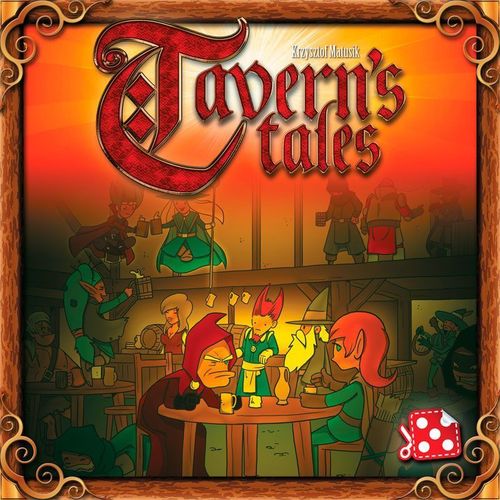
Tavern's Tales
Tavern's Tales Rulebook
Table of Contents
Table of Contents
Game elements
- 98 CHARACTER CARDS – Cards depicting heroes which players will be able to hire for their adventures.
- 36 QUEST TILES – Quest tiles depict quests which will be taken up by players to gather prestige points.
- 12 TIME COUNTERS – Players put one time counter on the Tavern card at the beginning of each round. There are 3 extra counters.
- 18 OTHER COUNTERS – You will find additional counters in the game box. They are not used for anything in the base game. You can use them for marking various elements of the game, like amount of additional actions you can perform.
- INNKEEPER CARD AND TAVERN CARD – Player who owns Innkeeper card will begin each round of the game. Players will put time counters on Tavern card to track which round of the game it is.
- 8 PLAYER AIDS – Cards with rules digest and icon explanation. Each player should get a set of 2 player aids. Players can look at them during the game. This will make the game go smoother.
What to read at the beginning
This rulebook is divided into the phases of familiarity with the game. If it is your first game of Tavern's Tales, then we encourage you to read the Game goal paragraph and proceed to playing the game simultaneously to reading further game rules. In some places there will be a table with text on the green background. This is simplified variant. Apply this to the game rules and ignore all tables with text on red background – advanced variant. We recommend you to teach rules this way every time a newcomer wants to play the game.
When you familiarize yourself with basic variant we encourage you to play full variant – you have to read up and apply rules in tables red backgrund.
Simplified variant and advanced variant are the two panels of the printed rulebook (green and red).
Game goal
As wealthy nobles, bored with everyday aristocratic high-life, you embark on a series of journeys to the unknown lands to experience real adventures. But that's not the most important thing: what really matters is that you will have stories to tell, tales that give you Prestige! You will need help in achieving this. Let's be honest: what do you know about adventurer's life? Fortunately there is a notorious tavern in proximity, called "Gates of Adventure". Head this way to recruit some daredevils – real heroes that will make challenges that lie before you possible to overcome. In addition to that, you could brag about having such awesome friends.
The task is simple: assemble your first team, ideally you want their abilities to synergise in some way. Even better if they know the terrain of quests that you will take. When you do it, it is time for your first quest. If you complete it, then your best shot is to recruit some more heroes. Then take another quest :) Find the best way to spend all 9 turns of the game.
Completed quest tiles and character cards will give you prestige points at the end of the game. You need to remember this while recruiting heroes and completing quests, the more difficult they are, the more points you will get.
You will gain experience during each match of Tavern's Tales, each time trying new tactics and looking for new combinations of abilities. Finally you will gather so much prestige to come back home and spin tales with your friends. The question is whether or not you'll be tempted to take up some more quests? If so, then Tavern's Tales will always be at your fingertips!
Game setup
First thing to do is finding comfortable playing space. Ideally it will be clean, flat surface the size of small table. This will be your game field. Next prepare other elements in order:
(1) TABLES at which heroes will sit.
There are 15 heroes in the game – you can identify them by name and art. Each hero is depicted on a few cards that differ in knowledge of terrain. During the game hero cards will be called character cards. Take all cards of one hero, shuffle them, and then form a stack on the game field, ready side up. From this time on these will be called tables, at which heroes sit in the tavern. Do this for each hero and place formed stacks in a pyramid shape according to the picture. First row consists of heroes with recruitment cost of "1", second row with heroes with recruitment cost of "2" etc.
Simplified variant: When you prepare simplified game, place only these heroes on the game field: Warslava Double-edge, Lubomyr Moldbeard, Dobrociech Onthetrack, Mscigniev The Charming, Goscislav Plunk, Sambor Silentrustle, Racimira Trueshot, Ludmila Inneed, Ryslava Bouttime, Zbygniev Stonebreaker. All remaining characters, marked with pint icon in lower part of ability field, have to be placed in the box.
Advanced variant: If you play the full game, place all 15 characters on the game field, forming pyramid similar to this shown on the picture.
Next, if there are less than 4 players participating in the game, remove characters from the stacks: In a 3-player game take 1 card at random from each stack of heroes with recruitment cost of 2, 3 and 4 and place it in the box. Do the same if you are playing a 2-player game, but removing 2 card instead of one.
(2) PLAYER'S PARTY, PLAYER AIDS.
There needs to be some place in front of each player to place played character cards which will form player's party. We also recommend that each player takes a set of two player aids, which will help to understand what is going on in the tavern.
(3) TAVERN CARD, TIME COUNTERS
Place Tavern card on the game field and 9 time counters by it.
(4) QUEST STACK and (5) AVAILABLE QUESTS.
Simplified variant: Before the first game remove quest tiles from the punch board. There are 2, 3 or 4 terrain icons on each tile – they depict the quest's difficulty. You can see detailed icon explanations in the table on page 7. Take all tiles with difficulty of 4 and place it in the box – they are not used in simplified game. Shuffle remaining tiles and put on the game field in a stack. All tiles must be face-down. This is quest stack. Next, take number of tiles from the top equal to number of players +1 and place them beside face-up. These are available quests.
Advanced variant: Take all quest tiles and shuffle them. Put them in a stack. All tiles must be face-down. This is quest stack. Next, take number of tiles from the top equal to number of players +1 and place them beside face-up. These are available quests.
(6) CARDS IN THE HAND – Assemble your first team.
Simplified variant: Starting from the youngest player (they have the least experience in adventuring) each player takes cards from the top of stacks – tables – one card of each hero: Lubomyr Moldbeard, Warslava Double-edge, Dobrociech Onthetrack. Keep cards in a way that other players can only see back of the cards. Then choose one player at random and give them an Innkeeper card.
Advanced variant: It's high time to choose heroes who will go adventuring with you! Choose a player who will start taking the cards. We suggest to choose a player who visited a tavern or place like that most recently. From now on, starting from the first player and going clockwise, each player will choose and take a character card with recruitment cost "1" and add it to their hand. You choose characters until each of you has 3 cards in hand. During this you cannot choose the same character twice.
Additionally no player can have the same combination of starting characters as any other player. This means that you have to check what characters have been taken to not repeat a combination!
The cards that have been taken have to be placed in front of their owner so other players can see them. Players take their cards hand and keep them exhausted side up after the draft ends. At the end of this phase player who drawn card last gets an Innkeeper card.
Flow of the game
Game lasts for 9 rounds. In each round each player, starting from the owner of Innkeeper card will perform their turns.
In their turn player performs following steps:
- (First player) Puts a time counter on the Tavern card. If the ninth counter was placed, then this counter marks the last round of the game. After it the game ends and players continue to scoring.
- If a player started the turn with no cards in hand, then they take all cards in their party and put them into their hand.
- Player can perform two of three available actions:
- play a character as ready (basic action),
- play a character as exhausted (basic action),
- play a set of cards (special action).
- If a player has no card in hand but has at least one action left, then they can declare that they want to perform an action and take all cards from their party into their hand. Then this player must perform an action.
- If a player has only one card left on their hand after finishing performing an actions, then they have to put it as ready in their party. They can't use its ability.
- The same character can be played only once each turn.
- Player end their turn and next player in the clockwise order begins their turn.
(Both steps are printed as "6" in the source.)
To make the game easier to follow, we gave keywords to some of the game areas. Better familiarize yourself with them now:
- Hand – players keep possessed, not yet played cards on their hands.
- Party – place on the game field in front of the player. This is where played cards go.
- Table – stack of cards of one hero, formed at the beginning of the game. Players can recruit characters from it.
Player's turn
- If you have no cards in hand at the beginning of the turn, then you take cards from the party to your hand.
- You can perform two actions, each of them is playing a card in one of three ways: Ready – face-up, Exhausted – face-down, A set of cards.
- If you want to perform an action but you do not have cards in hand, then take all the cards from company to your hand and perform an action.
- If you end your turn and have only one car in hand, then put it in your party as ready.
Heroes
Let's have a closer look at the heroes that we can hire in the tavern. Look closely at their cards so you can use their abilities in the most efficient way.
Character card can be placed in your party as ready (face-up) or exhausted (face-down).
If a character is placed as ready, then you know that it is ready to act and you can count on it.
If a characters is placed as exhausted, then it lets you know that it is done for the day and wants you to leave it alone.
The character card carries these labelled parts:
- A – RECRUITMENT COST Depicts how much persuasion you team must have to recruit this character.
- B – KNOWLEDGE OF TERRAIN Heroes have experience of adventures in various places. Here you can see terrains in which these character can take up quests. Knowledge of terrain is the only difference between cards of the same hero.
- C – NAME
- D – TALENT Each character walks one of three paths: fighting, magic or cunning.
- E – PRESTIGE You can see how much prestige will this character bring you at the end of the game.
- F – PERSUASION Number showing how much persuasion points a character have. You use persuasion to convince other heroes to join your cause.
- G – ABILITY FIELD Character's ability is located and described here.
- H – PINT OF EXPERIENCE Additional icon. Do not use these cards in simplified variant.
- I – CARD NUMBER To minimize the chance that you lost something we put numbers on the cards. There are 98 cards in the box.
- J – REMINDER Reminder of actions that you can perform while playing cards as exhausted.
Questa
The printed heading reads "Questa" as shown in the source.
Let's take a look how dangerous quests are described in the game.
The quest tile carries these labelled parts:
- A – QUEST'S TERRAIN Each quest you take takes place on one of four terrains: mountains, swamp, forest or desert. Heroes that you send to complete quest must know the terrain the quest takes place on!
- B – QUEST'S DIFFICULTY There are easier and harder quests. Quest's difficulty is depicted on the tile as a number of terrain icons. Quests can have difficulty of 2, 3 or 4. This is marked accordingly by number of quest icons.
- C – TALENT Heroes perform best in one particular task. There is a talent icon depicted on the quest tile. You know which characters will give the best results after completing this quest thanks to this icon. You will get additional prestige points for cards with talent matching the quest's talent at the end of the game.
- D – PRESTIGE Number of prestige points that this quest will give you at the end of the game.
Actions
The most important action in the game is playing cards and using their abilities. In Tavern's Tales you can play cards in three ways: placing it on the table face-up or face-down or playing a set of cards as a special action. The detailed instruction how to play cards is located below.
Remember: During your turn you can perform two actions out of three available. You can perform the same action twice a turn. You are allowed to perform one action or no action at all if you want to.
I. Play character as Ready
Play a card from hand and put it ready (face-up) in your party. you can use its ability.
Player chooses one card from hand and places it in front of them. In other words, they place it in their party. When you use this action to play a card you place this card as ready, that is face-up. Player can then use ability depicted on the played character. Detailed description of the abilities is located further in the rules.
Important: abilities must be used in the moment you play that character, you cannot do it later. You make the decision whether you want to use the ability or not the moment you play a card.
II. Play character as Exhausted
Take a card from your hand and put it exhausted (face-down) in your party. Then choose one of the following:
- a) Recruit a character to your hand.
- b) Take up the quest.
Player chooses one card in their hand and places it in front of them. In other words, they place it in their party. When you use this action to play a card you place this card as exhausted, that is face-down. By playing a card like this, player can recruit a new character to hand or take up and complete one of available quests.
Example: Adam plays Sambor and puts him exhausted in their party. He want to recruit Ludmila Inneed - whose recruitment cost is 3 - by using this action. He has ready Mscigniew The Charming and Dobrociech Onthetrack in his party. He flips both of them to the exhausted side to use their persuasion. Miscigniew has persuasion of 1 and Dobrociech of 2, so when combined they can convince Ludmila to go on adventure with them. Player takes the top card of Ludmila's table and puts them in their hand.
a) Recruit a character to your hand.
Definition: Exhaust any number of your ready characters with summed persuasion equal or higher than recruitment cost of a chosen character sitting at the table to recruit it to your hand.
Each character has persuasion. Its value is depicted with a number inside the pint icon on the character card. To recruit a new character, that means taking a card from the table to your hand, you need to pay recruitment cost which is located in upper-left corner of the card. During the recruitment a player first chooses one of the tables, that is stacks with characters for hire and then pays the recruitment cost by choosing and exhausting ready characters in their party so the summed amount of persuasion is equal or greater than the recruitment cost. Then, this player takes top card from chosen table and puts it into their hand.
b) Take up the quest.
Definition: Choose one of available quests. Exhaust a number of characters equal to the difficulty of this quest to complete it. Knowledge of terrain of used characters must be the same as terrain of the quest.
Taking up the quests is a crucial part of the game. Thanks to collected quest tiles you will gain precious prestige points at the end of the game. Each quest has difficulty, which is depicted on the tile by terrain icons. Quests can habe difficulty of 2, 3 or 4, which will be marked on the tile accordingly by 2, 3 or 4 icons.
Player chooses one of available quests, that is revealed tiles, which lie face-up by the quest tiles. To take up the quest, player must have number of characters in their party equal to or more than difficulty of the quest. Additionally knowledge of terrain of these characters' must match the terrain of this quest. That is, on each card that is used to complete the quest there must be terrain icon matching the quest's terrain. If the requirements are fulfilled, then player exhaust number of characters equal to quest's difficulty and matching its terrain to complete this quest. Then they take this quest tile and place them by them. If at this moment there are fewer quests than "number of players +1" number of available quests, then this player takes top tile from the quest stack and places it face-up together with other available quests.
Example: Barbara wants to take on the quest with little mummy art. There are two desert icons on the tile. That means that this quest's difficulty is 2 and it takes place in the desert. Barbara has three ready characters in her party: Gnievomyr, with forest and desert icons, Lubomyr with desert icon and Racimira with forest and mountains icons. She cannot assign Racimira for this mission because she does not have a terrain icon matching the quest's terrain, but she will be happy to send Gnievomyr and Lubomyr to this mission, especially that each of them has required terrain icon. Barbara uses the action of playing character as exhausted. She chooses Sambor that she has in hand and places him as exhausted in her party. Then, she declares that she will use the effect of taking up a quest. She exhausts Gnievomyr and Lubomyr and takes the completed quest's tile. At the end of the game she will get points for it. Barbara looks at the place where available quests lie and notices that there are only 3 tiles left. Because this is a 3-player game, she takes the top tile from the quest stack and places new available quest.
III. Play a set of cards (special action)
Definition: Play two or more cards of this same character to your party. Put one of them as ready and the rest of them as exhausted. You can use their ability as many times as many cards you played.
This is a special action that allows you to use the ability of one character multiple times in one turn. To use it player must have two or more cards of the same character in hand. Using this action player plays two or more cards of the same character and places them in their party: one as ready and the rest as exhausted. Then, they can use the ability of the character. They can use it as many times as many cards they played.
Example: Charlie has three cards of Lubomir Moldbeard and decides to play them by using special action of playing cards as a set. He places them in his party as a column, two exhausted and one ready and exhausts two characters in Barbara's party. Because he has one more opportunity to use Lubomir's ability, he uses it to ready his Dobrociech Onthetrack, that is to flip him to the ready side.
REMEMBER!
- Characters can be exhausted only if they are used to pay the recruitment cost or to use this character for taking up a quest.
- The same character can be played only once each turn. For example: John has two Warslavas Double-edge on hand. He plays one of them to perform recruitment action. John cannot play anymore Warslavas this turn. The only opportunity to play two Warslava cards is to play as a special action (playing a set of cards).
End of the game and scoring
Game end when all players have played nine turns. To keep track of this, place time counters on the Tavern card each time a round begins and when you place the ninth one, then you know that the last round has begun.
It's time to choose the winner. One of you that is, the one whose journeys became so famous that bards write poems and sing ballads about them. Player with the most points at the end of the game wins.
You get prestige points for:
1. Completed quests
Players get points equal to the prestige points on their quest tiles.
Each quest has Prestige that player gets at the end of the game on it. It is depicted with a number in the circle in the lower-right corner. Each player counts Prestige on their quests and adds them as their prestige points.
2. Acquaintance of heroes
For each hero you know – whenever player has at least one copy this hero's card – you get prestige points equal to prestige depicted on this character's card.
Prestige is also a property of heroes. There is a reason that you hired them, right? Prestige is depicted on a character card with a number in circle in central part of the card. Each of you counts prestige of all possessed heroes (in party and hand) and add it as your prestige points.
Note! Here you get points for heroes, not for their character's cards, so if you have more than one card of the same hero, then you get points only once for them.
3. Use of talents
For each possessed quest tile player gets prestige points equal to the number of characters they have with talent matching this quest's talent.
Heroes perform the best where their skills are useful. Each tile has a talent icon. At the end of the game each collected quest tile will give you prestige points equal to the number of character cards with the same icon.
Scoring example
1. Completed quests
Adam completed 6 quests with combined value of 13 prestige points.
2. Acquaintance of heroes
He met 7 different heroes, which gives him 8 prestige points.
3. Use of talents
Adam completed 3 quests with fighting talent and he has 5 character cards with this talent. Thanks to this, he gets 15 prestige points. He gains 4 prestige points (cunning) and 2 prestige points (magic) in the same way.
This way Adam got 42 (13+8+21) prestige points at the end of the game.
Description of character cards' abilities
Now you are familiar with the game rules, so you are halfway to becoming real adventure seekers. Congratulations! Now it's time to meet the heroes which you can convince to coming with you to brave the unknown. Well, for you it's unknown, not for them.
During the game you will get the best results if you try to use characters' abilities in synergy with the others. Don't expect us to give you a list of possibilities for each card. There would be no fun in that. It is worth it to explore the relations by yourself, learning to use them according to situation. We can however give you detailed rules to each hero.
General rule to using abilities: Player declares desire to use ability just after playing the card and placing it in the party. If after placing the card it comes up that player cannot fulfil requirements of the ability, ex. They don't have enough persuasion to recruit a character, then the effect does not occur, but played card remains in the party.
Lubomyr Moldbeard
Choose a character. Exhaust it or ready it.
Player chooses one character in their party or their opponent's party. Then, if this character is exhausted, ready it (flip it to the ready side). If this character is ready, then exhaust it (flip it to the exhausted side).
Warslava Double-edge
Recruit a character to your Hand.
When recruiting a character using this ability player follows rules describes in point a) of playing a character card as exhausted. Player can exhaust just played Warslava to pay the recruitment cost.
Dobrociech Onthetrack
Take up the Quest.
Taking up the quest by using this character's ability follows the rules described in point b) of playing character card as exhausted. Player can use just played Dobrociech to take up the quest.
Mscigniew The Charming
Recruit a character to your Party.
Recruiting a character by using this ability follows rules described in point a) of playing character card as exhausted, with the exception that the character goes into player's party as ready instead of going to the hand. Player can exhaust just played Mscigniew to pay the recruitment cost.
Gniewomyr Bearpaw
Take up the Quest. You can choose one character to exhaust in your opponent's Party instead of your character.
Taking up the quest by using this character's ability follows the rules described in point b) of playing character card as exhausted with exceptions listed below. During exhausting characters to complete the quest, player can choose one ready character in a party of chosen opponent. This character has to possess knowledge of terrain matching the terrain of taken quest.
Jaromyra Bubble
Characters in your Party cannot be chosen by your opponents.
No opponent can choose characters in a party of a player with ready Jaromyra Bubble. In Tavern's Tales, Jaromyra's ability protects player form abilities of listed characters: Lubomyr Moldbeard, Mira Divifurrow, Zbygniew Stonebreaker, Sambor Silentrustle, Gniewomyr Bearpaw. This ability is PASSIVE. This ability works as long as Jaromyra is in your party and is ready. The moment you exhaust her the ability stops working until you ready her again. Jaromyra's ability does not prevent losing the Innkeeper card because it is not a character card.
Bogumila Beautyface
Take the Innkeeper card.
DISRUPTION (on opponent's turn)
Use just after opponent exhausts one of your characters. Ready this character.
Bogumila has two abilities. The first one can be used only when playing Bogumila as ready. Second one can be use only when an opponent is playing a card.
"Take the Innkeeper card" means: Player takes the Innkeeper card from the current owner and places it in front of them. From now on this player owns the Innkeeper card. If this doesn't change, then they will start the next turn.
DISRUPTION works as follows: you can use it only when an opponent's exhausts one of your characters in your party and you have Bogumila in your hand. When using Disruption ability player places Bogumila as ready in their party and then flip a character that was just exhausted by opponent to the ready side. Bogumila card remains in the player's party.
In case when opponent exhausted a character to use their own action or ability, then readying a character with Bogumila doesn't interfere with this effect.
Wit Whereami
Take up the Quest. You may change the terrain. If characters do not have required knowledge of the terrain, then return one of characters that took the Quest to its table.
Taking up the quest by using this character's ability follows the rules described in point b) of playing character card as exhausted with exceptions listed below. You can change the terrain means: player can choose that chosen quest will have different terrain than printed on the tile. Only if player decided to change the terrain of taken quest, after getting the quest tile, this player must choose one of characters that was used in completing that quest and return it to the table. Then shuffle this table.
Example: Adam, while choosing a tile with two forest icons, decides that this quest will now take place in the desert. He has Dobrociech and Warslava in his party who happen to know the deserts around here. Adam exhaust these characters and takes the tile of just completed quest. Because knowledge of terrain of used characters is different than icons printed on the tile, Adam must return one of these characters to the table. So he takes the card of just exhausted Dobrociech and puts it back to the table with the rest of Dobrociechs. He shuffles cards at this table and puts them back.
Goscislaw Plunk
Take 3 tiles from the Quest stack. Choose one of them and place it by the available Quests. Put the rest of the tiles on the bottom of the Quest stack in any order.
Player takes 3 tiles from the top of quest stack. They look at them in a way that prevents other players from seeing their faces. Then they take one of these tiles and adds it to the available quests. From now on players can take up this quest. Player puts the remaining two tiles to the bottom of quest stack in any order.
Ludmila Inneed
Recruit a character to your Party. If used amount of Persuasion is higher than the recruitment cost then you can use the ability of recruited character immediately.
Recruiting a character by using this ability follows rules described in point a) of playing character card as exhausted, with the exception that the character goes into player's party as ready instead of going to the hand and other exceptions listed below. Additionally, if player exhausted characters with summed persuasion greater than the recruited character to recruit it, then this player can use the ability of recruited character.
Example: Using the ability of Ludmila Adam recruits Sambor Silentrustle, which recruitment cost is 2. To pay the recruitment cost he exhaust Dobrociech Onthetrack whose persuasion is 2 and Lubomyr Moldbeard with persuasion of 1. So, the summed persuasion equals 3 and is higher than the recruitment cost of Sambor. After finishing the recruitment of Sambor, Adam can immediately use Sambor's ability..
Mira Divifurrow
Choose Ready character in your Party and move it to another player's Party. Then, choose Ready character in that player's Party and move it to your Party.
Player chooses one of their ready characters in party and puts it into opponent's party as ready. Then they choose a ready character in that opponent's party and puts them into their own party as ready. This ability can be used on any character, no characteristic is important besides actual state of the card (it cannot be exhausted). When player uses the ability of Mira to transfer their character to the party of a player who has Jaromyra Bubble in their party, then the player with Mira cannot choose any character to transfer. According to the general rule the effect of Mira will not occur and characters will remain in their original parties.
Example: Barbara plays Mira Divifurrow as ready. She has a ready Dobrociech Onthetrack in her party. She declares use of Mira's ability choosing Dobrociech and puts him in Charlie's party. Then, she chooses ready Zbygniew Stonebreaker and puts him in hers party. That's what i call a good exchange!.
Zbygniew Stonebreaker
Choose Ready character in any Party. Use its ability.
This ability does not work on other cards of Zbygniew Stonebreaker. Player cannot choose another character of Zbygniew for this ability. While using Zbygniew's ability you cannot choose DISRUPTION ability because it is not your opponent's turn.
Sambor Silentrustle
Choose a character in any Party. Return it to its owner's hand.
Player chooses any character in any party. Owner of this card, that is player in whose party the character is, takes that card and puts it into their hand.
Racimira Trueshot
Take a character from your Hand and exchange it for any character by its table. Then put it Ready in your Party.
Player chooses one character card in their hand and puts it to its table. Then, this player browses the table and chooses one card and places it as ready in their party. Shuffle this character's table.
Example: Charlie has three cards in hand: Racimira, Dobrociech Onthetrack with knowledge of terrain: forest and Mscigniew The Charming with knoledge of terrain: swamp. He would like to take up the quest in the forest with difficulty of 3. He plays Racimira as ready and declares use of hers ability. He chooses Mscigniew from hand and puts him on the stack with other Mscigniews lying as a table on the game field. Then he takes the table and browses it. There is a Mscigniew with knowledge of terrain: forest, so Charle shows him to others and places him in his party as ready. He takes the rest of the cards at the table, shuffles them and puts them back. He will now be able to play Dobrociech with knowledge of terrain: forest and complete the desired quest.
Ryslava Bouttime
You can perform one additional basic action this turn.
After using Ryslava's ability player has the opportunity to perform one additional basic action this turn, that means they can perform one of these actions: Play a character as ready or Play a character as exhausted. Playing two or more Ryslava's card in "play a set of cards" action will result in getting two or more additional basic actions. Player can spend this actions in various ways, they don't need to be the same. Player can resign from performing additional actions. To memorize possessed additional basic actions we highly recommend using additional counters that come in the box..
Index
In this rules, as well as on the cards, there are plenty of so called keywords – words that name particular game elements or activities performed by players. They are listed here.
- ACTION – Player's activities of playing their cards from hand are called actions.
- BASIC ACTION – Basic actions are: Playing a character card as exhausted and Playing a character card as ready.
- AVAILABLE QUESTS – Quest tiles lying on the game field face-up, revealed at the beginning of the game in number equal to number of players +1.
- READY – State of a character in the party. Ready character is placed face-up.
- EXHAUSTED – State of a character in the party. Exhausted character is placed face-down.
- RECRUITMENT COST – Number determining the cost to recruit a character, depicted in the circle in upper-left corner of the card.
- HERO – a hero shown in the game with one or more cards with the same name. Hero as a keyword means a set of cards with the same name. Hero never points one particular card.
- CHARACTER, CHARACTER CARD – Used interchangeably in abilities text. When an ability points to a character, it points at one character card, chosen by the player performing an action or using its ability unless this ability states otherwise.
- OPPONENT – opponent is any player taking part in the game other than this player.
- TO READY – Player chooses an exhausted character and flips it to the ready side.
- HAND – Cards ready to be played, located in the player's hand.