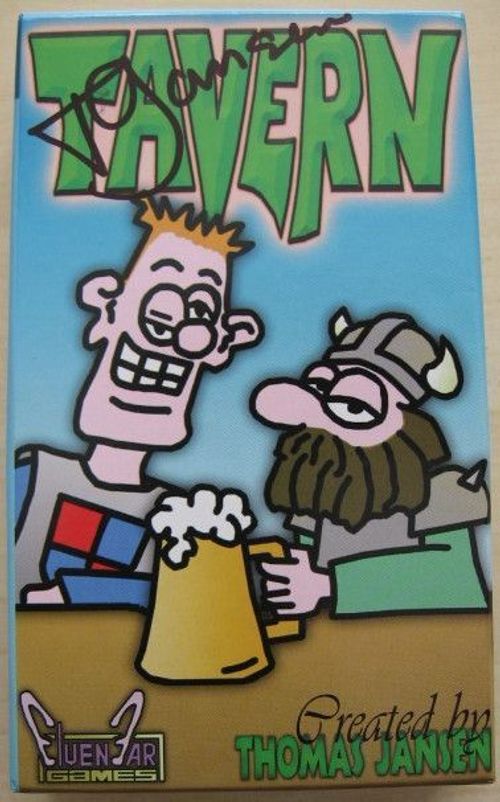
Tavern
Tavern Rulebook
Table of Contents
Table of Contents
- Goal of the Game
- Components
- Setup
- Round Structure
- 1. Bidding Phase
- 2. Turn of the Youngest Player
- 3. Turn of the Oldest Player
- The Customer Card
- What Do the Pictograms Mean?
- No Drink!?
- Drink Stack Empty
- End of the Day: Points
- The Night
- End of the Game
- Explanation of Some Customers (Cards with an Exclamation Mark)
Goal of the Game
Tavern is a game for 2 players. Each player is the owner of a tavern (pub) and tries to lure customers. They collect points by serving their guests drinks and by keeping them in their tavern for as long as possible. The winner is the player who has scored the most points after two rounds (day and night).
Components
- 28 customer cards
- 50 drink cards (beer, wine, herbal tea, firewater)
- 4 overview cards
- 10 musician cards
- 1 die
Setup
- Remove the customer cards that show a moon in the upper right corner from the game.
- Shuffle the remaining customer cards and place them, face up, in 2 stacks of 7 cards each in the middle of the table. (With the red sides facing down.)
- Lay out the bidding spaces (biedplaatsen) as shown in the setup illustration.
- Shuffle the drink cards and place them as a face-down stack. Turn 3 cards face up next to the stack.
- Each player takes 2 drink cards in hand, which only that player may look at.
- Each player takes a set of 5 musician cards, numbered 1 to 5.
- Each player receives an overview card, on which the pictograms are explained. During the game, each player forms a personal score pile (eigen puntenstapel).
Round Structure
Each round consists of three parts:
- Bidding phase (joint)
- Turn of the youngest player
- Turn of the oldest player
Each round begins jointly. Both players try to lure customers by playing two musicians face down on the bidding spaces. Then the youngest player takes his turn: he buys drinks and then serves his customers. Then the oldest player takes his turn and does the same. The next round then begins in the same way.
After 7 rounds, the customer cards on the street are used up and the day is over. The night begins: new customer cards are placed on the street. The night also has 7 rounds. After those, the game ends.
1. Bidding Phase
a. In each bidding phase, the players bid for the top customer card of each stack. The players choose 2 musicians and place them face down in front of both stacks, one for each stack. It is mandatory to place a musician for both customers.
b. All musicians are then revealed. The customer goes to the tavern of the player who played the musician with the highest value. (In the example, the dwarf on the left therefore goes to player A. Note: the elf goes to player B.)
The players place the customers they have won face up on the table in front of them. It can happen that both players bid equally high for a customer. This is dealt with later in the rules (see The Customer Card, point 1). After each round, the players get their musicians back.
2. Turn of the Youngest Player
Buying Drinks
The youngest player begins. He takes the number of drink cards in hand that is shown on the musician he played that has just lured a customer. Player A from the example above may therefore take 1 drink card. He may decide for himself whether he chooses from the face-up drink cards, takes a face-down card from the drink stack, or a combination of both. The face-up cards are replenished immediately.
If a player manages to lure 2 customers, the musician with the highest value is consulted to see how many drink cards he may take. This is also the case if he has not lured any customer at all.
Note: The higher the value of the musician, the fewer drink cards you may take.
Serving
The player now rolls the die to see which of his customers want a drink. The customer shown next to the die (the dwarf in the illustration) wants a mug of beer if a 5, 6, 7, 8, 9 or 10 is rolled. If the player rolls a 6, for example, he must give the dwarf a beer from his supply of drink cards. If the player has several customers who want a drink with this roll, he must serve them all as well.
The player takes the drink(s) from his hand and places them in front of the customer(s) concerned. He may decide the order in which the customers are served.
A player is not obliged to supply customers with drinks. Sometimes he does not have the drink that is wanted, or he does not want to give a customer anything because that customer has already drunk enough. Customers who want a drink but receive nothing are turned a quarter turn. These customers are then irritated.
After the customers have been supplied with drinks, the player may serve one additional customer. He must of course meet that customer's exact wish. If the player now has more than 4 drink cards in hand, he must discard cards of his choice until he has 4 left.
Example: This player has 5 customers in his tavern. Why is the dwarf irritated? Perhaps because the player no longer had beer in his hand. Perhaps because he found that the dwarf had drunk enough...
3. Turn of the Oldest Player
The oldest player then performs the same actions. Then the next round begins.
The Customer Card
The numbered points on the customer card explain the following:
- If the musicians of both players have an equally high value in the bidding phase, this pictogram determines to whom the customer goes.
- This pictogram shows when the customer will leave the tavern. This troll, for example, leaves if a dragon comes in.
- The top row of numbers shows the number of drinks the customer has already had. The bottom row shows the point value. After 4 drinks, this customer is worth 6 points.
- Here you see a picture of a customer with whom the troll will immediately pick a fight if it comes in. In this case that is a human.
- Here it is shown what the power of the customer is.
What Do the Pictograms Mean?
1. Equal musicians. If both players bid equally high for a customer in the bidding phase, this pictogram is consulted. Its meaning is found on the overview card. This troll, for example, goes to the tavern where the most orcs are. If both players have equally many orcs, the card is removed from the game.
2. The customer leaves. If at any moment the situation described here occurs in the tavern where this customer is, the customer leaves immediately for the score pile of this player. Its drinks are discarded. This troll, for example, runs away if there is a dragon in the tavern. The symbols of all customers are explained on the overview card. Each customer in a score pile is worth 1 point. A customer may never enter a tavern where the thing described is already present; in that case the card is removed from the game. The troll will therefore never enter a tavern where a dragon is, even though a player has bid higher with his musician.
3. Current point value of the customer. The point value stands for the cheerfulness of the customer. The higher the number, the longer the customer stays and the more points it yields in the count. If the troll in the example above has had 8 beers, it stands at a point value of -2. That is not so good. If the point value is shown in red figures, the card is turned over immediately: the customer is drunk, and its red side is now visible. The troll is looking for a fight... As long as there are no other drunk customers, nothing is on hand yet... (More about fights later.)
Example: This dwarf has had 3 beers. The player gives it one more beer...
A point value below 4 gives a red number. The customer is drunk and is turned over.
Because elves and dragons do not drink alcohol, they cannot become drunk either. The back of these cards is therefore not red.
4. The customer always starts a fight with... On some customer cards, in the bottom right corner, there is a picture of a different type of customer. If that customer enters the tavern, or enters a tavern where this customer is present, they immediately start a fight with each other. (More about fights later.)
5. Strength and fights. If two or more customers are drunk, a fight arises immediately. A fight always takes place between 2 persons. If more customers are drunk, the player himself decides which 2 customers fight each other first. The die is thrown for each of the two customers. The result is added to its strength, shown in the squares at the top left of the card. The customer with the lowest result loses and is placed on the score pile of the player. Its drink cards are discarded. In case of a tie, the dice are thrown again. If there are still fights, they are fought out as well.
Example: At a certain moment, a player has 3 drunk customers in his tavern (the 2 humans and the goblin). A fight arises. He decides to let the 2 humans fight each other first. He throws a 3 and a 5. That gives strengths of 6 and 8 respectively. The first human leaves the tavern. Its drinks are discarded. The customer may go onto the player's score pile. He now lets the remaining human fight the goblin. He throws an 8 for the goblin and a 7 for the human (strengths of 9 and 10). The human wins. The goblin also goes onto the score pile. The fight is over.
Note: Unfortunately the elf has the property that it leaves the tavern when a fight takes place (see overview card). It also goes onto the player's score pile, and its drinks are discarded. Perhaps it was not such a good decision to give everyone a drink...?
No Drink!?
Customers who want a drink but receive nothing, either because there is none or because the player does not want to give them one, are turned a quarter turn. The customer is irritated. This customer cannot be turned back. If it again receives no drink on a later occasion, it walks out without paying! The customer card is discarded. The player receives no points for it.
Drink Stack Empty
When the drink stack is used up, the discarded drink cards are reshuffled and a new stack is made.
End of the Day: Points
As soon as the 2 customer stacks on the street are empty, the round is completed, and then the day is over. The players count how many points their own customers deliver. The elf next to it, for example, delivers 4 points, because in the scale for point value printed on the customer card, the value under the 3 is a 4. Each player therefore adds up the point value of his customers. The points are recorded.
The Night
The players keep their drinks and their score pile. The guests also stay in the taverns. At night, strange figures visit the taverns: the customers with a moon are shuffled and placed in 2 stacks of 7 cards, open, in the middle of the table. A new round begins. This time, the oldest player is the starting player each round.
End of the Game
When the night is over, the points of the guests present are counted again. Now the score pile is also added to the score: each customer on it is worth 1 point. The points of the day and the night are added together. The player with the most points wins the game.
Explanation of Some Customers (Cards with an Exclamation Mark)
Goblins. Instead of ordering beer or wine, the goblin orders a drink. If the corresponding number of pips is rolled, the player must take the needed drink from another guest in his tavern and place it in front of the goblin. A goblin decides for itself when it wants a drink. A player may therefore not serve it an extra drink. Note: It is a bit strange, but it can happen that a goblin, by stealing a drink, makes another customer sober again!
Trolls. Trolls like to drink. Each time they take beer, they drink, but they prefer 2 mugs at the same time! If a player wants to serve an extra troll, he must also give it 2 beers. It can happen that a troll has drunk 3 beers, for example, because a goblin has stolen one from it. Its point value is then equal to having drunk 2 beers. See the troll card.
Dragon. The dragon is a special guest in the tavern. It does not drink, but it does eat: goblins and dwarves! If the die calls for it, the player MUST place a goblin or dwarf from his tavern in front of the dragon, as if it were a drink. Any drink cards are discarded. The dwarf or goblin loses its point value. The dragon also decides for itself when it wants to eat, and so it may not be served extra. The dragon fights with every drunk customer, except goblins and dwarves. For goblins, trolls and the dragon, the same rules otherwise apply as for the other customers.