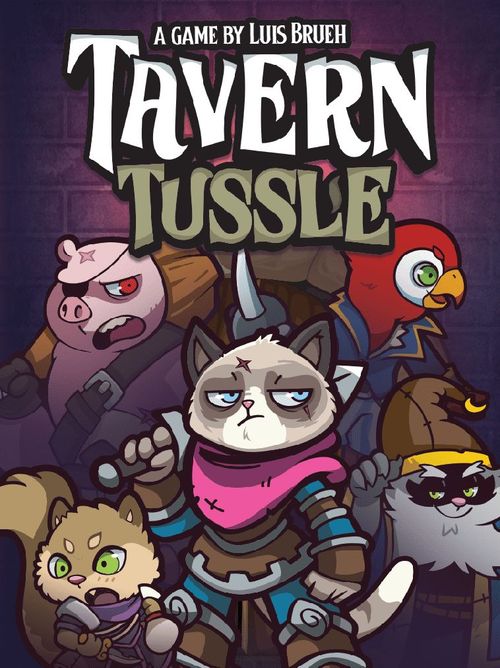
Tavern Tussle
Tavern Tussle Rulebook
Table of Contents
Table of Contents
Components
4x Taverner Cards: Labelled on the sheet as Story Points and Taverner Special.
54x Hero Cards: Labelled on the sheet as Hero Initiative, Story Theme, Player Count, and Hero Ability.
Game Objective
In Tavern Tussle you are a Taverner listening to traveling Heroes and trying to collect unique stories to score points. The player with the most points at the end of the game wins.
Game Setup
Shuffle the Taverner cards and give one to each player, return the rest to the box. Players place their card face up in front of them. Gather all the Hero cards that match the number of players and create the Hero deck. Return the rest of the cards to the box. Shuffle the Hero deck and place it face down near the players. The game is played in a series of 3 rounds. At the end of the 3rd round, you check the Scoring to see who won the game.
Round Setup
At the beginning of a new round, deal 6 cards to each player. If the Hero deck runs out, reshuffle its discard pile. Then proceed to execute 3 Story Phases.
Story Phase
Each player, at the same time, selects 2 Hero cards from their hand. They place one face-down in their play area as their active Hero and discard the other to a common discard pile near the Hero deck. Finally, they give the remaining cards from their hand to the player on their left.
Then all players, at the same time, reveal the active Hero in their play area. Once all Heroes are revealed, resolve the active Hero with the highest initiative and then proceed in descending initiative order activating the active Hero cards and resolving their abilities (if any). If Initiative is tied, the player with the most Luck showing on their Hero cards goes first. Then the player with the least amount of cards in their tableau. If it's still a tie, the youngest player goes first.
After all the abilities of active Hero cards have been resolved, move them to their owner's tableau. If players still have Hero cards in their hand, execute a new Story Phase. Repeat until players have no cards in their hands, then, if this is not the 3rd round, start a new round.
Hero Abilities
- Attack: Flip another player's active Hero card to the Coin side.
- Counter: Flip another player's active Battle Hero card to the Coin side.
- Steal: Take a Coin card from one enemy (active or in their tableau) and put it in your tableau.
- Heal: Unflip a Coin card in your tableau to its Hero side.
- Boost: If this card is face-up in your tableau, add 2 to the Initiative of all future Hero cards you activate.
- Cheers: Drink your Taverner Special and perform their special ability.
Taverner Special
- Attack an active Hero card of another player and then Heal a Hero in your tableau.
- Copy the ability of one of the Hero cards in your tableau.
- Steal 1 Coin from each other player.
- If this card is face-up in your tableau, add 3 to the Initiative of all future Hero cards you activate.
Golden Rules:
- If you are able to use a Hero ability, you MUST use it.
- Unless otherwise stated, all abilities on a card target the same player.
- Heroes in your tableau cannot be attacked, but Coins can be stolen.
- Only active Heroes will perform abilities, but some Heroes may provide Boosts to future turns.
Scoring
After the 3rd Round players score points based on the Stories they collect in their tableau. A player may have multiple collections, but Themes cannot be repeated in the same Story. The Stories score as follows: 1 point for 1 Theme, 3 points for 2 Themes, 6 points for 3 Themes, 10 points for 4 Themes, and 15 points for all 5 Themes. The player with the most points wins.
In the event of a tie, the player with the most Luck wins. If there is still a tie, the player with the least amount of cards in their tableau wins. If it is still a tie, the youngest player wins.
Story Themes: Luck, Battle, Journey, Elixir, Coin.
Keep in mind that having flipped cards in your tableau is the only way to score Coins.
3-4 Player Advanced Variant
When a player has a card flipped or stolen by another player, also flip their Taverner card face-down. Players with face-down Taverners are considered off-limits and their Hero and Coin cards cannot be targeted by other players. However, they can still use their Hero abilities and Taverner Specials.
Unflipping Taverners: If it's your time to perform a Hero ability and all other Taverners are face-down unflip all Taverners and only then activate your Hero ability targeting any other players (as now they are not face-down anymore).
Examples
Story Phase Example
After drafting Heroes (playing one face-down to activate and discarding one, and then passing cards clockwise) all players reveal their Active cards at the same time.
- Highest initiative goes first, so the Bear activates their Mercenary cat to Counter the Barbarian boar, flipping their Hero card to its Coin side. 2) Next, the Alligator activates their Archer to flip the Mercenary cat to its Coin side. 3) Then, the Toucan's Barbarian boar was already flipped to its Coin side, so they have no ability to activate.
Lastly, all players place their cards in their tableau and start a new story phase.
Now all players reveal their active cards.
Advanced Variant Example
In this 3 players example, the Alligator player starts their first Round with the cards below from which they select one Mage to discard and the Swashbuckler to activate in their play area (placing it face-down in front of their Taverner).
Then, the Bear player selects one King to discard and the Archer to activate (placing it face-down in front of their Taverner).
Lastly, the Toucan player selects one Mercenary to discard and the Barbarian to activate (placing it facedown in front of their Taverner).
The Archer goes first as they have "Initiative 7". The Bear player decides to Attack the Swashbuckler and flips it facedown to its Coin side.
The Alligator player also flips their Taverner, as they cannot be targetted until their Taverner is unflipped.
As the Swashbuckler was flipped they will not act this turn so the next Hero to activate is the Barbarian with their "Initiative 1" and their only possible target is the Archer.
So the Barbarian flips the Archer to its Coin side and then Steal it to their tableau. The Bear flips their Taverner card as a result of this action.
After this phase, all players take the cards in their Play Area and place them by the side of their Taverner in their tableau.
The Alligator had their Swashbuckler flipped but it still remains as a Coin in their tableau. As their Taverner is flipped they can't be attacked.
The Bear had their Archer flipped and then stolen having nothing in their tableau. As their Taverner is flipped they can't be attacked.
The Toucan has both their Barbarian and the Coin they stole in their tableau.
Player now pass their remaining 4 cards clockwise and start a new Turn selecting one card to activate and another to discard.
A round ends when all players have no cards in their hands.
Player Area Example
The sheet shows a diagram labelled "Play Area", "Tableau" and "Taverner" with a 3-4 player advanced variant example; the diagram carries no further text.
Scoring Example
In this example, the player will score 15 points for their first story, 6 for the 2nd and 1 for the third for a total of 22 Victory points.