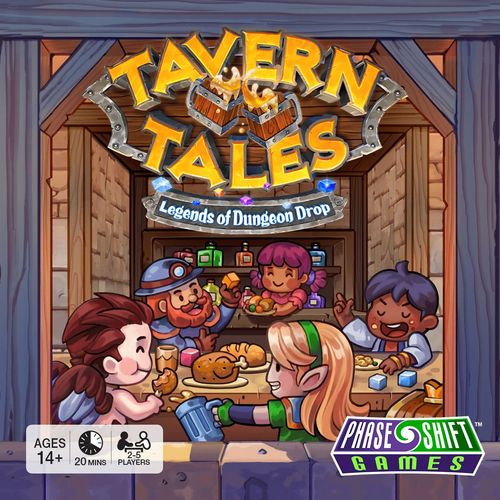
Tavern Tales: Legends of Dungeon Drop
Tavern Tales: Legends of Dungeon Drop Rulebook
Table of Contents
Table of Contents
Overview & Components
Tavern Tales is a raucous game of set collection and subtle bluffing for 2 to 5 players, featuring the heroes, monsters, and treasure you know and love from Dungeon Drop. Assuming the role of a proud hero who recently emerged from the dungeon, players will take turns staking outrageous claims and disputing their companions. Heroes must scheme their way to getting in the final word, earning prestige points. The first hero to achieve 30 prestige becomes the most renowned hero of epic legends!
- 71 Feat cards
- 5 Depth tiles
- 11 Room tiles and 1 Bonus Prestige token
- 51 Hero cards
- 5 Prestige Tracker tiles
- 5 Prestige tokens and Active Player token
Card & Tile Anatomy
Hero cards: Depth indicators; Max. Feats for a new Claim; Hero type; Special ability text area (advanced cards).
Feat cards: Quantity in deck; Scoring track; Feat type: Treasure, Monster Kill, Quest, Special.
Depth tiles: Depth indicator; Feat quantity and layout indicators: face up / face down.
Room tiles: Special rules; Feat quantity and layout indicators.
Setup
These steps outline how to set up your first game for 3 to 5 players. Refer to the back section of this rulebook for advanced modules to include after your first game, as well as modified 2 player rules.
- Place the 5 Depth tiles in the center of the table, with the solid side face-up, in the order shown on the next page (Mineshaft, Ice Caves, Caverns, Catacombs, Inferno). You will not use the circular Room tiles for your first game, so you can leave them in the box.
- Shuffle the Feat cards, forming a draw deck. Draw and place 3 Feat cards face-up below each Depth tile.
- Find the 6 Elite Heroes and place them in the box - you will not use them for your first game. Shuffle the remaining Hero cards, forming a draw deck. Deal 6 to each player, forming their hand. Each player chooses and discards 2 cards from their hand, face-down. After each player has discarded, shuffle the discarded cards back into the draw deck.
- Each player takes a Prestige Tracker tile and matching Prestige token. For the first game of the evening, place the Prestige Tracker tile so that the side with the special ability is face-down. Place the Prestige token to the side of the Prestige Tracker tile.
- The player who most recently told a lie goes first (or decide randomly). That player takes the Active Player token.
You're ready to play your first game!
Game Setup Diagram
The Feat deck and Hero deck sit above the five Depth tiles, each with 3 Feat cards face-up below it. Each player has a Prestige Tracker tile, Prestige token and a hand of 4 Hero cards. The Darkmander Elite Hero and the Room tiles are removed (returned to the box).
Gameplay
Players take turns in clockwise order around the table, starting with the player with the Active Player token. When it is your turn, you must decide to either Think'n'Drink or Stake a Claim.
Think'n'Drink
You will need coherent stories to Stake a Claim, so it's time to take a sip and collect your thoughts, as follows:
- Draw 3 cards from the Hero deck into your hand. If the Hero deck is empty, reshuffle the discard pile to form a new draw deck.
- Discard 1 card from your hand face-up to the discard pile (to the right of the draw deck). This does not need to be one of the 3 cards you just drew, but you must discard 1 card.
- Discard additional cards from your hand face-up if you are over your hand size limit. Your hand size limit is 4 if you have 15 Prestige points or lower, or 3 if you have 16 Prestige or higher.
You may not choose to Think'n'Drink if you started your turn at your hand size limit.
HINT: Hand management and card conservation are important aspects of this game. You must be strategic in deciding when to play cards from your hand, as the more you need to Think'n'Drink, the fewer opportunities you will have to Stake a Claim.
Stake a Claim
It's time to spin your story and earn some Prestige! Proceed as follows:
- Place 1 Hero card from your hand face-up in front of you. This represents a Hero you are claiming to have adventured with in the dungeon.
- Choose a Depth that matches one of the Depth indicators on your Hero card, and then identify the Feat cards you wish to Claim at that Depth. These Feats represent the heroic deeds you are claiming to have performed with the Hero at that location. Adventurer Heroes may only Claim 1 Feat, but they have 2 different Depths to choose from. Specialists, on the other hand, may Claim up to 2 Feats, but they do not have a choice of Depth.
(Example: a Dwarf Specialist matches the Mineshaft Depth; the player selects Feats there to start the Claim.)
Now it's time for your companions to attempt to one-up your Claim...
One-upmanship
Starting with the player to your left and proceeding clockwise, each player now chooses to either pass, indicating they do not (yet) wish to dispute the Claim, or "one-up."
To one-up, a player must play a Hero card that matches the chosen Depth from their hand face-up in front of them - it does not matter what kind of Hero is played, so long as it matches the chosen Depth. This represents the player claiming it was them, with the newly played Hero, going after the Feat(s). That player's story is now the freshest, nullifying your original story. Flip the Hero card you originally played face-down, so only the most recent Hero card played is face-up on the table.
(Illustration: the original Hero is "No longer winning the Claim..."; the newly played Boblin is "Currently winning the Claim!")
Another player is currently winning the Claim, but you and all other players still have a chance to chime in! Continue around the table clockwise, with each player choosing to either pass or one-up. IMPORTANT: Even if you passed at one point during the Claim, you may still one-up later on, if play passes back to you! This continues until all players pass consecutively, leaving just the player with the most recently played Hero card as the winner of the Claim!
Once the Claim winner has been determined, place all Hero cards played during the Claim face-up in the discard pile.
Claim Scoring
It's time to turn that story into a legend! When you win a Claim, regardless of whether or not you were the player who started the Claim, you collect the contested Feats and place them in front of you, organized into sets of identical Feats.
Gain Prestige points for the Feats you just collected. The scoring track at the top of each Feat card indicates how many Prestige points the Feat is worth upon collection, based on how many identical Feats you already had in front of you. If this is the first Feat of its kind you collected, you receive the left-most number of Prestige points and move your Prestige token up that many spaces on the Tracker tile. If it's the second, you receive the next indicated number of Prestige points, and so on.
(Example, Gold, scoring track 1, 1, 6, 6, 6, 6, 6: Receive 1 point for your 1st or 2nd Gold, and 6 points for each additional Gold.)
Monster Kill Feats each grant a set number of Prestige points, regardless of how many you previously collected. The next page contains additional rules for some special Claim scoring situations.
After scoring, replenish the Depth with new Feat cards drawn from the deck (if there are none left, do nothing). Pass the Active Player token to the next player on the left, and then proceed with their turn.
Victory
Play proceeds until one player has 30 (or more) Prestige points at the end of ANY player's turn, winning the game!
Special Claim Scoring Rules
Some Feats have special rules when they are collected, as follows:
- Dragon Egg and Mimic: These Feat cards can cause negative Prestige points at certain quantities. NOTE: Positive Prestige points from a Claim are always applied before negative points, and a player's Prestige may never go below 0.
- Boss Armor: Choose to either gain 2 Prestige points OR gain 2 Prestige points for each uniquely named Monster Kill Feat card you collected, including any that are being collected as part of the current Claim.
- Crystal Golem: Choose to either gain 2 Prestige points OR place the Crystal Golem card on a stack of Gem Feat cards, including one that would be formed as part of the current Claim, treating the Crystal Golem as though it is another one of those Gems (and gain the appropriate amount of Prestige points).
- Gelatinous Cube: Choose to either gain 2 Prestige points OR draw and collect a new Feat card from the deck (and keep the Gelatinous Cube Feat as well).
- Adventurer Powers: The 3 Special Feat cards grant 1 Prestige point and an "Adventurer Power" to be used later. Collect the Feat and gain the Prestige point as normal. Then, when you start a future Claim with an Adventurer, you may use 1 or more Adventurer Powers by resolving the special ability text written on the Feat cards and then shuffling them back into the deck. NOTE: The first and last Depths are not considered "adjacent" to each other.
Advanced Modules
STOP! You should play the base game at least once before proceeding.
...The evening is just getting started! Now that you've played your first game, let's add in all the goodies!
Elite Heroes
At the start of each game, shuffle and add 3 random Elite Heroes to the deck, and return the others to the game box. Elite Heroes cannot be used to start a Claim, but they can be used to one-up any Claim, and they have an additional special ability when played. Refer to the special ability text on each card for its unique effect.
In the rare event you have a full hand of Elite Heroes when you are required to start a Claim, you must discard your entire hand and draw a new one. Then proceed to Stake a Claim as normal.
Rooms
At the start of each game, shuffle the stack of Room tiles. Choose 3 Depths to receive Room tiles (decide as a group or choose randomly), flipping them so the slotted side is face-up. Draw a random Room tile for each one and slot them into the Depth tiles.
When drawing Feat cards for each Depth, draw and place the specified number of Feat cards below or above each Depth tile, face-up or face-down, as indicated by the icons on the Depth/Room tile. NOTE: Face-down Feat cards may not be inspected until they are collected, unless otherwise noted. Face-down Feats are always flipped face-up immediately when they are collected.
Slot in 3 Room tiles. A Bonus Prestige reminder token (Arcane Antechamber only) is placed on Feats when a new Claim is started.
Most Room tiles have additional special rules. These rules ONLY apply when a Claim is started at that location. They are ignored at all other times. EXAMPLE: When using the Secret Door's Adventurer Power to add a Treasure Feat from an adjacent Room, that Room's special rules do not affect the player's selection of the Treasure Feat. Refer to the special rules text on each tile for its unique effect.
Specialty Drinks
After the first game of the evening, the Prestige Tracker tiles are flipped to show their unique Specialty Drink effects. The winner of each game chooses which Specialty Drink they would like to use for the next game, and then each other player chooses their Specialty Drink in clockwise order.
A few clarifications:
- Magician's Mead: There can be a case where a player with Magician's Mead reaches 16+ Prestige points while still having 4 cards in their hand. If this happens, the player must immediately discard down to their new hand size limit of 3 cards. (Card text: "Your hand limit is 5 while your score is 15 or lower.")
- Dragonsvein: After randomly drawing the 3 Elite Heroes for the game, the player with Dragonsvein draws 2 of them into her hand and selects 1 to keep. The 3rd Elite Hero and the one the player chose not to keep are shuffled into the deck. NOTE: The selected Elite card counts toward the player's starting hand size, as normal. (Card text: "Draw 2 Elite Heroes and choose 1 to add to your hand.")
- Negative Prestige points: If a player with 16+ Prestige points drops back to 15 Prestige or lower, their Specialty Drink power comes back into effect (assuming it's one of the powers that's based on the player's current Prestige score).
2 Player Rules Modifications
Game setup changes: Players draw 5 initial cards and then discard 1 face-down. When playing with the Specialty Drinks module, only use Boblin's Bubbly and Slime'n'Lime.
Turn order changes: On your turn, you must always start a new Claim. After you start the Claim, the game flow works slightly different from the 3-5 player rules, as follows:
- Pass or one-up: Your opponent may either pass or one-up. If they choose to pass, you win the Claim immediately (proceed to End of Turn). If they choose to one-up, they play a Hero card from their hand FACE-DOWN in front of them - this Hero may or may not match the Depth (it might be a devious lie)!
- One-up or flip the table: From this point forward, both players proceed to either one-up, playing a Hero card from their hand face-down, or "flip the table." Once a player decides to flip the table, they flip the most recent card played by their opponent face-up. If the card matches the Depth, the card's owner wins the Claim. Otherwise, the table-flipper wins the Claim.
- Last call: If both players end up playing their entire hand of cards with no one flipping the table, the very last Hero card to be played must be played face-up and will decide the ultimate winner of the Claim (based on whether it matches the Depth or not).
End of Turn: The winner of the Claim collects the Feats and gains Prestige as normal.
Discard all Hero cards played during the Claim, and then each player draws up to a full hand of cards, based on their current Prestige total:
- 15 Prestige or lower: Draw up to 5 cards, and then discard 1 card face-down.
- 16 Prestige or higher: Draw up to 4 cards, and do not discard any.
The player who did NOT win the Claim becomes the active player and starts a new Claim for the next turn.
Elite Heroes: Elite Heroes have no special effects in 2 player games, other than the ability to be played into any Claim. Ignore all special ability text on Elite Hero cards.
Victory: Just like 3-5 player games, 2 player games end as soon as one player has 30 (or more) Prestige points at the end of either player's turn.
Epic Duel: For an optional longer 2 player game experience, play until one player reaches 45 Prestige points. When you reach 30 Prestige points, simply place one of the unused Prestige tokens on the 30 space on your Tracker tile, and then move your actual Prestige token back to the top of the Tracker tile to track your score past 30 Prestige points. NOTE: You do not re-gain an increased hand size when moving from 30 to 31 Prestige points.