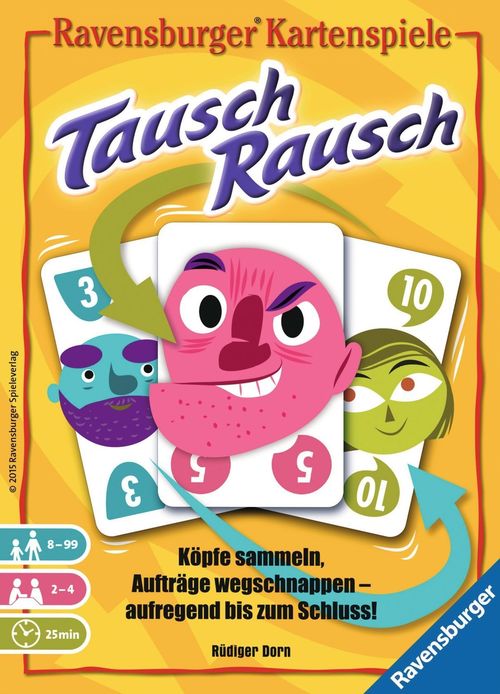
Tausch Rausch
Tausch Rausch Rulebook
Table of Contents
Table of Contents
Components
80 number cards (2 each of the values 1 to 10 in the colors Blue, Yellow, Green and Red)
5 Market cards (1x 1, 3x 2, and 1x 3)
24 Task cards
11 Overview cards
Game Overview and Goal
"Click here for as at the bazaar, it is changed, there's no tomorrow. Switch back and forth the cards that it is a real pleasure. But beware: Just addicted to the exchange-night noise and lose the game idea into reality: who fulfilled his fifth first task is the winner."
(Literal Google Translation, as printed in the source.)
Setup
Place the 5 market cards face-up in the middle of the table in ascending order.
Shuffle the 24 task cards (blue back side) then put them of them face up to the right of the market cards. Take the rest of the task cards and put them into a draw deck.
Shuffle the 80 number cards (multi-colored back side) then deal as many face up cards, slightly fanned so their values are visible, above the market cards as indicated on the market card. Take the rest of the number cards and put them into a draw deck.
Each player is dealt 5 number cards.
Place the overview cards within reach of all players.
The youngest player goes first.
Gameplay
Play rotates clockwise until one player completes 5 tasks, at which point they immediately win the game.
On your turn you have a choice between two actions: A: replace 1-3 cards or B: fulfill a task.
Action A: Replace 1-3 Cards
You choose 1-3 cards from your hand and put them on the empty side of a market card. The number of cards to play corresponds to the number on the market card. Play them slightly fanned so their values are visible. Then take cards from the other side of the market card.
Regardless of whether you've replaced 1, 2, or 3 cards, you draw exactly one more card from the draw pile. In other words, every time you perform the "trade cards" action, you get one card more.
Example: Nils chooses two cards from his hand and places them next to one of the three 2-card market cards. He then takes into his hand the two cards on the opposite side of the market card and draws one additional card from the draw deck.
Action B: Fulfill a Task
Instead of exchanging cards, you can also fulfill one of the 5 face-up task cards. In this case, you reveal the required number of cards to the other players. Then place them into the discard pile. Finally, you take the appropriate task card from the display and place it face down in front of you. Draw the top card from the task card deck and play it face-up so that there are 5 face-up task cards available.
Bonus: In addition, draw as many number cards as indicated on the task card you just completed.
Once the number deck is exhausted, shuffle the discard pile and make a new draw deck.
Game End
Once you have completed your 5th task card, you immediately win the game.
Task Cards
Collect 5 cards with even values (example: 2, 8, 4, 4, 6). The color of the cards does not matter.
Collect 5 cards with odd values (example: 1, 3, 9, 9, 7). The color of the cards does not matter.
Collect 5 cards of the same color (example: yellow cards). The value of the cards does not matter.
Collect 2 cards in the given color whose sum is exactly 9.
Collect 4 cards in the given color whose sum is equal to or greater then 23.
Collect 4 cards whose sum is less than or equal to 7. The color of the cards does not matter.
Collect 4 cards whose sum is greater than or equal to 37. The color of the cards does not matter.
Collect 5 cards with consecutive values (example: 3, 4, 5, 6, 7). The color of the cards does not matter.
Collect 4 cards with consecutive values in the color of your choice (example: red 7, 8, 9, 10).
Collect a Full House with 3 identical numbers and 2 identical numbers. The color of the cards does not matter.
Note: 5 cards of the same number is not allowed.
Collect Four of a Kind. The color of the cards does not matter.
Collect Three of a Kind. The color of the cards does not matter.
Collect 2 identical cards. That is, both the number and the color must be the same (example: 2 blue 4's).
Collect 2 pairs. The values of the pairs must be adjacent (example: 5, 5, 6, 6). The color of the cards does not matter.
Collect 3 pairs. The values of the pairs must be adjacent (example: 2, 2, 3, 3, 4, 4). The color of the cards does not matter.
Note: 10 and 1 are not adjacent.
Bonus: Draw cards from the deck as shown (1 or 2).
Transcriber's note: the source lists 15 task descriptions (and one bonus line), while the components list 24 task cards. The source does not enumerate the remaining task cards, so none are added here; the source's own text is reproduced in full.