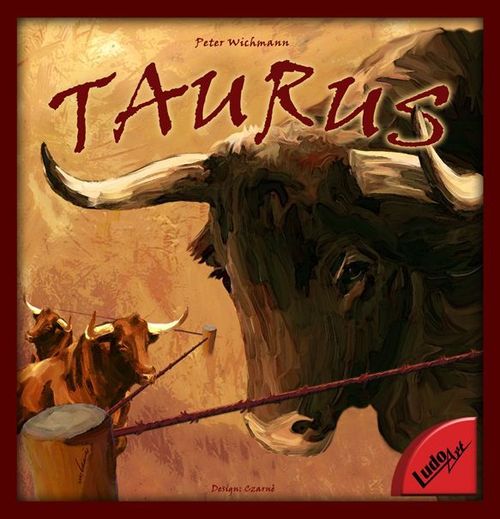
Taurus
Taurus Rulebook
Table of Contents
Table of Contents
Material
1 gameboard; 48 fence posts; 100 wires (20 of 5 different color); 48 bulls (12 black, 12 red, 12 brown and 12 grey); 4 bull heads (to store wires) and 1 rulebook.
Setup
-
The boardgame is placed in the center of the table.
-
Placing bulls:
- With 4 players, place one bull in each of the 48 fields of the board.
- With 3 players, 12 bulls (3 of each color) are not used. The 6 fields on the right edge and 6 on the bottom edge are left empty.
- With 2 players, 16 bulls (4 of each color) are not used. The 16 fields (each marked with one bull's head) are left empty.
Note: When placing bulls, be sure to place them away from each border, so that the board holes remain visible. Also be sure they are placed in such a way that colors are mixed well.
-
The fence posts and grey wires form a common pool next to the gameboard.
-
Each player receives all the wires in one color, sorts them by their length and places them on the bull's head storage area.
Gameplay
Choose the first player. The game is then played in a clockwise order.
Initial Turn
As his first action of the game, each player (in turn order) should take 2 posts from the pool and place them in two holes on the game board which are adjacent. He then uses the smallest available wire from his stock to attach it on the two posts, creating a fence. A wire can be attached to two posts located in the same field (red fence) or in two neighbouring fields (blue fence).
Subsequent Turns
After each player has created his initial fence, continuing clockwise, on all remaining turns, a player must always attach a wire (Fence building) and may place one (and only one) post beforehand.
Fence Building (General)
A wire can be only attached to two posts located in the same field or in two neighbouring fields. These posts are called neighbouring posts. Example: Red has attached two neighbouring posts, located in the same field (brown with a bull sign). Blue has attached two neighbouring posts, located in two neighbouring fields (black and brown). Green cannot attach the two posts located in the black fields as they are not adjacent.
During his turn a player may execute one action out of these 4 possibilities:
- Extending a fence while placing a new post: The player takes a post from the common pool and places it in an empty hole. In order to do this, another post must have already been placed either in the same field or in an adjacent field. Then, the player must attach this new post to any neighbouring post with one of his wires. Example: Red places a new post, which has three neighbouring posts. Red can either extend his red fence (A or B), or the blue fence (C). He chooses the second option (C), and uses one of his red wires.
- Extending a fence without placing a new post: The player attaches one wire from his stock to two neighbouring posts not already attached. Example: Green does not place any new post but attaches two neighbouring posts already placed on the board (A and B).
- Closing a fence while placing a new post: The player places a new post so that it has two neighbouring posts. He then attaches the two posts the following way: He uses a wire from his stock to attach the new post to the left post, and he uses a grey wire from the common pool to attach the new post to the right post. All animals which are now surrounded by a fence are captured (see Allocation below). Important: a fence can only be closed if it surrounds at least three bulls. Two closed areas can be created after placing a single wire. The player who closed the 2 fences chooses the one on which he wants to make the allocation of bulls first (this can be important if some bulls could be considered part of both fences). Example: The blue player places post A and, using a blue wire, attaches it to post B. He then attaches post A to post C using a neutral grey wire. The closed area contains 3 bulls. Instead of attaching A to B, blue could also have attached A to D, creating a closed area with 4 bulls. Note that on a future turn, A and B cannot be attached, as it would create a closed area with only one bull.
- Closing a fence without placing a new post: The player takes a neutral grey color wire and attaches 2 neighbouring posts, in such a way that a closed area is created (as described above). The captured bulls are then allocated.
Allocation
As soon as an area is closed, each surrounded bull is allocated to his new owner, in a clockwise order, starting from the wire following the grey wire. The player whose wire this is chooses a bull and places it in front of him. Then the player owning the next wire chooses a bull, and so on. If there are bulls remaining after a first turn, continue until an owner has been defined for each bull. Example: clockwise allocation starting from grey wire. Blue (1) first chooses a bull, then comes Green's (2) turn to select one. Finally Blue (3) takes the last bull. Red cannot take a bull as the closed area is now empty. He doesn't get anything from the allocation.
End of the Game and Scoring
Game ends as soon as all bulls have owners or if it is no longer possible to close any area with at least three bulls. Each player sorts his bulls by color. In each color, first bull grants 1 point, 2nd bull 2 points, 3rd bull 3 points, 4th 4 points, etc. (For 4 bulls of the same color, a player scores 1+2+3+4=10 points). The number of points scored in each case is summarized in the following table:
| # of bulls of the same color | 1 | 2 | 3 | 4 | 5 | 6 | 7 | 8 | 9 | 10 | 11 | 12 |
|---|---|---|---|---|---|---|---|---|---|---|---|---|
| Points | 1 | 3 | 6 | 10 | 15 | 21 | 28 | 36 | 45 | 55 | 66 | 78 |
The winner is the player with the highest score. In case of a tie, the winner is the player with the greater number of bulls in one color.
FAQ
- When building a fence, can I have my wire crossing another wire? Yes, but doing so, you won't be able to close any area with that fence.
- Can I attach two posts that are already attached? No, 2 posts can only be attached once to each other. A new attachment can only be made with another post.
- Can I have my wire going over a bull? Yes. A bull is on the side of a fence where its horns are. If when a player is attaching a wire, it passes between the horns of a bull, the player can move slightly the bull (as little as possible) so that both horns are on the same side (side at the player's choice).
- Which wire should I use depending on distance between posts to attach? Always use the appropriate length, so that the wire is not stretched too much or not tight enough. This means that it may become impossible for a player to connect posts when he doesn't have any more of the corresponding fences in his stock (because he has already played all of them).