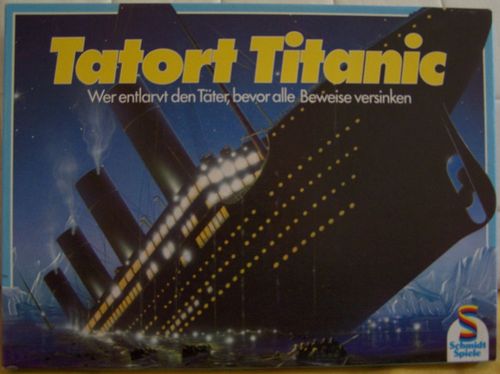
Tatort Titanic
Tatort Titanic Rulebook
Table of Contents
Table of Contents
Contents
A detective game for 3 to 6 players, ages 10 and up.
The box contains:
- 1 game board (Spielplan)
- 1 rulebook (Regelheft)
- 7 time cards (Tatzeitkarten)
- 7 scene cards (Tatortkarten)
- 7 weapon cards (Tatwaffenkarten)
- 7 motive cards (Tatmotivkarten)
- 7 suspect cards ("Verdächtige")
- 20 event cards (Ereigniskarten)
- 6 detective pawns (Spielfiguren, Detektive)
- 1 miniature ship "Titanic" (Miniaturschiff)
- 1 pad of investigation sheets (Block mit Ermittlungsbogen)
- 6 dice (Würfel)
Characters and Setup Background
Captain Smith did not announce the crime, to avoid a scandal, and secretly looked among the passengers for people with criminal investigation experience, because he himself was getting nowhere on the spot. A considerable sum of money was also involved: by radio, the captain had learned that the insurance company with which Muriel Wade had insured her most precious possession, her life, had offered a substantial reward for the conviction of the culprit. By 8:00 a.m. the suitable detectives had been found and briefed on the situation. They were:
- Bernhard Nicholls (67), Scotland Yard inspector in retirement
- Maurice Leroux (39), French police officer on holiday
- Katherine Robinson (47), author of crime novels
- David Cutler (32), agent of the Pinkerton detective agency
- Adrian O'Conner (41), sergeant of the British police, assigned as bodyguard to a high-ranking personality
- William Toby (50), ship's detective of the Titanic
You, as a player, choose one of these detectives and try to solve the murder of the wealthy Canadian woman. The investigation team around Captain Smith has already done some preliminary work and has narrowed the number of suspects, weapons, motives and scenes to six each. It is up to you to determine the actual circumstances of the crime. Time is short: in 50 hours the Titanic will collide with the iceberg, and if the murder is not solved by then, it will never be solved. (Printed figure, as in the original; the round tracker described under The Game Board spans 12 April, 10:00 to 14 April, 22:00.)
Objective
Your task as a detective is to find out the murderer, the murder weapon, the scene of the crime, the time of the crime and the motive as quickly as possible. This can only be done by collecting clues and crossing them off on your investigation sheet (Ermittlungsbogen).
The Game Board
The game board shows a small part of the rooms and decks of the giant ship Titanic. Here the detectives search for clues that lead them to the trail of the murderer and the circumstances of the crime.
On the three decks (A, B, C), which are connected by two staircases, there are several rooms each that may have played a role in the crime. Each room is reachable through a doorway and forms one space. In addition there are deck spaces (10 per deck) and staircase spaces (2 per staircase).
Around the decks runs the round tracker (Spielrundenanzeiger), which covers the period from 12 April, 10:00 to 14 April, 22:00. Each game round, the ship is moved one space along it.
Setup
Laying Out the Cards
One of the players is responsible for preparing the game board. He shuffles the event cards and places the stack on the event card space (Feld für Ereigniskarten). He then sorts the five blank cards out of the clue cards (Hinweiskarten) and shuffles each colour stack separately. Next he takes one card from each stack and places these five cards face down in a safe place. They represent the murderer, murder weapon, motive, scene of the crime and time of the crime. He then returns the five blank cards to the stack of the corresponding colour and shuffles each stack again.
The 30 clue cards are then laid out face down as follows:
- 5 cards (one of each colour) on the Radio Room space (Feld Funkraum)
- 5 cards (one of each colour) on the Clairvoyant space (Feld Hellseherin)
- 2 cards each in the rooms Library (Bibliothek), Restaurant, Swimming Pool (Schwimmbad), Smoking Room (Rauchsalon), Bar and Gymnasium (Gymnastikraum)
- 1 card per cabin (including the Changing Cabin / Umkleidekabine)
The Detectives
Each player receives a pawn and an investigation sheet (Ermittlungsbogen), on which he writes the name of his detective. If several players want the same detective, the dice decide.
When all players have a detective, the detectives are given "special abilities" (besondere Eigenschaften). These special abilities are simply rolled for and then also entered on the sheet. It can easily happen that two or more detectives have the same special abilities. This is permitted at any time.
Special Abilities
Roll one die for the special ability of each detective:
- Eavesdropper (Lauscher): recognises a card that another detective is currently taking. In the same room on a roll of 1–4; in an adjoining room on a roll of 1–3.
- Nimble-footed (Flinkfuß): may add 1 to each die result in the movement phase.
- Authority (Autorität): when questioning another detective, +1 on every die result.
- Charm (Charme): 2 attempts per game round at the Clairvoyant.
- Clever (Clever): when questioned, gives up a card of his own choice instead of having one drawn.
- Technically gifted (Technisch begabt): in the Radio Room always rolls as for "Weather 2" (Wetterlage 2).
Course of Play
"Tatort Titanic" is played in game rounds. Each detective may make one move per game round. At the start of the game the detectives gather on the bridge, where the captain explains the details of the case to them. Whoever rolls the highest number begins. Play then continues clockwise. A turn is divided into:
- Movement phase (Bewegungsphase)
- Clue search (Spurensuche): taking a clue card and, optionally, an action (eavesdropping or questioning)
When all detectives have completed their turns, the ship is moved one space further along the round tracker on the edge of the board.
Game length: maximum 25 game rounds.
1. Movement Phase
Each detective rolls a die and may move his pawn by up to the number of points rolled. There are deck, room and staircase spaces. Rooms are accessible through doors.
To reach a certain space, a detective may forgo the rolled points or his entire move.
2. Clue Search
Taking a clue card: If a detective moves onto a space that contains clue cards, he may take one clue card of his choice and read it. (Exceptions: see Radio Room and Clairvoyant.) Detectives must place their clue cards face down in front of them, so that all others can see them at any time, but cannot read them.
Action: If the opportunity arises, a detective may also carry out an action. In one game round, actions may be carried out in addition to the movement and the taking of a clue card. Actions are:
- Eavesdropping (Lauschen): A detective eavesdrops on what another has just found out. If a detective is in a room where another detective is taking a card at that moment, he takes over that card from him if a roll of 1–3 succeeds. Both now know what is on the card.
- Questioning (Befragen): The longer the game lasts, the fewer clue cards are within the detectives' reach. It is then essential to question other detectives if one wants to obtain new information. Any detective on whose space one stops may be questioned. Naturally every detective tries to find out as much as possible, but keeps his own information to himself. To receive an answer, the questioner must roll at least a 4 on the die. If this does not succeed, the questioned detective may draw a card from the questioner. That is risky.
Special Locations
Radio Room (Funkraum)
With the help of the radio set it is possible to obtain information about the suspects from Great Britain. Since the weather in April often changes, this is not always easy.
Atmospheric and other interference affects radio traffic. Every detective who enters the Radio Room and wants to take a clue card must roll the die a second time, and must reach at least the current weather condition (in points), which is determined by event cards. If a detective wants to send a radio message but the weather condition is not yet fixed, because no corresponding event card has been drawn yet, the weather is rolled (on a "1" or "6" the die is rolled again, since only weather 2–5 is possible).
Example: Detective Nicholls enters the Radio Room, and weather condition 4 prevails. He rolls a second time and gets a "3". The former Scotland Yard inspector may not take a card this round. Had he rolled a "4", "5" or "6", he could have taken a card.
Clairvoyant (Hellseherin)
Among the passengers of the Titanic is also the famous medium Madame Blavansky. Madame Blavansky has set up her residence in one of the cabins on Deck C. When Captain Smith asked her, she immediately agreed to help solve the case. With her clairvoyant abilities she will support the detectives. However, they must come to her with some prior knowledge of the situation. That means they may ask the Clairvoyant only about a clue from a group (colour) of which they already hold a card in hand (not merely crossed off on the investigation sheet).
Beyond that, clairvoyance is of course a deceptive matter. Detectives who want a card from Madame Blavansky must roll the die again, but first predict whether the result will be an even or an odd number. If they have predicted correctly, they may take the card of their choice (provided they already own a card of the same colour). If not, they receive no card in this round.
Event Cards
The stack of event cards is placed face down on the designated space between Deck A and Deck B. Each time a detective rolls a "1" or a "6", he draws an event card. The instructions on the event card must be followed, after which the drawn card is placed back under the stack.
Two event cards grant a bonus when questioning another detective and may not be applicable immediately. If one of these cards is drawn, the detective may keep it until he questions another detective. Then it must be applied and afterwards discarded.
Finally, four event cards indicate the weather condition (Wetterlage). They affect the radio and therefore apply to all detectives. When such a card is drawn, it is placed face up on the designated space. When the next weather card is drawn, it replaces the first one, which then goes back under the stack, and so on.
The Investigation Sheet
The investigation sheet (Ermittlungsbogen) is an important aid for the detective. On it he records his name and his special ability, and crosses off the individual clues he receives during the game. In this way he can easily narrow down the circumstances of the crime.
End of the Game
When a detective has determined all the circumstances of the crime, that is, the murderer, scene, time, murder weapon and motive, he may end the game. From that moment no further entries may be made on the investigation sheets. The five set-aside clue cards are then turned face up and compared with the detective's entries.
If even a single circumstance is wrong (after all, one may also guess when only a few possibilities remain), he has lost the game, and the player who was closest to the solution wins.
This is checked by examining the sheets: the five solutions must not be crossed off. Whoever has the fewest circumstances not crossed off, apart from these, is the winner of the game. (Literal rendering of the printed text: "wer darüber hinaus die wenigsten Umstände nicht abgestrichen hat".)
If no detective ends the game before then, the "winner" (Sieger) is determined after the 25th game round by comparing the sheets.