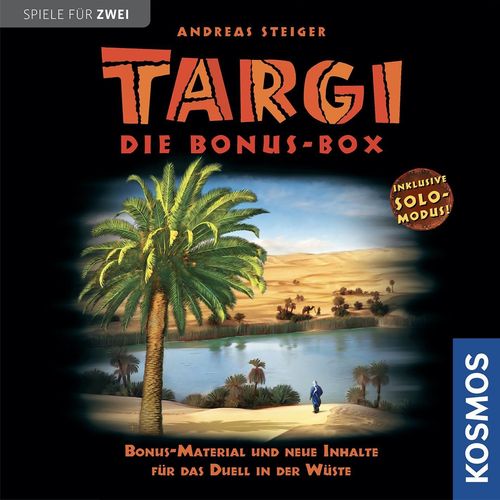
Targi: Die Bonus-Box
Targi: Die Bonus-Box Rulebook
Table of Contents
Table of Contents
Components (Spielmaterial)
30 playing cards, of which:
- 12 action edge cards (Aktions-Randkarten) (solo mode)
- 6 goods edge cards (Waren-Randkarten) (solo mode)
- 3 wandering dunes (Wanderdünen)
- 9 challenge cards (Herausforderungskarten) (solo mode)
36 goods pieces (Warenspielsteine), 12 each of dates, salt and pepper. The goods pieces replace the goods tiles (Warenplättchen). The pieces are 12 brown dates, 12 white salt heaps and 12 black pepper sacks, all made of wood.
Action Edge Cards (Randkarten)
The rulebook lists the action effects of the edge cards as follows. Each card is named by its printed title.
Händler (Trader) (card 5, two copies)
- You may trade 3 identical goods for 1 gold. For the second and third trade you only need to give 2 identical goods each time. You may also trade 2 goods of any kind for one other good.
- You may trade 3 goods of any kind for 1 gold, or 2 goods of any kind for 1 other good or 1 gold, or 1 gold for 1 goods of any kind and 1 victory point.
Fata Morgana (card 9, two copies)
- You may move one of your tribe markers from a card in the middle area to an unoccupied edge card and use that edge card instead. This may also be done next to a Targi that does not belong to you.
- You may use one of your tribe markers on a goods card twice. If the card lets you choose between goods, you may choose differently the second time.
Silberschmied (Silversmith) (card 10, two copies)
- You may receive victory points or goods: for 2 goods of any kind, 1 victory point, or for 3 identical goods, 2 victory points, or for 1 victory point, 3 goods of any kind, or for 1 gold, 2 victory points.
- You may receive victory points: for 2 identical goods and 2 other identical goods, 3 victory points, or for 1 goods of any kind and 1 gold, 3 victory points.
Karawane (Caravan) (two copies)
- Take what is shown on the top card of the discard pile (Ablagestapel): 1 or 2 goods, or 1 gold, or 1 victory point.
- Use the edge card on which the Robber stands, or pay 1 goods of any kind to use an edge card of your choice, even if a Targi of your own or of another player already stands there.
Stammeserweiterung (Tribe Expansion) (two copies)
- Reveal the top tribe card from the draw pile (Nachziehstapel). You may place it in your display (Auslage) and pay 1 goods of any kind less. Or you may discard it and receive 1 goods of any kind. You may not take it into your hand, even if you have no hand card.
- Reveal the top tribe card from the draw pile. You may place it immediately if you pay its cost. Or you may take it into your hand (if you have no hand card) or discard it. If you pay 1 victory point, you may carry out this process a second time.
Adliger (Noble) (two example cards)
- You may place your hand card in your display and pay 1 goods of any kind less. Or you may discard your hand card and reveal the top goods card from the draw pile, and take what is shown on it.
- You may place your hand card in your display and pay 1 goods of any kind less. Or you may discard your hand card. If you also discard 1 goods of any kind, you receive 1 victory point for it.
Wandering Dunes (Wanderdünen)
Wandering dunes came with the Targi expansion. You can also use the 3 wandering dunes of this Bonus-Box without the expansion. To tell them apart from those of the expansion, the wandering dunes of the Bonus-Box carry the following symbol on their front side. (The symbol itself is printed as an image in the original; it is not described in words.)
If you use the expansion, shuffle the 3 new wandering dunes into the corresponding stack and play by the known rules.
If you do not own the expansion but still want to use the 3 new wandering dunes, place them face up next to the game board at the start of the game.
Each time a Targi figure is placed, you may place it on an unoccupied wandering dune instead of an edge card. Only 1 Targi may be placed on each wandering dune, no matter whose it is. However, in your other turns you may each place 1 more Targi on another unoccupied wandering dune.
When you carry out the actions of your Targi figures and tribe markers, you use the one-time benefit of the wandering dune on which your Targi stands. Afterwards, take the Targi figure back from the card and turn the used wandering dune over onto its back side. Only if at the end of a round all wandering dunes lie on their back side, you turn them face up again. They are available to you again from the next round on.
Important: Whoever places a Targi on a wandering dune has 1 crossing point (Kreuzungspunkt) less available on the game board, so one action less. If two or even all three Targi figures are placed on wandering dunes in one round, no crossing point is available.
The order in which you use occupied edge cards, wandering dunes and cards occupied by tribe markers is arbitrary. However, the action of one card must be completed before the action of the next card is carried out. Carrying out the action of a wandering dune is optional. In that case the dune is turned over.
Variant: Personal Wandering Dunes (Persönliche Wanderdünen)
As an alternative to the wandering dune rule described above, you may shuffle the dunes, remove one card from the game without looking at it, and divide the other two randomly and face down among yourselves. Naturally, you may look at your own card. You can use the benefit of your dune exactly once during the game, when it is your turn. To do so, reveal the card, carry out its action and then remove it from the game. No Targi has to be placed on the card for this.
Variant: Challenge Cards (Herausforderungskarten)
The resource and obstacle cards, as well as the display card of the solo mode shown below, can also be used in a two-player game. Read the rules on pages 4 and 5 for this.
The special rules of the obstacles apply to both of you and make the game harder. (The obstacle with Andy as starting player may not be chosen.) With the resource cards and the display card, you can also earn additional points at the end of the game:
- Each fulfilled card brings 2 victory points.
Solo Mode
In solo mode you go alone against an imaginary player named Andy. He will try to wrest control of the desert from you. Do you accept the challenge?
You need the base game for solo mode, but you may also use content from the expansion if you own it.
Setup and goal (Spielvorbereitung und Spielziel)
Prepare a game for 2 players according to the known rules. Andy needs no goods.
Note for wandering dunes: When you play with the wandering dunes, the setup and rules from the expansion or from this Bonus-Box apply as described.
Solo edge cards
From the edge cards of this Bonus-Box, form the nomad stack (Nomaden-Stapel). The stack always consists of 12 cards, which correspond to the 12 occupiable edge cards of the game board. This means the edge cards numbered 1, 2, 3, 5, 6, 7, 9, 10, 11, 13, 14 and 15 must each be included once. Shuffle the stack and place it face down next to the game board.
Challenge cards (Herausforderungskarten)
With the challenge cards, you determine your goal for the game next. The cards are divided into five categories, which you can tell apart by their symbol in the middle of the card:
- Victory point cards (Punktekarten)
- Resource cards (Ressourcenkarten)
- Display cards (Auslagekarten)
- Obstacle cards (Hinderniskarten)
- Robber card (Räuberkarte)
Each card shows 4 different challenges. You may put together a combination of your own choosing, or put one together at random. In any case you should choose at most 1 challenge from each category. The remaining cards are not needed for this game.
The combination you choose determines what you must achieve and observe during the game. If you fail to meet even a single card's challenge, you lose the game. Lay the cards out, overlapping, next to the game board, so that you always keep all the challenges in view.
You may also choose fewer than 5 challenges to make the game easier. One victory point card should always be among them.
Example: resource card (the printed example shows four challenges): Challenge 1 (2 salt left over), Challenge 2 (2 pepper left over), Challenge 3 (2 dates left over), Challenge 4 (3 goods of any kind left over).
The Robber card (Räuberkarte) obliges you to subtract points from your total at the end of the game, depending on which edge card the Robber has reached.
Victory point cards (Punktekarten) state how many victory points you must have at least at the end of the game.
Resource cards (Ressourcenkarten) state which resources (dates, salt, pepper, goods of any kind, gold, victory point tokens) and how many of them you must have in your supply at least at the end of the game.
Display cards (Auslagekarten) state what your display must look like at the end of the game. Either with a certain number of rows of identical or different symbols, or with more symbols of one type than of another.
Obstacle cards (Hinderniskarten) introduce special rules that you must observe during or at the end of the game.
At the end of the game you may also earn additional points through the resource cards and the display card: each fulfilled card brings 2 victory points.
Solo game example (Beispiel: Spielaufbau mit dem Grundspiel)
The rulebook shows a setup example with the base game. It is printed as an image, and the setup is not described in words.
Solo Play (Spielablauf)
The rules of the base game and of the expansion apply. At the start of the game, reveal the top card of the nomad stack. With a 1-7 you receive the start player marker and begin; with a 9-15 Andy begins. Then shuffle the revealed card back into the nomad stack.
When it is your turn, carry it out as usual by placing 1 of your Targi on an edge card or, if applicable, a wandering dune card.
When it is Andy's turn, reveal the top card of the nomad stack. Then place 1 of his Targi figures on the edge card with the same number as the revealed card.
If the revealed card is not allowed, because either it or its opposite card is already occupied, place Andy's Targi instead on the next possible edge card in clockwise direction.
Note for wandering dunes: If you play with the wandering dunes, and for Andy you reveal an edge card occupied by the Robber, do not place his Targi on the next possible edge card, but on the topmost free wandering dune! If no wandering dune is free either, place his Targi instead on the next possible edge card clockwise from the one occupied by the Robber.
Once all 6 Targi figures have been placed, you mark the crossing points for both of you with the tribe markers. You carry out your actions as in a two-player game. Unlike you, Andy never lays out tribe cards in front of himself, collects goods or uses wandering dunes.
Instead, tribe and goods cards marked by him are discarded at the end of the round and replaced as usual. Occupied wandering dunes are turned over onto their back side. If the game is played with the expansion, they are discarded as usual.
After each round, return the revealed cards from the nomad stack to the remaining stack. Then the starting player marker passes and the next round begins.
The game ends as usual when you have laid out your twelfth tribe card, or when the Robber reaches the fourth field "Überfall" (Raid).
Then determine your victory points, taking the challenge cards into account. If you have fulfilled all of them and violated no special rule, you have won the duel for the desert!
Solo Edge Cards (Randkarten)
The 12 action edge cards (Aktions-Randkarten) and the 6 goods edge cards (Waren-Randkarten) are used in solo mode. The 6 edge cards numbered 2, 3, 6, 7, 11 and 15 correspond to the goods edge cards from the base game. They are needed only for solo mode.
The remaining 12 edge cards (2 each of 1, 5, 9, 10, 13 and 14) are alternatives for their same-named versions in the base game. You may use any or all of these alternatives and so change the setup of the base game and the 3 actions of the edge cards. You may also combine edge cards from the base game, the expansion and this Bonus-Box. Decide before each game which edge cards to use. The ascending numbering of the edge cards (1-16) must be kept. For the first game, take 6 random new edge cards, and for the second game the remaining 6.
Because the new edge cards are needed for solo mode, they show a uniform back in text form instead of their functions.