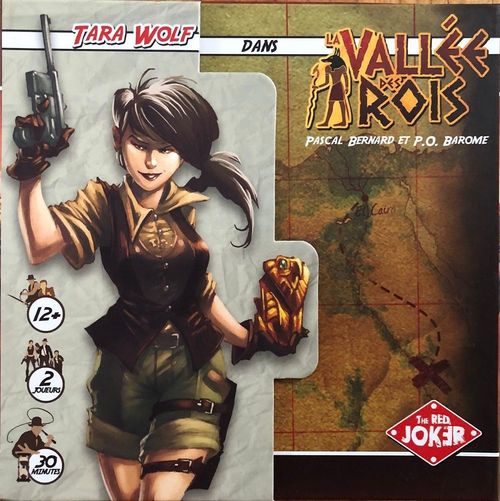
Tara Wolf in Valley of the Kings
Tara Wolf in Valley of the Kings Rulebook
Table of Contents
Table of Contents
Game Overview
In each round the players send their adventurer, together with his companions (humans and animals), out to explore a pharaoh's tomb. There they play obstacles: traps to eliminate opposing characters, and undead that reinforce their own rows. The winner of this fight finds the treasure hidden in the tomb.
Whoever first recovers four treasures from the tombs wins the game.
Components
- 4 large Adventurer cards
- 1 Medallion token
- 8 cardboard coins
- 2 pass markers
- 7 large Tomb cards
- 40 Companion cards
- 16 Animal cards
- 12 Trap cards
- 12 Undead cards
- 10 Papyrus cards
Setup
- Shuffle the 10 Papyrus cards. Each player randomly draws three Papyrus cards and places them face down next to his camp. The remaining four Papyrus cards are returned to the box unseen.
- Throw the medallion to determine who begins the game. The starting player takes the medallion and places it on his adventurer.
- Shuffle the Tomb cards and place them as a face-down Tomb stack.
- Shuffle the Companion, Animal, Trap and Undead cards together into a face-down main stack. Each player draws five cards from it to form his starting hand.
- Each player takes a pass marker.
- Each player randomly draws one of the four Adventurers and places its card in front of him in his camp.
The Medallion and the Round Sequence
During the game the magic medallion constantly changes its owner; the adventurers hunt each other for it. It grants its bearer supernatural powers. Each adventurer has a special ability, listed on its card. To use this ability, an adventurer must possess the medallion and be in a tomb.
The game is played in consecutive rounds until one of you reaches the victory condition by finding the fourth treasure. Each round follows these steps:
Round 1
- Camp phase of Player A (the player with the medallion).
- Camp phase of Player B (the player without the medallion).
- Tomb phase: Player A opens a tomb.
- Round end: A gives the medallion to B.
Round 2
- Camp phase of Player B (the player with the medallion).
- Camp phase of Player A (the player without the medallion).
- Tomb phase: Player B opens a tomb.
- Round end: B gives the medallion to A.
Round 3
Same as Round 1.
Camp Phase: Gaining Resources
1) Gain resources
At the start of your camp phase you receive four resources, which you may divide freely between coins and cards. In each round you may decide anew among these options:
- Take 4 coins, OR
- Take 3 coins and draw 1 card, OR
- Take 2 coins and draw 2 cards, OR
- Take 1 coin and draw 3 cards, OR
- Draw 4 cards.
You must decide the split before you take your first coin or draw your first card. Tell your opponent your choice, take that many coins from the supply, and draw that many cards from the main stack. If the main stack is empty, shuffle the discard pile into a new main stack.
2) Play cards
Now you may play Companion and Animal cards from your hand. To play a card, you must return to the supply as many of your coins as shown in the upper left of the card. If you do not have enough coins, you cannot play the card. Some cards have no cost. You may play these without giving up any coins, but only in this phase.
Some Companion cards have an effect when you play them. Carry out such an effect immediately, if possible. It happens only once, and only when you play the Companion from your hand. You may play a Companion even if you cannot carry out its effect.
Example: "When you play the Thief: Take a coin from your opponent (if possible)." You may play the Thief even if your opponent has no coin.
You cannot play the obstacle cards (Traps and Undead) in this phase. They are played only in the tomb phase (see below).
3) Clear your camp
If you do not want to, or cannot, play any further cards, declare the end of your camp phase and clear your camp.
At this point you may keep only 5 cards in hand. If you have more, you must discard excess cards of your choice. In addition, you may keep only 2 coins. If you have more coins, you must return the excess coins to the supply.
If you have the medallion, the camp phase of your opponent now begins. Otherwise, the tomb phase follows.
Anatomy of a Companion card
The card diagram labels the following parts:
- Cost: the coin cost shown in the upper left (the number of coins you must return to play the card).
- Name: the card's name and type (here: Archaeologist, Companion).
- Strength: the number shown on the left side of the card.
- Effect: the text at the bottom of the card, which is carried out when the card is played.
- Number of copies in the game: the figure in the lower right corner, indicating how many copies of this card exist in the game.
Example card: Archaeologist (Companion), strength 1. Effect: "When you play the Archaeologist: Draw the top three cards of the main stack. Take one of them into your hand and place the other two under the stack."
Papyrus Cards
Your Papyrus cards are not part of your hand. Therefore they do not count against your hand limit of 5 at the end of your camp phase. In addition, they are not affected by the effects of the Reporter, the Mercenary, the Spy, or the Tomb of Sethos I.
You may look at your Papyrus cards at any time, and your opponent must tell you, on request, how many he has left.
As soon as you have played a Papyrus card and its effect is over, place it face up outside the play area. It is not needed for the rest of this game.
Anatomy of a Papyrus card
The card diagram labels the following parts:
- Cost: the cost shown on the left edge of the card.
- Name: the card's name.
- Type: the card's type (for example, Undead).
- Strength: the number shown on the left side of the card.
- Effect: the text at the bottom of the card, which is carried out when the card is played.
- Number of copies in the game: the figure in the lower right corner.
Example card: Avatar of Anubis (Undead), strength as shown on the card. Effect: "The Avatar of Anubis has +1 strength for each further Undead in this tomb."
Tomb Phase
When both players have ended their camp phase, the player with the medallion opens a tomb by drawing the top card of the Tomb stack and laying it face up in the middle of the play area.
Anatomy of a Tomb card
The card diagram labels the following parts:
- Name: the name of the tomb (for example, Tomb of Tutankhamun).
- Effect: the text on the card, which is carried out when the tomb is opened.
Example card: Tomb of Tutankhamun. Effect: "When this tomb is opened, each player may eliminate one Companion or Animal of his opponent's with strength 1 or 2 of his choice."
Notes on Tomb cards:
- The text of some tombs (for example, the Tomb of Sethos I) begins with "When this tomb is opened." In this case, carry out the effect immediately, beginning with the player who has the medallion.
- Then the battle for the treasure of this tomb begins.
Entering the Tomb
1) Enter the tomb
The player with the medallion (Player A in the example below) chooses the characters with which he wants to explore the tomb. He may send out both his adventurer and any number of Companions and Animals from his camp. He must observe any restrictions given by the text on the Tomb card. Slide the chosen cards slightly forward to show this.
Then Player B takes his turn, sending characters from his camp into the tomb.
Important: If a player sends no character at all into the tomb, his opponent immediately receives the Tomb card as a reward.
Example: The Tomb of Haremhab: "All Undead in this tomb have +1 strength."
The diagram labels the following areas: the coin supply (Münzvorrat), the Tomb stack (Grabstapel), the main stack (Hauptstapel), and the discard pile (Ablagestapel).
Note: Strength bonuses
The strength of a character can be changed both by the effect of a tomb (Amenhotep III, Haremhab, Thutmosis III) and by the effect of one or more cards (Jackal, Desert Bandit, and others). These effects add up, and they apply as soon as the characters enter a tomb.
2) Play obstacles
The player with the medallion (A) may play any number of obstacle cards (Traps and Undead), as well as Papyrus cards, face down. This costs no coins. In addition, he may play exactly one other card (one that is not an obstacle) face down, in order to deceive his opponent. (Of course this is relevant only for Player A, the player with the medallion.)
Then it is Player B's turn, who may likewise play any number of obstacle and Papyrus cards face down. Once he is finished, all played cards are revealed.
3) Trigger traps
The player with the medallion (A) now triggers his traps, one after the other, in an order of his choice. For each trap he chooses any character as its target. Only characters that were previously sent into the tomb may be chosen. He must also observe any restrictions of the trap. Then the effect of the trap is carried out and the card is discarded. A character eliminated by a trap is also discarded.
Now Player B triggers his traps in the same way, if he has played any. If a played trap has no rule-compliant target, the trap is still triggered, but it has no effect.
Reminder: Played Papyrus cards are not placed on the discard pile. Place them face up next to the play area instead.
Anatomy of an obstacle card
The card diagram labels the following parts:
- Name: the card's name (for example, Spear Trap).
- Type: the card's type (for example, Trap or Undead).
- Effect: the text at the bottom of the card, which is carried out when the card is triggered.
- Number of copies in the game: the figure in the lower right corner.
Example card: Spear Trap (Trap). Effect: "Eliminate one Companion, Animal or Undead of your opponent's with strength 2 or less (your choice, except in the camp)."
4) Resolve the battle
After all traps have been triggered, each of you adds up the strength values of all characters (adventurers, companions, animals and undead) that you sent into the tomb. Also consider any bonuses. The player whose group has the higher total strength wins the battle for the treasure of this tomb. As his reward he receives the Tomb card and places it in his camp. In case of a tie, the player with the medallion wins.
Example: The Jackal and the Desert Bandit were eliminated by traps. Player A has a total strength of 13, and Player B also has a total strength of 13. Both players add up the strength values of their characters in the tomb. Since Player A has the medallion, he wins the tie.
5) Leave the tomb
Both adventurers return to their camp. All Companions, Animals and Undead that explored the tomb are discarded (except the Monkey).
Reminder: Played Papyrus cards are not placed on the discard pile. Place them face up next to the play area instead.
End of the Round
The player with the medallion passes it to his opponent, and a new round begins.
Passing
Each player may pass once per game instead of opening a tomb, but only when he currently possesses the medallion. This can make sense when the opponent has significantly more characters in his camp, so that his chances of winning the treasure are not very high. In this case he places his pass marker aside, keeps the medallion, and a new round begins.
Winning the Game
As soon as a player receives his fourth Tomb card, he wins the game!
Variants and Optional Rules
- Shorter game: The winner is whoever first has three (instead of four) Tomb cards.
- Bonus coins: A player receives two coins if he has no character in the tomb. (Only once per game.)
Tips and Clarifications
- You do not have to play any of your cards, even if you have enough coins.
- Your opponent must tell you at any time how many coins and cards he has (including Papyrus cards).
- Whenever you must discard a card (whether because of the Mercenary, your hand limit of 5, or the Tomb of Sethos I), place it from your hand on the discard pile.
- You may look at your played Papyrus cards and at the Tomb cards already lying in your camp. However, you may not look through the discard pile.
Strategy Tips
- Take enough time to read the card texts. The moment at which you may play a card is highlighted in bold on every card.
- Do not always send all your Companions into the tomb, and do not always play all your obstacles. Always look at your opponent's characters and at the number of cards in his hand. Sometimes it can be better to give up a tomb than to waste cards.
- For some Companions it pays to leave them in camp (Doctor, Patron, Smuggler, Seer, Foreman) so that you profit from their effect over several rounds.