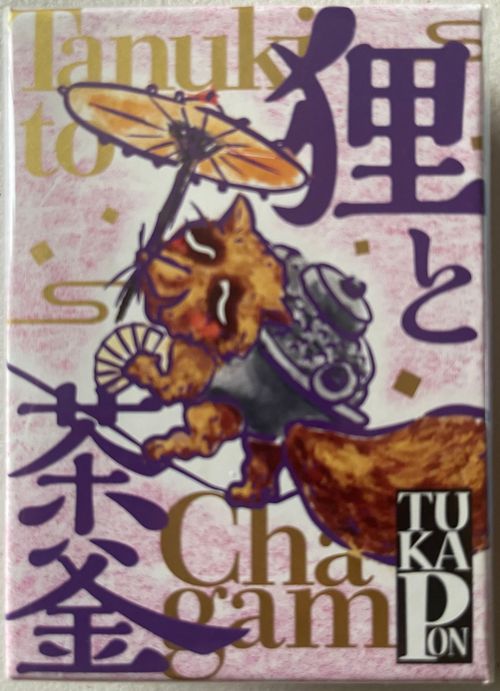
狸と茶釜 (Tanuki to Chagam)
狸と茶釜 (Tanuki to Chagam) Rulebook
Table of Contents
Table of Contents
Components
- 36 cards (1-9 in 4 colors; 2, 5, and 8 are the tea kettle cards; all other cards are raccoon dog cards)
- Chips
Preparation
- The player who most recently made sense [sic] becomes the dealer. The dealer shuffles the 36 cards, face-down, and deals them fully to the players.
- All players look at their hands and predict how many tricks they can win with these cards. All players indicate their predictions with their fingers at the same time. (For example, if you think you can win one trick, you can show one finger, and if you think you can't win any, you can show rock.) Take a number of chips from the table equal to the number you predicted and place them in front of you.
- The dealer becomes the start player and begins the procedure.
Game Procedure
The starting player plays any card from their hand. Afterwards, the next player in clockwise order takes a turn. If the next player has a card of the same color as the card played by the lead player, they must play a card of that color. If they have no card of the same color, the player may play any card.
When all players have played their cards, see which card is the strongest, and decide the winner of the trick. The strength of the cards will be explained later.
The winning player collects the cards, one by one, and places them face down in front of themselves. If there are any chips in front of them, they place one of them on top of the cards. If there are no chips left in front of them, they do not place any chips.
The winning player leads to the next trick, and the procedure repeats. When the players have played all of their cards, move on to scoring.
Checking for the Strongest Card
(Accounting for raccoon dog exceptions...)
- If all of the played cards are the same color, the highest number is the strongest.
- If there is a card of a different color from the lead player's card, the highest number among the cards of any different color is the strongest.
- If the cards of different colors from the starting player's card have the same number, the first one played is stronger.
Tea Kettle Cards
Tea kettle cards are the 2, 5, and 8 cards. A raccoon dog can hide inside a tea kettle card (or not). If the following three conditions are met, the card can be hidden (regardless of the color of the tea kettle card and the raccoon dog card):
- There is already a tea kettle card played to the trick.
- The number of the raccoon dog card is larger than the number of the tea kettle card that had been played.
- There is no other raccoon dog already hiding in the tea kettle.
A hidden raccoon dog is placed under the tea kettle card and is treated as a 0 of the same color as the tea kettle.
Score Calculation
(Scoring erratum, translated from the publisher's Japanese erratum and applied in place of the printed scoring section. See the note below.)
Your score is calculated based upon the number of chips you put in front of yourself in the preparation phase of the game.
- Subtract the difference between the number of tricks you declared and the number of tricks you took from the chips you placed in front of yourself when you declared.
- If the result is still negative, subtract the remaining amount from the chips you won in earlier tricks.
- If subtracting would take your score to 0 or below, ignore the excess. Do not carry it over to later tricks.
In short: subtract the difference between your declared tricks and your taken tricks.
Note on the source: The printed community rules scored as follows, and this has been replaced by the erratum above. Printed text: "If you took any chips, you score as follows: 1 pt per trick taken; 2 pts if you hit your bid exactly; -1 pt for each trick you missed by. If you took no chips, you score as follows: 5 pts if you hit your bid exactly."
Prepare for the Next Round
If any player has not been the dealer, pass the role to the left and begin a new round. Once each player has been the dealer once, move on to the end of the game.
End of the Game
After all players have been the dealer once, total each person's points throughout the rounds. The player with the highest total score wins.
If more than one player has the same number of points, the player who hit their bid exactly the most wins. If they are also equal, they share the victory.