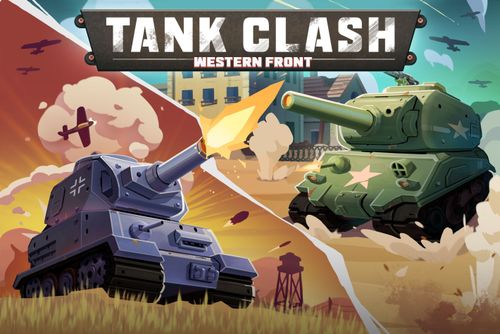
Tank Clash: Western Front
Tank Clash: Western Front Rulebook
Table of Contents
Table of Contents
Introduction
Welcome to Tank Clash, a casual easy-to-understand World War 2 tank vs tank combat game with light strategic options for 2 players to enjoy.
Contents
- 4 terrain boards
- 6 mission cards
- 12 tactical cards
- 12 morale cards
- 10 tank tokens
- 1 insignia token
- 24 armour tokens
- 14 damage tokens
- 6 checkpoint tokens
- 2 ace tokens
- 6 acrylic dice
Tank Types
The game pits 3 well known German and American tank types against each other:
- medium tank: Panzer IV vs M4 Sherman
- heavy tank: Tiger I vs M26 Pershing
- tank destroyer: Marder III vs M18 Hellcat
The firepower, armour and speed of the opposing forces are symmetrical so the gameplay is balanced no matter which side a player chooses.
Tank Stats
| Tank | Type | Firepower | Armour | Speed |
|---|---|---|---|---|
| Panzer IV | medium tank | 2 | 2 | 3 |
| M4 Sherman | medium tank | 2 | 2 | 3 |
| Tiger I | heavy tank | 3 | 3 | 2 |
| M26 Pershing | heavy tank | 3 | 3 | 2 |
| Marder III | tank destroyer | 4 | 1 | 3 |
(Stats are shown on the tank pages as red diamonds for firepower and armour and white diamonds for speed.)
Game Setup
Players can choose or randomly draw which side to play.
Each player draws a mission card and keeps it secret as it will dictate the player's strategy.
There are 3 types of mission cards:
- capture any enemy checkpoint
- destroy all enemy medium tanks
- kill enemy ace
Players may have the same mission card.
Players can win the game by reaching 1 of these 3 goals:
- capture enemy base
- destroy all enemy tanks
- fulfill secret mission
Players can also opt for a victory point winning condition (see supplementary rules). When playing for victory points, don't draw mission cards and disregard the 3 goals above.
Flip the double-sided insignia token to determine who will be the first player.
Card setup
Shuffle the morale cards and put them in a morale card deck. Deal each player 1 of each type of tactical card which they place face up on the table.
Terrain setup
Setup the terrain with the 4 piece terrain boards. Each player will place 2 boards as his/her territory. The boards are modular so they can be combined in different ways (see supplementary rules).
Players will place 3 checkpoints on hexagon rows 1, 4 and 7 on their side of the terrain boards. Note: half a hexagon is treated as a full hexagon when counting placement.
Checkpoints on rows 1 are base camps while those on rows 4 and 7 are checkpoints.
Checkpoints must be placed in open spaces and not inside obstacles like houses or forests.
(The setup diagram shows, for each territory, the row 1 base camp, the row 4 checkpoint, the row 7 checkpoint, and the morale discard area.)
Tank Setup
Players take turns to place their 5 tanks (3 medium, 1 heavy and 1 tank destroyer). The starting player will place the first tank followed by the 2nd player until all 10 tanks are placed on the board.
Markings help identify tank types.
Place corresponding armour tokens under the tanks according to their armour types. For example, the Sherman tank has 2 armour tokens.
Assign a tank ace to any tank (see tank ace section for details).
Player Actions
Each player has 2 actions per turn. The player may perform the actions using either one or two tanks in any order as follows:
- one tank moves and second tank moves
- one tank attacks and second tank attacks
- one tank moves and attacks
- one tank attacks and moves
Players CANNOT use one tank to move twice or attack twice during their turn.
Tank Movement
Players may move their tanks up to the maximum distance stated in the stats sheets (pages 4-9) during their turn.
For example: the Sherman tank's speed is 3 (speed = movement) so it can move up to 3 hexagons.
There are 4 different terrain types that will affect a tank's movement or attack in varying degrees. Flat terrain like grass and roads have no effect on movement or attack.
Basic obstacles like rivers block a tank's movement, but a tank can shoot across them.
Terrain Effect
Trees can provide good concealment for tanks. If a tank is on a tree hexagon, an enemy tank has to be within 2 hexagons to be able to spot and shoot it. Movement of a tank on a tree hexagon is also reduced to just one hexagon regardless of the tank's speed.
A tank on a tree hexagon can spot and shoot at an enemy tank in the open as it normally would. For example, the Tiger tank (on a tree hexagon) can spot and shoot the Pershing tank that is 3 hexagons away.
The Pershing tank has to close in to just 2 hexagons away to spot and shoot at the concealed Tiger tank.
If both tanks are in the forest, they need to be adjacent to each other to attack. Both tanks can also only move 1 hexagon at a time until they are in the open field again.
Checkpoints
As mentioned in the game setup section, players will place 3 checkpoints on their side of the terrain board. The checkpoint on row 1 is the base camp and the other 2 are checkpoints.
Each player will setup checkpoints and tanks within the 2 terrain boards (i.e. half of entire 4 terrain boards setup).
A player who captures an enemy checkpoint will flip the token and also draw a morale card from the deck.
Players can repair their damaged tanks (by removing damage tokens) at their respective checkpoints. Players CANNOT replenish their armour tokens at checkpoints.
A player who occupies a checkpoint will have a defender advantage. The attacker subtracts 1 from all dice rolls.
A player who occupies a checkpoint and suffers a hit on his/her tank has to move out of the checkpoint and back in again to repair the damaged tank. Checkpoints can be captured, lost and recaptured again any number of times.
Attacking
Opposing tanks can attack one another once they are within range. A tank's range is indicated by the firepower strength in the stats sheet (firepower = attack range).
Each player can take 2 actions during his/her turn. Players can either:
- attack with one tank and attack with a second tank; or
- move and attack (or vice-versa) with one tank.
For example: the Sherman tank moves within 2 hexagons (1st action) so that it can attack the Marder tank (2nd action). The Sherman tank's attack strength is 2 dice and the range of its attack is also 2 hexagons.
- (1st action) The Sherman tank moves within its attack range (2 hexagons) of the Marder tank.
- (2nd action) The Sherman tank attacks the Marder tank.
Note: A tank cannot attack an enemy that is hiding behind tall or solid obstacles like trees or houses.
Line-of-Sight
Besides being in range, opposing tanks also need to have line-of-sight to attack one another.
The line-of-sight rule is simple ... only direct barriers can obstruct 2 opposing tanks.
- No line-of-sight (house directly obstructs the 2 tanks) (two diagrams: the Sherman tank cannot shoot the Panzer tank)
- Line-of-sight (house does not obstruct the 2 tanks) (the Sherman tank can shoot the Panzer tank)
Dice Rules
The goal when attacking an enemy tank is to remove all its armour tokens and finally destroy the tank token on top.
For example, it will require 3 hits to remove the 2 armour tokens and the Sherman tank token.
Players roll the number of dice equal to the firepower of the attacking tank, and choose the die with the highest value.
| Roll | Result | Effect |
|---|---|---|
| 6 | Critical hit | Remove 1 armour token from defending tank and draw a morale card |
| 5 | Hit | Remove 1 armour token from defending tank |
| 4 | Heavy damage | Place 2 damage tokens on defending tank |
| 3 | Light damage | Place 1 damage token on defending tank |
| 2 | Scare | Defending tank retreats one hexagon |
| 1 | Miss | No effect |
Rolling a 5 or 6 will result in the defending tank losing an armour token (or destroying a tank once the armour tokens are all removed). The attacker also gets a morale card for rolling a 6.
Rolling a 3 or 4 will result in damage to the defending tank.
Damage to tanks is denoted by damage tokens (red discs). Add damage token(s) to the opponent's tank when it is damaged.
Once a damaged tank accumulates 3 damage tokens, an armour token will be removed and the damage tokens are discarded.
Once a tank is damaged and receives damage token(s), it will remain so until it loses an armour token or it goes to a friendly checkpoint for repairs.
Rolling a 2 will result in the retreat of the enemy tank by one hexagon. The winning player will get to decide on which hexagon the losing player's tank will retreat to.
Rolling a 1 will have no effect on the opponent.
The attacking player rolls 2 or more dice, the die with the highest value determines the attack strength.
Example
- The Pershing tank attacks with 3 dice. The Panzer tank attacks with 2 dice.
- The Pershing tank takes the highest value 5 which is a hit and the Panzer tank loses 1 armour token. The Panzer tank goes next but rolls the highest value 4 which causes heavy damage (add 2 damage tokens) to the Pershing tank.
- The damaged Pershing tank attacks with 3 dice. The Panzer tank attacks with 2 dice.
- The damaged Pershing tank attacks again and rolls the highest value 3 which damages the Panzer tank (add 1 damage token). The Panzer tank attacks back and rolls a double 6 (however only 1 die is counted) which causes the Pershing tank to lose 1 armour token. The Panzer tank gains 1 morale card for the critical hit as well.
Tank Aces
Each player gets 1 tank ace at the start of the game. Assign a tank ace to a tank by putting it under that tank's token.
The attacking dice rolls of the tank with an ace will get a +1 bonus.
Example: A tank ace added to a Pershing tank will result in a +1 value for any dice roll. This means that the player needs only to have a dice roll of 5 to score a 6 (critical hit).
For the Pershing tank depicted, 4 hits will result in its destruction and loss of the ace as well.
The tank ace will remain with the same tank throughout the game. He cannot switch tanks and he is removed from the game when the tank he occupies is destroyed.
Alternative tank ace ability - The tank ace can reroll one die during an attack.
Tactical Cards
Each player gets 1 of each type of tactical card at the start of the game. There are 6 types of tactical cards (3 offensive & 3 defensive) that each player lays face up on the table.
Each tactical card may only be used once during the game, and will be flipped face down to show that it is unavailable after use, so use them wisely!
- Artillery support - tank on selected hex loses 1 armour token; any tank on surrounding hexagons adds 1 damage token
- Air support - tank on selected hex loses 1 armour token; any tank in a row of hexagons as shown in the diagram adds 1 damage token
- Infantry support - add one die to attacking tank
- Smoke - opponent cannot perform an attack for 1 turn (opponent can only move tanks)
- Repair - replace 1 lost armour token on a damaged tank
- Mines - add 2 damage tokens to any enemy tank in the player's territory
Tactical cards are used at the start of a player's turn and can be used only once per turn.
There is no range limit for tactical card use (e.g.: execute artillery support on enemy tanks anywhere on the board).
Artillery and air support do not affect friendly units.
Morale Cards
There are 4 types of morale cards:
- Red - attack bonus
- Green - movement bonus
- Blue - defend bonus
- Purple - sabotage bonus
There are 2 ways to gain morale cards during the game:
- Activating a die with a value of 6 during an attack. The player takes a morale card from the deck.
- Capturing enemy checkpoints. The player who moves into an enemy checkpoint also draws a morale card from the deck. (see checkpoints section for details)
Each player may only use one morale card per turn. In the event both players wish to use a morale card, the attacking player shall decide first, followed by the defending player.
Players can have a maximum of 3 morale cards in their hand. If a player ever draws a 4th morale card, they must discard one from their hand.
Red and Green morale cards are used during a player's turn to boost a tank's capability. These morale cards have a star symbol at the bottom.
For example: Players who use the experience card during their turn can reroll a die when they attack.
Blue and Purple morale cards can be used anytime, even when it isn't the player's turn. These morale cards have a lightning symbol at the bottom.
For example: Player can use the deflect card when attacked and the attacker must reroll if he/she scores a hit.
Used morale cards are placed in a discard pile. If the morale card deck runs out of cards, reshuffle the discard pile to replenish the deck.
For precise usage of morale cards (for example: to use a card before or after dice roll), please refer to the next section. Otherwise, players who prefer may mutually agree on when to use morale cards.
Morale Cards Conditions of Use
Use this guide for precise usage of morale cards:
- Attack
- Sniper - before dice roll
- Experience - before dice roll
- Reinforce - before dice roll
- Defend
- Conceal - before enemy dice roll
- Deflect - after enemy dice roll (reroll all dice that score a hit)
- Overhaul - anytime
- Movement
- Transport - at start of movement
- Refuel - at start of movement
- Airdrop - at start of turn
- Sabotage
- Sabotage - anytime
- Demolish - anytime
- Ambush - before enemy attacks
Supplementary Rules
Victory Points to Win
Besides ending the game by fulfilling secret missions, players can win by gaining victory points instead. Victory points are earned by accomplishing any of the following tasks in any order:
- destroy heavy tank: 2 points
- destroy tank destroyer: 1 point
- destroy medium tank: 1 point
- kill tank ace: 1 point
- capture enemy checkpoint: 2 points
- move 3 tanks into enemy territory: 2 points
The first player who reaches 5 points wins the game.
When using this as a win condition, the secret mission cards will not be used and returned to the box.
Earning Morale Cards
Players may choose to earn morale cards in an alternative way. Instead of earning morale cards by a critical hit, morale cards are earned when a player's tank crosses into enemy territory.
This incentivizes players to move their tanks into their opponent's territory. Each tank can only earn a maximum of 1 morale card.
Fog of War
During the setup phase, tanks are placed with the reverse side facing up on the board.
Place the ace under a designated tank and 1 armour token under each of the remaining tanks. This ensures that each tank stack is the same height and players will not know each other's tank types.
During gameplay, players will reveal their tank when an enemy tank comes into range and has a line-of-sight.
Once a tank is revealed by the enemy, flip the top token to reveal the tank type and restore its armour to its original strength.
Opposing tanks must both be in range of each other before they are both revealed. Continue the game as usual until a player reaches a winning condition.
Tip: Move concealed tanks at 2 hexagons each time so that the opposing player cannot determine the tank type.
Tactical Card Attack Activation
For attack tactical cards (air, artillery and infantry support), players have to perform a successful dice roll to activate the effect.
Players must throw a 3-6 dice roll to execute a successful attack. This makes it more difficult for players to inflict damage with tactical cards and have to rely on tank warfare instead.
Alternative Terrain Board Placement
Combine the terrain boards in different ways other than the default setup (alternative layouts are shown in diagrams, with the base camps marked).