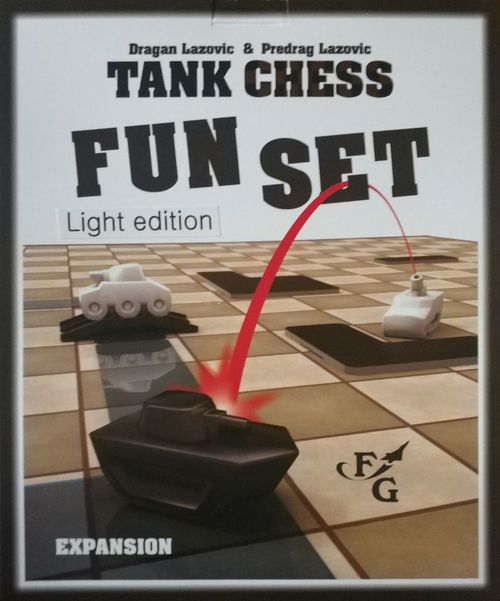
Tank Chess: Fun Set
Tank Chess: Fun Set Rulebook
Table of Contents
Table of Contents
- Contents of the Expansion
- Obstacles
- Mines
- New Game-End Variants
- New Vehicle Types
- Super-heavy Tank (ST)
- Tank Hunter (TH)
- Assault Gun (AT)
- Amphibious Tank (AM)
- Combat Reconnaissance Vehicle (RT)
- Light Mortar (LM)
- Heavy Howitzer (HH)
- Minesweeper Tank (MS)
- Engineer Tank (BT)
- Bridge Layer (B)
- Light Howitzer (LH)
- Heavy Engineer Tank (HB)
- Repair Tank (R)
- Rocket Launcher (RL)
- Two-Gun Tank (TT)
Contents of the Expansion
The Fun Set expansion contains:
- 3 new types of obstacles: low obstacles, water obstacles and trees.
- 15 new types of vehicles: Super-heavy Tank (ST), Tank Hunter (TH), Assault Gun (AT), Amphibious Tank (AM), Combat Reconnaissance Vehicle (RT), Light Mortar (LM), Heavy Howitzer (HH), Minesweeper Tank (MS), Engineer Tank (BT), Bridge Layer (B), Light Howitzer (LH), Heavy Engineer Tank (HB), Repair Tank (R), Rocket Launcher (RS), Two-Gun Tank (TT).
- 2 types of mines: visible mines and remote-controlled mines.
Note: the source names the Rocket Launcher as "RS" in the contents list and as "RL" in its unit description. This document uses "RL" for it throughout, as the unit description does.
Obstacles
In the base set, obstacles are tall buildings, through which tanks can neither pass nor fire. But there are also obstacles that cannot be crossed by moving over them, yet over which one can fire, and some obstacles that can be destroyed by driving straight through them. Therefore the Fun set includes pieces representing these additional types of obstacles.
- Low obstacles. These may be walls, trenches, etc., which tanks cannot drive through. But because of their low height, all types of tank can fire over such obstacles.
- Water obstacles (rivers, lakes, canals). These are also impassable to almost any tank (except the amphibious tank), but firing across them is possible for all types of tank.
- Trees. A tree is an obstacle that can be neither bypassed nor fired over. However, super-heavy tanks, heavyweights and bulldozers can knock a tree down by simply driving through it. Once a tree is destroyed, the vehicle that destroyed it cannot move any further during that turn, but it can still fire. The tree's marker is then removed from the board and the obstacle no longer exists. On the following turn the vehicle involved can move as normal.
Mines
Visible mines are marked with a red token, each occupying one square. No tank may pass through such a square without being destroyed, with the exception of the Minesweeper Tank, but all tanks may fire over visible mines. Visible mines may be placed in addition to the basic setup or any other obstacle layout, and they must be placed on the north and south sides, observing the rule of central symmetry, as with all other obstacles.
- If the players agree, mines need not be placed symmetrically. In that case the players take turns placing an agreed number of mines on chosen squares within their own half of the board.
- It is logical that in most cases deliberately blowing up one's own tank on a mine will not be a good move. However, in some situations a destroyed tank (turned on its side) can serve as a useful cover for another vehicle.
Remote-controlled mines are not marked by a token. Instead, each player has a set of 3 Mining Cards. A card shows the coordinates of a board square containing a remote-controlled mine that is invisible to the enemy. Before writing these coordinates on the card, the player must place the card in their own Invisibility Zone. The zone is coloured in the player's colour, and the cards in this zone are invisible to opponents.
When an enemy tank drives over a marked square, the player who set the mine may activate it. If they decide to do so, they must take the card out of their Invisibility Zone and show the coordinates of that square to the opponent. The destroyed tank piece is then turned on its side and remains on that square. However, if the player does not want to activate the mine at that moment (for example, they are waiting for another tank which they consider more dangerous or decisive in the upcoming position), they are not required to show the Mining Card.
New Game-End Variants
There are various scenarios for winning the game, and players should agree on one before each battle. Here are some of the scenarios proposed in the manual:
- Last Tank Standing (До последнего). Regardless of the obstacle layout, the game can be played with the goal of destroying all of the opponent's tanks. In this mode no piece has Command tank status, because there is no way to cross the enemy edge of the board and win that way. A draw is a relatively common outcome here. For example, if one player is left with an LT and the other with an HT, the LT can never destroy the HT, and the HT will almost never reach the LT to fire at it.
- Escape of Three (Уход трех). As in the previous scenario, there is no Command tank here, and any obstacle layout may be used. The goal of each player is to break through the enemy lines and escape across the opposite edge of the board with any three tanks. The player who first succeeds is the winner. If both players fail, the winner is the one with more tanks remaining. If they have the same number of tanks, the game is a draw.
- Capture the Flag (Захват флага). This scenario can be played on a board of any size and with any obstacle layout in which the 4 central squares are unoccupied (no obstacles). One flag is placed exactly in the middle of the board, between these 4 central squares. The goal of the game is to reach the flag, take it, and then carry it to a square in row 1 if that square is white, or to a square in row 16 or 20 (depending on the board size) if it is black.
- When a piece carrying the flag reaches one of the 4 central squares, the flag is removed from the board and placed on top of that piece. The piece's goal is now to move to the corresponding row, which wins the game.
- If the piece carrying the flag is destroyed before it reaches row 1 or row 16/20, the flag is taken by the first tank that ends its move on a square adjacent to the destroyed tank.
- The flag may be taken by a friendly or an enemy tank, and there is no limit on how many tanks may carry the flag during one game.
- In one variant of this scenario there may be an odd number of flags, and the winner is the player who captures more than half of them.
Other possible scenarios will be presented in the brochure, together with some specific obstacle layouts.
New Vehicle Types
All vehicle types in the base game and the Fun Set represent categories of real vehicles that took part in the Second World War. Of course the pieces are stylised, but almost every piece was modelled on a real tank. In addition to combat tanks, the Fun Set includes vehicle types that perform a specific role: defusing mines, pushing destroyed tanks aside, crossing water obstacles, and so on. The characteristics of each type are given in the description of each piece on the game board.
Super-heavy Tank (ST)
The Super-heavy Tank has the strongest armour (IV-III-II; the source prints "Il" in the last value, read here as II, a typo), a very powerful gun (IV), but the lowest speed (max 2). It moves only very short distances in a turn, but it is almost indestructible.
Tank Hunter (TH)
The Tank Hunter has weak armour (0-0-0), but it is very fast (max 5) and has a decent gun (II). It can be very effective for tracking down the enemy Command tank.
Assault Gun (AT)
The Assault Gun has high speed (max 4), strong frontal armour (III-0-0) and a decent gun (II). It has no rotating turret, so it can fire only at targets directly in front of it.
Note: the unit list names this piece "Штурмовое орудие" (assault gun) and the description calls it "Штурмовой танк" (assault tank); both refer to the AT piece.
Amphibious Tank (AM)
The Amphibious Tank has poor armour (0-0-0) and a modest gun (I), but a high maximum speed (max 5). It is the only vehicle able to cross water obstacles.
Note: the unit list calls this piece "Плавающий танк" (floating tank); the description calls it "Танк-амфибия" (amphibious tank).
Combat Reconnaissance Vehicle (RT)
The Combat Reconnaissance Vehicle has the highest speed (max 6), but weak armour and gun (0-0-0, I). It can be very useful as a Command tank, or when pursuing the enemy Command tank.
Light Mortar (LM)
The Light Mortar can fire over obstacles from short range, only two or three squares away. Its armour is weak (0-0-0), but its speed is high (max 4). Unlike the heavy mortar, it has a medium gun (II), but it is still dangerous to all targets in cover. It can fire in three directions.
Heavy Howitzer (HH)
The Heavy Howitzer has poor armour (I-I-0) and low speed (max 2). However, its gun is powerful (IV) and it can fire over obstacles at long range (7, 8 or 9 squares). This is most useful when it is on the back line.
Minesweeper Tank (MS)
The Minesweeper Tank is a medium tank with a mine roller, which can destroy visible mines simply by driving through the squares that contain them. Mine markers are removed from the board. In one turn the MS can clear several mined squares. It can fire like all other medium tanks, but its side armour is slightly weakened (II-0-0) to compensate for the weight of the mine roller.
Engineer Tank (BT)
The Engineer Tank is a type of medium tank fitted with a dozer blade for pushing aside destroyed tanks and trees. It can push all destroyed tanks to the side, except heavy and super-heavy tanks. It can also fight (with a level II weapon), but its side armour is weakened by the extra weight of the dozer blade (II-0-0). In one turn it can push only one destroyed tank, by a maximum of 4 squares, because its maximum speed is also 4. The push is always made straight ahead. If a destroyed vehicle, as a result of being pushed, ends up on a square with a water obstacle, it is removed from the board (it sinks).
Bridge Layer (B)
The Bridge Layer is one of the pieces in the game that has no gun, so it cannot fight. It performs a supporting role: it allows other tanks to cross water obstacles (narrow rivers or canals).
On reaching a square with a water obstacle, the piece is split into two parts. The lower part (hull and tracks) is removed from the board, while the upper part (the bridge) is placed on that square. From that moment all pieces (even enemy pieces), except super-heavy tanks, may use this bridge to cross the water barrier. To do so, vehicles must approach the bridge in a straight line, and while moving across the bridge the pieces must move forward (turning on the spot is not allowed). Once placed, the bridge can neither be moved nor destroyed.
Light Howitzer (LH)
The Light Howitzer can fire over obstacles, but it is limited to firing at targets directly in front of it and at a distance of 5 to 7 squares. It has practically no armour (0-0-0), its maximum speed is 3, and its firepower is also modest.
Heavy Engineer Tank (HB)
The Heavy Engineer Tank is the only unit that can be effective in attack when there are many destroyed tanks on the battlefield, because it can push everything except super-heavy tanks. It has a reliable gun (III), strong frontal armour (III-I-I) and a maximum speed of 3.
Repair Tank (R)
In addition to the Bridge Layer, this is the second type of vehicle that does not take part in combat. Its task is to repair destroyed friendly tanks. The repair sequence is as follows:
- On the first turn, R takes up a position so that the destroyed friendly tank is directly in front of it.
- On one of the following turns (not necessarily the next one), the damaged tank is repaired. The whole turn is spent making the destroyed tank operational again, and in this turn its piece returns to its tracks (no other move with any piece may be made).
- From this point the tank is repaired and can enter combat again.
The Repair Tank has no gun and no armour (0-0-0), and its maximum speed is 4.
Optional rule: players may agree that enemy vehicles can also be repaired. A vehicle repaired in this way is requisitioned by the player who repaired it, and from then on it can be used as their own. If this is agreed, the repair procedure is the same as described above. After the tank is back on its tracks, its piece is swapped for the same piece in the other colour.
Rocket Launcher (RL)
The Rocket Launcher is a very simple rocket system mounted on a half-tracked armoured vehicle. It has a maximum speed of 4 and weak armour (0-0-0). Unlike all other combat units, the RL has no gun, but it has rockets, which work somewhat differently. The biggest difference is that it has a limited number of shots: only 4. Another unique feature of this vehicle is that it can fire twice in one turn and potentially destroy two targets.
It fires only straight ahead; it can fly over obstacles and other pieces, and its range is 4 to 8 squares. The power of the rocket is V (the most powerful weapon, alongside the gun on the heavy mortar). After all 4 rockets have been launched, the player may use the RL as cover or for blocking.
Note: the source compares the rocket to "the gun on the heavy mortar", while the unit list in the contents names the long-range artillery piece as the Heavy Howitzer (HH); the reference is transcribed as printed.
Two-Gun Tank (TT)
The Two-Gun Tank is a type of medium tank (armour II, 1, 0; maximum speed 4) equipped with two guns. The main gun has value II and fires only straight ahead, while the other gun (value 1) is mounted on a small turret that can rotate and therefore fire in three directions. Thus it can shoot at two targets simultaneously.