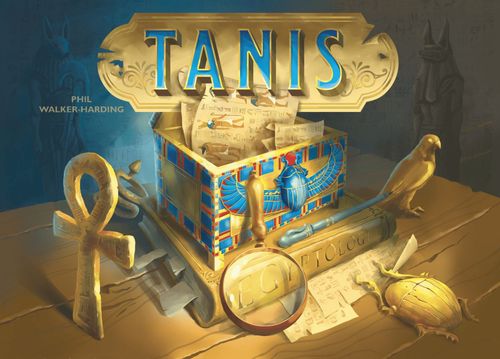
Tanis
Tanis Rulebook
Table of Contents
Table of Contents
Components
- 1 dig box: To store the papyrus tiles, but also to act as the dig site during play.
- 40 papyrus tiles: 4 types numbered 1-10: Snakes, Ankhs, Falcons, and Scarabs.
- 12 basic action cards: 6 each in 2 player colors. Each player has a set of 6 cards: 3 Explorer, 2 Excavator, and 1 Expert cards.
- 2 reference cards: To explain scoring.
- 2 identical digging tools: These tools may be used to assist when removing tiles while playing the game.
Game Overview
A historic cache of ancient papyri has just been discovered in Tanis! It is your job to carefully collect these precious scraps from the sand and assemble them back together into their original scrolls. Each time you collect a piece, you will reveal parts of other papyri buried beneath it on lower levels of the dig. Using this vital information, you must try to outwit your rival to assemble the most impressive scrolls!
Setup
- Each player takes a set of 6 basic action cards (marked with the B icon on the cards) and a reference card and places them on the table in front of them. The number and type of action cards available to the players are open information.
- Remove all the papyrus tiles from the inner box. Shuffle them face-down on the table.
- Take the top of the dig box and place all 40 tiles in it face-down in 4 layers of 10 tiles. Make sure no tile is laid directly on top of any other. Any configuration of tiles may be used, but an example would be to use the two patterns depicted (Pattern 1 and Pattern 2) on alternating layers.
- Place the bottom of the dig box into the top of the dig box to close the box.
- Flip the whole box over so that the dig box bottom now rests on the table. Remove the top of the dig box by pulling it up and away from the dig box bottom. (A video of this process is available on the publisher's website.)
- The top layer of papyrus tiles will be revealed in the dig box. The dig box with the papyrus tiles in it is called the dig site. Players will take tiles from it during the game. The example shown in the rulebook is only one possible way the tiles could be arranged.
Gameplay
A start player is chosen at random. The players then proceed to alternate turns throughout the game.
On the active player's turn, they must either:
- TAKE A TILE or
- PLAY AN ACTION CARD.
Take a Tile
The player chooses any 1 papyrus tile that is completely visible (i.e., both the number and the tile type icon are visible and no part of another tile is on top of the tile) on any level of the dig site. They pick it up, being careful not to move any other tiles, and place it in front of them. Tiles should be grouped by type and ordered by tile number.
Storing Collected Tiles
The players should store their collected tiles in columns, one for each type of papyrus. Tiles should be placed in numerical order from top to bottom. Doing this makes it easier for both players to visualize which tiles have been collected. Any tiles of the same type that are in exact sequential order are placed touching one another. These tiles are now considered a group and represent a connected scroll.
Play an Action Card
Three types of Action Cards are given to the players during setup. Each player has:
- 3 Explorer Cards
- 2 Excavator Cards
- 1 Expert Card
Each card may be used only once per game. After a player plays an action card, the player returns the used card to the game box.
Action Cards
Explorer Card
When playing this card, the player slides any 1 papyrus tile that is completely visible in the dig site and then takes any 1 tile. Sliding a tile allows the player to see what is below it before choosing what tile to take or perhaps to block their opponent from taking a certain tile. The following rules must be observed:
- The tile may only be moved in a straight line (any number of spaces horizontally or vertically).
- The tile must stay on the same level in the dig site. When sliding, it may not pass over any gaps of missing tiles and must always be supported by the tiles below it.
- The tile may not push any other tiles.
- The tile must come to rest aligned with the edges of the tiles below or at the halfway point of a tile (see example below).
- The player does not have to declare how far they will slide the tile before making their move. They may stop moving it at any time.
For example: In the diagram, the player moves the "Snake 7" tile to the right. Once they see that the "1" tile underneath it is a scarab tile, they decide to stop moving. The tile comes to rest halfway along the "Scarab 1" tile. The player could also have chosen to move the tile all the way to the right to fully cover the "Snake 6" tile.
After sliding a tile, the player must take any 1 papyrus tile as usual. They may take the tile just slid, or they may take a different, fully-visible tile instead.
Excavator Card
The player playing this card removes any 1 fully-visible papyrus tile from the game and then takes a different tile, according to the normal rules. An excavator can be used to deny the opponent a valuable tile or to remove a tile in order to gain access to one underneath.
The player chooses any 1 papyrus tile that is completely visible on any level of the dig site. They pick it up and place it face-up outside of the play area. This tile has been removed from the game and will not score for either player.
After excavating, the player must take any 1 papyrus tile as usual.
Expert Card
The player playing this card takes 2 tiles in a single turn. They first take 1 tile as usual and then must immediately take another tile. This second tile may not have the same tile type icon as the first tile taken. The player must declare they are using their Expert card at the start of their turn.
Game End
After the last tile is taken from the dig site, the game ends. The players will now score each group of sequential papyri of the same type that they have collected. A player may have more than one group for each type of papyrus. Each group is scored separately based on the following table:
| Size of Group | Points |
|---|---|
| 1 | 0 |
| 2 | 2 |
| 3 | 4 |
| 4 | 7 |
| 5 | 10 |
| 6 or more | 14 |
The players add the scores of all their groups together. Unused action cards are worth nothing. Whoever has the most points is the winner!
In the case of a tie, the player who did not take the first turn in the game is the winner.
Example
The rulebook shows each player's collected tiles with group scores (the tile illustration is not reproduced here).
Player 1's group scores as printed: 2+4, 10, 0+0+0+0, 2+2 = 20 points.
Player 2's group scores as printed: 0+2, 2+4, 2+0+2, 7+0 = 19 points.